
Activism
With Union Contract OK’d, Moe’s Books Workers Get Improved Wages, Benefits
Despite some mixed feelings from workers about the owner’s reactions to the union, both workers and ownership expressed optimism about what they think the Moe’s Books union can do for the future of the four-story store with over 200,000 mostly used books. “If customers see the positive impact of shopping at independently owned stores that do all they can to support their workers,” said Moe’s Books owner, Doris Moskowitz, “then this agreement will only make Moe’s Books’ future stronger.”


By Zack Haber
Workers at Moe’s Books in Berkeley agreed to their first union contract with store ownership on November 23. The agreement has given them a $20 minimum wage, dental insurance, more paid vacation days, a new procedure for filing grievances, and job security protections.
“I think this is a good, solid contract, and a good starting point for improving worker/owner relations,” said Owen Hill, who’s worked at Moe’s for about 35 years. “I wish we had this 10 years ago, but better late than never.”
Moe’s Books owner, Doris Moskowitz, told this publication she’s happy with the contract as well.
“I feel great about the agreement,” said Moskowitz. “Supporting our workers is part of Moe’s 60-year legacy, and we are proud to continue in that tradition.”
In early March about 95% of eligible Moe’s workers agreed to form a union by joining with the Industrial Workers of the World (IWW). The move was part of a growth in bookstore unionization spurred by COVID-related issues.
Workers at Elliot Bay Book Company in Seattle and Bookshop Santa Cruz each formed unions in 2020. This year, bookstore unionization has expanded as workers at Printed Matter in New York City formed a union in October, while workers at three different Half Price Books locations in Minnesota are awaiting election results in mid-December to certify their unions.

Immediately after its formation, Moskowitz recognized Moe’s Books Union, but she had mixed feelings about it. In early April, she told Berkeleyside she “deeply respected” the workers’ decision to unionize but that the move had also left her “very sad and confused.” Following initial negotiations related to COVID safety measures, the union and Moskowitz began its first contract negotiations. In total, both sides came to 35 agreements during 16 bargaining sessions over eight months.
“The bargaining process was long, tiresome, and sometimes tense,” said Hill. “But mostly people were respectful and tried to come to an understanding.”
According to Bruce Valde, an organizer with the IWW who works with Moe’s Books Union, the eight months it took to agree to the contract was comparatively quick. In his experience, it usually takes workers and ownership a year to a year-and-a-half to agree to a first union contract. Valde called Moskowitz’s choice to immediately recognize the union “wise” and lauded the workers’ collaboration in clearly stating their requests.
“I think the workers diligence in actually forming our positions was excellent,” said Valde.
Since the new contract has passed, all union members will soon be getting a 10% raise in their salaries, or a $20 an hour wage if the 10% bump doesn’t already exceed that wage.
They’ll also get a 3% wage increase during the second and third year of the contract.
Additionally, the contract has stipulations related to respecting employees’ gender and gender expression. Harassment violations now specifically include ownership or management commenting in an ostracizing manner on workers’ gender expression, including clothing choices or hairstyles, or not making a concerted effort to correctly use workers’ pronouns.
While the union members unanimously agreed to the contract and Moskowitz told this publication “I feel like it is a win-win” situation, workers claimed along the way that the owner wasn’t always respectful of the union. In late September, union members and supporters held an informational picket at the store to support their demand for the $20 minimum wage that was eventually granted, but also to share information with the public about how they thought the owners were practicing “union busting.”
Around this time, the union filed unfair labor practice claims to the National Labor Relations Board, one of which was related to their accusation that Moskowitz was offering promotions for the sole purpose of removing people from the union by placing them in management positions.
Barry Bloom, who works as a book shipper, claimed Moskowitz asked him if he’d agree to be the supervisor of the shipping department, a position that would prevent him from joining in the union. He was the only member of the shipping department at the time, and she didn’t offer him a raise.
“My immediate reaction was to wonder ‘who would I be supervising?’” Bloom said. “I pretty much instantly saw it as a union-busting tactic.”
Moskowitz denied the accusation of union busting, saying, at the time “We have not made any job offer or offers of promotions in order to encourage any employee to break from their support of the union.”
Soon after agreeing to the new contract, Moskowitz taped a statement to the front window of the store, expressing that she was proud of the contract and Moe’s openness to organized labor. The statement, which was posted to Moe’s instagram and Facebook accounts, also encouraged other businesses, specifically large bookstores, to allow workplace organizing.
“If a small, independent used-book seller can accomplish this while keeping the doors open during a global pandemic,” the statement reads, “there is no reason for more lucrative companies to claim labor organizing will shut down their business or harm their employees.”
Two days after the statement appeared on Moe’s books social media sites, Moe’s Books union’s Twitter account put up a post stating “There’s a little revisionist history going on over at the boss’s social media site.”
While largely happy with the contract, Moe’s Books worker Phoebe Wong told this publication she’s uncomfortable with the owners’ actions immediately following its ratification.
“I’m really pleased and so proud of the work everyone put into doing the contract,” said Phoebe Wong. “But it’s been a long fight. And, to be honest, it makes me a little queasy to see ownership touting pride because it seems pretty dishonest considering the pushback we got.”
Despite some mixed feelings from workers about the owner’s reactions to the union, both workers and ownership expressed optimism about what they think the Moe’s Books union can do for the future of the four-story store with over 200,000 mostly used books.
“If customers see the positive impact of shopping at independently owned stores that do all they can to support their workers,” said Moskowitz, “then this agreement will only make Moe’s Books’ future stronger.”
“Moe’s now offers good wages, good benefits, and job protection,” said Hill. “I think we have a lot to offer to workers, and that we will be able to employ top quality people. I don’t think I’m being too dramatic when I say that the union saved the business.”












Activism
Oakland Post: Week of August 5 – 11, 2026
The printed Weekly Edition of the Oakland Post: Week of August 5 – 11, 2026
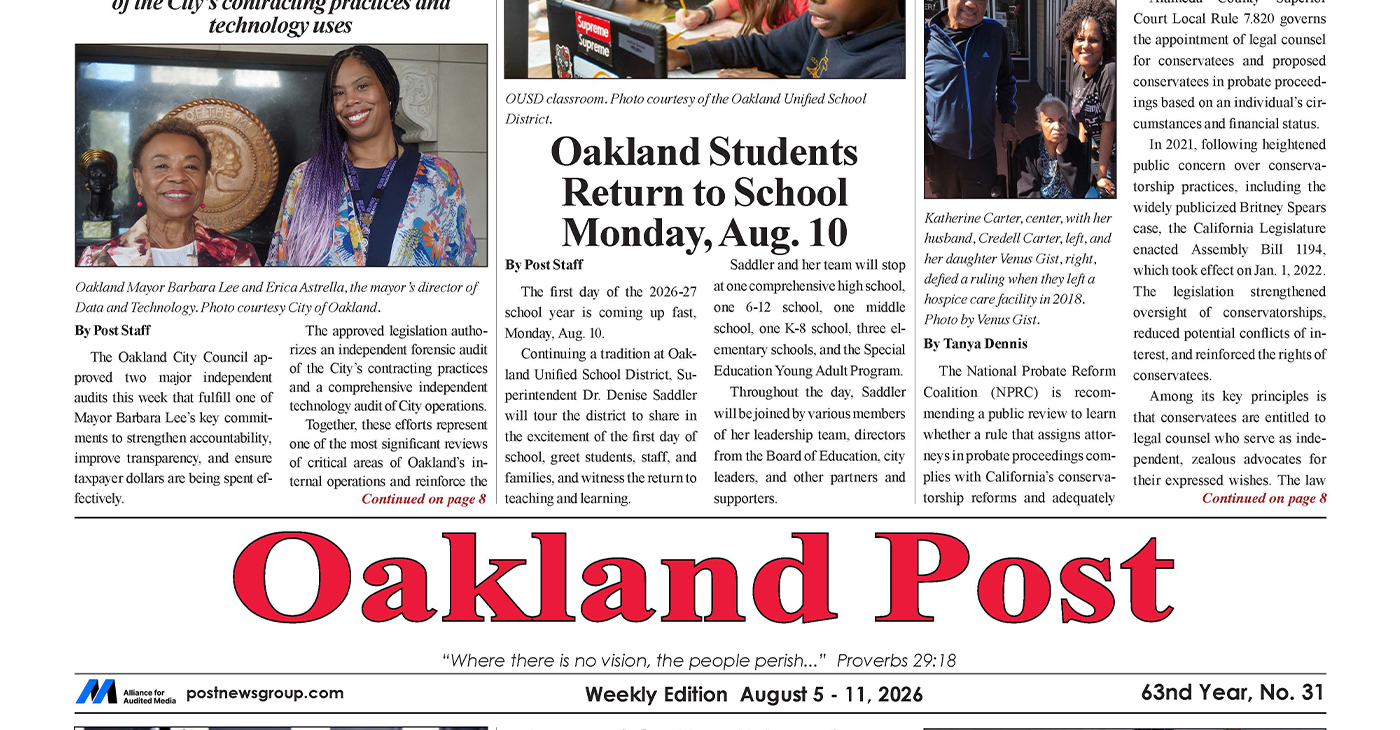
To enlarge your view of this issue, use the slider, magnifying glass icon or full page icon in the lower right corner of the browser window.
Activism
Oakland Post: Week of July 29 – August 4, 2026
The printed Weekly Edition of the Oakland Post: Week of July 29 – August 4, 2026
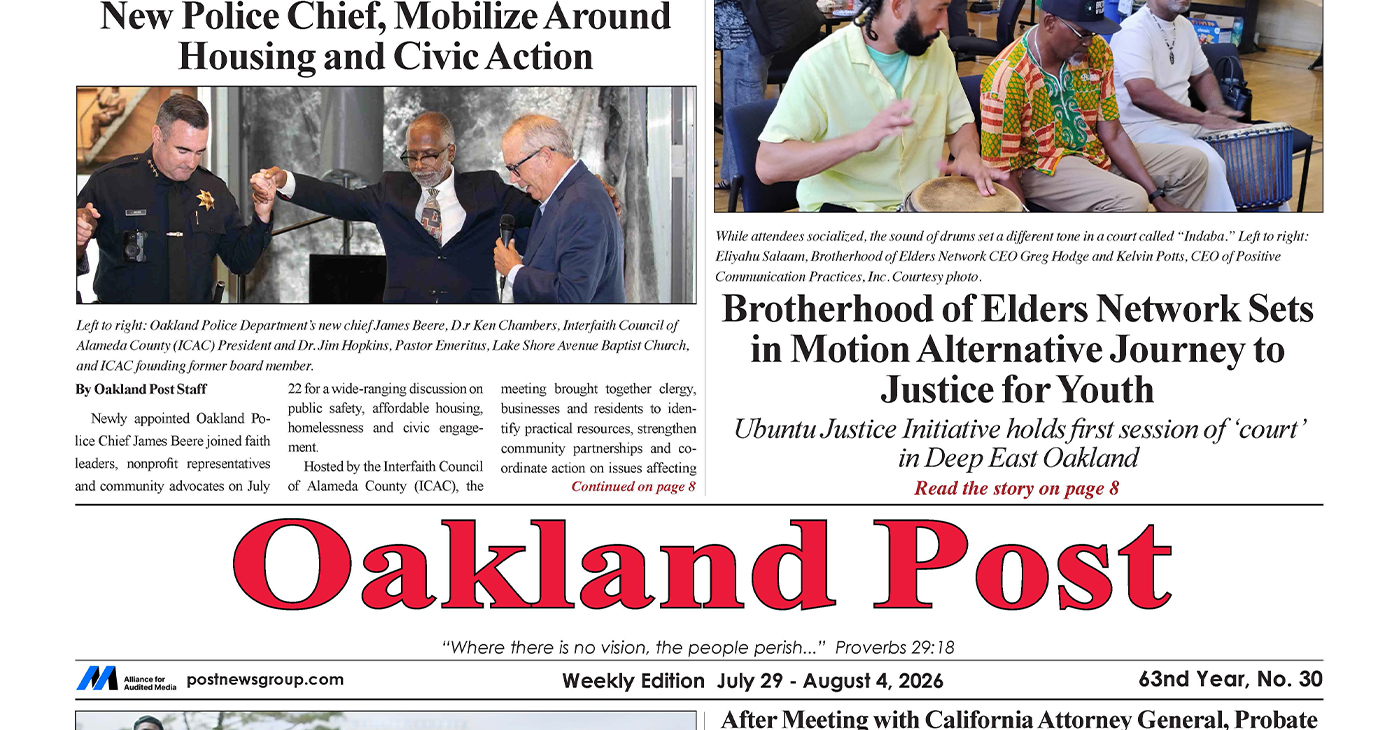
To enlarge your view of this issue, use the slider, magnifying glass icon or full page icon in the lower right corner of the browser window.
Activism
Oakland Post: Week of July 22 – 28, 2026
The printed Weekly Edition of the Oakland Post: Week of July 22 – 28, 2026

To enlarge your view of this issue, use the slider, magnifying glass icon or full page icon in the lower right corner of the browser window.
WORK FROM HOME
Home-based business with potential monthly income of $10K+ per month. A proven training system and website provided to maximize business effectiveness. Perfect job to earn side and primary income. Contact Lynne for more details: Lynne4npusa@gmail.com 800-334-0540


Misty Copeland Shapes Ballet’s Tomorrow

As Part of Your Back-to- School Checklist, Vaccinate

As Part of Your Back-to- School Checklist, Vaccinate

Congresswoman Simon Demands Investigation into Trump’s Abuse of Emergency Powers for Coal Export Terminal in West Oakland

OPINION: The Philippines Isn’t Foreign When Your Family Still Lives There

Asm. McKinnor’s Bill Banning Drones Above Outdoor Entertainment Events Awaits Senate Decision

California Sen. Padilla Joins Colleagues to Introduce Bill Imposing Term Limits on Supreme Court Justices

Department of Homeland Security Demands California Secretary of State Shirley N. Weber Scrub Voter Rolls

George Cook: The Inventor Who Made Fishing Smarter

Gov. Newsom Announces $109.6 Million in Funding for 278 Supportive Homes in Bakersfield, Contra Costa, Sacramento and Fresno

Rep. Kamlager Dove Demands Care, Justice for Man Shot by ICE

“The Power to See Threats Sooner”: Gov. Newsom, Safety Officials Showcase California’s Investments in Hi-Tech Wildfire Prevention

100 Black Wings’ Team Oakland Youth Athletes Heading to Taiwan for 2026 International Children’s Games

Oakland ‘Port Serves as a Powerful Engine for Good Jobs and Economic Development

Oakland Faith Leaders Welcome New Police Chief, Mobilize Around Housing and Civic Action
Department of Homeland Security Demands California Secretary of State Shirley N. Weber Scrub Voter Rolls

Oakland Children’s Hospital Workers and Patients Rally for Pediatric Medical Care
“The Power to See Threats Sooner”: Gov. Newsom, Safety Officials Showcase California’s Investments in Hi-Tech Wildfire Prevention

New Judge Could Decide if Karmelo Anthony Gets a New Trial

Surveillance Pricing Fight: State Senate Debates Bill Banning Retailers from Using AI to Set Prices Based on a Buyer’s Profile

Mount Zion MBC, Church of Jesus Christ of Latter-day Saints Partner to Bring 29,000 Meals to Alameda County

Alpha Kappa Alpha Sorority, Inc. Celebrates New North Atlantic Regional Director
California Sen. Padilla Joins Colleagues to Introduce Bill Imposing Term Limits on Supreme Court Justices

Starting This Summer, California Car Buyers Can Get an Instant $3500 Off the Cost of Electric Vehicles

COMMENTARY: You Are Already Paying for the AI Boom

California Bill Would Let Abuse Victims Use Trauma as Legal Defense for Violent Crime

Fed Court to Decide Landmark First Amendment Case

Gov. Gavin Newsom Signs Law Streamlining Affordable Housing Rules

Oakland Celebrates $125 Million Coliseum Sale

Saving Black Mothers Starts Outside the Hospital

The Conversation With Al McFarlane 6/23/26

Media Monday 6/22/26

LIVE! ASK ALMA! — TUES. 6.23.26 7PM EST

Car Buying Secrets: 4 Hidden Checks Before You Sign!

Is This 550 HP Charger Worth YOUR Money? AutoNetwork Review

Celebrating Juneteenth – Frederick Douglass on education and resistance

LIVE! — ASK ALMA! — TUES. 6.19.26 7PM EST

Hyundai Ioniq 5 Parking, Safety, and 360 View #shorts

2025 Ioniq 5 New Wiper & Powerful Performance! #shorts

Electric SUV Range: Is 259 Miles Enough? #shorts

EV Charging: How Fast Can You Charge an Electric Vehicle? #shorts

Biometric Cooling… Messaging Seats…Come on! 2025 Infiniti QX80 Autograph 4WD

Charged Up: Witness the Magic of a Fully Electric Car! #shorts

Range Rover Sport PHEV Included…: See What’s Inside This Luxury SUV! #shorts

Invisible Hood View: Perfect Parking with X-Ray Vision! #shorts
-
 Featured3 days ago
Department of Homeland Security Demands California Secretary of State Shirley N. Weber Scrub Voter Rolls
-
 Business2 weeks ago
Oakland Children’s Hospital Workers and Patients Rally for Pediatric Medical Care
-
 Environment3 days ago
“The Power to See Threats Sooner”: Gov. Newsom, Safety Officials Showcase California’s Investments in Hi-Tech Wildfire Prevention
-
 #NNPA BlackPress2 weeks ago
New Judge Could Decide if Karmelo Anthony Gets a New Trial
-
 Business2 weeks ago
Surveillance Pricing Fight: State Senate Debates Bill Banning Retailers from Using AI to Set Prices Based on a Buyer’s Profile
-
 Business2 weeks ago
Mount Zion MBC, Church of Jesus Christ of Latter-day Saints Partner to Bring 29,000 Meals to Alameda County
-
 Black History1 week ago
Alpha Kappa Alpha Sorority, Inc. Celebrates New North Atlantic Regional Director
-
 Featured3 days ago
California Sen. Padilla Joins Colleagues to Introduce Bill Imposing Term Limits on Supreme Court Justices
