
Bay Area
Once Again, Community Demands Reinstatement of OPD Chief LeRonne Armstrong
Armstrong says there’s a sense of fairness that should be considered due to his track record. “This is not a sport; this is a community in desperate need of public safety…This is a community that has been asking the police department to police the community differently, to build trust and that’s what I’ve been doing. So, any coach should see, based on my track record, I’ve done just that. This department is not the same department as it was 10-20 years ago, and it’s because of the recent leadership.”

By Carla Thomas
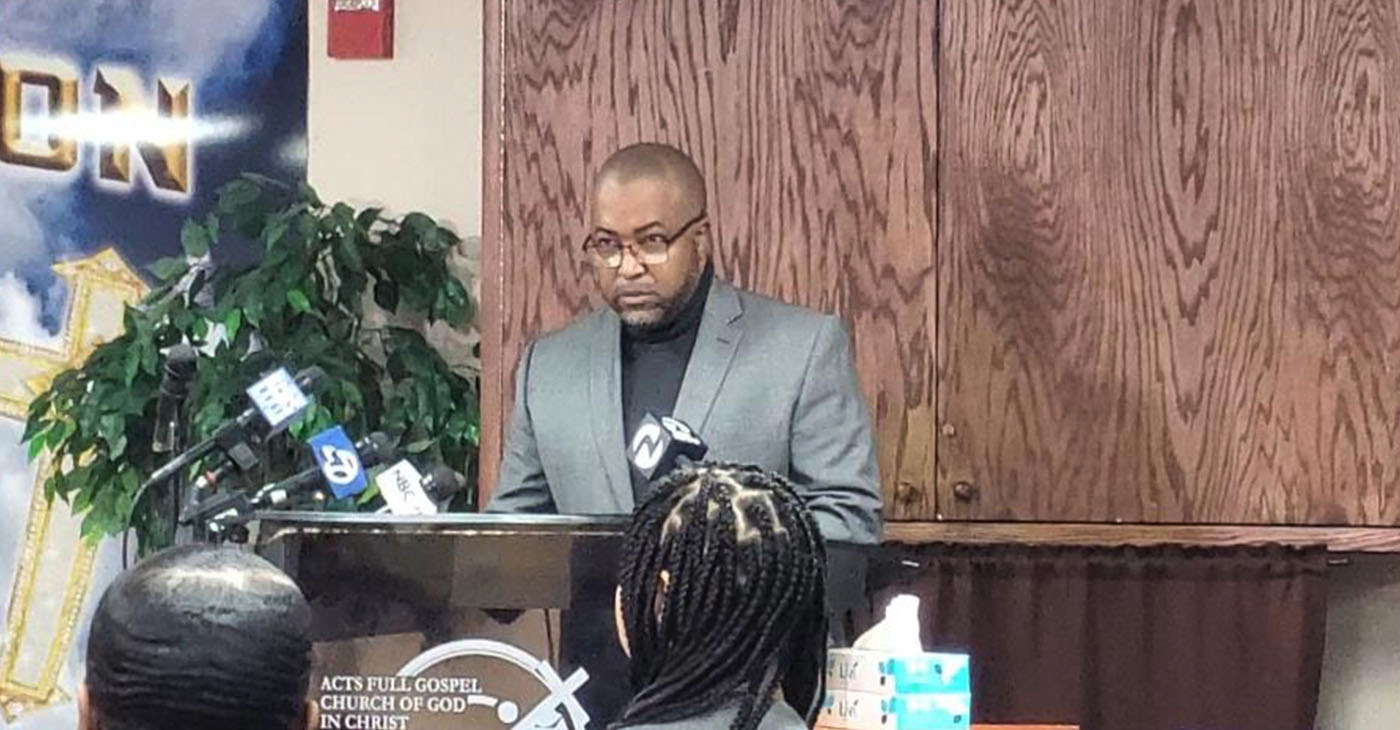
After its Sunday service, Acts Full Gospel Church of God in Christ hosted a press conference by the Oakland NAACP in their continued support of reinstating Oakland’s Chief of Police LeRonne Armstrong.
Armstrong was placed on administrative leave last month pending a report accusing him of not holding an Oakland officer accountable for misconduct. In the church’s Madeline Senegal fellowship meeting room, a dozen media outlets heard directly from Armstrong, the Oakland NAACP, and questions from community members.
Armstrong said that additional information from the federal monitor being reviewed by the mayor shows that the conclusions in the summary report leading to his suspension are inaccurate and lack evidentiary support.
“The situation defies common logic,” said Armstrong. “A policy that says the investigation should not be discussed with anyone in an investigation that determined the chief should have known by policy he had no right to know…There’s a reason why the Negotiated Settlement Agreement (NSA) has a clause that says that the IAD (Internal Affairs Division) cannot be located within the OPD. It is located in Frank Ogawa Plaza because an NSA mandates that there’s independence between the departments.”
Armstrong said, “I deserve to be in this position of chief of police, as someone born and raised in Oakland, raised in poverty. As someone who has struggled and come from poverty to make it to the chief of police…but to have someone tarnish my reputation, tarnish the beliefs of my family and friends in this community is unacceptable.”

Armstrong also expressed that he has brought OPD closer to the end of federal oversight than any other chief previously. The OPD has been under federal oversight for two decades since 2003, pending compliance with 52 reforms negotiated in a settlement agreement including racial profiling and reporting practices about the use of force.
The appointed federal monitor, Robert Warshaw, is paid $100,000 a month according to reports, which amounts to $1.2 million annually to oversee and ensure that the OPD remains compliant.
With just months away from the end of federal oversight, Armstrong’s supporters call into question placing Armstrong on leave and that the overall investigation may be a ploy to extend the oversight and allow Warshaw to remain on a lucrative payroll.
“I believe in holding officers accountable when the information is presented to me, but, in this case, that information was not brought to me, so I was not able to take the proper action. If I’d have had the information, I would have launched a full investigation,” said Armstrong.
Armstrong says there’s a sense of fairness that should be considered due to his track record. “This is not a sport; this is a community in desperate need of public safety…This is a community that has been asking the police department to police the community differently, to build trust and that’s what I’ve been doing. So, any coach should see, based on my track record, I’ve done just that. This department is not the same department as it was 10-20 years ago, and it’s because of the recent leadership.”
Armstrong says he’s worked toward building a department that polices professionally and constitutionally.
“I have worked hard to change the way the community views the department because when I was growing up, we didn’t like it: We hated it, and we feared it.”
Armstrong has served the police department his entire adult life, promoting volunteering, giving back and treating people with dignity and respect. As chief, he encouraged this culture and is proudest of reducing stops of African Americans by 65%.
“This is a huge deal because less Black people being touched by law enforcement lowers the risk of the violence we’ve seen across the country. And so, when you can minimize the opportunities for the interaction of law enforcement and African American men in particular, you can reduce the number of violent incidents. I believe we can focus on crime, but not over-police certain communities,” he said.
A church member said, “We have had way too many chiefs in the last decade that have been relieved of their duties, yet we have the same monitor who appears to have made a small fortune.”
Former Chief Assistant District Attorney of Alameda County Terry Wiley supports the chief and said he has known Armstrong for 30 years and characterized him as a “tremendous leader.
“He is a man of integrity, with a highly decorated career as a police officer,” said Wiley. “It says a lot when the African American, Asian and Hispanic community join forces as a collective to say that we want the chief reinstated because he did not do anything wrong. We don’t want to see his career tarnished and he does not deserve the treatment he is receiving. We are here to ask the mayor to reconsider her actions and reinstate the chief.”
“On behalf of the community, the Oakland NAACP, we are asking the mayor, again, again, and again to reinstate the chief,” said Oakland NAACP President Cynthia Adams. “The voters are also asking you, mayor. Listen to the voters, listen to your community; they are asking you to reinstate the chief. Bring the chief back to his duties. Please bring him back to where he needs to be in Oakland.”
A response from Oakland Mayor Sheng Thao has yet to be received.













Activism
Oakland Post: Week of September 16 – 22, 2026
The printed Weekly Edition of the Oakland Post: Week of September 16 – 22, 2026

To enlarge your view of this issue, use the slider, magnifying glass icon or full page icon in the lower right corner of the browser window.
Activism
Oakland Post: Week of September 9 – 15, 2026
The printed Weekly Edition of the Oakland Post: Week of September 9 – 15, 2026

To enlarge your view of this issue, use the slider, magnifying glass icon or full page icon in the lower right corner of the browser window.
Activism
Oakland Post: Week of September 2 – 8, 2026
The printed Weekly Edition of the Oakland Post: Week of September 2 – 8, 2026

To enlarge your view of this issue, use the slider, magnifying glass icon or full page icon in the lower right corner of the browser window.



BOOK REVIEW: ‘Laws of Solomon’ Reveals Tender Heart of Former Child Soldier

OPINION: The New American Fear – From 9-11 to AI

Passing for White, Fighting for Black America: The Courage of Walter White

Oakland People’s Arms Embargo Coalition Demands End to Military Shipments Thru Oakland

Barbara Lee Mourns Gloria Steinem, Remembers a Friendship Rooted in Equality

Event Preview: ‘Fashion v. Fascism’ – A Runway Revolution Is Coming to the Bay Area

Two Looming Threats Every Alameda County Elder Should Know About

Oakland Mayor Reads to Children at Bookout Block Party at Marcus Books Store

Tradition Comes to the Streets in 11th Annual Black-Eyed Pea Festival at the Freedom Farmers Market

Attorney General Rob Bonta Continues Opposition to President Trump’s Tariff Regime

Neighborhood Empowerment Day in Deep East Oakland Brings Community Together After Recent Tragedy

Community Action Group ‘Friends of Zakiya’ Ask Sheriff for Time

Oakland Launches Aerbits Program to Identify, Report Abandoned Trash

Mayor Lee Announces $1 Million Kaiser Permanente Grant for Pilot Program to Address Homelessness, Clean Up Public Spaces throughout Oakland

Alameda County DA Ursula Jones Dickson Says Key to Optimal Use of DA’s Office Is Knowledge

Department of Homeland Security Demands California Secretary of State Shirley N. Weber Scrub Voter Rolls

“The Power to See Threats Sooner”: Gov. Newsom, Safety Officials Showcase California’s Investments in Hi-Tech Wildfire Prevention

California Sen. Padilla Joins Colleagues to Introduce Bill Imposing Term Limits on Supreme Court Justices

Less Affluent School Districts, Including Sacramento City, Face Threat of State Takeover

Car Wash Workers Cope with Lingering Impacts of ICE Raids

ESSAY: California Can Close Its Colorectal Cancer Gap

As Part of Your Back-to- School Checklist, Vaccinate

Oakland ‘Port Serves as a Powerful Engine for Good Jobs and Economic Development

Gov. Newsom Announces $109.6 Million in Funding for 278 Supportive Homes in Bakersfield, Contra Costa, Sacramento and Fresno

California Hispanic Chambers of Commerce Unveils: ‘Powering the Future’ Theme for 47th Annual Statewide Convention

Congresswoman Simon Demands Investigation into Trump’s Abuse of Emergency Powers for Coal Export Terminal in West Oakland

Four Candidates, Including Incumbent Barbara Lee, Qualify for Oakland Mayor’s Race

Oakland Post: Week of August 12 – 18, 2026

From Blueprint to Breakthrough: Tackling Affordable Housing in Oakland

Oakland Observes Black August with Block Parties, Film Showings, Workshops

The Conversation With Al McFarlane 6/23/26

Media Monday 6/22/26

LIVE! ASK ALMA! — TUES. 6.23.26 7PM EST

Car Buying Secrets: 4 Hidden Checks Before You Sign!

Is This 550 HP Charger Worth YOUR Money? AutoNetwork Review

Celebrating Juneteenth – Frederick Douglass on education and resistance

LIVE! — ASK ALMA! — TUES. 6.19.26 7PM EST

Hyundai Ioniq 5 Parking, Safety, and 360 View #shorts

2025 Ioniq 5 New Wiper & Powerful Performance! #shorts

Electric SUV Range: Is 259 Miles Enough? #shorts

EV Charging: How Fast Can You Charge an Electric Vehicle? #shorts

Biometric Cooling… Messaging Seats…Come on! 2025 Infiniti QX80 Autograph 4WD

Charged Up: Witness the Magic of a Fully Electric Car! #shorts

Range Rover Sport PHEV Included…: See What’s Inside This Luxury SUV! #shorts

Invisible Hood View: Perfect Parking with X-Ray Vision! #shorts
-

 Commentary3 weeks ago
Standoff for Justice: Our Homes Are Worth Fighting For
-

 Activism3 weeks ago
Oakland Post: Week of August 26 – September 1, 2026
-

 Business3 weeks ago
Gubernatorial Candidate Steve Hilton Blasts California New Tire Rules; Newsom Hits Back
-

 Business3 weeks ago
Frontier Airlines’ Return to Oakland Airport Brings Flights, Jobs and Opportunity
-

 Business3 weeks ago
Chef Sharon Lee Blends Culinary Excellence, Education and Empowerment
-

 Education3 weeks ago
Gov. Newsom’s Latest Appointees Include Sacramento Advocate for Formerly Incarcerated Students; State’s New Tech Chief
-

 Business3 weeks ago
Oakland Coliseum Project Opens Door for Small Businesses to Build Bigger
-

 Community3 weeks ago
Big City Mayors Ask for “Yes” Vote on Housing Bond Measure; Conservatives Say “No”
