
Bay Area
Billionaire John Fisher Linked to Privatization of Schools and Port of Oakland
Doris Fisher, worth $2.6 billion, has “focused much of her wealth and resources on building charter schools. She and her late husband Donald donated more than $70 million to … (KIPP schools) … (building) the operation into the largest network of charter schools in the country, with 200 schools serving 80,000 students in 20 states,” according to an article in the website Capital & Main in 2016.


Oakland A’s owner Fisher, a charter school tycoon, is a leader in ‘charterizing’ public schools.
Libby Schaaf connected to Fisher through funding of her education nonprofit, Oakland Promise; she calls for closing schools.
By Ken Epstein
How does real estate development at the Port connect to closing schools? Some political observers say ongoing attempts to displace residents and ‘whiten’ Oakland has two components: one is the snatching of public funds and property to build luxury housing as Oakland A’s owner John Fisher is doing at the Port.
The other part is removing the neighborhood schools attended by generations of Oakland residents and replacing them with charter schools and private schools designed to appeal to more affluent newcomers.
Significant potential allies for school communities fighting closures may be the International Longshore and Warehouse Union (ILWU) and other labor unions at the Port of Oakland, which are under threat from conservative billionaire Fisher’s stadium/real estate project that seeks to take over public land at the Port of Oakland, potentially fatally disrupting the port’s functioning.
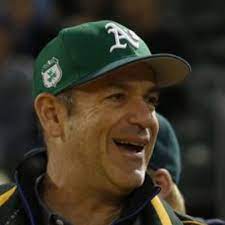
John Fisher. Twitter photo.
Fisher has strong connections to local politicians. Mayor Libby Schaaf, an outspoken leader pushing for the Oakland A’s Port real estate project, also publicly backs the closing of Oakland schools. She is a charter school supporter and has significant connections to Fisher, who, along with other charter school billionaires, helps fund Schaaf’s pet nonprofit project, Oakland Promise.

Fisher is not only a baseball team owner, he is also a charter school tycoon. He and his mother Doris Fisher are leaders in the national effort to charterize school districts. According to the Knowledge is Power Program website, Fisher is on the board of directors of KIPP schools, which has charter schools across and the country and a network of 17 charters in Northern California, including a school in West Oakland and another in downtown Oakland.
KIPP’s office in this region is at 1000 Broadway, the same building where the school district has its headquarters.
Who is John Fisher? Politically, he is very conservative. According to Wiki, In 2019, it was revealed that Fisher, together with his mother Doris F. Fisher, as well as brothers William S. Fisher and Robert J. Fisher, had donated nearly $9 million to a dark money group that opposed Barack Obama in the 2012 election.”
According to the website of the KIPP charter school chain: “John Fisher is the executive vice chairman of Pisces Inc., and co-founder of Sansome Partners, which are the family office and investment group, respectively, for the Fisher Family, founders of The Gap. The Doris & Donald Fisher Fund focuses on education reform and charter schools and was founded by Doris Fisher and the late Donald Fisher.
“In addition to serving on a number of corporate boards, (Fisher) helped found and continues to serve on the board of Charter School Growth Fund and Silicon Schools Fund.”
Doris Fisher, worth $2.6 billion, has “focused much of her wealth and resources on building charter schools. She and her late husband Donald donated more than $70 million to … (KIPP schools) … (building) the operation into the largest network of charter schools in the country, with 200 schools serving 80,000 students in 20 states,” according to an article in the website Capital & Main in 2016.
Doris Fisher was listed in 2016 “as the second-largest political donor in California by the Sacramento Bee – and nearly all of her money now goes to promoting pro-charter school candidates and organizations,” according to Capital & Main. “While often labeled a Republican, she gives to Democrats and Republicans alike, just as long as they’re supportive of the charter school movement.”
Some of the financial connections between Oakland Promise — Schaaf’s nonprofit — to Fisher and other charter school billionaires are documented in Oakland Promise’s 2018 annual report.
Donations to Oakland Promise in 2018 by Fisher and Fisher-owned organizations include between $50,000-$100,000 from the Oakland Athletics, between $10,000-$25,000 from the Fisher Family and between $10,000-$25,000 from the Silicon Schools Fund.
Other charter school billionaires supporting Oakland Promise in 2018 were Arthur Rock, between $1 million-$3 million; Rogers Family Foundation, between $100,000- $1 million; Reed Hastings of Hastings Fund at Silicon Valley, between $100,000-$1 million
A locally based pro- charter school organization, Educate78, donated between $100,000-$1 million.
Schaaf is on board with Fisher’s agenda. In a KQED television interview on February 4, she offered “full-throttle support Fisher’s multi-billion-dollar real estate development at the Port,” she said. “This is everything that I as a mayor could want.”
Schaff was also unequivocal in her support for closing 15 Oakland neighborhood schools. She said that Oakland has 80 schools, while comparable districts have 40 schools, implying she supported closing as many as half the public schools in her city.
“I really feel for parents, students, teachers,” she said. “They have every right to be distrustful of this decision. But I believe it is different this time… This is an opportunity to do better for our students, for our educators, our families.”












Activism
Oakland Post: Week of September 16 – 22, 2026
The printed Weekly Edition of the Oakland Post: Week of September 16 – 22, 2026

To enlarge your view of this issue, use the slider, magnifying glass icon or full page icon in the lower right corner of the browser window.
Activism
Oakland Post: Week of September 9 – 15, 2026
The printed Weekly Edition of the Oakland Post: Week of September 9 – 15, 2026

To enlarge your view of this issue, use the slider, magnifying glass icon or full page icon in the lower right corner of the browser window.
Activism
Oakland Post: Week of September 2 – 8, 2026
The printed Weekly Edition of the Oakland Post: Week of September 2 – 8, 2026
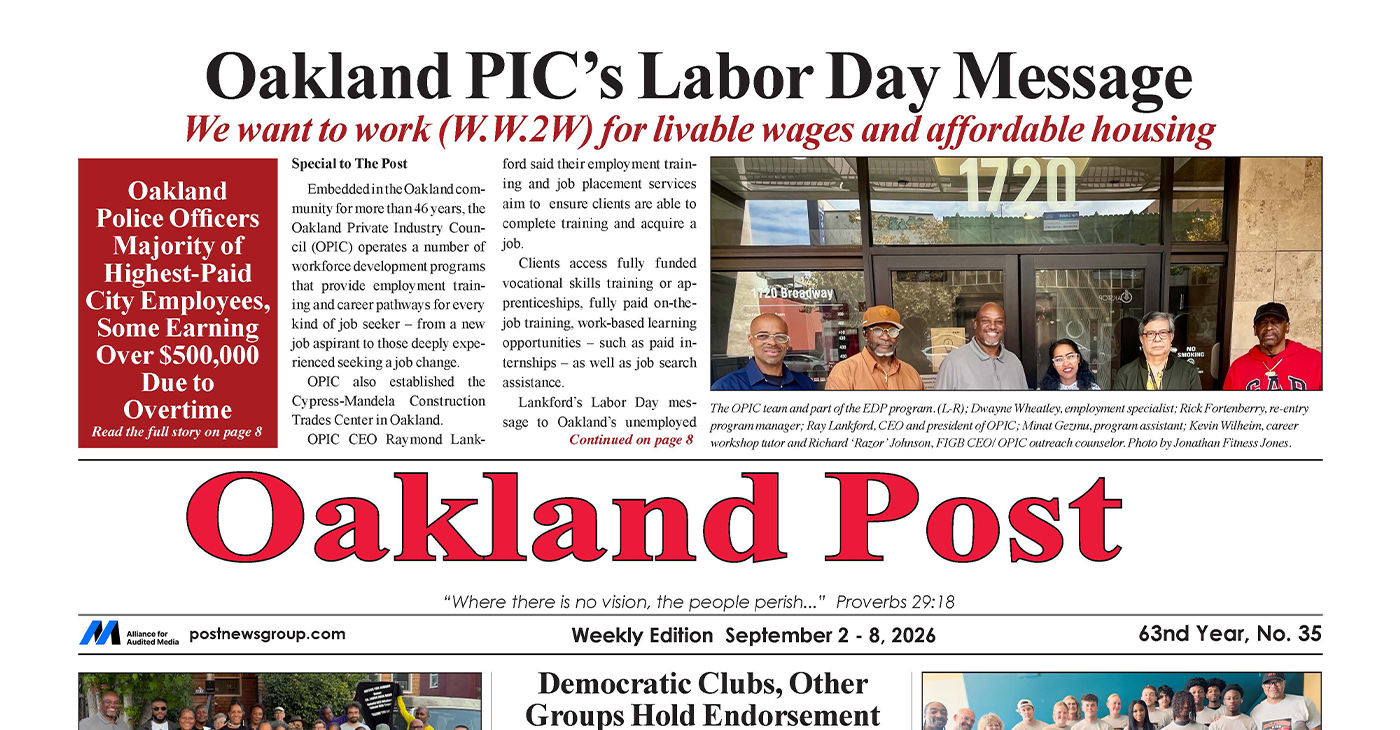
To enlarge your view of this issue, use the slider, magnifying glass icon or full page icon in the lower right corner of the browser window.



Doulas Are Helping Black California Moms Navigate Pregnancy–Even as High Mortality Rates Persist

Newsom Signs Addictive Social Media Law to Protect Kids

On Your November Ballot: Prop 38 Would Allocate $8.4 Billion to Immunology and Immunotherapy Funding

Ask California: Golden State Releases New AI Chatbot

Asm. Isaac Bryan’s Bill Banning California Police From ICE Side Jobs Reaches Newsom’s Desk

Assemblymember LaShae Sharp-Collins’s Bill Would Pause Law Enforcement’s Use of Shock Gloves Pending Study

BOOK REVIEW: ‘Laws of Solomon’ Reveals Tender Heart of Former Child Soldier

OPINION: The New American Fear – From 9-11 to AI

Passing for White, Fighting for Black America: The Courage of Walter White

Oakland People’s Arms Embargo Coalition Demands End to Military Shipments Thru Oakland

Barbara Lee Mourns Gloria Steinem, Remembers a Friendship Rooted in Equality

Event Preview: ‘Fashion v. Fascism’ – A Runway Revolution Is Coming to the Bay Area

Two Looming Threats Every Alameda County Elder Should Know About

Oakland Mayor Reads to Children at Bookout Block Party at Marcus Books Store

Tradition Comes to the Streets in 11th Annual Black-Eyed Pea Festival at the Freedom Farmers Market

Less Affluent School Districts, Including Sacramento City, Face Threat of State Takeover

ESSAY: California Can Close Its Colorectal Cancer Gap

California Hispanic Chambers of Commerce Unveils: ‘Powering the Future’ Theme for 47th Annual Statewide Convention

Four Candidates, Including Incumbent Barbara Lee, Qualify for Oakland Mayor’s Race

Oakland Post: Week of August 12 – 18, 2026

From Blueprint to Breakthrough: Tackling Affordable Housing in Oakland

Oakland Observes Black August with Block Parties, Film Showings, Workshops

COMMENTARY: Why Local School Tax Measure G1 Will Not Be on the November Ballot

Standoff for Justice: Our Homes Are Worth Fighting For

Returning to Its Roots, the Oakland Black-Eyed Pea Festival Partners with the Freedom Farmers Market Sept. 12

NPRC Scores First Advocacy Victory: David Shaw Finally Gets His Wish to ‘Go Home’

Oakland Post: Week of August 26 – September 1, 2026

Frontier Airlines’ Return to Oakland Airport Brings Flights, Jobs and Opportunity

Gubernatorial Candidate Steve Hilton Blasts California New Tire Rules; Newsom Hits Back

Chef Sharon Lee Blends Culinary Excellence, Education and Empowerment

The Conversation With Al McFarlane 6/23/26

Media Monday 6/22/26

LIVE! ASK ALMA! — TUES. 6.23.26 7PM EST

Car Buying Secrets: 4 Hidden Checks Before You Sign!

Is This 550 HP Charger Worth YOUR Money? AutoNetwork Review

Celebrating Juneteenth – Frederick Douglass on education and resistance

LIVE! — ASK ALMA! — TUES. 6.19.26 7PM EST

Hyundai Ioniq 5 Parking, Safety, and 360 View #shorts

2025 Ioniq 5 New Wiper & Powerful Performance! #shorts

Electric SUV Range: Is 259 Miles Enough? #shorts

EV Charging: How Fast Can You Charge an Electric Vehicle? #shorts

Biometric Cooling… Messaging Seats…Come on! 2025 Infiniti QX80 Autograph 4WD

Charged Up: Witness the Magic of a Fully Electric Car! #shorts

Range Rover Sport PHEV Included…: See What’s Inside This Luxury SUV! #shorts

Invisible Hood View: Perfect Parking with X-Ray Vision! #shorts
-
 Commentary4 weeks ago
Standoff for Justice: Our Homes Are Worth Fighting For
-
 Activism4 weeks ago
Oakland Post: Week of August 26 – September 1, 2026
-
 Business4 weeks ago
Frontier Airlines’ Return to Oakland Airport Brings Flights, Jobs and Opportunity
-
 Business4 weeks ago
Gubernatorial Candidate Steve Hilton Blasts California New Tire Rules; Newsom Hits Back
-
 Business4 weeks ago
Chef Sharon Lee Blends Culinary Excellence, Education and Empowerment
-

 Education4 weeks ago
Gov. Newsom’s Latest Appointees Include Sacramento Advocate for Formerly Incarcerated Students; State’s New Tech Chief
-

 Community4 weeks ago
Big City Mayors Ask for “Yes” Vote on Housing Bond Measure; Conservatives Say “No”
-

 Business4 weeks ago
Oakland Coliseum Project Opens Door for Small Businesses to Build Bigger
