
#NNPA BlackPress
Reflecting on Black History Milestones in Birmingham AL
THE BIRMINGHAM TIMES — As we bring Black History Month to a close here’s a look at some historic Birmingham milestones since the city’s founding.

Compiled by The Birmingham Times
As we bring Black History Month to a close here’s a look at some historic Birmingham milestones since the city’s founding.
1871—City of Birmingham founded; now the state’s most populous city, Birmingham was established at the crossing of two rail lines near one of the world’s richest mineral deposits.
1885—Birmingham Barons baseball team originally established as Birmingham Coal Barons.
1890—The Penny Savings Bank, founded by the Rev. William Reuben Pettiford in Birmingham, opens, becoming the first Black-owned and Black-operated financial institution in Alabama.
1902—Woodward Building, construction completed on the first of four steel-frame skyscrapers that would make up Birmingham’s “Heaviest Corner on Earth.”
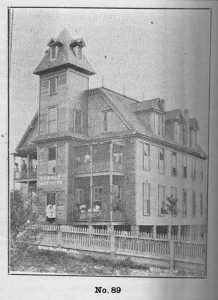
The Tuggle Institute, a boarding school for African American children in Birmingham Alabama, pictured in 1906. (Public Domain)
1903 —Social worker Carrie A. Tuggle opens the Tuggle Institute and School, the first orphan home in Alabama for African American boys. The Institute operated until Tuggle’s death on Nov. 5, 1924, and was later renamed Tuggle Elementary School in 1936.
1904 —Vulcan Statue, the world’s largest cast-iron statue, created as Birmingham’s entry in the St. Louis World’s Fair, was sculpted by Giuseppe Moretti.
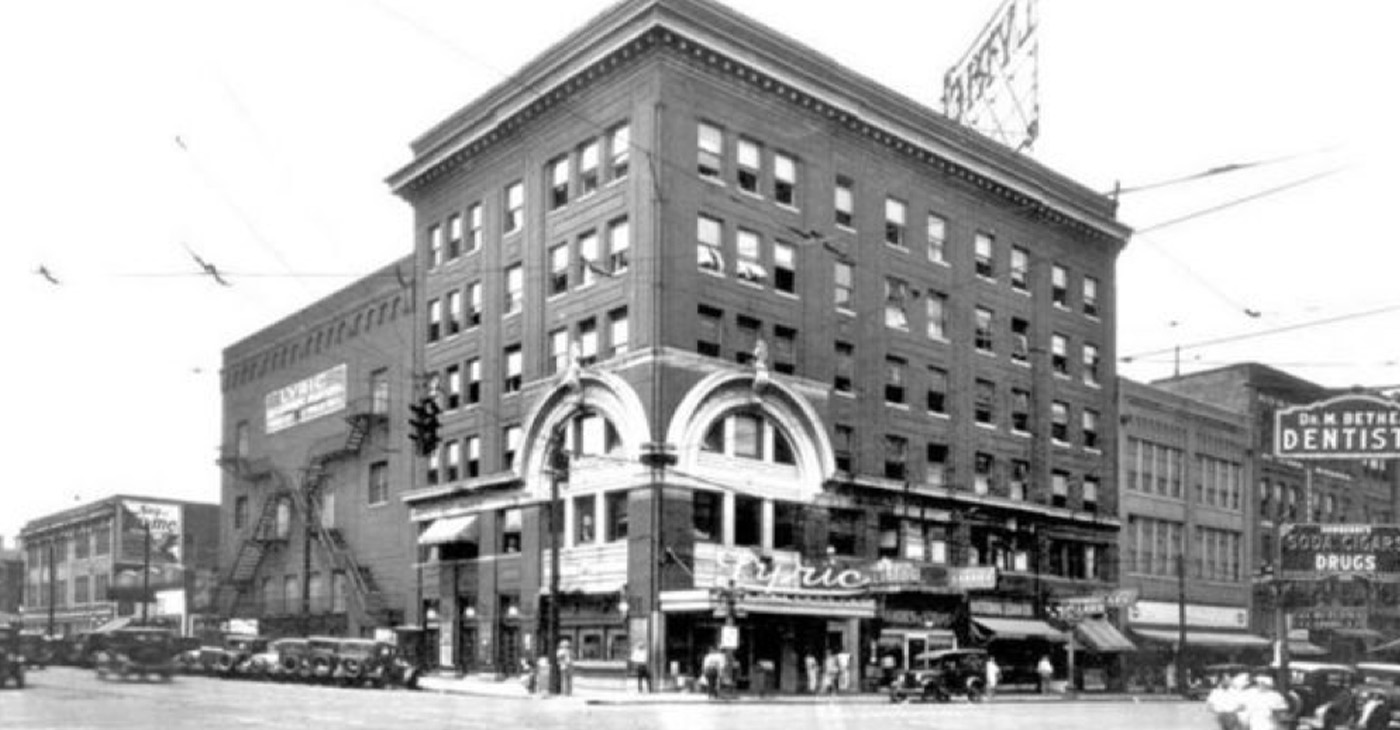
1914—Birmingham’s Lyric Theatre was established as one of the first in the South where Black and white audiences could see the same show for the same price, though Black sat in an isolated section with inferior accommodations
1918—Birmingham College and Southern University merged to establish Birmingham-Southern College.
1925—The Pittsburgh of the South, Birmingham, is the largest cast iron and steel producer in the Southern U.S.
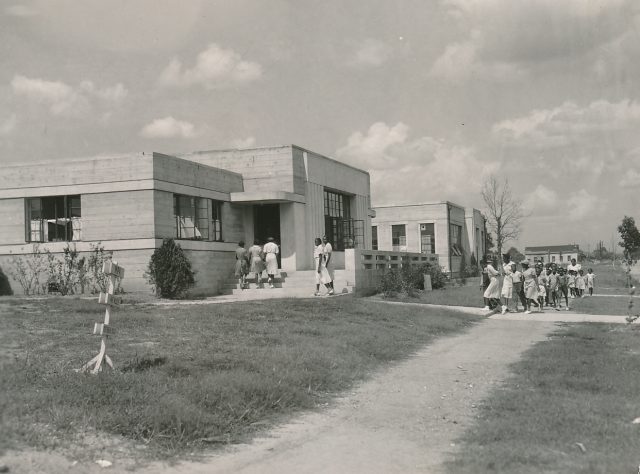
The Slossfield Community Center campus included a health clinic, a maternity ward, a recreational center, and an education building. The complex was built between 1936 and 1939 by ACIPCO (American Cast Iron Pipe Company). (National Archives Record Group 69-N)
1939—Slossfield Health Clinic, located in a neighborhood surrounding ACIPCO’s plant, considered one of Birmingham’s most blighted, opens.
1941—The Sisters of Charity of Nazareth (SCN) assume responsibility for a small health clinic in the predominantly African American community of Ensley near Birmingham, Alabama. The clinic later becomes Holy Family Hospital.
1941—World War II. The demand for steel during the war brought Birmingham out of the Great Depression.
1948—Slossfield’s medical center closes in 1948 after World War II. The rest of the Slossfield Community Center campus closed in 1954.
1951—Birmingham Museum of Art, currently home to one of the finest collections in the Southeast, with extensive holdings from around the globe dating from ancient to modern times, opens.
1954—A.G. Gaston Motel founded by entrepreneur and activist A.G. Gaston to provide higher-class service to Black visitors.
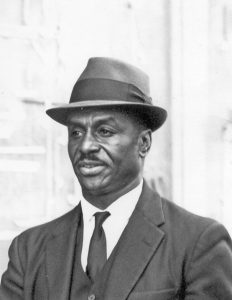
The Rev. Fred L. Shuttlesworth and other local Black ministers established the Alabama Christian Movement for Human Rights (ACMHR) during a mass meeting at Birmingham’s Sardis Baptist Church. (File)
1956—The home of Birmingham minister and Civil Rights leader Fred Shuttlesworth is bombed. Although the structure is severely damaged, Shuttlesworth emerges uninjured.
- During a mass meeting at Birmingham’s Sardis Baptist Church, Shuttlesworth and other local Black ministers establish the Alabama Christian Movement for Human Rights (ACMHR). Founded in response to the State of Alabama’s eight-year ban on the NAACP, ACMHR was central to the civil rights movement in Birmingham.
- The Freedom Riders arrive at the Greyhound bus terminal in Montgomery, where they are attacked by an angry mob. The Freedom Ride, an integrated bus trip from Washington, D.C., through the Deep South, was formed to test the 1960 Supreme Court decision prohibiting segregation in bus and train terminal facilities.
1963—After previously establishing the ACMHR and the Southern Christian Leadership Conference (SCLC), Shuttlesworth invites Rev. Martin Luther King, Jr. to Birmingham to lead what becomes the Birmingham Campaign for Desegregation. King writes Letter From Birmingham Jail.
- Sixteenth Street Baptist Church was bombed, killing four young girls in an attack against the Civil Rights Movement and humanity.
1966—Oscar Adams Jr. becomes the first African American to join the Birmingham Bar Association.
1968—Arthur Shores was appointed to the Birmingham City Council, making him the first African American to serve as a councilman.
1970—The Sisters of Charity of Nazareth (SCNs) transfer ownership of Holy Family Hospital to a local non-profit organization, which was renamed Community Hospital. By 1986, the facility was sold and operated as Medical Park West until its closing in 1988. The facility would briefly reopen in 1989 as Community Hospital with 22 beds, only to close it down for good soon thereafter.
1974—J. Richmond Pearson and U.W. Clemon were the first African Americans elected to the Alabama State Senate since Reconstruction.
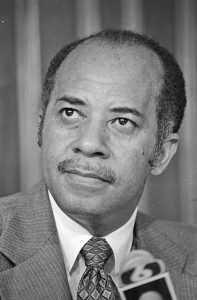
Richard Arrington. (File)
1979—Richard Arrington Jr. was elected as the first African American mayor of Birmingham. Arrington served in that post for nearly 20 years, until his resignation in July 1999.
1980—Oscar Adams Jr. was appointed to the Alabama Supreme Court, making him the first African American justice to hold that office.
1984—J. Mason Davis becomes the first African American president of the Birmingham Bar Association. He is also the first minority adjunct professor at The University of Alabama School of Law, serving from 1972 to 1997.
1986—Reuben Davis and Chris McNair were elected to the County Commission, the first district by district election, and are the first African Americans to serve on the commission.
1991—Carole Smitherman appointed to become the first African American woman to serve as a circuit court judge in Alabama
1992—Birmingham Civil Rights Institute opens its doors at Kelly Ingram Park in the Civil Rights District.
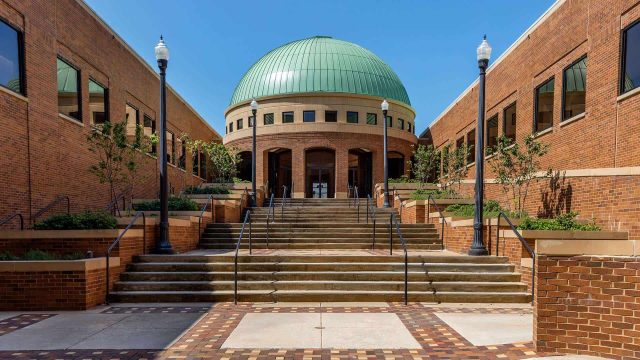
The Birmingham Civil Rights Institute. (File)
1993—Alabama Jazz Hall of Fame opens.
2002—Shelia Smoot elected first Black female Jefferson County Commissioner.
2003—Helen Shores Lee becomes the first African American woman to serve as a judge on the Jefferson County Circuit Court.
2005—Condoleezza Rice, a Birmingham native, is named U.S. Secretary of State.
2008-11—Jefferson County and creditors attempt to reach a settlement of the $3.14 billion sewer debt, but any deal would need to erase $1 billion or more of that debt.
2009—Carole Smitherman becomes Birmingham’s first African American female mayor.
2010—Railroad Park, a 19-acre park, opened, becoming a catalyst for revitalization in downtown Birmingham
2011—A massive storm in April, causing numerous powerful tornadoes, rips through the southeastern United States, killing 250 people in Alabama, including 20 people in Jefferson County communities of Pleasant Grove (10), Concord (6), Cahaba Heights (1), Pratt City (1), Forestdale (1), and McDonald Chapel (1).
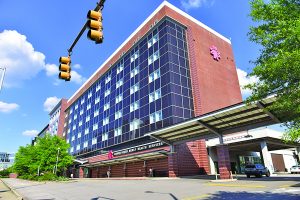
In 2012 the Jefferson County Commission voted 3-2 to close the inpatient care unit and emergency room at Cooper Green Mercy Hospital. (File)
2012—Cooper Green Mercy Hospital downsized. The Jefferson County Commission votes 3-2 to close the inpatient care unit and emergency room at Cooper Green following weeks of debate and protests from community leaders who have begged the county to continue operating the facility for the sick and poor.
2016—Lynneice Washington elected District Attorney for the Bessemer Cutoff, the first African American DA in the state of Alabama.
2016—Theo Lawson was named the first African American Jefferson County attorney.
2016—Representative Terri Sewell introduces legislation leading to Birmingham Civil Rights National Monument designation by presidential proclamation one year later.
2017—John Henry joins the Jefferson County Commission Finance Department and becomes the county’s first Black chief financial officer.
2017—Danny Carr and Mark Pettway were elected the county’s first Black district attorney and first Black sheriff, respectively.
2019—Walter Gonsoulin was named the first permanent African American superintendent of the Jefferson County School System
2020—Felicia Rucker-Sumerlin was named the first female Deputy Chief in the 200-year history of the Jefferson County Sheriff’s Office.
2020—Elisabeth French becomes the first woman selected to serve as Presiding Judge in Jefferson County’s 200-year history. She will oversee the 10th Judicial Circuit, the largest in Alabama’s Judicial System.
2021—Ashley M. Jones, founder of the Magic City Poetry Festival, is named Poet Laureate for Alabama, making her the first Black Poet Laureate for the state and the youngest person to hold the position.
2022—Dr. Adolphus Jackson of Birmingham is elected President of the Alabama Dental Association, the first African American to serve as president of the state Association.
2022—Birmingham Mayor Randall Woodfin issues a proclamation declaring March 18 Reverend Fred Shuttlesworth Day, the 100th anniversary of the leader’s birth.
2023—Writer and educator Salaam Green becomes the city’s first poet laureate.
2024—Democrats Yashiba “Red” Blanchard and Jameria Moore on Tuesday became the first Black female judges elected to Probate Court in Jefferson County, Alabama.
2024—Myrna Carter Jackson, a Birmingham civic leader and Foot Soldier who participated in marches, sit-ins, demonstrations, and other Civil Rights activities, dies. She was 82.
2024—Hezekiah Jackson IV, who served as president of the Metro Birmingham NAACP, Birmingham Citizens Advisory Board, and the Inglenook Neighborhood Association, dies. He was 65.
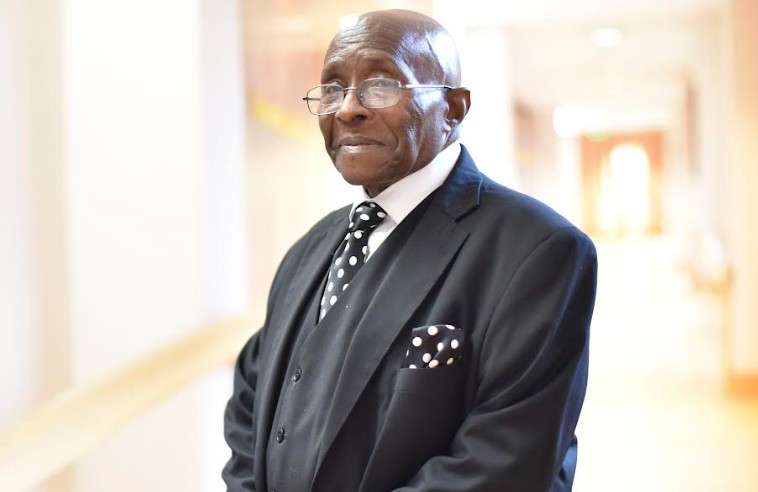
For decades, Bishop Calvin Woods Sr., was one of Birmingham’s leading voices for equality. (File)
2025—Judge Carole Smitherman retires after 50 years in law and politics in Birmingham, including being the first Black woman hired as a deputy district attorney in Jefferson County and becoming the city’s first Black woman municipal and circuit court judge.
2025—Bishop Calvin Woods Sr., distinguished Birmingham Civil Rights leader and longtime pastor of Shiloh Baptist Church in Norwood, dies. He was 91.
2025—Former U.S. Attorney General Eric Holder Jr. accepts the prestigious 202d L. Shuttlesworth Human Rights Award at the downtown Sheraton.
2026—Claudette Colvin, who refused to move to a bus seat at the start of the Civil Rights Movement, dies at 86. Homegoing celebration was held at Greater Shiloh Missionary Baptist Church in SW Birmingham.
Source: The Birmingham Times, 1963: How The Birmingham Civil Rights Movement Changed America and the World; City of Birmingham Public Library; Associated Press; blackpast.org; Politics and Welfare in Birmingham, 1900–1975.









#NNPA BlackPress
Youth-Led Black August Event Brings Past to Present at East Oakland Boxing Association
The mission of Youth Alive! Is to “break the cycle of violence, heal trauma, and uplift a thriving community of leaders, to save lives in Oakland and beyond” by serving “as mentors, youth leaders, counselors, case managers, intervention specialists and violence interrupters,” working “to help violently wounded people heal themselves and their community.”
The post The mission of Youth Alive! Is to “break the cycle of violence, heal trauma, and uplift a thriving community of leaders, to save lives in Oakland and beyond” by serving “as mentors, youth leaders, counselors, case managers, intervention specialists and violence interrupters,” working “to help violently wounded people heal themselves and their community.” appeared first on BlackPressUSA.

Youth-Led Black August Event Brings Past to Present at East Oakland Boxing Association
The East Oakland Boxing Association (EOBA) and Youth Alive! came together on Aug. 21 to share with their community all that Black August means to them.
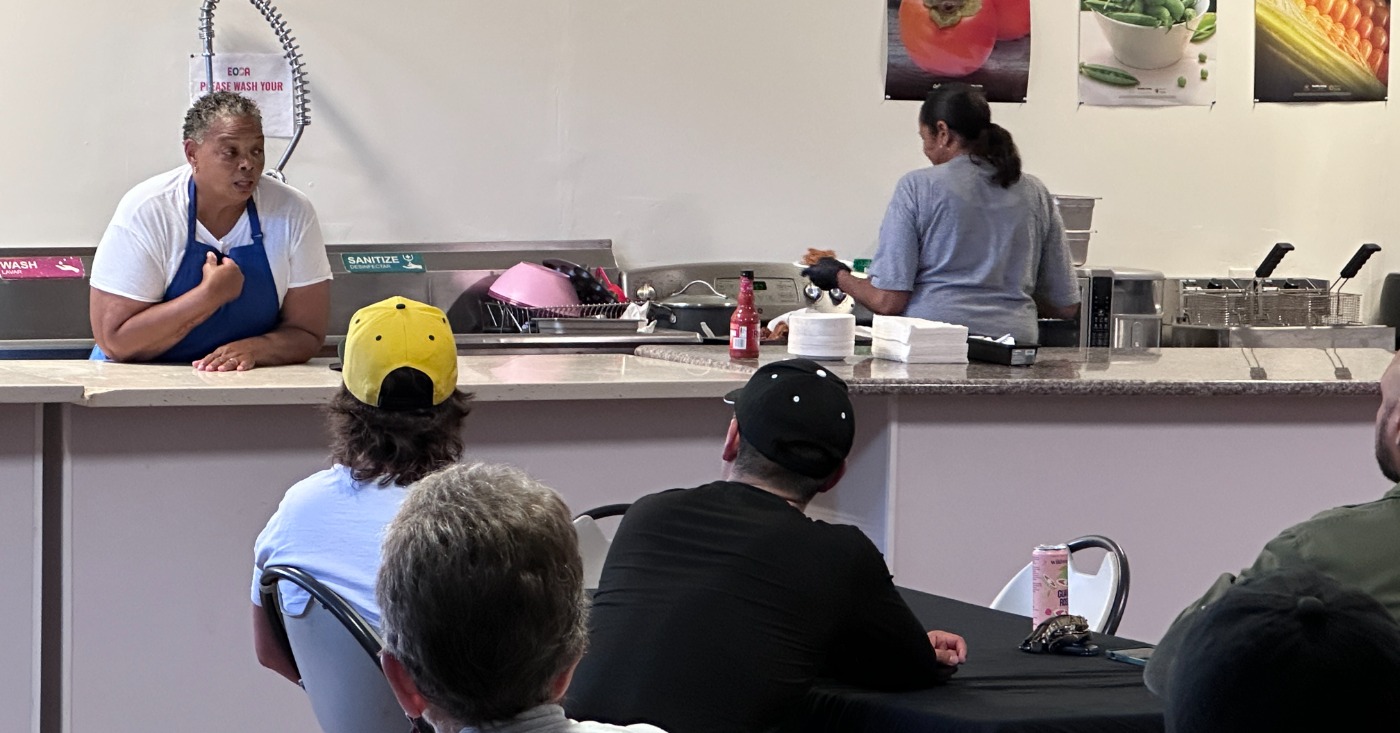
Held on EOBA’s patio at 816 98th Ave. in Deep East Oakland, the two organizations hosted their second annual Black August Experience, featuring a food tasting, financial literacy and mindfulness workshops, and voter registration with the League of Women Voters Oakland (LWV).
Black August is known as a time to uphold the legacy of prisoners who protested their conditions by fasting, fighting, and educating themselves on the economic and political circumstances that contributed to their incarceration.
According to its website, “EOBA is a multi-service youth and community development hub that goes far beyond the ring. While rooted in the discipline of boxing, for nearly 40 years EOBA has also integrated robust programs in workforce development, food justice, afterschool enrichment, financial literacy, mentorship, and wellness.”.
The mission of Youth Alive! Is to “break the cycle of violence, heal trauma, and uplift a thriving community of leaders, to save lives in Oakland and beyond” by serving “as mentors, youth leaders, counselors, case managers, intervention specialists and violence interrupters,” working “to help violently wounded people heal themselves and their community.”
Through Coro California, another leadership organization serving young people across the state for 80 years, they gained a broader understanding of Black August.
EOBA Executive Director Dawna Williams spoke about how much she learned about Black August from the youth who created it. “I let them educate me,” she said. Instead of talking about prison reform and mass incarceration, Williams and youth interns found that Black August meant so much more. “We would have done a disservice if we had just focused on who the people were and what their situation was…We tried to take their message from back in the day and make it relevant to the young people today. What do they need to know?”
Youth interns created and placed posters around the patio to help participants understand how traditional Black foodways, civic engagement, financial literacy, and the power of education are relevant to Black resistance today.
An EOBA member described Black August with Youth ALIVE! as “a whole vibe. “This year we added the Fun Zone for the kids, because you really cannot go wrong with a Fun Zone. I also loved seeing everyone chillin’ in the outdoor lounge, catching some Vitamin D and just enjoying a Friday evening together.”
The food tasting, a popular event from last year, featured traditional Black foods such as black-eyed peas, johnny cakes, and fried chicken. Led by Williams, the tasting included a talk about how these traditional foods were made and why they are forms of Black resilience.
The “‘Plate of History’ was a favorite of the online writers. “Fun, educational, and did I mention delicious? Our Taste of History cook, Angela Southall, served up some good eats while connecting food to history and culture.”
The writer also commended the “League of Women Voters Oakland for their civic leadership and for getting our young people informed, ready, and registered to vote.”
Overall, it was a “good Friday event in East Oakland,” the writer said.
Upcoming Black August events: Building Opportunities for Self-Sufficiency (BOSS), will host “Black August: The Arc of Liberation” at Oakland City Hall on Sat. Aug. 29, from 11 a.m. to 3 p.m.
The websites for East Oakland Boxing Association, Youth Alive! and CORO are sources for this report.
Jana Lang is an Oakland resident, teacher, gardener and poet participating in the Propel News Initiative.
The post The mission of Youth Alive! Is to “break the cycle of violence, heal trauma, and uplift a thriving community of leaders, to save lives in Oakland and beyond” by serving “as mentors, youth leaders, counselors, case managers, intervention specialists and violence interrupters,” working “to help violently wounded people heal themselves and their community.” appeared first on BlackPressUSA.

#NNPA BlackPress
EV Home Charging Warning: What Dealerships Won’t Tell You! #shorts
Is your home EV charging setup ready? Dealerships may not warn you about critical outlet and circuit needs. Find out before you plug in!
The post EV Home Charging Warning: What Dealerships Won’t Tell You! #shorts appeared first on BlackPressUSA.

Dealerships won’t tell you: charging this big battery at home isn’t always simple. Verify your outlet capacity, circuit, and setup before assuming level one or basic outdoor outlets will suffice.
 Watch the full video: https://youtu.be/A9Cd2SspoaQ
#AutoNetwork
The post EV Home Charging Warning: What Dealerships Won’t Tell You! #shorts appeared first on BlackPressUSA.
#NNPA BlackPress
Car Buying Secrets: Dealership Traps & How to Avoid Them #shorts
Don’t get tricked at the dealership! Learn essential car buying secrets to secure the best deal and avoid hidden traps.
The post Car Buying Secrets: Dealership Traps & How to Avoid Them #shorts appeared first on BlackPressUSA.

Before stepping into a dealership, secure bank pre-approval for your financing rate. Then, get the out-the-door price in writing. Never discuss monthly payments until that number is fixed. Test road noise and rear visibility yourself. Decline add-ons with a simple ‘Not today’. Check backseat space with your tallest household member.
Watch the full video: https://youtu.be/maAOBjO1puY
#AutoNetwork
The post Car Buying Secrets: Dealership Traps & How to Avoid Them #shorts appeared first on BlackPressUSA.


Port of Oakland, Army Corps Sign Historic Harbor Design Agreement

Democratic Clubs Interview Candidates for Oakland School Board

Nuna Phillips-McKee Celebrates 100 Years: ‘A Century of Faith, Family and God’s Amazing Grace!’

D.A. Ursula Jones Dickson: Terminix to Pay $3.15 Million Over Illegal Disposal of Pesticides, Customer Records

REPORT: Community Level Policy Is Impacting Homelessness and Drug Abuse in California

OPINION: AI Needs to Know Who Is the Boss
Goldi-Locs and Two (or Three) Bears in the Forest in California Hills

Election Watch 2026: 85% of Eligible Voters in California Are Registered

Don’t Let scammers Crash Your School Year

BOOK REVIEW — Curved Air: A Biography of Sickle Cell Anemia and the Quest to Cure the First Molecular Disease

California’s Legal Cannabis Market Hits $8 Billion as State Touts Progress on Fighting Drugs, Crime

Blacks and Latinos Clash Over LA’s Barrio Run; Mayor Karen Bass Calls for Dialogue Across Racial, Neighborhood Lines

Asm. Smallwood-Cuevas’s Bill Repealing ‘Racist’ CalWORKs ‘Man-in-the-House’ Rule Clears Legislature

Asm. Smallwood-Cuevas’s Bill Repealing ‘Racist’ CalWORKs ‘Man-in-the-House’ Rule Clears Legislature

‘Ready to See These Bills Become Law’: Sen. Weber’s Package of 15 Bills Advance to Gov. Newsom’s Desk

Department of Homeland Security Demands California Secretary of State Shirley N. Weber Scrub Voter Rolls

“The Power to See Threats Sooner”: Gov. Newsom, Safety Officials Showcase California’s Investments in Hi-Tech Wildfire Prevention

Alpha Kappa Alpha Sorority, Inc. Celebrates New North Atlantic Regional Director

California Sen. Padilla Joins Colleagues to Introduce Bill Imposing Term Limits on Supreme Court Justices

Less Affluent School Districts, Including Sacramento City, Face Threat of State Takeover

Car Wash Workers Cope with Lingering Impacts of ICE Raids

ESSAY: California Can Close Its Colorectal Cancer Gap

Oakland Post: Week of August 5 – 11, 2026

As Part of Your Back-to- School Checklist, Vaccinate

Oakland ‘Port Serves as a Powerful Engine for Good Jobs and Economic Development

Gov. Newsom Signs New Affordable Housing Legislation

Gov. Newsom Announces $109.6 Million in Funding for 278 Supportive Homes in Bakersfield, Contra Costa, Sacramento and Fresno

California Hispanic Chambers of Commerce Unveils: ‘Powering the Future’ Theme for 47th Annual Statewide Convention

Closing the Gap: What the Data and Frontline Experiences Reveal About Cancer in Black California

Congresswoman Simon Demands Investigation into Trump’s Abuse of Emergency Powers for Coal Export Terminal in West Oakland

The Conversation With Al McFarlane 6/23/26

Media Monday 6/22/26

LIVE! ASK ALMA! — TUES. 6.23.26 7PM EST

Car Buying Secrets: 4 Hidden Checks Before You Sign!

Is This 550 HP Charger Worth YOUR Money? AutoNetwork Review

Celebrating Juneteenth – Frederick Douglass on education and resistance

LIVE! — ASK ALMA! — TUES. 6.19.26 7PM EST

Hyundai Ioniq 5 Parking, Safety, and 360 View #shorts

2025 Ioniq 5 New Wiper & Powerful Performance! #shorts

Electric SUV Range: Is 259 Miles Enough? #shorts

EV Charging: How Fast Can You Charge an Electric Vehicle? #shorts

Biometric Cooling… Messaging Seats…Come on! 2025 Infiniti QX80 Autograph 4WD

Charged Up: Witness the Magic of a Fully Electric Car! #shorts

Range Rover Sport PHEV Included…: See What’s Inside This Luxury SUV! #shorts

Invisible Hood View: Perfect Parking with X-Ray Vision! #shorts
-

 Commentary2 weeks ago
Standoff for Justice: Our Homes Are Worth Fighting For
-

 Business2 weeks ago
Gubernatorial Candidate Steve Hilton Blasts California New Tire Rules; Newsom Hits Back
-

 Activism2 weeks ago
Oakland Post: Week of August 26 – September 1, 2026
-

 Education2 weeks ago
Gov. Newsom’s Latest Appointees Include Sacramento Advocate for Formerly Incarcerated Students; State’s New Tech Chief
-

 Business2 weeks ago
Frontier Airlines’ Return to Oakland Airport Brings Flights, Jobs and Opportunity
-

 Community2 weeks ago
Big City Mayors Ask for “Yes” Vote on Housing Bond Measure; Conservatives Say “No”
-

 Business2 weeks ago
Oakland Coliseum Project Opens Door for Small Businesses to Build Bigger
-

 Business2 weeks ago
Chef Sharon Lee Blends Culinary Excellence, Education and Empowerment
