
Activism
Womanist Theology: Recognizing Black Women’s Leadership, Contributions to the Black Church
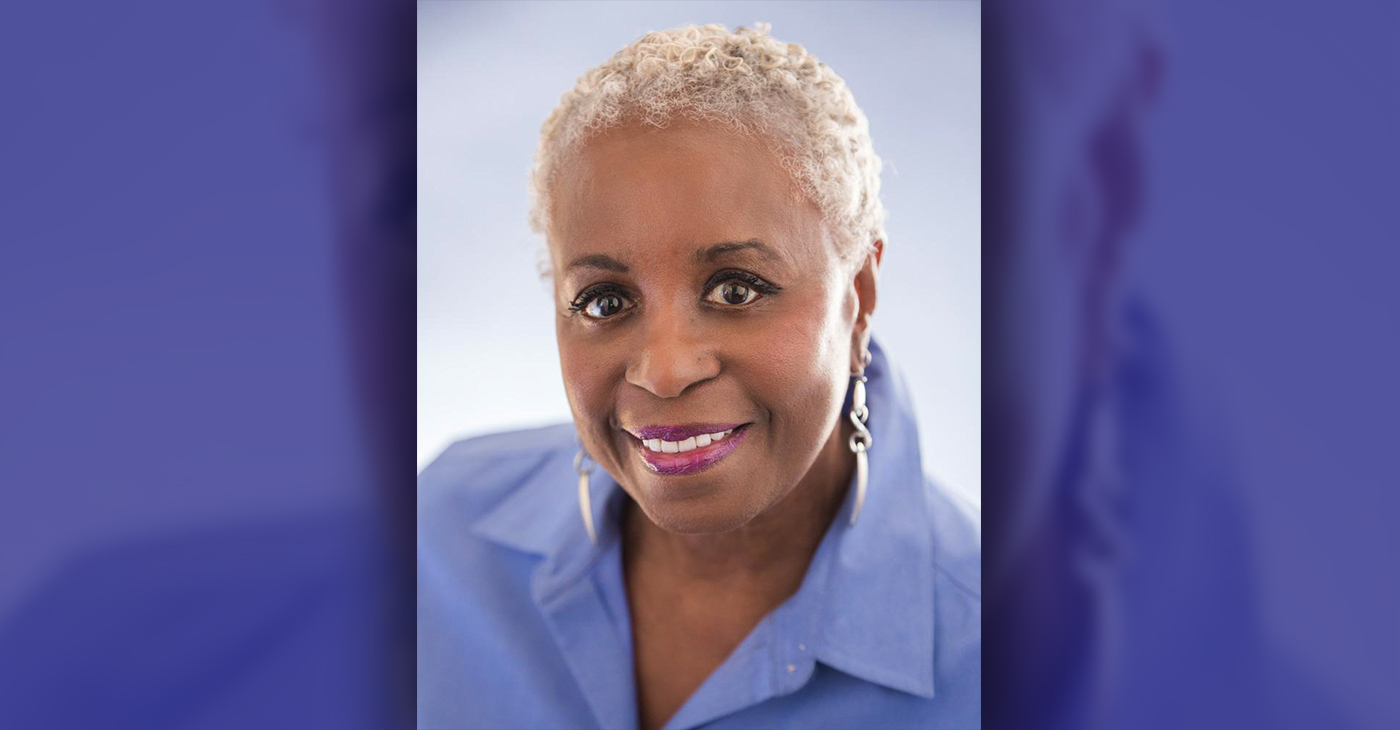
“To do womanist theology, we must read and hear the Bible and engage it within the context of our own experience,” Dr. Jacquelyn Grant said. “This is the only way that it can make sense to people who are oppressed. Black women of the past did not hesitate in doing this and we must do no less…”

Part One
By Rev. Dr. Martha C. Taylor

During this Women’s History Month as we review the history of the Black Church we are reminded of the development of Womanist Theology that recognizes the lived experiences and contributions of Black Women.
The white, middle class Feminist Movement did not perceive Black women as their “sisters.” The focus was on their equality to white men in the workplace. They were not concerned with racism and class that impacted Black women.
James Cone, the “father” of Black Theology and renowned professor, critiqued the teachings of theology in seminaries that overlooked the lived experiences of Black people and the Black church.
Drs. Jacquelyn Grant, Katie Cannon and Delores Williams, Ph.D. students of Cone, told him that Black Theology excluded the lived experiences of Black women. Cone later said, “When I read my book today, I am embarrassed by its sexist language and patriarchal perspective. There is not even one reference to a woman in the whole book!”
These women scholars began to develop a theology that considered the lived experiences of Black Women using the oppressors of racism, classism and sexism. Womanist Theology affirms the previously ignored historical contributions of Black women who have been silenced and ignored in other theologies.
“To do womanist theology, we must read and hear the Bible and engage it within the context of our own experience,” Dr. Jacquelyn Grant said. “This is the only way that it can make sense to people who are oppressed. Black women of the past did not hesitate in doing this and we must do no less…”
In the Fall of 2011, when I was serving as an adjunct professor in the Doctor of Ministry and the Master of Divinity Programs at the San Francisco Theological Seminary, I approached the late Rev. James Noel, PhD, the only African American to head a department, namely Black Church/Africana Religious Studies Certificate Program.
With his support, I gathered a group of Bay Area Black women scholars, professors, and pastors. To our authenticity as Black mothers, grandmothers, other mothers, sisters, and aunties, who lived in the Black Community, we brought our theological education and lived experiences as Black women to the “kitchen table” and brainstormed about how we could bridge the divide between the seminary and our beloved Black community.
We were not naïve that sexism was alive and well in the majority of Black churches. However, not all male pastors practice sexism.
We linked theology, anthropology and sociology in terms that could be understood by non-seminarians. We used the words of Jesus who posed a question to His disciples: “But who do they say I am?” [Matthew 16:15] to brand our symposiums.’
Workshops did not focus on pain and sorrow only. We emphasized the strides of Black women across the board. Congresswoman Barbara Lee was the guest speaker at our first conference.
The Womanist Project was an anchor in the community that shed light on understanding the history of womanist theology including using stories in the Bible and in our everyday lives. The work of the symposium lasted more than five years and was one-of-a-kind in the Bay Area.
There were times that sessions were standing-room-only, and attended by all peoples. Students at the Graduate Theological Union began to write on womanist thought.
The birth of Black churches in the Bay Area would not have emerged if it weren’t for Black women. Black women opened up their homes for prayer meetings, Bible study and more.
For instance, the Market Street Seventh Day Adventist Church in Oakland was founded in 1923 by three pioneering Black women. The same holds true for Oakland’s Bethlehem Lutheran Church, founded in 1929 by three Black women.
Though these women founded churches, they did not lead the church as pastors. Bishop Ernestine Reems opened the Center of Hope Church in 1968 in Oakland. I dare say there would not be a single Black church in the Bay Area or otherwise if it were not for the women.
Rev. Dr. Martha C. Taylor, is a long-time member of Allen Temple Baptist Church and serves as the historian/archivist. She is the past historian/archivist for the Progressive National Baptist Convention Inc, Washington, D.C. She authored a first-of-its-kind epic history book “From Labor to Reward, Black Church Beginnings in San Francisco, Oakland, Berkeley, and Richmond 1849-1972.”
A former adjunct professor at the San Francisco Theological Seminary she continues as an advisor to students writing their doctoral dissertations. Dr. Taylor is dually ordained Baptist and Presbyterian and served as “installed” pastor at Elmhurst Presbyterian Church and pulpit supply for the Bethlehem Lutheran Church.












Activism
Oakland Post: Week of September 30 – October 6, 2026
The printed Weekly Edition of the Oakland Post: Week of September 30 – October 6, 2026
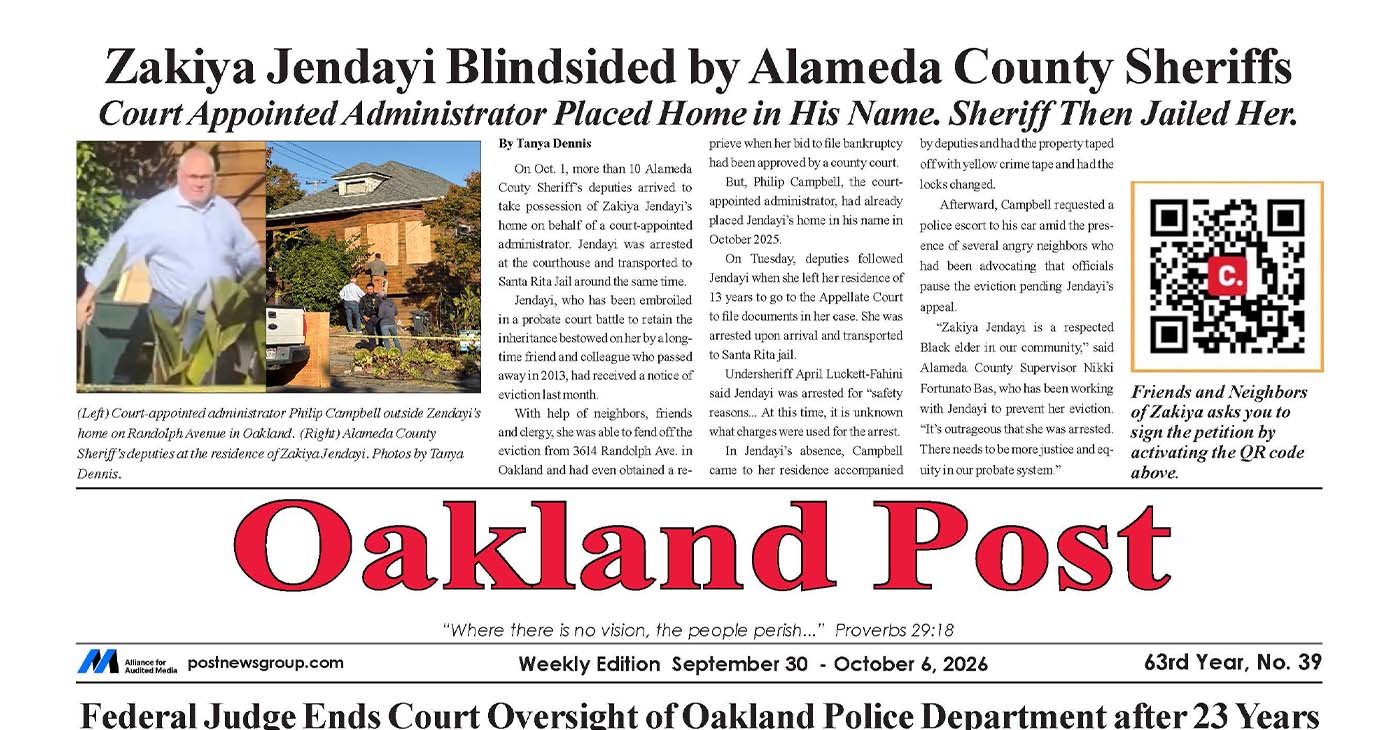
To enlarge your view of this issue, use the slider, magnifying glass icon or full page icon in the lower right corner of the browser window.
Activism
Oakland Post: Week of September 23 – 29, 2026
The printed Weekly Edition of the Oakland Post: Week of September 23 – 29, 2026
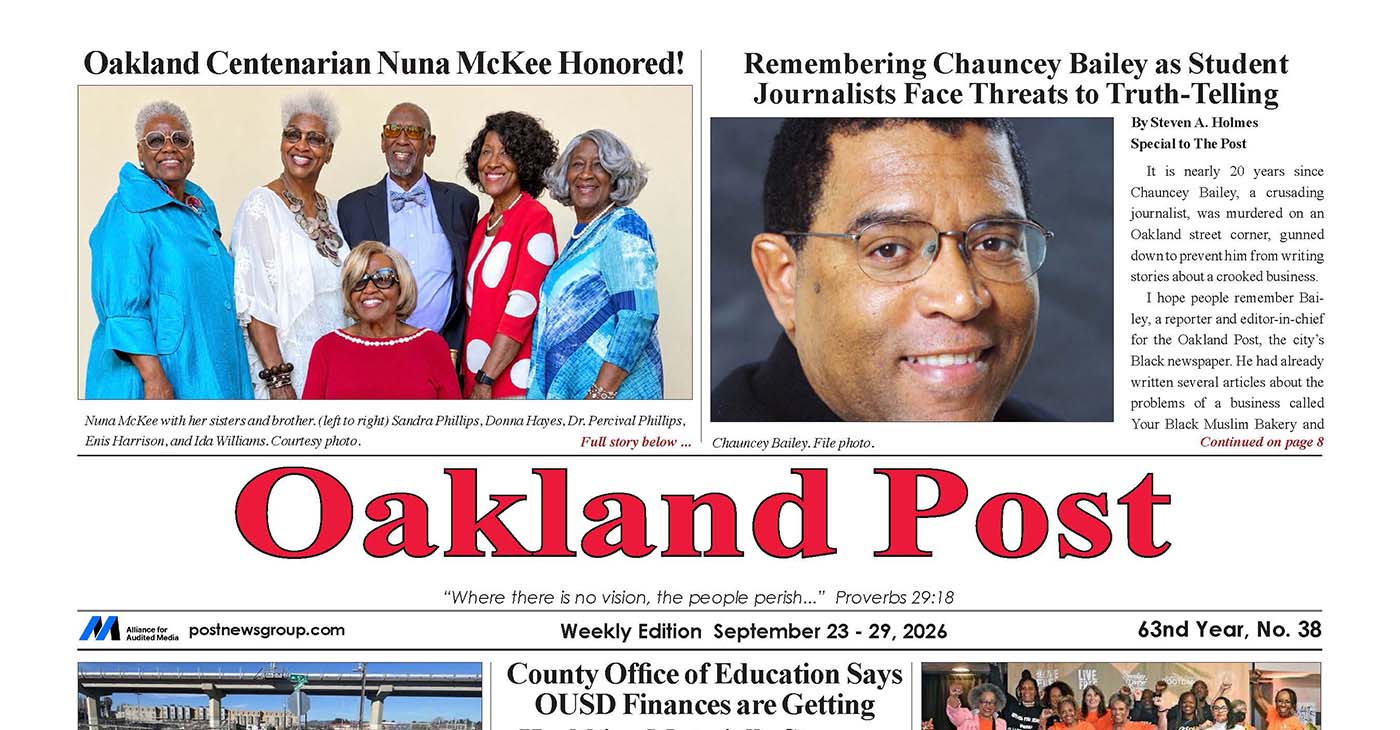
To enlarge your view of this issue, use the slider, magnifying glass icon or full page icon in the lower right corner of the browser window.
Activism
Oakland Post: Week of September 16 – 22, 2026
The printed Weekly Edition of the Oakland Post: Week of September 16 – 22, 2026
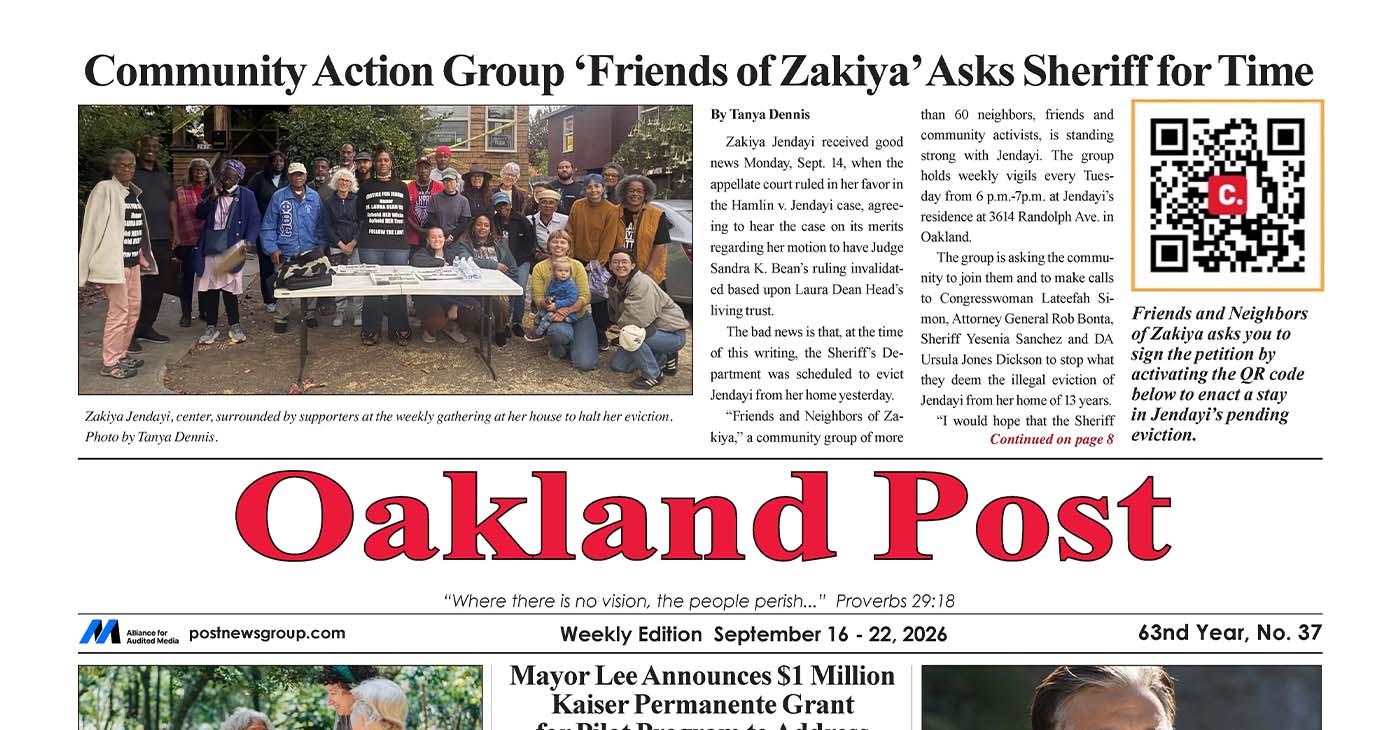
To enlarge your view of this issue, use the slider, magnifying glass icon or full page icon in the lower right corner of the browser window.


OP-ED: Proposition 44 Would Put a Price on Trust

OP-ED: Proposition 40: It’s Time to Play Chess, Not Checkers

Listening as a Lifeline: A Doula’s Witness to Black Maternal Health

New Protections for Ticket Buyers: Gov. Newsom Signs Assemblymember Isaac Bryan’s Bill

‘We Don’t Talk Trash — We Pick Up Trash!’

Zakiya Jendayi Arrested, Locked Out of Home by Sheriff’s Deputies

Oakland Post: Week of September 30 – October 6, 2026

Asm. Corey Jackson Announces Launch of 24-Hour Childcare in His District

IN MEMORIAM: The Rev. Leon “Sonny” Clark, Longtime Orange County Pastor and Community Leader, Dies at 72

Poll: Becerra Widens His Lead Over Hilton; Californians Split on Wealth Tax

From Historic Memories to New Possibilities: Oakland Celebrates Coliseum 60

County Office of Education Says OUSD Finances Are Getting Healthier, Materially Stronger

LIVE FREE Sunday Dinner Brings Faith, Fellowship and Civic Conversation to Oakland

Remembering Chauncey Bailey as Student Journalists Face Threats to Truth-Telling

BLACspace Cooperative Invites Bay Area to Experience Oakland’s Black Cultural Ecosystem Through a BLAC Map Tour + Party

Standoff for Justice: Our Homes Are Worth Fighting For

Oakland Post: Week of August 26 – September 1, 2026

Frontier Airlines’ Return to Oakland Airport Brings Flights, Jobs and Opportunity

Jackie Wright Champions Bay Area Stories, Filmmakers and Cultural Institutions

Gubernatorial Candidate Steve Hilton Blasts California New Tire Rules; Newsom Hits Back

Chef Sharon Lee Blends Culinary Excellence, Education and Empowerment

Misnamed ‘Parent’ PAC Seeks to Influence Oakland School Board Elections

Oakland Coliseum Project Opens Door for Small Businesses to Build Bigger

Big City Mayors Ask for “Yes” Vote on Housing Bond Measure; Conservatives Say “No”

Gov. Newsom’s Latest Appointees Include Sacramento Advocate for Formerly Incarcerated Students; State’s New Tech Chief

Oakland Post: Week of September 2 – 8, 2026

Longtime BWOPA Member Brendalyn Goodall Appointed to California Workforce Development Board

Gov. Newsom Signs Law Shielding Immigration Aid Workers From Doxing Threats

Secretary of State Shirley N. Weber Urges Californians to Vote Early as Voter ID Battle Intensifies

Oakland Post: Week of September 9 – 15, 2026

The Conversation With Al McFarlane 6/23/26

Media Monday 6/22/26

LIVE! ASK ALMA! — TUES. 6.23.26 7PM EST

Car Buying Secrets: 4 Hidden Checks Before You Sign!

Is This 550 HP Charger Worth YOUR Money? AutoNetwork Review

Celebrating Juneteenth – Frederick Douglass on education and resistance

LIVE! — ASK ALMA! — TUES. 6.19.26 7PM EST

Hyundai Ioniq 5 Parking, Safety, and 360 View #shorts

2025 Ioniq 5 New Wiper & Powerful Performance! #shorts

Electric SUV Range: Is 259 Miles Enough? #shorts

EV Charging: How Fast Can You Charge an Electric Vehicle? #shorts

Biometric Cooling… Messaging Seats…Come on! 2025 Infiniti QX80 Autograph 4WD

Charged Up: Witness the Magic of a Fully Electric Car! #shorts

Range Rover Sport PHEV Included…: See What’s Inside This Luxury SUV! #shorts

Invisible Hood View: Perfect Parking with X-Ray Vision! #shorts
-
 Community4 weeks ago
Misnamed ‘Parent’ PAC Seeks to Influence Oakland School Board Elections
-
 Activism4 weeks ago
Oakland Post: Week of September 9 – 15, 2026
-

 Community4 weeks ago
Richmond Tiny House Village Farm & Garden Set to Open Gates on Sept. 26
-

 Black History4 weeks ago
Latest Massacre in Haiti Reveals Cruelty U.S. Deportations
-

 Black History4 weeks ago
OPINION: Nolan Wells’ Death One of Several Signifying Racial Terror Lives on in U.S. South
-

 Business3 weeks ago
Mayor Lee Announces $1 Million Kaiser Permanente Grant for Pilot Program to Address Homelessness, Clean Up Public Spaces throughout Oakland
-

 Community4 weeks ago
Democratic Clubs Interview Candidates for Oakland School Board
-
 Economy2 weeks ago
Poll: Becerra Widens His Lead Over Hilton; Californians Split on Wealth Tax
