
Bay Area
Remembering Housing Activist Lillian Love


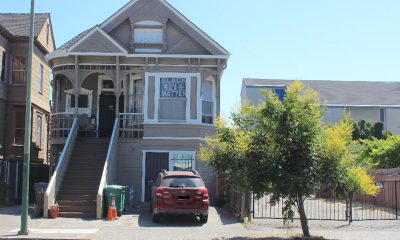
If you take a stroll through West Oakland along 10th Street, the differences you will notice looking south into the Acorn neighborhood, and looking north into the Oak Center neighborhood are striking.
Acorn’s housing is high density and mostly small homes that look similar to one another. Oak Center’s housing is colorful with high ceilings, different from home to home, and intricate in design.
The reason for the differences? The City of Oakland allowed developers to demolish almost the entire Acorn neighborhood in 1962 to execute the first phase of The General Urban Renewal Plan (GURP). As the city geared up to execute the second phase of the plan, which would have originally meant the almost total destruction of homes in Oak Center, many of which were constructed early in the 20th century, it was met with stubborn organized opposition that changed the city’s plans.
The leader of this opposition was a Black woman named Lillian Q Love, and the old Victorian homes in Oak Center were mostly rehabilitated instead of demolished.
“There is no discussion about West Oakland and its history without the name Lillian Love. There has never been a person who has been more influential in preserving the neighborhood and character of Oak Center,” said Henry Gardner, who moved to Oakland in 1971 and has previously served as Oakland’s city manager.
Love felt that homes in West Oakland needed aid, but was against the manner in which the city worked with Acorn, simply demolishing homes there instead of working to fix them. While a World War II and post-WWII migration caused the Black population of Oakland to quintuple between 1940 and 1950, discriminatory lending practices and racist zoning laws confined Blacks during that time mostly to West Oakland. But the population was far too large for the housing available, and the overcrowding was a cause for many of the area’s old homes to fall into disrepair.
“The City did more to destroy West Oakland than anyone else,” said Gardner, of the time.
Born in Texas on April 3, 1912, Love moved to Oakland as a child, and graduated from The University of California, Berkeley, probably at some point in the 1930s. She claims her organizing was inspired by her father, William E. Meneweather, who unsuccessfully fought the city over constructing public housing that displaced his family in 1938.
In 1963, Love formed The Oak Center Neighborhood Association (OCNA), an organization that pushed the city to provide housing rehabilitation funding in place of destruction and redevelopment. The OCNA then accused Thomas Bell, the first director of The Oakland Redevelopment Agency (ORA), of purposely misleading the public on GURP. Bell faced pressure to resign by the federal Urban Renewal Administration and did so in 1964, but there’s evidence that pressure from the OCNA also caused Bell’s resignation.
“He said he was with us for preservation but in his actions he was for clearance,” said Constantine Lekas, the OCNA’s original vice president, in a 1981 interview. In the same interview, Lekas claims that OCNA was able to get Bell fired, and describes his leaving the position as “a turning point.”
While Love worked almost entirely with other Black people, it’s noteworthy that some of her organizing crossed racial lines. Lekas was an immigrant from Greece.
After Bell resigned, John B. Williams became the ORA’s new director. In 1966, Love was named a commissioner for the ORA. Williams also allotted a grant to the OCNA in 1966 in the amount of $15 million for housing rehabilitation, which is about $120 million in today’s dollars when adjusted for inflation.
Williams enforced minority training and hiring policies, which required the ORA to hire and award contracts to far more non-white people than they had previously.
Love died on Feb.21, 1987, at the age of 74. Henry Gardner, who saw her speak regularly at City Hall and admired her, said she kept up her housing activism long after the Oak Center fight had ended.
“She understood the issues upside-down. And she was active until her last breath,” said Gardner.
The Oakland Post thanks Moriah Ulinskas, who provided biographical information for this article that will soon be added to the biography cards in the Oakland History Room at The Oakland Library.









Activism
Oakland Post: Week of March 11 -17, 2026
The printed Weekly Edition of the Oakland Post: Week of March 11 – 17, 2026

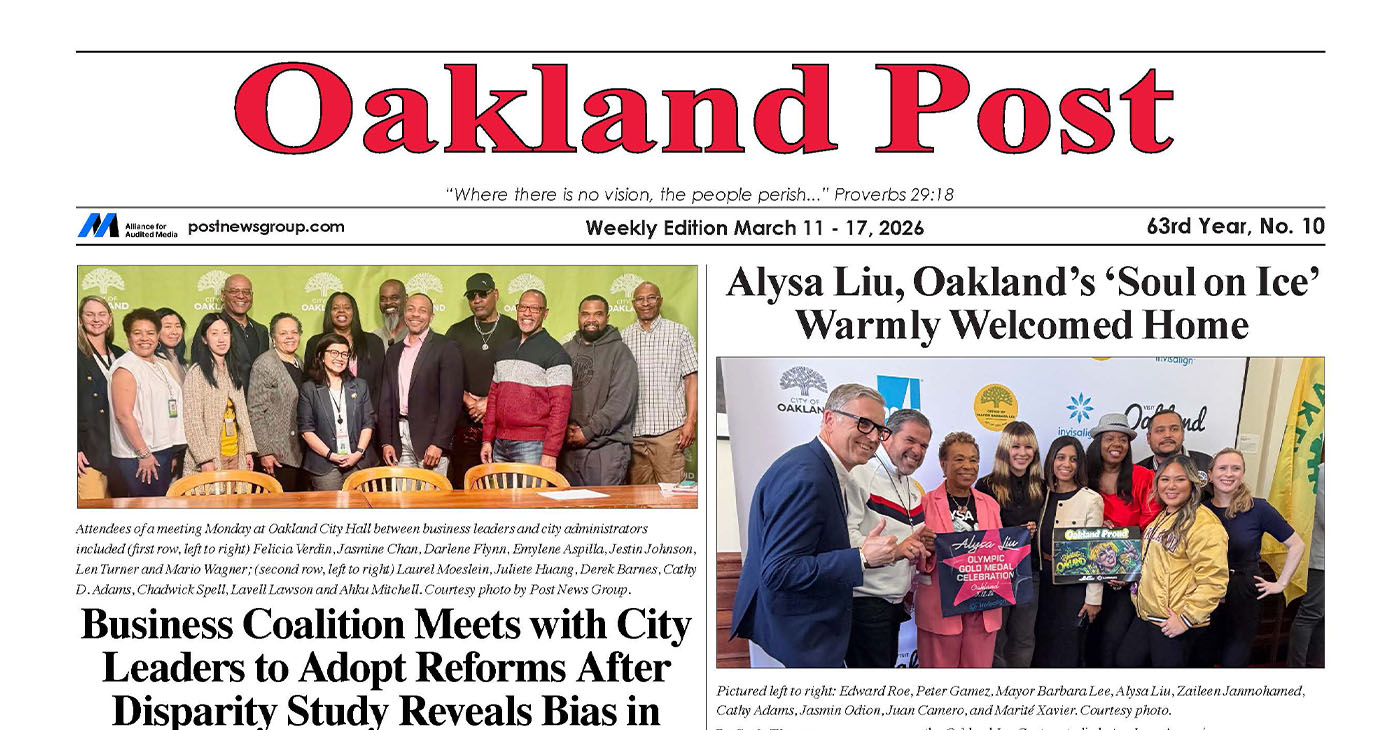
To enlarge your view of this issue, use the slider, magnifying glass icon or full page icon in the lower right corner of the browser window.

Activism
Oakland Post: Week of March 4 – 10, 2026
The printed Weekly Edition of the Oakland Post: Week of March 4 – 10, 2026

To enlarge your view of this issue, use the slider, magnifying glass icon or full page icon in the lower right corner of the browser window.
Activism
Oakland Post: Week of February 25 – March 3, 2026
The printed Weekly Edition of the Oakland Post: Week of – February 25 – March 3, 2026

To enlarge your view of this issue, use the slider, magnifying glass icon or full page icon in the lower right corner of the browser window.


WORK FROM HOME
Home-based business with potential monthly income of $10K+ per month. A proven training system and website provided to maximize business effectiveness. Perfect job to earn side and primary income. Contact Lynne for more details: Lynne4npusa@gmail.com 800-334-0540


Financial Wellness and Mental Health: Managing Money Stress in College

Oakland Post: Week of March 11 -17, 2026

Women & Wealth: Tips for Navigating Your Lifelong Financial Journey

COMMENTARY: Women of Color Shape Our Past and Future

Woman’s Search for Family’s Roots Leads to Ancestor John T. Ward – A Successful Entrepreneur and Conductor on the Underground Railroad

Advocates Raise Alarm Over ICE Operation, MOU and Detention Risks in Baltimore County

Pete Buttigieg to Join Mayor Randall Woodfin for Community Town Hall in Birmingham

WATCH: Week One – NNPA’s “Leadership Matters” Video Series

Oakland Post: Week of March 4 – 10, 2026

OP-ED: NNPA Launches 2026 “Leadership Matters” Video Series

PRESS ROOM: PMG and Cranbrook Horizons-Upward Bound Launch Journey Fellowship Cohort 2

Los Angeles Summit Brings Together Leaders to Tackle Poverty and Affordability

Civil Rights TV Launches 24/7 Network Focused on Black History, Education and Equity

REVIEW: The Ultimate Hot Girl Summer Getaway: Sunseeker Resort Florida

COMMENTARY: How You Stop a Prescription Medicine is as Important as How You Start

Oakland Post: Week of January 28, 2025 – February 3, 2026

Life Expectancy in Marin City, a Black Community, Is 15-17 Years Less than the Rest of Marin County

Community Celebrates Turner Group Construction Company as Collins Drive Becomes Turner Group Drive

Book Review: Books on Black History and Black Life for Kids

California Launches Study on Mileage Tax to Potentially Replace Gas Tax as Republicans Push Back

Discrimination in City Contracts

COMMENTARY: The Biases We Don’t See — Preventing AI-Driven Inequality in Health Care

Post Newspaper Invites NNPA to Join Nationwide Probate Reform Initiative

Black History Events in the East Bay

Art of the African Diaspora Celebrates Legacy and Community at Richmond Art Center

Medi-Cal Cares for You and Your Baby Every Step of the Way

COMMENTARY: The National Protest Must Be Accompanied with Our Votes

New Bill, the RIDER Safety Act, Would Support Transit Ambassadors and Safety on Public Transit

Oakland Post: Week of February 4 – 10, 2026

Oakland Post: Week of February 11 – 17, 2026

Hyundai Ioniq 5 Parking, Safety, and 360 View #shorts

2025 Ioniq 5 New Wiper & Powerful Performance! #shorts

Electric SUV Range: Is 259 Miles Enough? #shorts

EV Charging: How Fast Can You Charge an Electric Vehicle? #shorts

Biometric Cooling… Messaging Seats…Come on! 2025 Infiniti QX80 Autograph 4WD

Charged Up: Witness the Magic of a Fully Electric Car! #shorts

Range Rover Sport PHEV Included…: See What’s Inside This Luxury SUV! #shorts

Invisible Hood View: Perfect Parking with X-Ray Vision! #shorts

AI Is Reshaping Black Healthcare: Promise, Peril, and the Push for Improved Results in California

ESSAY: Technology and Medicine, a Primary Care Point of View

Sanctuary Cities

The RESISTANCE – FREEDOM NOW

STATE OF THE PEOPLE: Freddie

ECONOMIC BOYCOTT DAY!!!!!

I told You So
-
 #NNPA BlackPress3 weeks ago
Reflecting on Black History Milestones in Birmingham AL
-

 Bay Area4 weeks ago
CITY OF SAN LEANDRO STATE OF CALIFORNIA PUBLIC WORKS DEPARTMENT ENGINEERING DIVISION NOTICE TO BIDDERS FOR ANNUAL STREET OVERLAY/REHABILITATION 2019-21 – PHASE III
-

 #NNPA BlackPress3 weeks ago
PRESS ROOM: NBA Hall of Fame Nominee Terry Cummings Joins 100 Black Men of DeKalb County to Launch Victory & Values Initiative
-
 Activism4 weeks ago
Oakland Post: Week of February 18 – 24, 2026
-

 #NNPA BlackPress3 weeks ago
U.S. manufacturing rebounds – how foundry services are adapting to rising demand
-

 #NNPA BlackPress3 weeks ago
OP-ED: One Hundred Years of Black Workers Telling the Truth
-

 #NNPA BlackPress3 weeks ago
Advancements in solar technology that are changing the way we power the world
-

 #NNPA BlackPress3 weeks ago
PRESS ROOM: Civil Rights TV Launches in Selma as the World’s First 24/7 Civil Rights Television Network
