
Bay Area
Who Are the Top Donors in the Alameda County District 5 Supervisor’s Race?
District 5 covers West and North Oakland and includes Emeryville, Berkeley, Piedmont and Albany. The five-member Board of Supervisors sets the county’s budget, governs its unincorporated areas, oversees the sheriff, Alameda Health System, and the mental health system. Voting in this election has already begun. Most of those living in the district will have been mailed paper ballots. Residents can also vote in person on March 5, the last day voting is open. If no candidate gets more than half of the votes, the top two candidates will face off in the general election in November.

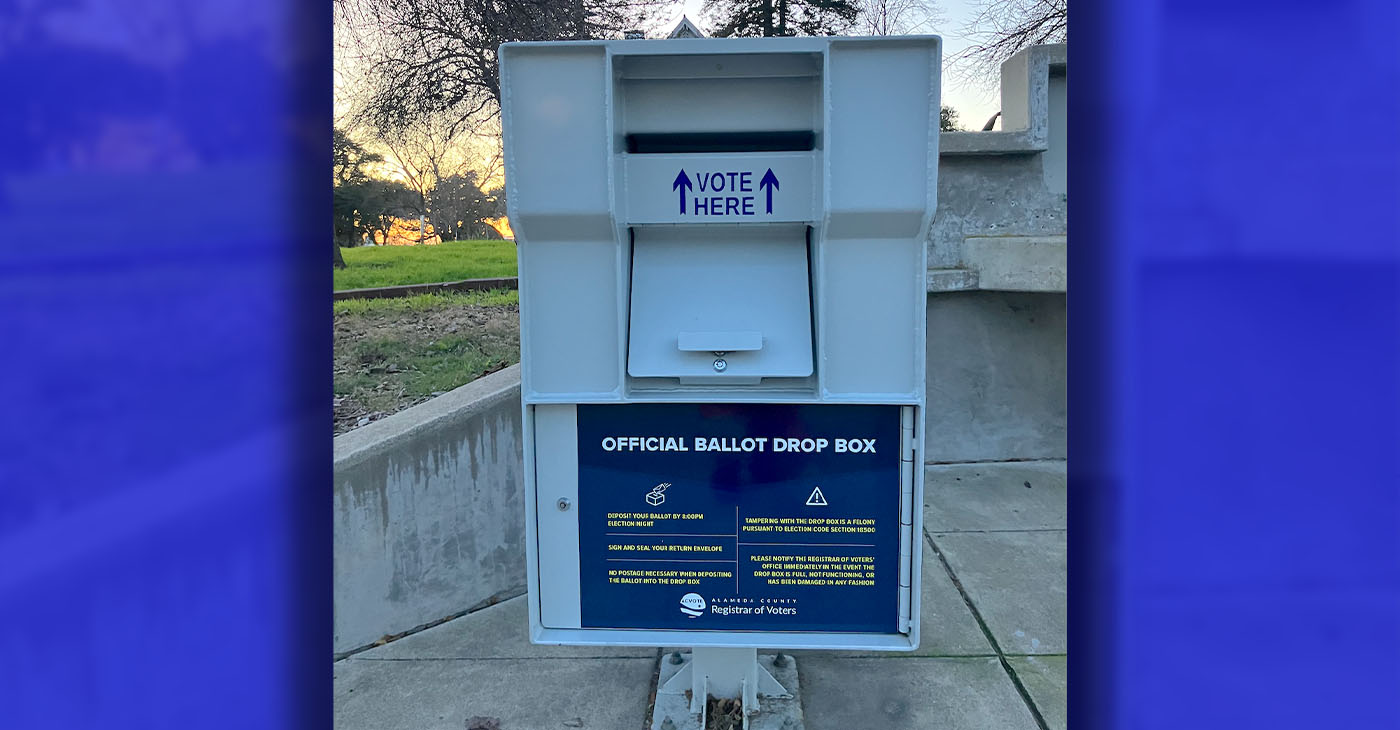
About $342,500, a little less than half of the approximately $705,000 raised in the race so far, has come from just 30 sources.
By Zack Haber
Nine candidates are running to represent District 5 on the Alameda County’s Board of Supervisors.
District 5 covers West and North Oakland and includes Emeryville, Berkeley, Piedmont and Albany.
The five-member Board of Supervisors sets the county’s budget, governs its unincorporated areas, oversees the sheriff, Alameda Health System, and the mental health system.
Voting in this election has already begun. Most of those living in the district will have been mailed paper ballots. Residents can also vote in person on March 5, the last day voting is open. If no candidate gets more than half of the votes, the top two candidates will face off in the general election in November.
Candidates in Alameda County are required to report all of their campaign donations. The public can search these filings through an online portal.
Looking through the county’s campaign finance reports, we found that residents, businesses and other organizations, such as unions, have donated around $705,000 in total to all candidates as of Feb. 13. In three cases, candidates donated to their own campaigns, but we excluded these figures.
Of the nine candidates, John Bauters, the former Emeryville Mayor and current City Councilmember, has raised the most, about $167,500. Alameda County Board of Education Trustee Ken Berrick has raised about $157,500. Piedmont resident and East Bay Rental Housing Association board member Chris Moore has raised about $129,000. Oakland City Councilmember Nikki Fortunato Bas has raised about $130,000; and Berkeley City Councilmember Ben Bartlett raised about $103,500.
The other candidates, Omar Farmer, Gregory Hodge, Gerald Pechenuk and Lorrel Plimier have all raised much less than the other candidates. So far, Hodge has raised about 11,500 and Plimier has raised about $5,500. Farmer and Pechenuk haven’t reported receiving any campaign donations.
While there were over 525 donations to candidates in total, of these, about $342,500 or a little less than half of the about $705,000 in total donations, came from just 30 sources. For the purposes of this article, we’ve defined these 30 donations as large donations—$5,000 or more. Bartlett, Bas, Bauters, Berrick, and Moore have received large donations, while Farmer, Hodge, Pechenuk and Plimier have not.
Below is a listing of each reported large donation, and information we could find about its source. We ordered the list in alphabetically by candidate name.
Large donations to Ben Bartlett:
Mukemmel ‘Mike’ Sarimsakci of Millbrae donated $10,000. Sarimsakci is a real estate developer and the CEO of Alterra Worldwide, a commercial real estate company. Man Hao Chen of San Francisco, CEO and founder of crop farming company Sunbber, inc., donated 5,000. Bao Le of Fremont, CEO of medical marijuana company Hemp.co, donated $5,000. Retired Berkeley resident Frank Brown donated $5,000.
Large donations to Nikki Fortunado Bas:
Alameda Labor Council AFL-CIO Unity, which represents about 135,000 healthcare, construction, service, education, and manufacturing workers, donated $20,000. Building and Construction Trades Council of Alameda County donated $20,000. Quinn Delaney of Piedmont, founder and the board chair of Akonadi Foundation, donated $20,000. Wayne Jordan of Piedmont, husband to Delaney, Akonadi Foundation board member, landlord and founder and president of Jordan Real Estate Investments, donated $20,000. California Working Families Party, a “grassroots party for the multiracial working class,” donated $10,000. Bas also received a $5,000 donation from the San Francisco crop farming company, Sunbber, inc. Man Hao Chen, who donated to Ben Bartlett’s campaign, is the CEO of Sunbber. IBEW Local 595, a union representing about 2,000 electric workers in Alameda and San Joaquin/Calaveras counties, donated $5,000. UA Local 342, a union representing around 4,000 workers in the pipe trades industries in Contra Costa and Alameda counties, donated $5,000.
Large donations to John Bauters:
Maryam Asefinejad of Orangevale, board member of Teranomic Software, donated $20,000. Fred J Bauters of Lisle, IL, relative of John Bauters, donated $20,000. The International Association of Firefighters Local 55 donated $11,000. State Assemblymember Buffy Wicks donated $10,000 from her reelection campaign. Nick Josefowitz of San Francisco, commissioner with the Metropolitan Transportation Commissionand co-founder of the nonprofit Permit Power, donated $10,000. Daniel Golden of Santa Monica, who works in sales at the pharmaceutical company Bausch Healthcare, donated $5,000. Marc Hedlund of Berkeley, founder of the investment company Tenuki Moves LLC and board treasurer of the nonprofits Bike East Bay and Code 2040, donated 5,000. The California YIMBY Victory Fund donated $5,000. Steven Berger of Berkeley, president of the company NYF Properties, inc. donated $5,000.
Large donations to Ken Berrick:
Megan Salazar of Richmond, director of advocacy for the Bay Area based nonprofit, Just Advocates which Ken Berrick founded, donated $13,520. Christopher Ciauri of London, England, CEO of the software company Unily, donated $17,500. Betsy Maushardt, unemployed resident of Santa Cruz, donated $10,500. Christopher Seiwald of Alameda, member of the University of San Francisco’s Board of Trustees and investor with the Berkeley Angel Network, donated 5,000.
Large donations to Chris Moore:
Quintin Anderson of Redwood City, Chief Operating Officer with Granite River Labs, donated $20,000. Madeline Moore, retired resident of Walnut Creek and relative of Chris Moore, donated $20,000. Philip Dreyfuss of Oakland, partner with Farallon Capital Management, a San Francisco based hedge fund, donated $20,000. Fred Morse of Piedmont, landlord with Morse Management, donated $15,000 through individual and company donations.
Justin Wallway of Oakland, landlord with JDW Enterprises, donated $10,000.









Activism
Oakland Post: Week of September 30 – October 6, 2026
The printed Weekly Edition of the Oakland Post: Week of September 30 – October 6, 2026

To enlarge your view of this issue, use the slider, magnifying glass icon or full page icon in the lower right corner of the browser window.
Activism
Oakland Post: Week of September 23 – 29, 2026
The printed Weekly Edition of the Oakland Post: Week of September 23 – 29, 2026
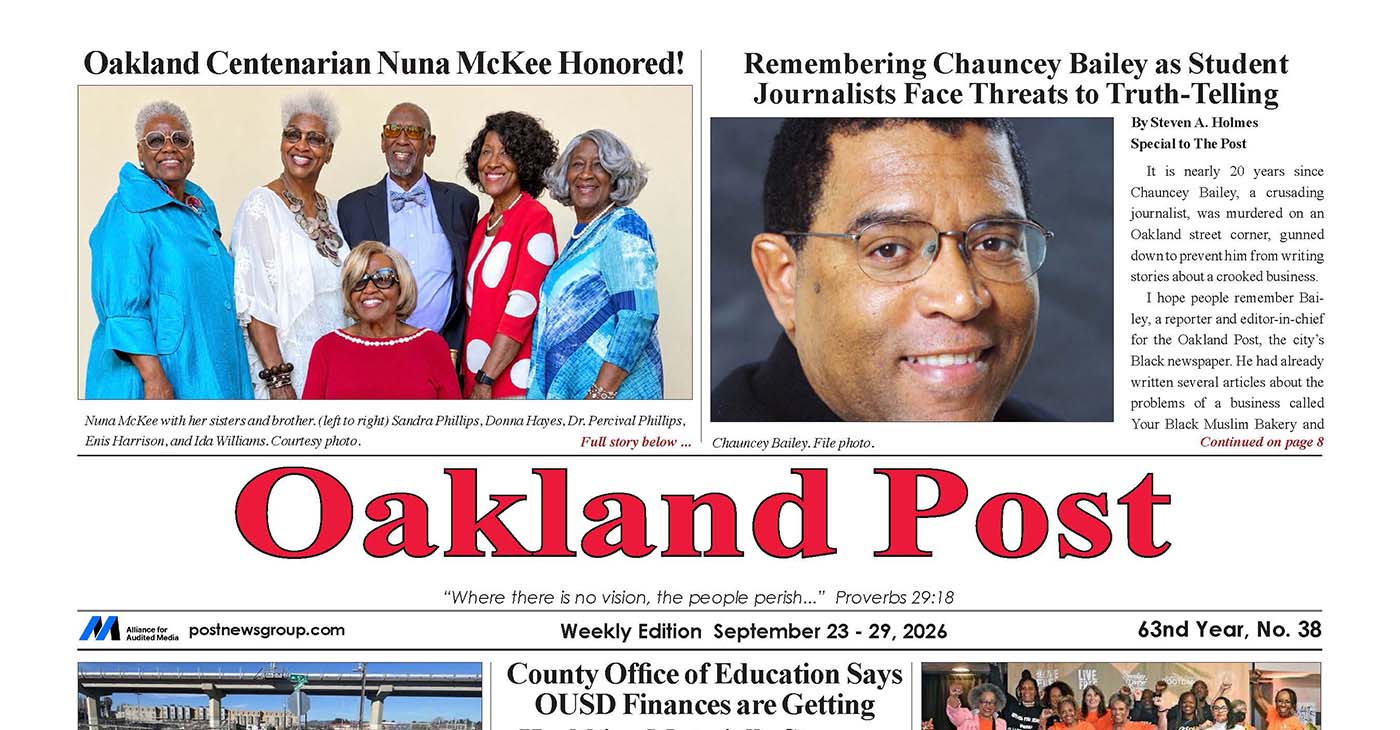
To enlarge your view of this issue, use the slider, magnifying glass icon or full page icon in the lower right corner of the browser window.

Activism
Oakland Post: Week of September 16 – 22, 2026
The printed Weekly Edition of the Oakland Post: Week of September 16 – 22, 2026

To enlarge your view of this issue, use the slider, magnifying glass icon or full page icon in the lower right corner of the browser window.



OP-ED: Proposition 44 Would Put a Price on Trust

OP-ED: Proposition 40: It’s Time to Play Chess, Not Checkers

Listening as a Lifeline: A Doula’s Witness to Black Maternal Health

New Protections for Ticket Buyers: Gov. Newsom Signs Assemblymember Isaac Bryan’s Bill

‘We Don’t Talk Trash — We Pick Up Trash!’

Zakiya Jendayi Arrested, Locked Out of Home by Sheriff’s Deputies

Oakland Post: Week of September 30 – October 6, 2026

Asm. Corey Jackson Announces Launch of 24-Hour Childcare in His District

IN MEMORIAM: The Rev. Leon “Sonny” Clark, Longtime Orange County Pastor and Community Leader, Dies at 72

Poll: Becerra Widens His Lead Over Hilton; Californians Split on Wealth Tax

From Historic Memories to New Possibilities: Oakland Celebrates Coliseum 60

County Office of Education Says OUSD Finances Are Getting Healthier, Materially Stronger

LIVE FREE Sunday Dinner Brings Faith, Fellowship and Civic Conversation to Oakland

Remembering Chauncey Bailey as Student Journalists Face Threats to Truth-Telling

BLACspace Cooperative Invites Bay Area to Experience Oakland’s Black Cultural Ecosystem Through a BLAC Map Tour + Party

Standoff for Justice: Our Homes Are Worth Fighting For

Oakland Post: Week of August 26 – September 1, 2026

Frontier Airlines’ Return to Oakland Airport Brings Flights, Jobs and Opportunity

Gubernatorial Candidate Steve Hilton Blasts California New Tire Rules; Newsom Hits Back

Chef Sharon Lee Blends Culinary Excellence, Education and Empowerment

Jackie Wright Champions Bay Area Stories, Filmmakers and Cultural Institutions

Misnamed ‘Parent’ PAC Seeks to Influence Oakland School Board Elections

Oakland Coliseum Project Opens Door for Small Businesses to Build Bigger

Big City Mayors Ask for “Yes” Vote on Housing Bond Measure; Conservatives Say “No”

Gov. Newsom’s Latest Appointees Include Sacramento Advocate for Formerly Incarcerated Students; State’s New Tech Chief

Longtime BWOPA Member Brendalyn Goodall Appointed to California Workforce Development Board

Gov. Newsom Signs Law Shielding Immigration Aid Workers From Doxing Threats

Oakland Post: Week of September 2 – 8, 2026

Secretary of State Shirley N. Weber Urges Californians to Vote Early as Voter ID Battle Intensifies

IN MEMORIAM: Dolly Parton Dead at 80 — How She Built a Legacy of Love and Earned Her Place in Black Culture

The Conversation With Al McFarlane 6/23/26

Media Monday 6/22/26

LIVE! ASK ALMA! — TUES. 6.23.26 7PM EST

Car Buying Secrets: 4 Hidden Checks Before You Sign!

Is This 550 HP Charger Worth YOUR Money? AutoNetwork Review

Celebrating Juneteenth – Frederick Douglass on education and resistance

LIVE! — ASK ALMA! — TUES. 6.19.26 7PM EST

Hyundai Ioniq 5 Parking, Safety, and 360 View #shorts

2025 Ioniq 5 New Wiper & Powerful Performance! #shorts

Electric SUV Range: Is 259 Miles Enough? #shorts

EV Charging: How Fast Can You Charge an Electric Vehicle? #shorts

Biometric Cooling… Messaging Seats…Come on! 2025 Infiniti QX80 Autograph 4WD

Charged Up: Witness the Magic of a Fully Electric Car! #shorts

Range Rover Sport PHEV Included…: See What’s Inside This Luxury SUV! #shorts

Invisible Hood View: Perfect Parking with X-Ray Vision! #shorts
-
 Community3 weeks ago
Misnamed ‘Parent’ PAC Seeks to Influence Oakland School Board Elections
-

 Activism3 weeks ago
Oakland Post: Week of September 9 – 15, 2026
-

 Community3 weeks ago
Richmond Tiny House Village Farm & Garden Set to Open Gates on Sept. 26
-

 Black History3 weeks ago
Latest Massacre in Haiti Reveals Cruelty U.S. Deportations
-

 Black History3 weeks ago
OPINION: Nolan Wells’ Death One of Several Signifying Racial Terror Lives on in U.S. South
-

 Business2 weeks ago
Mayor Lee Announces $1 Million Kaiser Permanente Grant for Pilot Program to Address Homelessness, Clean Up Public Spaces throughout Oakland
-

 Community3 weeks ago
Democratic Clubs Interview Candidates for Oakland School Board
-
 Uncategorized3 weeks ago
NBA All-Star Damian Lillard Returns Home for 15th Annual Backpack Giveaway
