
Bay Area
Large Grocery Stores End Hazard Pay in Oakland, Berkeley
Immediately after Oakland and Berkeley reached the yellow tier of COVID-19 spread, as state restrictions like capacity limits lifted, and as the Delta variant continued to spread, positive cases of the virus began to trend upward. A chart showing data collected by Alameda County shows that when the county entered the yellow tier on June 8, the total cases from the previous 14 days was 455. Toward the end of July, this 14-day total passed 4,000 cases on three consecutive days, which was about a ninefold increase.

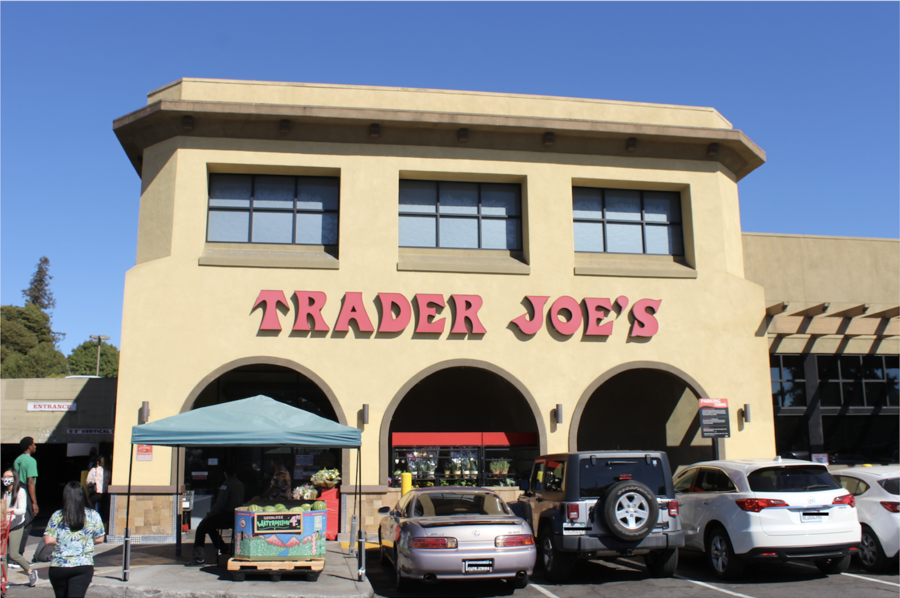
Workers in four different chain grocery stores in Oakland, Berkeley and Emeryville told The Oakland Post that they are not receiving hazard pay related to the COVID-19 pandemic.
While Oakland and Berkeley city councils each unanimously passed ordinances last February that required large grocery stores to pay workers an additional $5 per hour due to COVID-19 hazards, both ordinances stated that once the cities reached the yellow tier — that indicating minimal COVID-19 spread — this requirement would end.
Workers in Whole Foods, Grocery Outlet and Trader Joe’s based in either Oakland or Berkeley reported that they received their last hazard paychecks in early July, about a month after these cities reached the yellow tier on June 8.
The Oakland Post contacted Oakland City Council President Nikki Fortunato Bas, who wrote The Grocery Store Worker Hazard Pay Emergency Ordinance, to ask about hazard pay ending. Bas’s chief of staff, Miya Saika Chen responded by acknowledging that since the ordinance “was tied to state guidelines determining safe reopening,” and Oakland had reached the yellow tier, the ordinance no longer applies.
Immediately after Oakland and Berkeley reached the yellow tier of COVID-19 spread, as state restrictions like capacity limits lifted, and as the Delta variant continued to spread, positive cases of the virus began to trend upward. A chart showing data collected by Alameda County shows that when the county entered the yellow tier on June 8, the total cases from the previous 14 days was 455. Toward the end of July, this 14-day total passed 4,000 cases on three consecutive days, which was about a ninefold increase.
In response to questions about hazard pay ending as COVID-19 cases increased, Chen emphasized the impact of vaccination, as vaccines have been effective in preventing serious health effects related to the virus.
“Our top priority must be to ensure everyone has accurate information about the vaccines and safe and equitable access to the vaccines in order to prevent another wave of infections,” she said.
Neither Bas nor any members her staff responded when asked if there was anything council could do or is planning to do to reinstate grocery store hazard pay. The Oakland Post posed the same question to Berkeley City Councilmember Terry Taplin, who wrote Berkeley’s hazard pay ordinance. He responded by saying that to reinstate grocery store hazard pay, Berkeley’s City Council would have to pass a new ordinance.
“The city is currently evaluating several options to respond to the Delta variant,” Taplin said. “I will have to consult with the city team and legal to discuss what can be done around new hazard pay.”
In Oakland and Berkeley, new hazard pay ordinances cannot be passed this month through City Council actions, as council meetings in both cities are on hold through August. But both Oakland and Berkeley City Councils could revisit the issue in September when meetings start up again. The grocery store workers who The Oakland Post spoke to felt they deserved hazard pay due to their hard work during the COVID-19 pandemic.
“[The hazard pay] was so helpful,” said a Whole Foods worker in Berkeley. “It’s so expensive to live here and I can barely make it. I was able to put a little money away and not penny-pinch when I was getting it.”
Like all workers interviewed for this article, this worker feared retaliation from their employers for speaking to the press about their pay, and asked not to be named.
Furthermore, with temperature checks suspended, the Berkeley Whole Foods worker said they did not feel safe at work. They also claimed that in May there was an outbreak of the virus in the prepared foods section of their store. Although The Oakland Post contacted Whole Foods to ask about hazard pay, temperature checks, and the alleged COVID-19 outbreak, their media team has not responded.
The City of Emeryville, which borders both Oakland and Berkeley, has never required any grocery stores to offer its employees COVID-19 hazard pay. A worker at a Pak ’N Save in Emeryville, who has been on the job for about a year, said they were being paid Emeryville’s minimum wage, which is currently $17.13, and has never received any hazard pay. They said low pay has hit some of their co-workers with families especially hard. Children sometimes wait in the Pak ’N Save break room during shifts as the pay rates make it impossible for some grocery store workers to afford childcare.
“They are paying us the lowest they are literally allowed to pay us,” the Pak ’N Save worker said. “A lot of people are sick of it. A lot of people are quitting.”
Wendy Gutshall, a spokesperson for Safeway, the company that owns and operates Pak ’N Save, confirmed that the Emeryville store has not been paying hazard pay and that Safeway stores in Oakland and Berkeley stopped paying the $5 hazard pay after those cities reached the yellow tier. Gutshall said Safeway and Pak ’N Save paid workers an extra $2 an hour in hazard pay from March through June 13 of 2020 and gave a bonus to their frontline workers last December.
Although they have not currently been receiving hazard pay, workers at Pak ’N Save in Emeryville have faced exposure to COVID-19. Emails this Pak ’N Save worker shared with The Oakland Post from a Regional Human Resources Manager indicate that between July 21 and July 28, workers had been exposed to COVID-19 three separate times in the store.
This same worker shared a photo of a letter the store displayed in its break room indicating that one of their co-workers recently filed a complaint with State of California’s Dept. of Industrial Relations accusing the store of making them work for several days after they reported experiencing COVID-19 symptoms due to the store being short staffed.
When asked about the complaint, Gutshall said she could not speak to it directly, stating “For privacy reasons, we cannot provide specifics regarding a [worker’s] situation.” She said workers experiencing COVID-19 symptoms are instructed to go home, that the company is in close contact with such workers to investigate their contacts with other workers and ensure they receive appropriate medical care, and that such workers can access 80 hours of quarantine pay.
According to Gutshall, workers are required to check their temperature when reporting for work at Pak ’N Save and Safeway. The Pak ’N Save worker The Oakland Post interviewed said such temperature checks are optional at the store where they worked.
Both the Pak ’N Save worker and the Whole Foods worker that The Oakland Post interviewed said that as the pandemic has dragged on, increasing numbers of their co-workers have quit, which has caused their workload to intensify and increase.
“Everyone has to do a little bit of everything,” the Pak ’N Save worker said. “We don’t have enough checkers or enough people who walk around the store to help customers and clean up. But [Pak ‘’N Save] is not even willing to increase wages to meet the need for labor.”
“The work is just getting more and more stressful,” said the Whole Foods worker. “We’re running on a skeleton crew. And now we’re back to regular pay.”







Activism
Oakland Post: Week of September 23 – 29, 2026
The printed Weekly Edition of the Oakland Post: Week of September 23 – 29, 2026


To enlarge your view of this issue, use the slider, magnifying glass icon or full page icon in the lower right corner of the browser window.

Activism
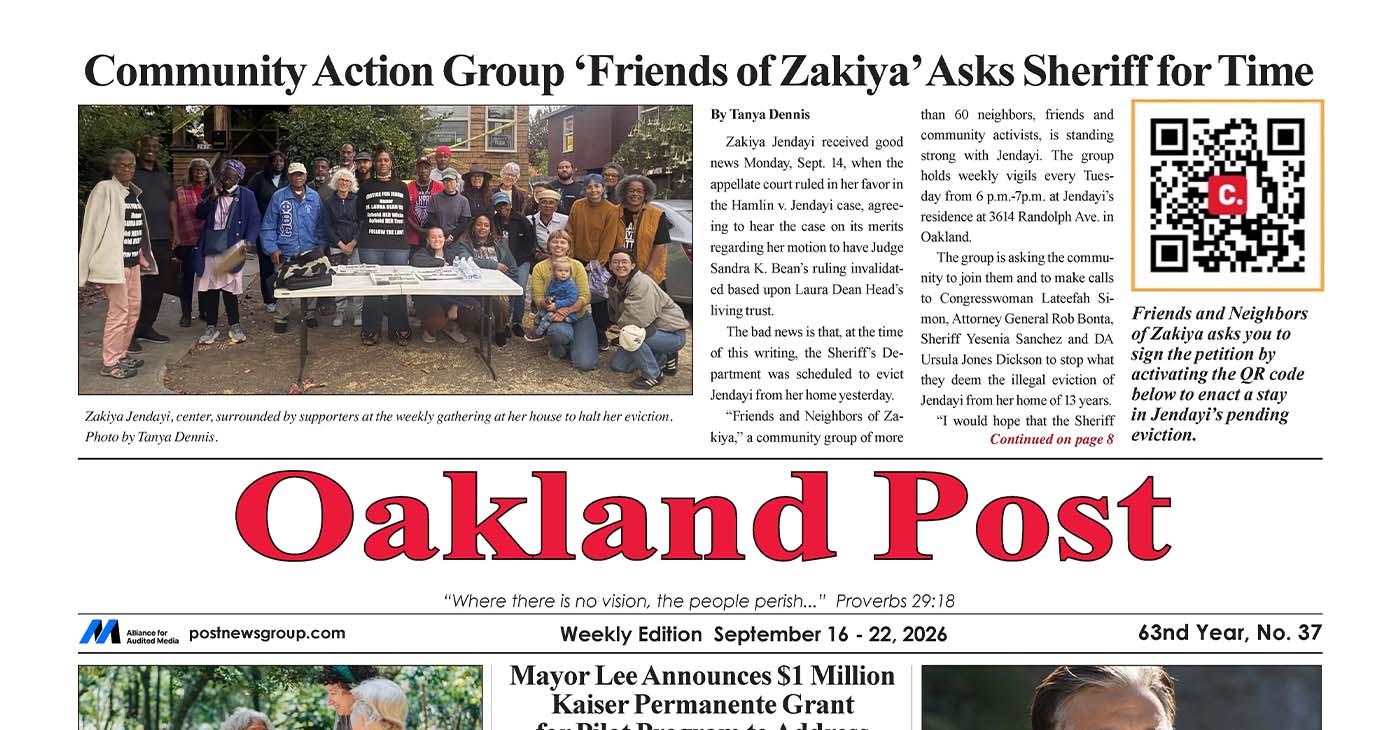
Oakland Post: Week of September 16 – 22, 2026
The printed Weekly Edition of the Oakland Post: Week of September 16 – 22, 2026
To enlarge your view of this issue, use the slider, magnifying glass icon or full page icon in the lower right corner of the browser window.
Activism
Oakland Post: Week of September 9 – 15, 2026
The printed Weekly Edition of the Oakland Post: Week of September 9 – 15, 2026

To enlarge your view of this issue, use the slider, magnifying glass icon or full page icon in the lower right corner of the browser window.



Asm. Corey Jackson Announces Launch of 24-Hour Childcare in His District

IN MEMORIAM: The Rev. Leon “Sonny” Clark, Longtime Orange County Pastor and Community Leader, Dies at 72

Poll: Becerra Widens His Lead Over Hilton; Californians Split on Wealth Tax

From Historic Memories to New Possibilities: Oakland Celebrates Coliseum 60

County Office of Education Says OUSD Finances Are Getting Healthier, Materially Stronger

LIVE FREE Sunday Dinner Brings Faith, Fellowship and Civic Conversation to Oakland

Remembering Chauncey Bailey as Student Journalists Face Threats to Truth-Telling

BLACspace Cooperative Invites Bay Area to Experience Oakland’s Black Cultural Ecosystem Through a BLAC Map Tour + Party

In Wake of Death on Doorstep, Williams Chapel Baptist Church Calls for Better Care, Funding for Unhoused

Oakland Centenarian Nuna McKee Honored!

Caribbean Nations Produce Action Plan Calling for UK Reparations Over Slavery

Oakland Post: Week of September 23 – 29, 2026

Doulas Are Helping Black California Moms Navigate Pregnancy–Even as High Mortality Rates Persist

Newsom Signs Addictive Social Media Law to Protect Kids

On Your November Ballot: Prop 38 Would Allocate $8.4 Billion to Immunology and Immunotherapy Funding

Standoff for Justice: Our Homes Are Worth Fighting For

Oakland Post: Week of August 26 – September 1, 2026

Frontier Airlines’ Return to Oakland Airport Brings Flights, Jobs and Opportunity

Gubernatorial Candidate Steve Hilton Blasts California New Tire Rules; Newsom Hits Back

Chef Sharon Lee Blends Culinary Excellence, Education and Empowerment

Jackie Wright Champions Bay Area Stories, Filmmakers and Cultural Institutions

Big City Mayors Ask for “Yes” Vote on Housing Bond Measure; Conservatives Say “No”

Oakland Coliseum Project Opens Door for Small Businesses to Build Bigger

Gov. Newsom’s Latest Appointees Include Sacramento Advocate for Formerly Incarcerated Students; State’s New Tech Chief

Misnamed ‘Parent’ PAC Seeks to Influence Oakland School Board Elections

Longtime BWOPA Member Brendalyn Goodall Appointed to California Workforce Development Board

Gov. Newsom Signs Law Shielding Immigration Aid Workers From Doxing Threats

Secretary of State Shirley N. Weber Urges Californians to Vote Early as Voter ID Battle Intensifies

From Palestine to Oakland: Seeds for Liberation Examines Shared Struggles for Freedom

IN MEMORIAM: Dolly Parton Dead at 80 — How She Built a Legacy of Love and Earned Her Place in Black Culture

The Conversation With Al McFarlane 6/23/26

Media Monday 6/22/26

LIVE! ASK ALMA! — TUES. 6.23.26 7PM EST

Car Buying Secrets: 4 Hidden Checks Before You Sign!

Is This 550 HP Charger Worth YOUR Money? AutoNetwork Review

Celebrating Juneteenth – Frederick Douglass on education and resistance

LIVE! — ASK ALMA! — TUES. 6.19.26 7PM EST

Hyundai Ioniq 5 Parking, Safety, and 360 View #shorts

2025 Ioniq 5 New Wiper & Powerful Performance! #shorts

Electric SUV Range: Is 259 Miles Enough? #shorts

EV Charging: How Fast Can You Charge an Electric Vehicle? #shorts

Biometric Cooling… Messaging Seats…Come on! 2025 Infiniti QX80 Autograph 4WD

Charged Up: Witness the Magic of a Fully Electric Car! #shorts

Range Rover Sport PHEV Included…: See What’s Inside This Luxury SUV! #shorts

Invisible Hood View: Perfect Parking with X-Ray Vision! #shorts
-
 Community2 weeks ago
Misnamed ‘Parent’ PAC Seeks to Influence Oakland School Board Elections
-

 Activism3 weeks ago
Oakland Post: Week of September 2 – 8, 2026
-

 Community2 weeks ago
Richmond Tiny House Village Farm & Garden Set to Open Gates on Sept. 26
-

 Black History2 weeks ago
Latest Massacre in Haiti Reveals Cruelty U.S. Deportations
-

 Black History2 weeks ago
OPINION: Nolan Wells’ Death One of Several Signifying Racial Terror Lives on in U.S. South
-

 Activism2 weeks ago
Oakland Post: Week of September 9 – 15, 2026
-

 Community2 weeks ago
Democratic Clubs Interview Candidates for Oakland School Board
-
 Featured2 weeks ago
‘Ready to See These Bills Become Law’: Sen. Weber’s Package of 15 Bills Advance to Gov. Newsom’s Desk
