
Activism
Advocates for Unhoused Residents Protest Eviction Lawyer

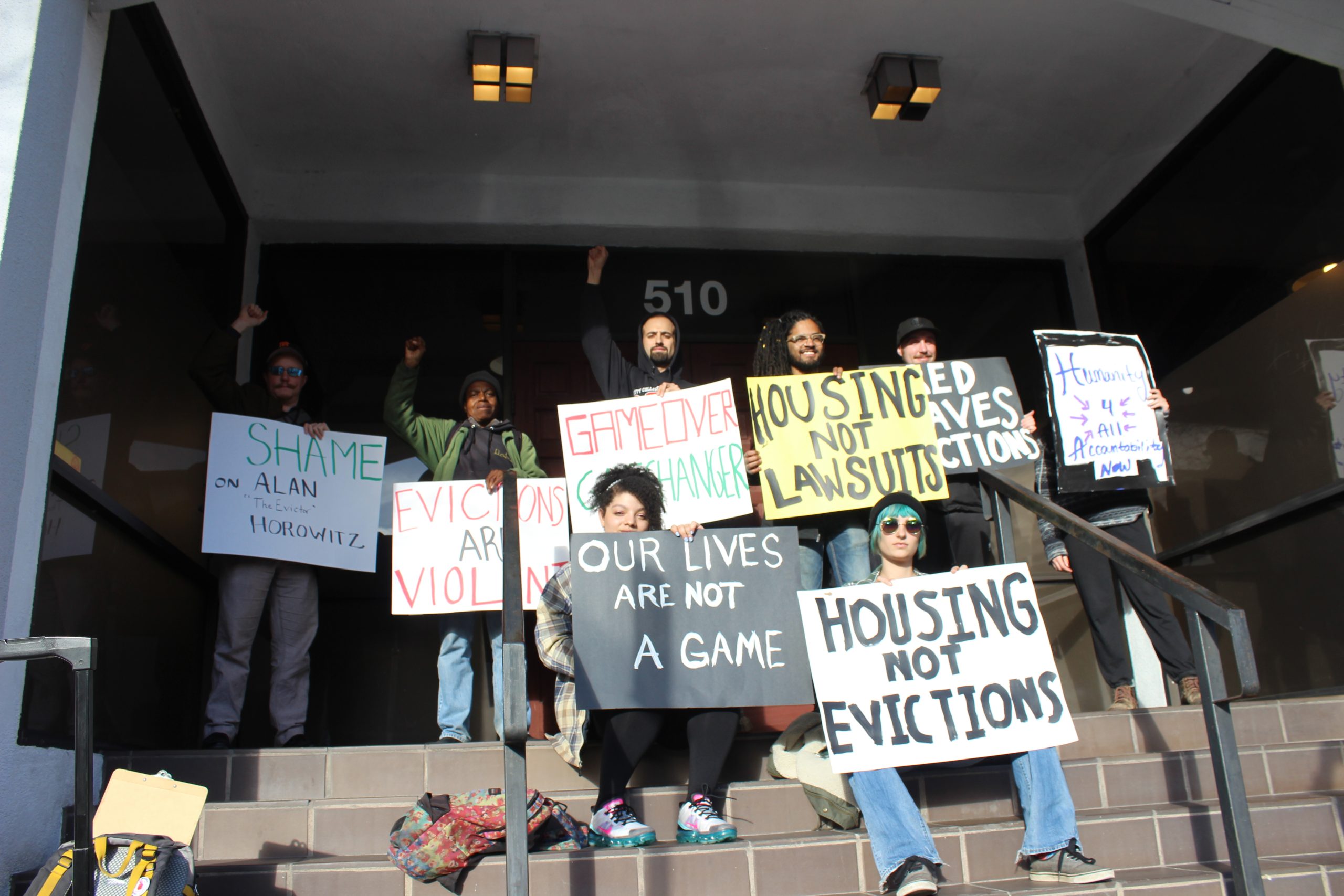
A small group of advocates for unhoused residents gathered outside of The Evictors and The Law Offices of Alan J Horwitz on Monday Jan. 27 to protest the firm’s agreement to represent Game Changer LLC in their effort to evict nine unhoused Oakland residents from land the company has owned but left unused for years.
In advance of the protest, Alan J Horwitz wrote an email to the advocates and taped a copy to the door of his offices, at 501 3rd Street in Oakland.
“When you appear at my office later this afternoon,” reads Horwitz’s email, “I am sorry to say that no one will be present. I have instructed my office to go home because it is not fair for them to suffer through a hostile attack by a misguided mob.”
Although Horwitz and his staff had already left their offices, protesters still gathered around 3 p.m. to hold signs, chant, and talk with media. Before ending the protest around 5 p.m., they taped some of their signs to the doors of Horwitz’s offices, matching his gesture.
“The heart of the West Oakland Wood Street community is a private lot that’s owned by Game Changer LLC,” said Dayton Andrews, an advocate who works with unhoused residents who live on or near Wood Street in West Oakland. “They’ve been trying to push the community out so they can ultimately develop it.”
Some Oakland residents have lived along Wood St. between West Grand Ave and 26th St. in West Oakland for about eight years. Sitting about as far west into West Oakland as you can get, many of its residents have found it’s offered decreased conflicts from neighbors and police than other sites. Some residents claim police directed them to the site from other areas of town. As time passed and space on the street filled up, residents began to move onto tracts of land just west of Wood St owned by Game Changer LLC and Caltrans.
By the time the City of Oakland moved to clear the tracts of land on Nov. 5 and 6 2019, at least a hundred vehicles were on site, some abandoned, as well as dozens of people who lived in tents and self-made structures. Many then moved onto Wood St. The city has laid out plans to lease Game Changer’s land for one dollar a year for 18 months and possibly three years in order to make a city-run safe parking site for residents that live in vehicles. But residents and advocates claim such a site would only be temporary, and would be unavailable to residents who don’t live in vehicles.
At least nine residents stayed on Game Changer’s tract of land, defying the city-run clearance, with the support of over three dozen protestors. Game Changer has hired Horwitz’s firm to remove the remaining residents.
“Your protest is, quite honestly, perplexing,” wrote Horwitz in his email to the protestors. “It appears that the city and my client are attempting to deliver exactly what you are demanding: a safe place for those without housing to park their vehicles and be provided with basic human needs, like potable water, garbage removal and sanitation.”
The proposed safe parking site wouldn’t be available to those who live on the site but don’t live in a vehicle.
The Oakland Post emailed Horwitz and asked if there was a plan for residents that don’t live in vehicles, but he didn’t respond. Since other city-run safe parking sites limit stays to six months, some advocates and residents worry the Wood St. residents will soon have no safe place to go.
“What people are asking for is exits out of homelessness…not just temporary reprieves from being on the street,” said Dayton Andrews. “So in lieu of that folks would also like to remain in place with expanded services. Those are the two things people are demanding and that’s not what we’re getting.”









Activism
Oakland Post: Week of March 11 -17, 2026
The printed Weekly Edition of the Oakland Post: Week of March 11 – 17, 2026


To enlarge your view of this issue, use the slider, magnifying glass icon or full page icon in the lower right corner of the browser window.

Activism
Oakland Post: Week of March 4 – 10, 2026
The printed Weekly Edition of the Oakland Post: Week of March 4 – 10, 2026

To enlarge your view of this issue, use the slider, magnifying glass icon or full page icon in the lower right corner of the browser window.
Activism
Oakland Post: Week of February 25 – March 3, 2026
The printed Weekly Edition of the Oakland Post: Week of – February 25 – March 3, 2026

To enlarge your view of this issue, use the slider, magnifying glass icon or full page icon in the lower right corner of the browser window.


WORK FROM HOME
Home-based business with potential monthly income of $10K+ per month. A proven training system and website provided to maximize business effectiveness. Perfect job to earn side and primary income. Contact Lynne for more details: Lynne4npusa@gmail.com 800-334-0540


Financial Wellness and Mental Health: Managing Money Stress in College

Oakland Post: Week of March 11 -17, 2026

Women & Wealth: Tips for Navigating Your Lifelong Financial Journey

COMMENTARY: Women of Color Shape Our Past and Future

Woman’s Search for Family’s Roots Leads to Ancestor John T. Ward – A Successful Entrepreneur and Conductor on the Underground Railroad

Advocates Raise Alarm Over ICE Operation, MOU and Detention Risks in Baltimore County

Pete Buttigieg to Join Mayor Randall Woodfin for Community Town Hall in Birmingham

WATCH: Week One – NNPA’s “Leadership Matters” Video Series

Oakland Post: Week of March 4 – 10, 2026

OP-ED: NNPA Launches 2026 “Leadership Matters” Video Series

PRESS ROOM: PMG and Cranbrook Horizons-Upward Bound Launch Journey Fellowship Cohort 2

Los Angeles Summit Brings Together Leaders to Tackle Poverty and Affordability

Civil Rights TV Launches 24/7 Network Focused on Black History, Education and Equity

REVIEW: The Ultimate Hot Girl Summer Getaway: Sunseeker Resort Florida

COMMENTARY: How You Stop a Prescription Medicine is as Important as How You Start

Oakland Post: Week of January 28, 2025 – February 3, 2026

Life Expectancy in Marin City, a Black Community, Is 15-17 Years Less than the Rest of Marin County

Community Celebrates Turner Group Construction Company as Collins Drive Becomes Turner Group Drive

Book Review: Books on Black History and Black Life for Kids

California Launches Study on Mileage Tax to Potentially Replace Gas Tax as Republicans Push Back

Discrimination in City Contracts

COMMENTARY: The Biases We Don’t See — Preventing AI-Driven Inequality in Health Care

Post Newspaper Invites NNPA to Join Nationwide Probate Reform Initiative

Black History Events in the East Bay

Art of the African Diaspora Celebrates Legacy and Community at Richmond Art Center

Medi-Cal Cares for You and Your Baby Every Step of the Way

COMMENTARY: The National Protest Must Be Accompanied with Our Votes

New Bill, the RIDER Safety Act, Would Support Transit Ambassadors and Safety on Public Transit

Oakland Post: Week of February 4 – 10, 2026

Oakland Post: Week of February 11 – 17, 2026

Hyundai Ioniq 5 Parking, Safety, and 360 View #shorts

2025 Ioniq 5 New Wiper & Powerful Performance! #shorts

Electric SUV Range: Is 259 Miles Enough? #shorts

EV Charging: How Fast Can You Charge an Electric Vehicle? #shorts

Biometric Cooling… Messaging Seats…Come on! 2025 Infiniti QX80 Autograph 4WD

Charged Up: Witness the Magic of a Fully Electric Car! #shorts

Range Rover Sport PHEV Included…: See What’s Inside This Luxury SUV! #shorts

Invisible Hood View: Perfect Parking with X-Ray Vision! #shorts

AI Is Reshaping Black Healthcare: Promise, Peril, and the Push for Improved Results in California

ESSAY: Technology and Medicine, a Primary Care Point of View

Sanctuary Cities

The RESISTANCE – FREEDOM NOW

STATE OF THE PEOPLE: Freddie

ECONOMIC BOYCOTT DAY!!!!!

I told You So
-
 #NNPA BlackPress3 weeks ago
Reflecting on Black History Milestones in Birmingham AL
-

 Bay Area4 weeks ago
CITY OF SAN LEANDRO STATE OF CALIFORNIA PUBLIC WORKS DEPARTMENT ENGINEERING DIVISION NOTICE TO BIDDERS FOR ANNUAL STREET OVERLAY/REHABILITATION 2019-21 – PHASE III
-

 #NNPA BlackPress3 weeks ago
PRESS ROOM: NBA Hall of Fame Nominee Terry Cummings Joins 100 Black Men of DeKalb County to Launch Victory & Values Initiative
-
 Activism4 weeks ago
Oakland Post: Week of February 18 – 24, 2026
-

 #NNPA BlackPress3 weeks ago
U.S. manufacturing rebounds – how foundry services are adapting to rising demand
-

 #NNPA BlackPress3 weeks ago
OP-ED: One Hundred Years of Black Workers Telling the Truth
-

 #NNPA BlackPress3 weeks ago
Advancements in solar technology that are changing the way we power the world
-

 #NNPA BlackPress3 weeks ago
PRESS ROOM: Civil Rights TV Launches in Selma as the World’s First 24/7 Civil Rights Television Network
