
Bay Area
Kaplan Proposes Law to Protect Police Commissioners From Official ‘Intimidation and Harassment’

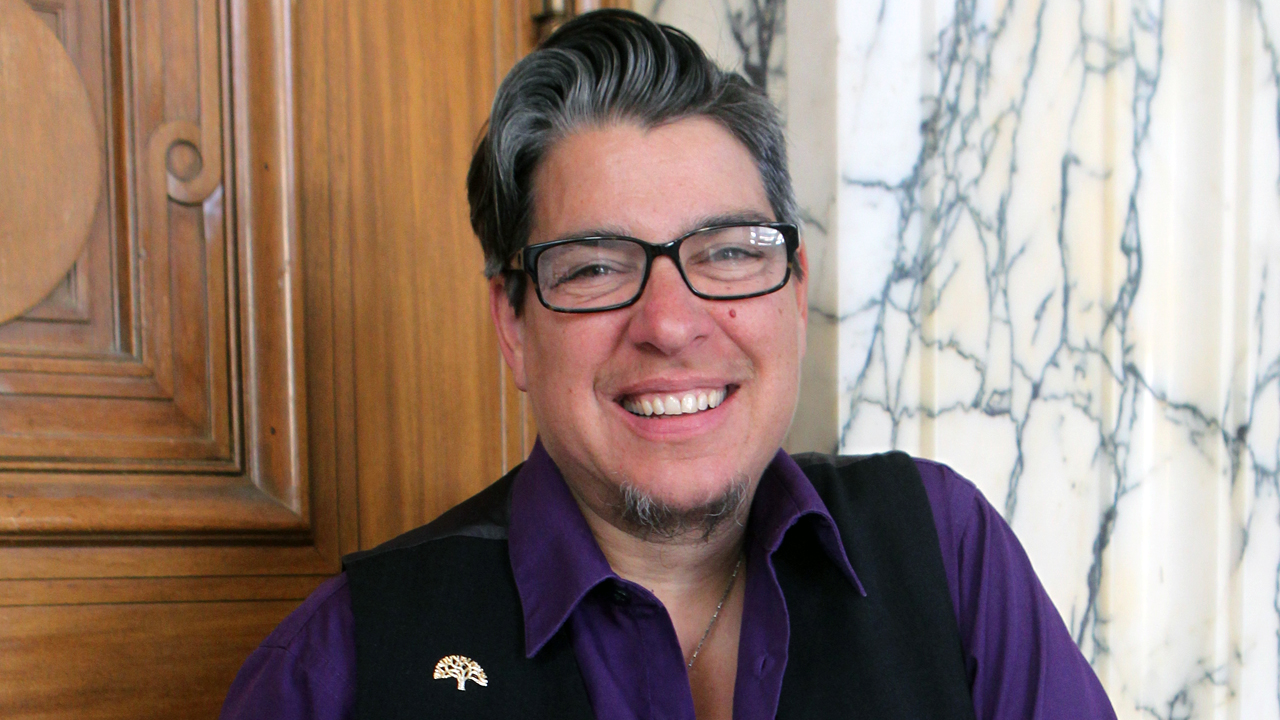
Reacting to reports that the City Administration secretly spent $50,000 to hire an outside contractor to investigate a member of the Oakland Police Commission, City President Rebecca Kaplan is proposing an ordinance that reaffirms that the City Charter gives investigative author-ity solely to the Police Commission and the City Council.
The proposed ordinance “reiterates the importance of an independent police commission and that neither the City Administrator nor the Chief of Police are authorized to engage in any action against commissioners, nor are they authorized to assume the powers granted to the Council, the Ethics Commission or the Police Commission.”
This conflict between the authority of the council and the administraor authority has been brewing for a while, focusing on repeated moves by the Chief of Police Anne Kirkpatrick and the City Administrator Sabrina Landreth against Oakland Police Commission Vice Chair Ginale Harris.
“Several meetings ago, I requested a copy of the contract between the City Administration and the outside project investigator who apparently was hired to investigate a police commissioner without notice to council, without a vote of council,” said Kaplan, speaking at Tuesday’s Public Safety Committee meeting.
This administrative action “was felt by police commission members as intimidating and harassment of them,” said Kaplan.
She never received the copy of the contract from the City Administrator but was eventually given a copy this week by a blogger, known as Hyphenated-Republic (hyphenatedrepublic.com), who had obtained it through a Public Records Act request to the city.
The contract confirms that the administrator in November 2018 hired a company to investigate “a specifically named member of the police commission,” Kaplan said.
“I believe that what was done was illegal,” she said.
“The charter of the City of Oakland states that it is the City Council that has the power to remove a commissioner for misconduct,” said Kaplan. “I don’t see any authority anywhere for the city administrator to independently decide to undertake an investigation.”
In a memo accompanying the proposed ordinance, Kaplan noted that Measure LL, which estab-lished the police commission, specifically quoted the National Association for Civilian Oversight of Law Enforcement about the key importance of creating a commission with “independence from the executive branch of government.”
According to the City Charter, as quoted in the memo, “The City Council may remove members of the commission for cause as provided in Section 601 of the charter, or members of the commission may be removed by a majority vote of the commission, only for conviction of a felony, conviction of a misdemeanor involving moral turpitude, a material act of dishonesty, fraud, or other act of moral turpitude, substantial neglect of duty (and) gross misconduct in office.”
A more recent incident involving an attempt to remove Harris took place in November 2019 when OPD Chief Anne Kirkpatrick complained about Harris to Police Commission Chair Regina Jackson by phone and email. In the email dated Nov. 19, Kirkpatrick mentioned an “anony-mous” call to internal Affairs concerning a verbal dispute between Harris and an administrator at her child’s school in San Francisco.
“While Harris’ style is more ‘sharp’ than some, her observations have often been proven to be accurate This sort of treatment feels like bullying,” said Jackson in an email to the Oakland Post.
“The Police Commission was voter approved by 83 percent of the citizens of Oakland,” Jackson continued. “We are volunteers seeking to understand and improve structures and policies in order to support OPD in being more emotionally intelligent and transparent in their accountability to communities they serve. We take our jobs seriously and have been resisted since we started.”
This latest incident, which led to coverage by the Bay Area media, predated the City Administrator’s hiring of the investigator by one year and involved different allegations.
The city administration also has filed two or three Public Ethics Commission complaints against Harris, and she was exonerated in all these cases, according to Commissioner Henry Gage.
“The question of who investigates the commission is an important one,” Gage said. “We don’t want someone who is too close to the police department to turn around and investigate the commission.”
“The administration should be on the side of increased police oversight,” he said.
The criticisms of Harris “seem very trivial,” said civil rights attorney Dan Siegel, who is repre-senting Harris.
“The city administration does not have the authority under the charter to be investigating members of the police commission,” said Siegel. “It does not seem like the City Administrator is justified in dealing with this like she is an employee.”
Representatives of the City Attorney and the City Administrator who attended the committee meeting said they didn’t have the information to be able to comment on the issue.
This conflict over the police commission reflects a broader problem: the city administration ignores, subverts or buries City Council decisions that the administration does not like, according to Rashidah Grinage of the Coalition for Police Accountability.
“Basically, Oakland is replicating Washington, D.C.,” said Grinage. “We have an administration that basically thumbs its nose at the City Council and decides what decisions it wants to implement.”
“Once something passes the City Council, it goes into a black hole. It is really quite astonishing,” she said.
The decision on Kaplan’s proposed ordinance was postponed to the Tuesday, Feb. 11 Public Safety Committee meeting, to give the City Attorney a chance to look at the proposal.
Kaplan Proposes Law to Protect Police Commissioners
From Official ‘Intimidation and Harassment’








To enlarge your view of this issue, use the slider, magnifying glass icon or full page icon in the lower right corner of the browser window.


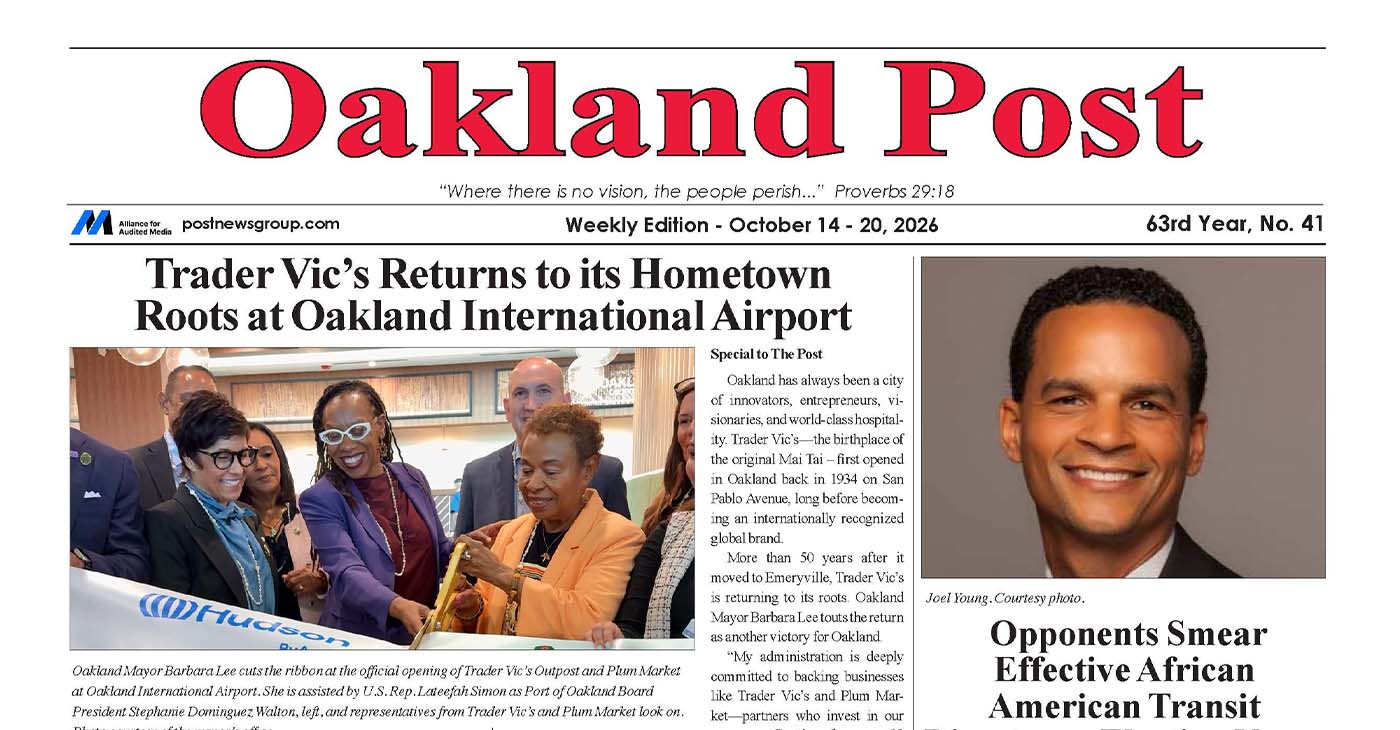
To enlarge your view of this issue, use the slider, magnifying glass icon or full page icon in the lower right corner of the browser window.
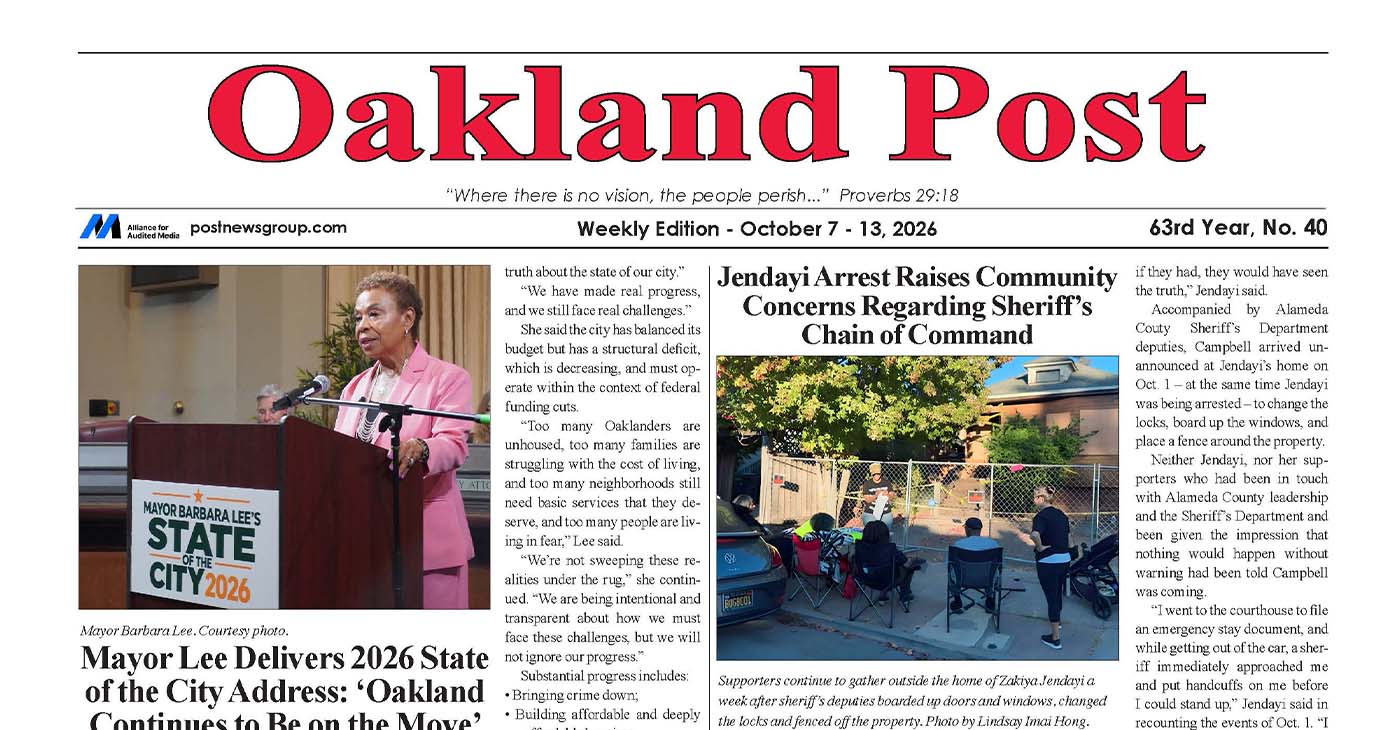
To enlarge your view of this issue, use the slider, magnifying glass icon or full page icon in the lower right corner of the browser window.



Oakland Probate Dispute Raises Questions About Court-Ordered Property Transfer and Missing Notice

‘Raising a Child Shouldn’t Break the Bank’: California Is Helping Families Save on Childcare Costs

Secretary of State Shirley Weber Pushes Back Against DOJ Demands Over California Voter Rolls

Chase Launches Fraud & Scam Prevention Month

U.S. Rep. Simon Secures More Than $1 Million for Public Safety at Mills College at Northeastern University Oakland, Surrounding Neighborhood

COMMENTARY: Valarie Bachelor and Jennfier Brouhard are Excellent School Board Members and Deserve to Be Reelected

Oakland Faith Leaders Gather to Revitalize the Interdenominational Ministerial Alliance of Oakland

Statue of ‘La Catrina,’ a Beloved Symbol of Dia de Los Muertos, Visits Oakland

Oakland Honors 60 Years of the Black Panther Party at the All Power to the People Gala

Fate of Bay Area Public Transit Hinges on Regional Transit Measure

Why AC Transit Director Joel Young is My Choice for AC Transit Board Ward 3

Oakland Post: Week of October 21 – 27, 2026

Mayor Barbara Lee Holds Special State of the City Address in Deep East Oakland

Practitioners of African Traditional Spirituality Offer Ancestral Reverence Ritual Oct. 31

It’s Time to Lose Weight Before the Holidays

Misnamed ‘Parent’ PAC Seeks to Influence Oakland School Board Elections

Listening as a Lifeline: A Doula’s Witness to Black Maternal Health

Poll: Becerra Widens His Lead Over Hilton; Californians Split on Wealth Tax

County Office of Education Says OUSD Finances Are Getting Healthier, Materially Stronger

Oakland Post: Week of September 9 – 15, 2026

Doulas Are Helping Black California Moms Navigate Pregnancy–Even as High Mortality Rates Persist

Zakiya Jendayi Arrested, Locked Out of Home by Sheriff’s Deputies

Mayor Lee Announces $1 Million Kaiser Permanente Grant for Pilot Program to Address Homelessness, Clean Up Public Spaces throughout Oakland

Richmond Tiny House Village Farm & Garden Set to Open Gates on Sept. 26

BLACspace Cooperative Invites Bay Area to Experience Oakland’s Black Cultural Ecosystem Through a BLAC Map Tour + Party

OPINION: Nolan Wells’ Death One of Several Signifying Racial Terror Lives on in U.S. South

Latest Massacre in Haiti Reveals Cruelty U.S. Deportations

Oakland People’s Arms Embargo Coalition Demands End to Military Shipments Thru Oakland

Oakland Post: Week of September 16 – 22, 2026

Democratic Clubs Interview Candidates for Oakland School Board

The Conversation With Al McFarlane 6/23/26

Media Monday 6/22/26

LIVE! ASK ALMA! — TUES. 6.23.26 7PM EST

Car Buying Secrets: 4 Hidden Checks Before You Sign!

Is This 550 HP Charger Worth YOUR Money? AutoNetwork Review

Celebrating Juneteenth – Frederick Douglass on education and resistance

LIVE! — ASK ALMA! — TUES. 6.19.26 7PM EST

Hyundai Ioniq 5 Parking, Safety, and 360 View #shorts

2025 Ioniq 5 New Wiper & Powerful Performance! #shorts

Electric SUV Range: Is 259 Miles Enough? #shorts

EV Charging: How Fast Can You Charge an Electric Vehicle? #shorts

Biometric Cooling… Messaging Seats…Come on! 2025 Infiniti QX80 Autograph 4WD

Charged Up: Witness the Magic of a Fully Electric Car! #shorts

Range Rover Sport PHEV Included…: See What’s Inside This Luxury SUV! #shorts

Invisible Hood View: Perfect Parking with X-Ray Vision! #shorts
-
 Black History3 weeks ago
Listening as a Lifeline: A Doula’s Witness to Black Maternal Health
-
 Economy4 weeks ago
Poll: Becerra Widens His Lead Over Hilton; Californians Split on Wealth Tax
-
 Business4 weeks ago
County Office of Education Says OUSD Finances Are Getting Healthier, Materially Stronger
-
 Lead Story3 weeks ago
Zakiya Jendayi Arrested, Locked Out of Home by Sheriff’s Deputies
-
 Art4 weeks ago
BLACspace Cooperative Invites Bay Area to Experience Oakland’s Black Cultural Ecosystem Through a BLAC Map Tour + Party
-

 Business4 weeks ago
From Historic Memories to New Possibilities: Oakland Celebrates Coliseum 60
-

 Community4 weeks ago
Asm. Corey Jackson Announces Launch of 24-Hour Childcare in His District
-

 Black History4 weeks ago
IN MEMORIAM: The Rev. Leon “Sonny” Clark, Longtime Orange County Pastor and Community Leader, Dies at 72
