
Activism
Undocumented Workers Are Struggling to Feed Themselves. Slashed Budgets and New Immigration Policies Bring Fresh Challenges
Founded more than 20 years ago, Street Level Health Project started with a handful of nurses and volunteers visiting day laborer sites in East Oakland to provide medical assistance and other resources to newly arrived immigrants. They quickly spotted symptoms common among day laborers: nausea, fatigue, and headaches. Sitting in the sun for hours waiting for work is typical. Once on a job, some men shared incidents of nearly passing out while working. Volunteer nurses also noticed signs of hunger among the men, with some going days without eating a proper meal.

By Magaly Muñoz
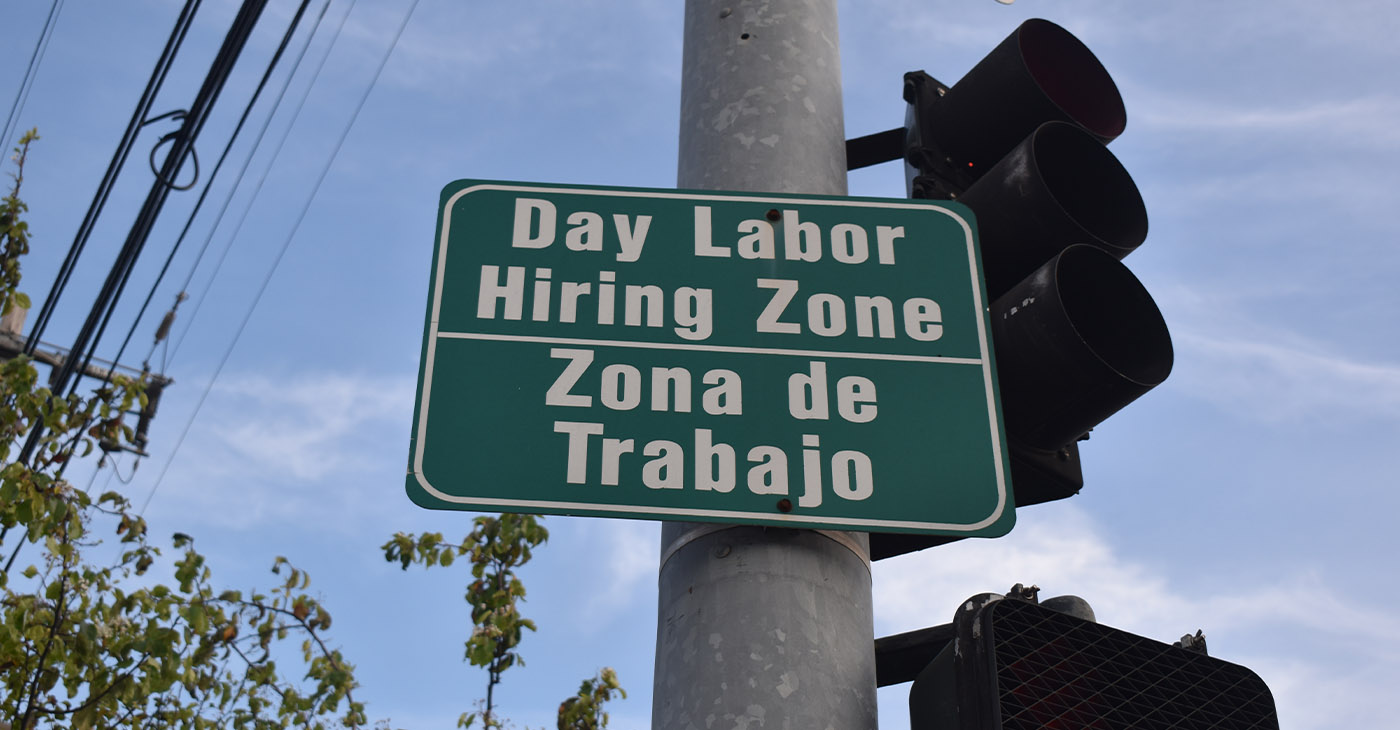
Up and down the streets of the Fruitvale neighborhood in Oakland, immigrant workers head to empty parking lots and street corners waiting for a job. Some are as young as 14 and as old as 60.
Diego, a man in his late thirties, is a construction worker who arrived in the United States nine months ago. He, like many of the men standing beside him at the day laborer site, came to the U.S. in the hopes of providing a new life for his family. Now, Diego and other immigrants are worried as threats of deportation increase from the Trump administration.
Also worried are organizations such as Street Level Health Project, an Oakland-based nonprofit dedicated to providing access to health care and basic services to these laborers.
Street Level Health Project’s funding primarily comes from federal and local grants, These are in jeopardy because of city budget constraints and proposed cuts to federal social service dollars.
Already, the nonprofit’s local funding has been cut. The City of Oakland decreased one of the organization’s grants by $35,000 in one of its latest rounds of budget cuts, with city officials citing a looming budget deficit.
“Our primary day laborer program funding right now is secured, but we do have concerns in this next budget cycle if it will continue to be secured, given [the budget shortfall], and the recent cut to 13 community grants across the city,” said Executive Director Gabriela Galicia.

Founded more than 20 years ago, Street Level Health Project started with a handful of nurses and volunteers visiting day laborer sites in East Oakland to provide medical assistance and other resources to newly arrived immigrants. They quickly spotted symptoms common among day laborers: nausea, fatigue, and headaches. Sitting in the sun for hours waiting for work is typical. Once on a job, some men shared incidents of nearly passing out while working. Volunteer nurses also noticed signs of hunger among the men, with some going days without eating a proper meal.
“We’re the safety net to the safety net,” said Galicia. As Oakland’s sole organization devoted to helping undocumented workers, Street Level is often tasked with “picking up the leftovers” for groups that provide resources to the larger immigrant or underserved communities, she added. Now, that mission is under threat.
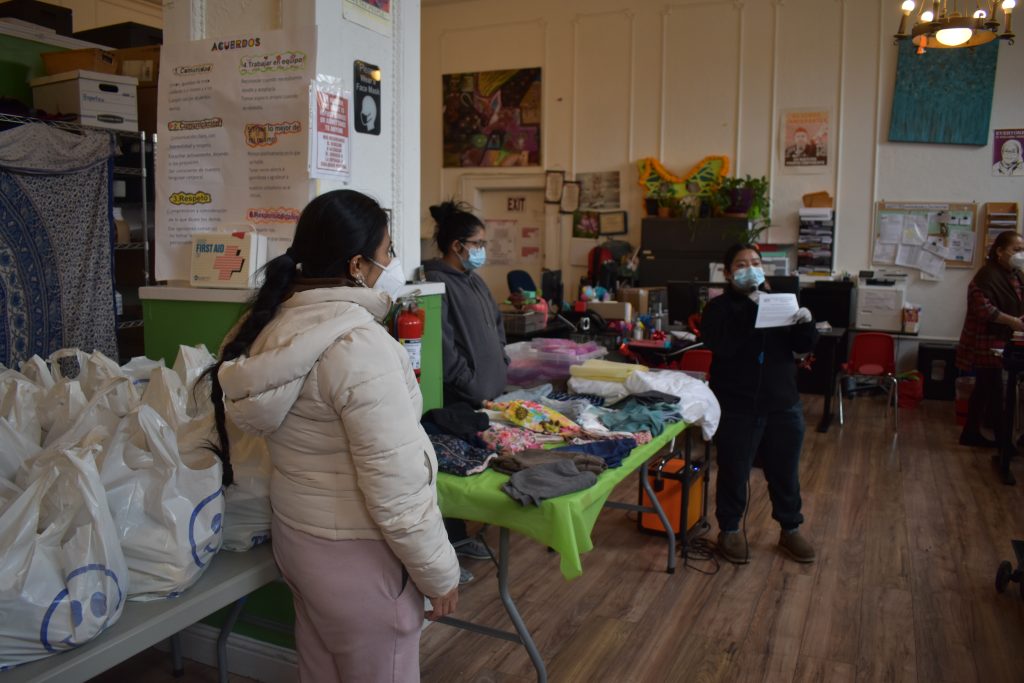
Level Health Project is a nonprofit organization in East Oakland that provides health and employment resources for immigrant day laborers and their families. The staff upped their efforts to provide information about immigration rights in the wake of Donald Trump’s presidency. Photo by Magaly Muñoz.
At day laborer sites in East Oakland, several workers said that they often skip buying groceries or meals for themselves in order to save money for rent or other necessities.
Diego, who like others interviewed for this story asked to not share his full name because of his undocumented status, said he’s lucky if he makes $300 a week. He said that is enough to pay for the small room he and his son rent in the Fruitvale – but not enough to feed them both. Diego said that he will sometimes go days without food.
The family Diego rents from is more fortunate, he said, because they’re able to afford meat and rice. At times, Diego said, it’s hard to ignore the savory smell that finds its way to his bedroom. Diego tells his son to look away from his landlord’s table to avoid feeling envious about what they cannot buy themselves.
“It’s hard because I know there’s food at the store, but there’s never enough [money] to buy it,” Diego said. “We barely have enough to pay our rent every month.”
On top of paying for the basics here in the U.S., day laborers also face pressure to support relatives in their home countries.
Pedro, interviewed on his BART ride home after an unsuccessful day of trying to find work in East Oakland, said his family in Guatemala regularly goes days without eating because he can’t make enough money in the Bay Area to send home to them.
“A lot of [day laborers] have their families back in [Latin America], making it harder to keep up with our needs here,” Pedro said. Some days he said the only thing he eats is the fruit that some local organizations hand out to workers like him.
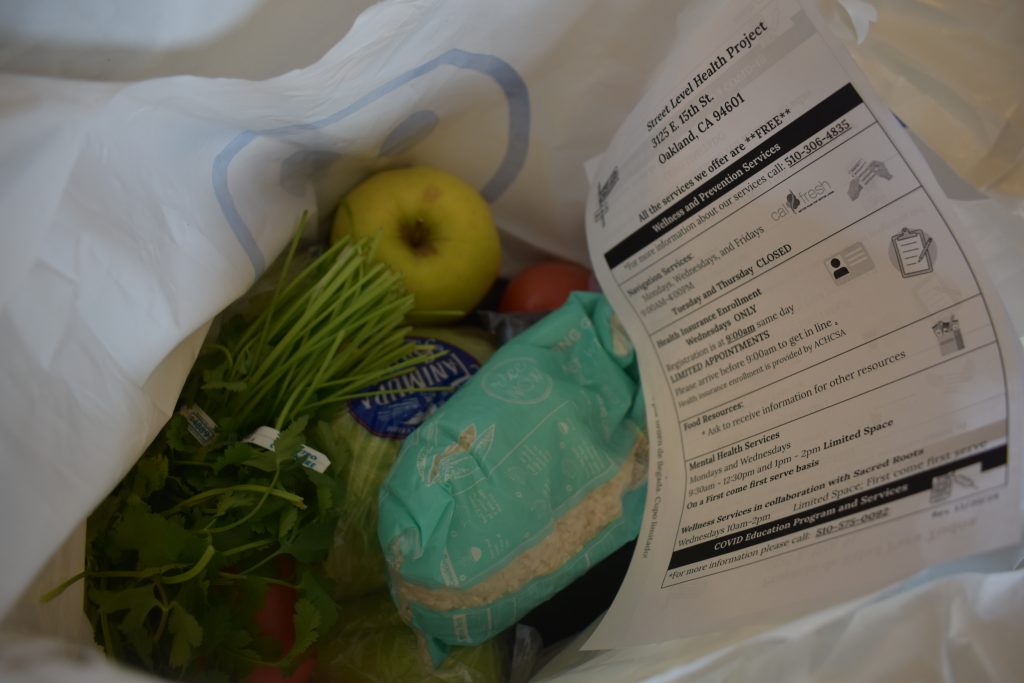
Street Level Health Project is providing weekly grocery bags to immigrant day laborers and their families to address the growing need for food in the community. Photo by Magaly Muñoz.
Bracing for bigger challenges
Before the pandemic, Street Level Health Project had a hot meal lunch program at their central office in the Fruitvale, where the organization provided meals twice a week for over 50 people. The organization also had a hot meal breakfast program where they prepared 50 to 90 meals, three times a week.
Understanding the food insecurity that many day laborers face, the project launched a food distribution program in 2011, distributing nearly 70 bags of groceries weekly. Thanks to additional funding, they were able to increase that to 150 food bags a week during the pandemic.
In recent years, Street Level Health Project reduced its weekly grocery distribution back to 70 bags and cut its hot meal program completely. Galicia, the director, said that’s because of the end of COVID-19 funding and staffing reductions.
Street Level Health Project also receives regular donations from the Alameda County Food Bank, but Galicia said it has not been enough to restore the food distribution program to what it was during the pandemic.
Currently, Street Level has a $100,000 grant from the city of Oakland to provide wrap-around services for day laborers, such as getting jobs for the workers, providing assistance with CalFresh and MediCal applications, and referring people to legal aid or immigration assistance. Galicia said that funding is barely enough to do the amount of work that the city expects.
Meanwhile, the $35,000 cut in funding has impacted the organization’s workers’ rights outreach and education services, she said.
The Oakland Post tried reaching out to city and county officials several times for comment but did not get a response.
Galicia fears city leaders will make even harsher cuts during the upcoming budget cycle this spring to balance a $130 million shortfall. Last year, Oakland cut funding for public safety, arts and culture programs, and 13 other nonprofits that serve the city’s most vulnerable populations.
Yet the budget concerns don’t stop with local government.
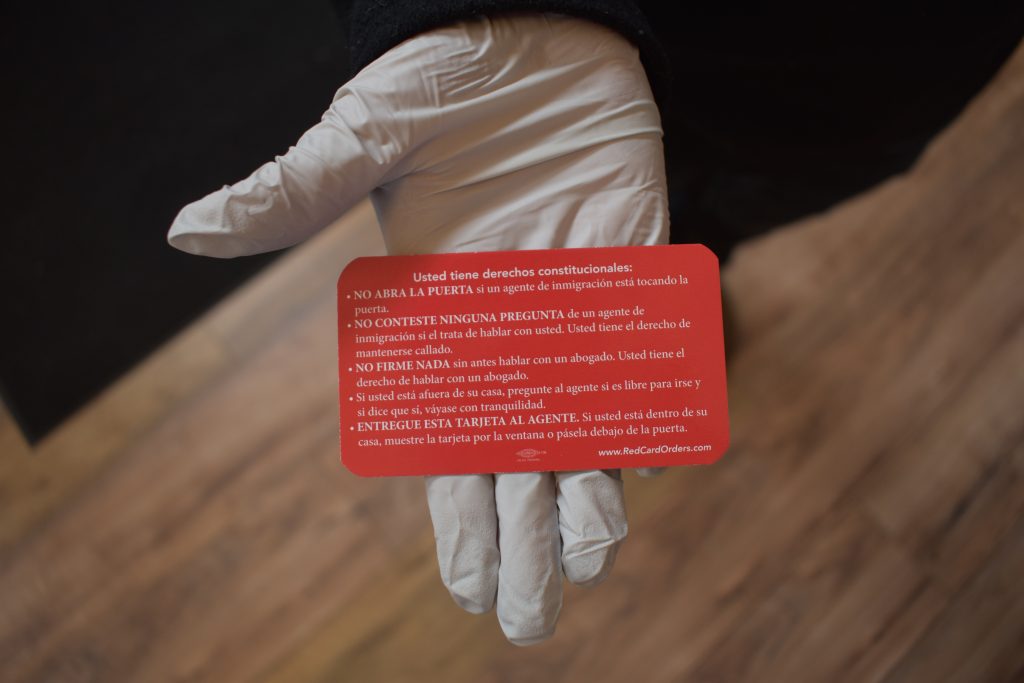
In the wake of Trump 2.0, organizations across the country are handing out “red cards” with the rights that immigrants should be aware of when encountering immigration officers. Photo by Magaly Muñoz.
Since President Donald Trump’s second inauguration, immigrant communities and the organizations that serve them have been in crisis mode.
Trump, who ran on a promise to deport millions of immigrants, has signed executive orders to stop birthright citizenship, shipped migrants to Guantanamo Bay, and attempted to freeze federal funding to social programs. Undocumented residents are increasingly anxious that their families might get separated.
Galicia said this is the time for local and state governments to invest in their organizations’ staff and direct resources, not take them away, from the people on the frontlines.
“I think that it’s just as important that funders are able to give to our teams, not just for the community but because the people doing the work have to be well, and we need ample resources to be able to do this work to support our community,” Galicia said.
For Pedro, the day laborer in Oakland, the combination of less support from nonprofits like Street Level Health Project, along with fear raised by the Trump administration’s deportation threats, has left him fearful. He is not alone, he said. He has noticed fewer day laborers showing up to their usual spots. Pedro said he himself fears encountering an immigration officer on his way to work.
“We don’t want to leave our homes, but at the same time, if we don’t go outside, we don’t work,” he said. “If we don’t work, we can’t afford to live.”
Oakland Post reporter Magaly Muñoz produced this story as part of a series as a 2024 USC Annenberg Center for Health Journalism Data Fellow and Engagement Grantee.







Activism
Oakland Post: Week of September 16 – 22, 2026
The printed Weekly Edition of the Oakland Post: Week of September 16 – 22, 2026

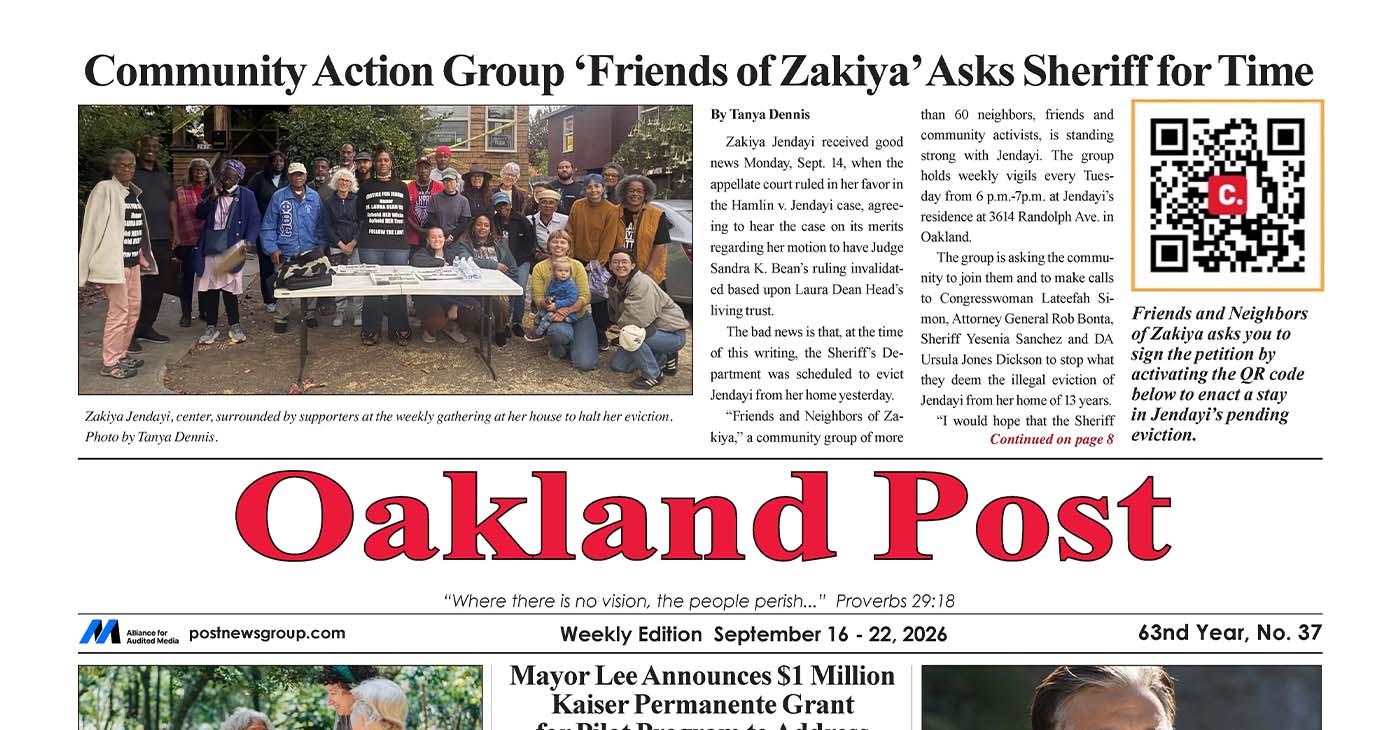
To enlarge your view of this issue, use the slider, magnifying glass icon or full page icon in the lower right corner of the browser window.

Activism
Oakland Post: Week of September 9 – 15, 2026
The printed Weekly Edition of the Oakland Post: Week of September 9 – 15, 2026

To enlarge your view of this issue, use the slider, magnifying glass icon or full page icon in the lower right corner of the browser window.
Activism
Oakland Post: Week of September 2 – 8, 2026
The printed Weekly Edition of the Oakland Post: Week of September 2 – 8, 2026
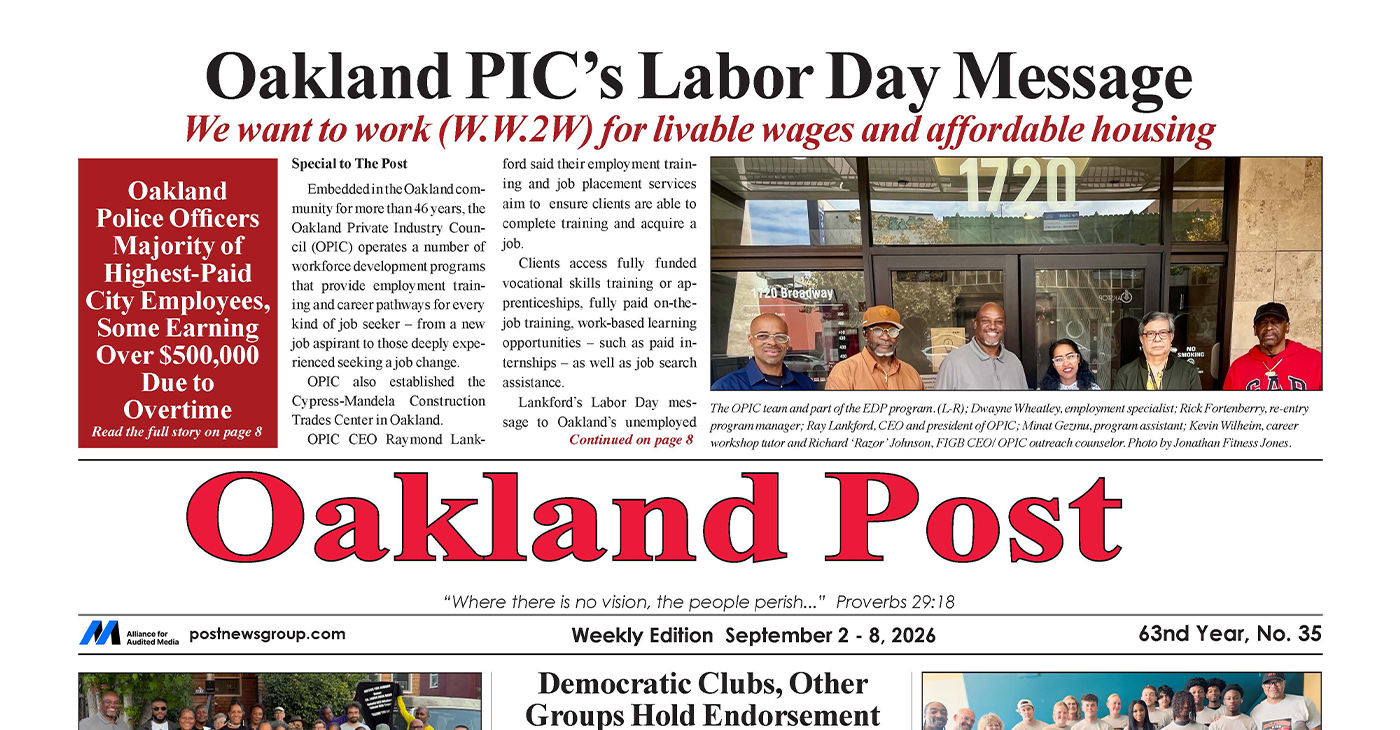
To enlarge your view of this issue, use the slider, magnifying glass icon or full page icon in the lower right corner of the browser window.



Doulas Are Helping Black California Moms Navigate Pregnancy–Even as High Mortality Rates Persist

Newsom Signs Addictive Social Media Law to Protect Kids

On Your November Ballot: Prop 38 Would Allocate $8.4 Billion to Immunology and Immunotherapy Funding

Ask California: Golden State Releases New AI Chatbot

Asm. Isaac Bryan’s Bill Banning California Police From ICE Side Jobs Reaches Newsom’s Desk

Assemblymember LaShae Sharp-Collins’s Bill Would Pause Law Enforcement’s Use of Shock Gloves Pending Study

BOOK REVIEW: ‘Laws of Solomon’ Reveals Tender Heart of Former Child Soldier

OPINION: The New American Fear – From 9-11 to AI

Passing for White, Fighting for Black America: The Courage of Walter White

Oakland People’s Arms Embargo Coalition Demands End to Military Shipments Thru Oakland

Barbara Lee Mourns Gloria Steinem, Remembers a Friendship Rooted in Equality

Event Preview: ‘Fashion v. Fascism’ – A Runway Revolution Is Coming to the Bay Area

Two Looming Threats Every Alameda County Elder Should Know About

Oakland Mayor Reads to Children at Bookout Block Party at Marcus Books Store

Tradition Comes to the Streets in 11th Annual Black-Eyed Pea Festival at the Freedom Farmers Market

Less Affluent School Districts, Including Sacramento City, Face Threat of State Takeover

ESSAY: California Can Close Its Colorectal Cancer Gap

California Hispanic Chambers of Commerce Unveils: ‘Powering the Future’ Theme for 47th Annual Statewide Convention

Four Candidates, Including Incumbent Barbara Lee, Qualify for Oakland Mayor’s Race

Oakland Post: Week of August 12 – 18, 2026

From Blueprint to Breakthrough: Tackling Affordable Housing in Oakland

Oakland Observes Black August with Block Parties, Film Showings, Workshops

COMMENTARY: Why Local School Tax Measure G1 Will Not Be on the November Ballot

Standoff for Justice: Our Homes Are Worth Fighting For

Returning to Its Roots, the Oakland Black-Eyed Pea Festival Partners with the Freedom Farmers Market Sept. 12

NPRC Scores First Advocacy Victory: David Shaw Finally Gets His Wish to ‘Go Home’

Oakland Post: Week of August 26 – September 1, 2026

Gubernatorial Candidate Steve Hilton Blasts California New Tire Rules; Newsom Hits Back

Frontier Airlines’ Return to Oakland Airport Brings Flights, Jobs and Opportunity

Chef Sharon Lee Blends Culinary Excellence, Education and Empowerment

The Conversation With Al McFarlane 6/23/26

Media Monday 6/22/26

LIVE! ASK ALMA! — TUES. 6.23.26 7PM EST

Car Buying Secrets: 4 Hidden Checks Before You Sign!

Is This 550 HP Charger Worth YOUR Money? AutoNetwork Review

Celebrating Juneteenth – Frederick Douglass on education and resistance

LIVE! — ASK ALMA! — TUES. 6.19.26 7PM EST

Hyundai Ioniq 5 Parking, Safety, and 360 View #shorts

2025 Ioniq 5 New Wiper & Powerful Performance! #shorts

Electric SUV Range: Is 259 Miles Enough? #shorts

EV Charging: How Fast Can You Charge an Electric Vehicle? #shorts

Biometric Cooling… Messaging Seats…Come on! 2025 Infiniti QX80 Autograph 4WD

Charged Up: Witness the Magic of a Fully Electric Car! #shorts

Range Rover Sport PHEV Included…: See What’s Inside This Luxury SUV! #shorts

Invisible Hood View: Perfect Parking with X-Ray Vision! #shorts
-
 Commentary4 weeks ago
Standoff for Justice: Our Homes Are Worth Fighting For
-
 Activism4 weeks ago
Oakland Post: Week of August 26 – September 1, 2026
-
 Business4 weeks ago
Gubernatorial Candidate Steve Hilton Blasts California New Tire Rules; Newsom Hits Back
-
 Business4 weeks ago
Frontier Airlines’ Return to Oakland Airport Brings Flights, Jobs and Opportunity
-
 Business4 weeks ago
Chef Sharon Lee Blends Culinary Excellence, Education and Empowerment
-

 Education4 weeks ago
Gov. Newsom’s Latest Appointees Include Sacramento Advocate for Formerly Incarcerated Students; State’s New Tech Chief
-

 Community4 weeks ago
Big City Mayors Ask for “Yes” Vote on Housing Bond Measure; Conservatives Say “No”
-

 Business4 weeks ago
Oakland Coliseum Project Opens Door for Small Businesses to Build Bigger
