
Bay Area
Unanswered Questions Over Costs of Proposed Howard Terminal Ballpark


There is growing public scrutiny of the deal the Oakland A’s are offering to the city in a proposal, released the end of April, to “privately fund” the building of a $1 billion ballpark and a massive $12 billon real estate development, almost a city within a city, on the waterfront at Howard Terminal and Jack London Square in downtown Oakland.
The Oakland A’s “term sheet,” released on April 23 and available at www.mlb.com/athletics/oakland-ballpark/community-report, proposes a construction project that, in addition to a 35,000-seat waterfront ballpark, would feature 3,000 units of mostly market rate housing, a hotel, an indoor performance center and 1.5 million square feet of offices and 270,000 square feet of retail space, as well as a gondola to transport fans over the I-880 freeway.
Many of the details of the proposal are vague, and there are many unanswered questions about how much this project will cost Oakland taxpayers and what benefits the city would ultimately see.
Among those who raised questions was Mike Jacob, vice president and general counsel of Pacific Merchant Shipping Association, an opponent of moving the A’s to Howard Terminal.
“I think it’s hard to say what’s going on. They haven’t made it plain what they’re asking for and what they’re proposing,” Jacob said in an interview with the Oakland Post.
The A’s term sheet proposes a cost of $955 million for infrastructure and $450 million that will be utilized for community benefits, but that funding would be paid by taxpayers, presumably with a bond, he said.
“It is unclear whether (the funding) is underwritten by the bond, whether it is backed by general fund money and pretty unclear what the scope for the infrastructure really is,” said Jacob.
Do infrastructure costs include toxic waste cleanup at the site, which would be considerable, the cost of the gondola, multiple safe railway crossings for pedestrians and cars and any required construction if the Port of Oakland shipping is impacted? He asked.
In addition, not only would taxpayers pay the millions of dollars in community benefits they would supposedly receive for various types of services and other projects, the money would be spread over a 45-year period.
To help fund the project, the A’s propose the city create a tax district for property owners along 1.5 miles near downtown Oakland to help pay for city services and infrastructure to serve the development.
The A’s also have said in their literature that the project would generate 6,000 jobs but are short of details about what that promise means. According to a letter to a state agency in August 2019, many of the estimated 6,667 would be jobs at offices in the development, in effect counting as new jobs any existing Oakland businesses that lease space in one of the new office buildings.
For their part, the A’s are pushing the City Council to approve their deal before the council recesses for its July break.
“We are really excited to get that (the term sheet) out there, and we are even more excited to get this to the City Council to vote this summer,” Dave Kaval, A’s president, told the San Francisco Chronicle.
While Oakland Mayor Libby Schaaf has thrown the weight of her office behind the deal, she is expressing some reservations after the term sheet was released and community opposition to the Howard Terminal project has continued to grow.
In a comment to the Chronicle, Schaaf spokesperson Justin Berton said:
“Our goals for the project are unchanged: We want to keep the A’s in Oakland – forever. We need a deal that’s good not just for the A’s, but for the City, one that provides specific, tangible, and equitable benefits to our residents and doesn’t leave Oakland’s taxpayers on the hook.”
“The A’s contend that the growth in tax revenues attributed to their project will be sufficient to fully fund those investments and that they will benefit the entire community, (and) the city is critically examining these claims,” said Berton in the East Bay Times.
The impact of the decision on the A’s proposal could be huge for Oakland, noted Berton. “The commitments requested by the A’s would pre-determine the use of a substantial portion of tax revenue from this part of the city for years to come,” he told the East Bay Times.













Activism
Oakland Post: Week of March 18 – 24, 2026
The printed Weekly Edition of the Oakland Post: Week of March 18 – 24, 2026


To enlarge your view of this issue, use the slider, magnifying glass icon or full page icon in the lower right corner of the browser window.

Activism
Oakland Post: Week of March 11 -17, 2026
The printed Weekly Edition of the Oakland Post: Week of March 11 – 17, 2026
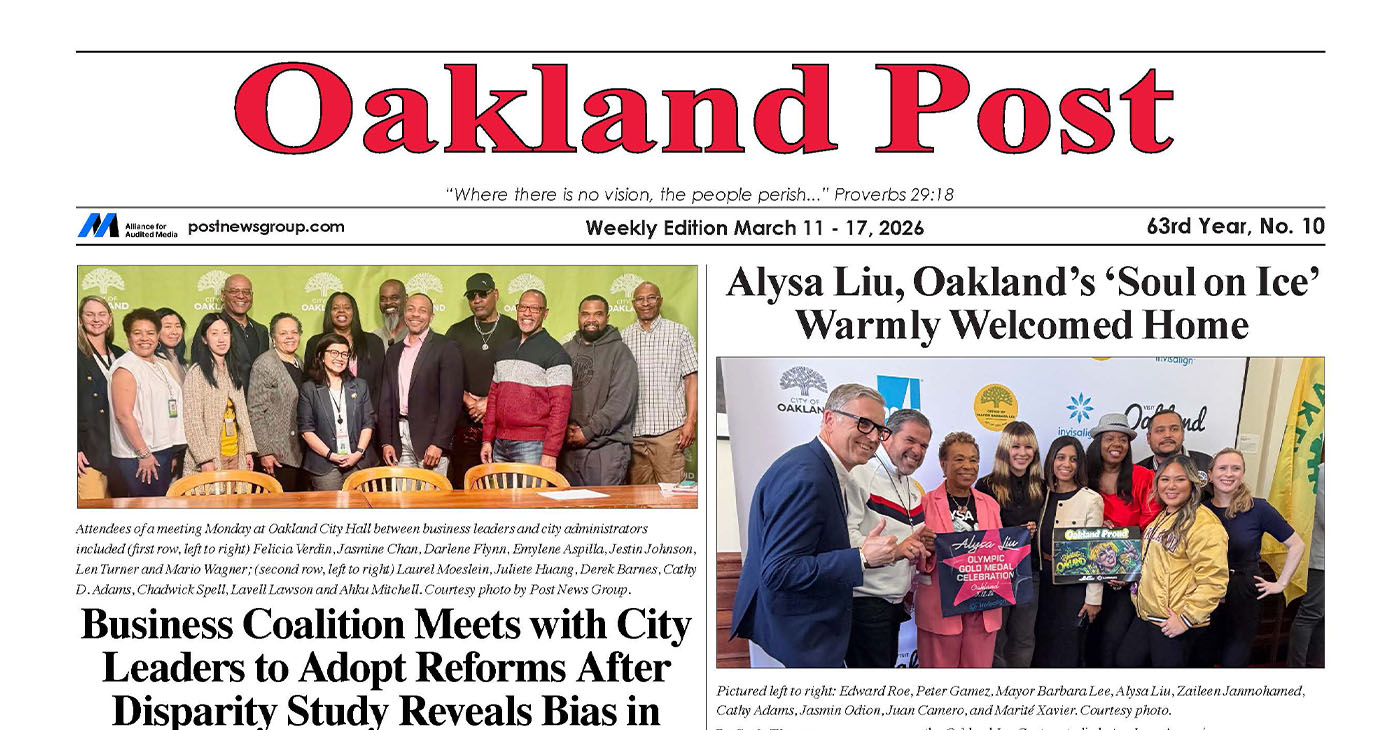
To enlarge your view of this issue, use the slider, magnifying glass icon or full page icon in the lower right corner of the browser window.
Activism
Oakland Post: Week of March 4 – 10, 2026
The printed Weekly Edition of the Oakland Post: Week of March 4 – 10, 2026

To enlarge your view of this issue, use the slider, magnifying glass icon or full page icon in the lower right corner of the browser window.

WORK FROM HOME
Home-based business with potential monthly income of $10K+ per month. A proven training system and website provided to maximize business effectiveness. Perfect job to earn side and primary income. Contact Lynne for more details: Lynne4npusa@gmail.com 800-334-0540


Black Artists in America, Installation Three Wraps at the Dixon Gallery and Gardens

Grief, Advocacy, and Education: A Counselor Reflects on Black Maternal Health

Future of Florida’s Black History Museum in Limbo

New Research Shows the Many Benefits of Early Learning

South Hampton K-8 Students Among Top 10 Finalists for Samsung’s ‘Solve for Tomorrow’ Competition

Cuba: No Negotiation with US on the President or Political System

Brooklyn Academy of Music Names Jamaican-Born Tamara McCaw as President

Trinidad & Tobego – U.S. Launches WhatsApp Channel for American Citizens in the Country

Oakland Post: Week of March 18 – 24, 2026

AI Innovation vs. Ethics and Environmental Impact

AI, Web3, and Digital Reparations

What If You Owned Your AI Agent?

Season 7, Episode 3 – January Reporter’s Roundtable 📱

Season 7, Episode 3 – January Reporter’s Roundtable

AI, Media, and Power | Part 2, Real-World Impacts and Tradeoffs

Discrimination in City Contracts

Oakland Post: Week of February 11 – 17, 2026

Reflecting on Black History Milestones in Birmingham AL

Rising Optimism Among Small And Middle Market Business Leaders Suggests Growth for California

CITY OF SAN LEANDRO STATE OF CALIFORNIA PUBLIC WORKS DEPARTMENT ENGINEERING DIVISION NOTICE TO BIDDERS FOR ANNUAL STREET OVERLAY/REHABILITATION 2019-21 – PHASE III

Oakland Post: Week of February 18 – 24, 2026

PRESS ROOM: NBA Hall of Fame Nominee Terry Cummings Joins 100 Black Men of DeKalb County to Launch Victory & Values Initiative

Oakland Post: Week of February 25 – March 3, 2026

U.S. manufacturing rebounds – how foundry services are adapting to rising demand

Trump’s MAGA Allies are Creating Executive Order Plan to Steal the 2026 Midterms

OP-ED: One Hundred Years of Black Workers Telling the Truth

Advancements in solar technology that are changing the way we power the world

Chase Oakland Community Center Hosts Alley-Oop Accelerator Building Community and Opportunity for Bay Area Entrepreneurs

Poll Shows Support for Policies That Help Families Afford Child Care

PRESS ROOM: Civil Rights TV Launches in Selma as the World’s First 24/7 Civil Rights Television Network

Hyundai Ioniq 5 Parking, Safety, and 360 View #shorts

2025 Ioniq 5 New Wiper & Powerful Performance! #shorts

Electric SUV Range: Is 259 Miles Enough? #shorts

EV Charging: How Fast Can You Charge an Electric Vehicle? #shorts

Biometric Cooling… Messaging Seats…Come on! 2025 Infiniti QX80 Autograph 4WD

Charged Up: Witness the Magic of a Fully Electric Car! #shorts

Range Rover Sport PHEV Included…: See What’s Inside This Luxury SUV! #shorts

Invisible Hood View: Perfect Parking with X-Ray Vision! #shorts

AI Is Reshaping Black Healthcare: Promise, Peril, and the Push for Improved Results in California

ESSAY: Technology and Medicine, a Primary Care Point of View

Sanctuary Cities

The RESISTANCE – FREEDOM NOW

STATE OF THE PEOPLE: Freddie

ECONOMIC BOYCOTT DAY!!!!!

I told You So
-
 #NNPA BlackPress4 weeks ago
Reflecting on Black History Milestones in Birmingham AL
-
 #NNPA BlackPress4 weeks ago
PRESS ROOM: NBA Hall of Fame Nominee Terry Cummings Joins 100 Black Men of DeKalb County to Launch Victory & Values Initiative
-
 Activism4 weeks ago
Oakland Post: Week of February 25 – March 3, 2026
-
 #NNPA BlackPress4 weeks ago
Trump’s MAGA Allies are Creating Executive Order Plan to Steal the 2026 Midterms
-
 #NNPA BlackPress4 weeks ago
OP-ED: One Hundred Years of Black Workers Telling the Truth
-
 #NNPA BlackPress4 weeks ago
Poll Shows Support for Policies That Help Families Afford Child Care
-

 Activism3 weeks ago
Oakland Post: Week of March 4 – 10, 2026
-

 #NNPA BlackPress3 weeks ago
Woman’s Search for Family’s Roots Leads to Ancestor John T. Ward – A Successful Entrepreneur and Conductor on the Underground Railroad
