
Bay Area
Women’s Cancer Resource Center Celebrates 35th Anniversary
Founded in 1986, WCRC’s mission has been to improve the quality of life for women with cancer and advance equity in cancer support, especially for low-income persons, people of color, and members of the LGBTQIA+ community. Nearly 80% of WCRC’s clients live below the federal poverty level, and 70% of them identify as people of color.

The Bay Area is full of “best-kept secrets.” The Women’s Cancer Resource Center is one of them. Tucked away in an unassuming building in a residential neighborhood in Berkeley, the Center serves more than 2,000 people with cancer and their loved ones every year.
They’ve been doing this for three and a half decades.
The Women’s Cancer Resource Center is celebrating its 35thanniversary at an online event on May 13. Visit www.wcrc.org/unite for more information and to register. If you or a loved one is facing cancer, please reach out to WCRC for assistance. 510-601-4040, www.wcrc.org or info@wcrc.org.
Founded in 1986, WCRC’s mission has been to improve the quality of life for women with cancer and advance equity in cancer support, especially for low-income persons, people of color, and members of the LGBTQIA+ community. Nearly 80% of WCRC’s clients live below the federal poverty level, and 70% of them identify as people of color.
WCRC staff have long observed that cancer often is not the greatest concern for the low-income and marginalized individuals in its client population. Limited access to primary health care, inadequate health services and financial resources, language and cultural barriers, racism, low literacy, fear, and mistrust of medical systems contribute to late diagnosis and earlier death, especially for African American, Latinx, and all other groups of low-income women diagnosed with cancer.

WCRC provides a set of comprehensive, coordinated services to mitigate these problems for people with limited access to essential, life-giving care. Free services include psychotherapy, support groups, art and wellness classes, community-based cancer patient navigation, and information and referral to community resources. These services increase adherence to cancer treatment and advance self-empowerment and care, improving quality of life and treatment outcomes.
But most of all, WCRC provides a place of refuge. Anyone who comes through the Center’s doors will feel safe, connected, and seen. The Center was able to extend this feeling of community even during the pandemic, transitioning its direct services to phone and Zoom.
One client for whom WCRC has made a huge difference is Ms. Arenoso.
She couldn’t trust anyone. Ms. Arenoso has been on her own since the age of sixteen. The trauma of her early life and experience of homelessness made it hard to trust others and feel safe.
She learned that self-reliance isn’t always the answer. In 2019, Ms. Arenoso was diagnosed with cancer. A few months into her treatment, which affected her ability to think clearly, she realized that she needed to be around other people who had cancer, andshe was referred to WCRC.
She was able to start to relax and receive support. Ms. Arenoso felt an instant connection with WCRC staff, who took the time to get to know her and tailor WCRC’s services to her needs. Her navigator helped her fill out housing and financial support paperwork and apply for emergency funding, which granted her enough money to cover three months of rent. WCRC also provides her with practical and emotional support, which she especially appreciates during the pandemic.
She found a home away from home, where she could truly be herself. Describing a visit to WCRC last year, Ms. Arenoso observed, “Your center was welcoming and beautiful. Everyone was so kind, and no one was rude. I felt that they loved me for me.”
As her heart healed, she was inspired to practice generosity. Ms. Arenoso wants to give back. “I used to be very angry,” she said. “WCRC helped me become more kind and compassionate.” She now collects toiletries to provide to people who are homeless and shares cancer resources with her neighbors to ensure that people understand the importance of cancer screenings. “I don’t know what I would have done without WCRC,” she said.
If you or a loved one is facing cancer, please reach out to the Women’s Cancer Resource Center for assistance. 510-601-4040, www.wcrc.org or info@wcrc.org.









Activism
Oakland Post: Week of September 16 – 22, 2026
The printed Weekly Edition of the Oakland Post: Week of September 16 – 22, 2026


To enlarge your view of this issue, use the slider, magnifying glass icon or full page icon in the lower right corner of the browser window.

Activism
Oakland Post: Week of September 9 – 15, 2026
The printed Weekly Edition of the Oakland Post: Week of September 9 – 15, 2026

To enlarge your view of this issue, use the slider, magnifying glass icon or full page icon in the lower right corner of the browser window.
Activism
Oakland Post: Week of September 2 – 8, 2026
The printed Weekly Edition of the Oakland Post: Week of September 2 – 8, 2026
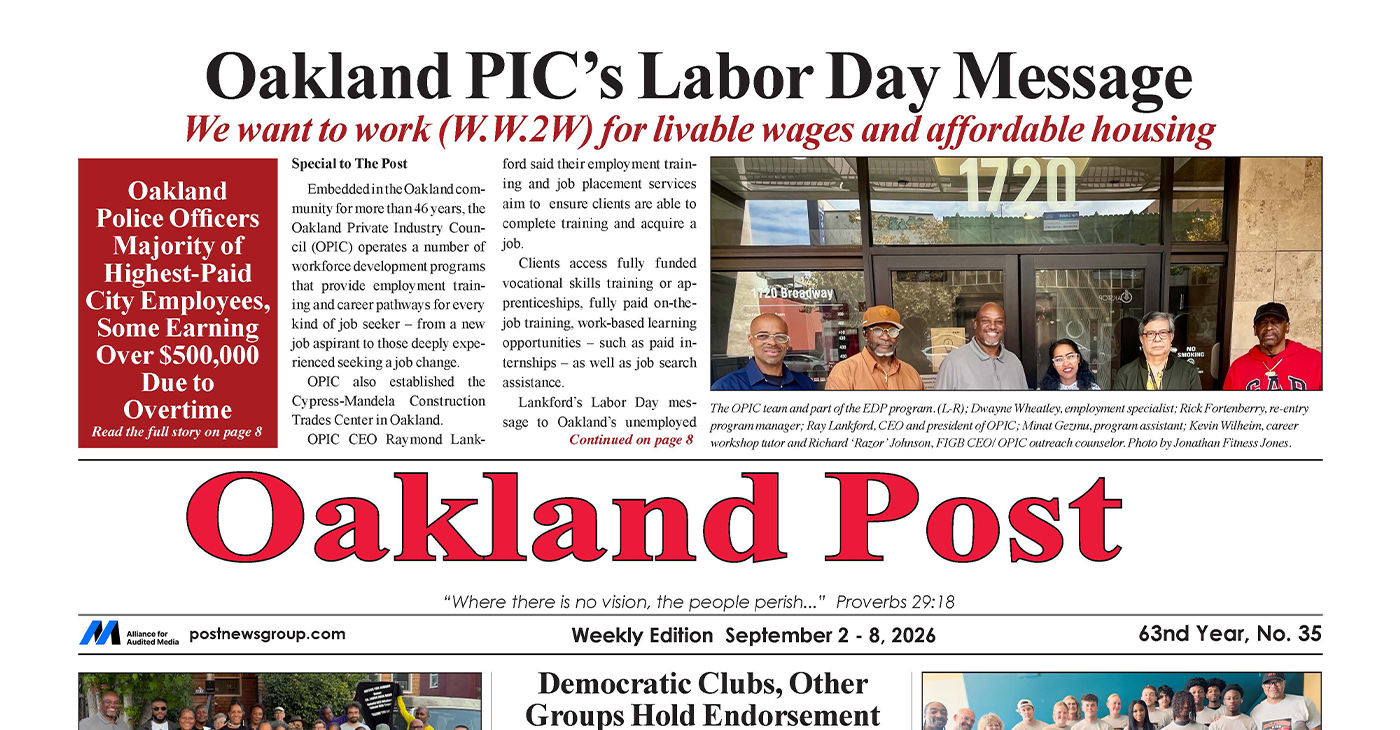
To enlarge your view of this issue, use the slider, magnifying glass icon or full page icon in the lower right corner of the browser window.



Doulas Are Helping Black California Moms Navigate Pregnancy–Even as High Mortality Rates Persist

Newsom Signs Addictive Social Media Law to Protect Kids

On Your November Ballot: Prop 38 Would Allocate $8.4 Billion to Immunology and Immunotherapy Funding

Ask California: Golden State Releases New AI Chatbot

Asm. Isaac Bryan’s Bill Banning California Police From ICE Side Jobs Reaches Newsom’s Desk

Assemblymember LaShae Sharp-Collins’s Bill Would Pause Law Enforcement’s Use of Shock Gloves Pending Study

BOOK REVIEW: ‘Laws of Solomon’ Reveals Tender Heart of Former Child Soldier

OPINION: The New American Fear – From 9-11 to AI

Passing for White, Fighting for Black America: The Courage of Walter White

Oakland People’s Arms Embargo Coalition Demands End to Military Shipments Thru Oakland

Barbara Lee Mourns Gloria Steinem, Remembers a Friendship Rooted in Equality

Event Preview: ‘Fashion v. Fascism’ – A Runway Revolution Is Coming to the Bay Area

Two Looming Threats Every Alameda County Elder Should Know About

Oakland Mayor Reads to Children at Bookout Block Party at Marcus Books Store

Tradition Comes to the Streets in 11th Annual Black-Eyed Pea Festival at the Freedom Farmers Market

Less Affluent School Districts, Including Sacramento City, Face Threat of State Takeover

ESSAY: California Can Close Its Colorectal Cancer Gap

California Hispanic Chambers of Commerce Unveils: ‘Powering the Future’ Theme for 47th Annual Statewide Convention

Four Candidates, Including Incumbent Barbara Lee, Qualify for Oakland Mayor’s Race

Oakland Post: Week of August 12 – 18, 2026

From Blueprint to Breakthrough: Tackling Affordable Housing in Oakland

Oakland Observes Black August with Block Parties, Film Showings, Workshops

COMMENTARY: Why Local School Tax Measure G1 Will Not Be on the November Ballot

Standoff for Justice: Our Homes Are Worth Fighting For

Returning to Its Roots, the Oakland Black-Eyed Pea Festival Partners with the Freedom Farmers Market Sept. 12

NPRC Scores First Advocacy Victory: David Shaw Finally Gets His Wish to ‘Go Home’

Oakland Post: Week of August 26 – September 1, 2026

Frontier Airlines’ Return to Oakland Airport Brings Flights, Jobs and Opportunity

Gubernatorial Candidate Steve Hilton Blasts California New Tire Rules; Newsom Hits Back

Chef Sharon Lee Blends Culinary Excellence, Education and Empowerment

The Conversation With Al McFarlane 6/23/26

Media Monday 6/22/26

LIVE! ASK ALMA! — TUES. 6.23.26 7PM EST

Car Buying Secrets: 4 Hidden Checks Before You Sign!

Is This 550 HP Charger Worth YOUR Money? AutoNetwork Review

Celebrating Juneteenth – Frederick Douglass on education and resistance

LIVE! — ASK ALMA! — TUES. 6.19.26 7PM EST

Hyundai Ioniq 5 Parking, Safety, and 360 View #shorts

2025 Ioniq 5 New Wiper & Powerful Performance! #shorts

Electric SUV Range: Is 259 Miles Enough? #shorts

EV Charging: How Fast Can You Charge an Electric Vehicle? #shorts

Biometric Cooling… Messaging Seats…Come on! 2025 Infiniti QX80 Autograph 4WD

Charged Up: Witness the Magic of a Fully Electric Car! #shorts

Range Rover Sport PHEV Included…: See What’s Inside This Luxury SUV! #shorts

Invisible Hood View: Perfect Parking with X-Ray Vision! #shorts
-
 Commentary4 weeks ago
Standoff for Justice: Our Homes Are Worth Fighting For
-
 Activism4 weeks ago
Oakland Post: Week of August 26 – September 1, 2026
-
 Business4 weeks ago
Frontier Airlines’ Return to Oakland Airport Brings Flights, Jobs and Opportunity
-
 Business4 weeks ago
Gubernatorial Candidate Steve Hilton Blasts California New Tire Rules; Newsom Hits Back
-
 Business4 weeks ago
Chef Sharon Lee Blends Culinary Excellence, Education and Empowerment
-

 Education4 weeks ago
Gov. Newsom’s Latest Appointees Include Sacramento Advocate for Formerly Incarcerated Students; State’s New Tech Chief
-

 Community4 weeks ago
Big City Mayors Ask for “Yes” Vote on Housing Bond Measure; Conservatives Say “No”
-

 Business4 weeks ago
Oakland Coliseum Project Opens Door for Small Businesses to Build Bigger
