
Bay Area
Town Hall Says Don’t Let Fisher’s Stadium Project Choke the Port of Oakland
Post publisher Paul Cobb said the newspaper has been discussing the different sides of this issue and hopes to help clear up the confusing messages the public is receiving about whether this project will help or damage the prospects of good jobs for Oaklanders.

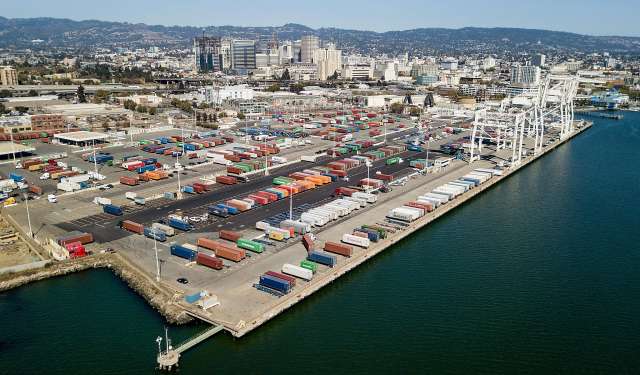
A town hall meeting this week examined the negative consequences of placing John Fisher’s privatized, multibillion dollar real estate development on publicly owned land at the Port of Oakland, the region’s thriving and growing economic engine.
More than 100 people attended the town hall on Wednesday, which was live on Zoom and Facebook. Councilmembers Carroll Fife and Noel Gallo were among those who attended.
Speakers included voices of those who are directly impacted by the project: members of the longshore union, the ILWU, who said the project was a dangerous threat to the livelihood of port workers, over 70% of whom are Black; representatives of the Pacific Merchants Shipping Association and several of the largest businesses based at the port; and Paul Cobb, publisher of the Oakland Post.
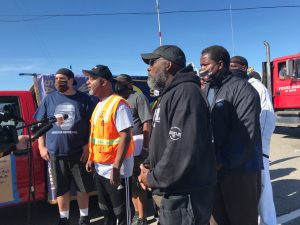
ILWU Local 10 President Trent Willis, with other union members, speaks on June 19, 2020 about shutting down West Coast ports for Juneteenth. Photo by Workers World, Judy Greenspan.
Though called a baseball stadium project, the massive, luxury real estate development is what backers have called a “city within a city.” Besides a stadium, the plan calls for 3,000 luxury condominiums, with no guaranteed affordable housing; 1.5 million square feet of high-rise office space; a 400-room hotel; retail shopping; and a performance venue with seating for 3,500.


Linda Adams, a member of the ILWU who is who is one of the workers “responsible for moving the cargo on a daily basis,” said, they are “compromising our jobs.”
“They say they can build these high rise luxury condos, and (we) can work around them. But we’re moving cargo around the clock, (with) thousands of (workers), trucks and cargo coming into the port.” She pointed out that luxury tenants will go to court to stop the noise, pollution, bright lights and thousands of daily trucks and railroads that are wrecking their days and nights, pushing companies to leave Oakland for other West Coast ports.
Susan Ransom, representing SSA Marine, the Port’s largest tenant, said the Port has over 84,000 total employees and moves the products on which everyone depends – food, household goods and medical supplies
“We have grave concerns about the A’s (stadium) project,” she said. ”We operate 24/7, (our work) would not be stopped during a game” or for a fireworks display.
Mike Jacob of the Pacific Merchants Shipping Association which represents employers, said, “We have real issue here. Do we want to preserve our industrial base? Do we want to make Oakland a smaller kid’s version of San Francisco? Should Oakland continue to be a blue-collar city with good blue-collar jobs.”
Jacob said he was talking with the A’s, but they stopped meeting with him in 2019 when he raised concerns that would be expensive to mitigate. “You don’t have to be either pro- or anti-baseball to be pro-port,” he said.
ILWU business agent Aaron Wright, broadcasting live from on top of a port crane, showed the basin where ships have to turn around, which would be impacted by the project, and the Howard Terminal property, where thousands of trucks park daily instead of where they parked in the past on West Oakland and other neighborhoods’ residential streets. “One day at the port can do more for the economy than all of the team’s home games,” he said. “You can’t bring in thousands of sports fans to block all of this.”
Andrea Luna Bocanegra, who works for a manufacturing company that does business with the port, said that disrupting shipping at the port would cause a ripple effect, damaging manufacturing businesses throughout Northern California that utilize the port as a dependable way to ship their products and the receive goods they need to run their operations.
Post publisher Paul Cobb said the newspaper has been discussing the different sides of this issue and hopes to help clear up the confusing messages the public is receiving about whether this project will help or damage the prospects of good jobs for Oaklanders.
Cobb displayed an Alameda Labor Council flyer promoting jobs for Blacks. He said “it’s encouraging to see Labor unions join the fight to hire and protect Black workers. By working together with civil rights groups we can finally expand the narrow definitions of PLA’s (project labor agreements) and redefine them as CLA’s (community labor agreements) that will hire Blacks and formerly incarcerated across all trades.”
“We are being lobbied on both sides of this issue,” he said. “Some say Howard Terminal is no longer vital to port operations, but others it very important to the economy” and to keep the port running daily.
A number of people submitted written comments during the Zoom meeting.
Housing rights activists James Vann wrote, “There are innumerable negatives from placing an A’s stadium at Howard Terminal. Can anyone name just one benefit from placing the stadium at this location within the Port?”
BART Director Robert Raburn, wrote, “A significant and unmitigated impact is public safety at the unprotected railroad grade crossings.”
“In addition to BART, I also serve on the governing board for the Capitol Corridor, which operates 30 passenger trains. a day on West Embarcadero (and) another 20 trains deadhead to the Amtrak yard each day,” he said.
“No stadium in the US permits postgame crowds of up to 35,000 to risk crossing mainline railroad tracks at-grade! The costs to mitigate these hazards are not included in the (A’s) ‘term sheet.’”
Organizers of the townhall are asking community members to attend the City Council meeting Tuesday, July 20. The council will consider voting on a non-binding resolution regarding the term sheet for the development. Public comment begins at 9 a.m.
People are encouraged to email council members at https://form.123formbuilder.com/4755450/
The video of Wednesday’s town hall can be watched on Facebook at https://fb.watch/6M9NiSMAxc/








To enlarge your view of this issue, use the slider, magnifying glass icon or full page icon in the lower right corner of the browser window.

Activism
Oakland Post: Week of September 30 – October 6, 2026
The printed Weekly Edition of the Oakland Post: Week of September 30 – October 6, 2026


To enlarge your view of this issue, use the slider, magnifying glass icon or full page icon in the lower right corner of the browser window.
Activism
Oakland Post: Week of September 23 – 29, 2026
The printed Weekly Edition of the Oakland Post: Week of September 23 – 29, 2026

To enlarge your view of this issue, use the slider, magnifying glass icon or full page icon in the lower right corner of the browser window.


WCCUSD Joins Statewide Organic School Food Purchasing Cooperative

Democrats, Community Groups Back Measure EE to Change How Oakland Is Governed

Four Tips to Help You Plan a Holiday “Staycation”

Veterans Housing Project Proposed for South Richmond
PRESS ROOM: Transformative Justice Coalition 2026 Voting Rights Champion Awards Reception ‘Yesterday Is Today: The Battle For Voting Rights

Mayor Lee Delivers 2026 State of the City Address: ‘Oakland Continues to Be on the Move’

Oakland Awarded More than $14 Million in State Funding

Jendayi Arrest Raises Community Concerns Regarding Sheriff’s Chain of Command

Marin County Supes Expand Small Business Options with Home Kitchen Pilot Program

Allen Temple Baptist Church Hosts Free Prostate Cancer Screenings on Oct. 17

AC Transit Labor Unions Back Director Joel Young

Locals Can Get Locally Grown Produce Delivered Through Urban Tilth

‘ICE-Free Marin’ Supporters Press Supervisors as County Drafts Enforcement Restrictions

Oakland Post: Week of October 7 – 13, 2026

Ghana’s Ministry of Foreign Affairs Publishes Global Circle’s Vatican Reparations Call in Special Edition Alongside Heads of State

Misnamed ‘Parent’ PAC Seeks to Influence Oakland School Board Elections

Oakland Post: Week of September 2 – 8, 2026

Oakland Post: Week of September 9 – 15, 2026

Richmond Tiny House Village Farm & Garden Set to Open Gates on Sept. 26

Latest Massacre in Haiti Reveals Cruelty U.S. Deportations

OPINION: Nolan Wells’ Death One of Several Signifying Racial Terror Lives on in U.S. South

Poll: Becerra Widens His Lead Over Hilton; Californians Split on Wealth Tax

Mayor Lee Announces $1 Million Kaiser Permanente Grant for Pilot Program to Address Homelessness, Clean Up Public Spaces throughout Oakland

County Office of Education Says OUSD Finances Are Getting Healthier, Materially Stronger

Democratic Clubs Interview Candidates for Oakland School Board

Oakland People’s Arms Embargo Coalition Demands End to Military Shipments Thru Oakland

Oakland Post: Week of September 16 – 22, 2026

BLACspace Cooperative Invites Bay Area to Experience Oakland’s Black Cultural Ecosystem Through a BLAC Map Tour + Party

Two Looming Threats Every Alameda County Elder Should Know About

Zakiya Jendayi Arrested, Locked Out of Home by Sheriff’s Deputies

The Conversation With Al McFarlane 6/23/26

Media Monday 6/22/26

LIVE! ASK ALMA! — TUES. 6.23.26 7PM EST

Car Buying Secrets: 4 Hidden Checks Before You Sign!

Is This 550 HP Charger Worth YOUR Money? AutoNetwork Review

Celebrating Juneteenth – Frederick Douglass on education and resistance

LIVE! — ASK ALMA! — TUES. 6.19.26 7PM EST

Hyundai Ioniq 5 Parking, Safety, and 360 View #shorts

2025 Ioniq 5 New Wiper & Powerful Performance! #shorts

Electric SUV Range: Is 259 Miles Enough? #shorts

EV Charging: How Fast Can You Charge an Electric Vehicle? #shorts

Biometric Cooling… Messaging Seats…Come on! 2025 Infiniti QX80 Autograph 4WD

Charged Up: Witness the Magic of a Fully Electric Car! #shorts

Range Rover Sport PHEV Included…: See What’s Inside This Luxury SUV! #shorts

Invisible Hood View: Perfect Parking with X-Ray Vision! #shorts
-
 Economy3 weeks ago
Poll: Becerra Widens His Lead Over Hilton; Californians Split on Wealth Tax
-
 Business3 weeks ago
Mayor Lee Announces $1 Million Kaiser Permanente Grant for Pilot Program to Address Homelessness, Clean Up Public Spaces throughout Oakland
-
 Business3 weeks ago
County Office of Education Says OUSD Finances Are Getting Healthier, Materially Stronger
-
 Uncategorized3 weeks ago
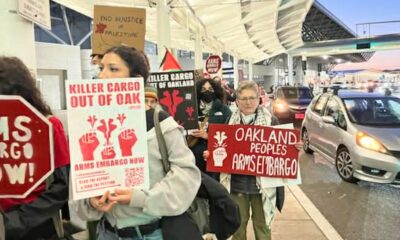
Oakland People’s Arms Embargo Coalition Demands End to Military Shipments Thru Oakland
-
 Activism3 weeks ago
Oakland Post: Week of September 16 – 22, 2026
-
 Art3 weeks ago
BLACspace Cooperative Invites Bay Area to Experience Oakland’s Black Cultural Ecosystem Through a BLAC Map Tour + Party
-
 Community3 weeks ago
Two Looming Threats Every Alameda County Elder Should Know About
-
 Lead Story2 weeks ago
Zakiya Jendayi Arrested, Locked Out of Home by Sheriff’s Deputies
