
Entertainment
The Whitewashing of Allison Ng: ‘Aloha’ Isn’t Alone in Casting White Actors in Asian Roles


Benedict Cumberbatch, Emma Stone, Scarlett Johansson (Paramount Pictures/Columbia Pictures/AP/Jordan Strauss)
Like Cumberbatch as Khan and ScarJo in “Ghost in the Shell,” Emma Stone isn’t Asian, just playing one on film
(Salon) – During the ‘00s – the aughts — it used to be that blockbuster summer films popped an Asian guy into its cast (“we ought to have an Asian guy”) and made sure he was dead before the final credits. (“We ought to have a Meaningful Death here. Let’s kill him off!”) I called this guy the Expendable Asian Crewmember, in reference to the security officer in the ‘60s television version of “Star Trek,” the red-shirted extra fans referred to as the “Expendable Crewmember” because he was sure to get phasered into oblivion after beaming down onto the hostile planet. Now that we’re halfway through the teen years of our 21st century, Hollywood has developed a kinder, gentler way of making sure that only white heroes are left standing by the end: it tells you the character is Asian, but casts a blindingly white actor to play him/her/them.
Apparently, when film producers are presented with the problem of casting a bankable Asian male, the first actor that springs to mind is Benedict Cumberbatch. When he is unavailable, the next best option is … Tilda Swinton? A woman who did a very good job playing an archangel named Gabriel and even better job playing a vampire is now in talks to play a male Tibetan mystic to round out her “androgynous immortal” portfolio.

This latest batch of white actors playing Asian characters is different from the (formerly heinous, insultingly clumsy) attempts at yellowface, blackface, and redface that used to plague Hollywood, because no attempt has been made to change the appearance of their features. The history of the most racist yellowface castings is well-trodden ground: Mickey Rooney as a Japanese neighbor, Marlon Brando as a Japanese interpreter, John Wayne as Genghis Khan — that kind of obvious yellowface makes Millennial eyeballs burn from the cinematic Sriracha being squirted into them. Nowadays, pancake makeup and cheap prosthetics are far too crude. Today’s sophisticated viewers are postmodern, and the burn is far more subtle. Polite people are not supposed to notice that the radiant white actor playing a person of color is, in fact, not a person of color. And if you do notice? Well, making a big deal out that actor’s blonde whiteness means you’re bigot. (Heck, you might even be a thug.) If Tilda tells you earnestly that she is playing an Asian male and you respond in confusion, “You don’t look Tibetan,” then you’re the troll unable to accept all forms of identity, race and gender included, as a cri de coeur of self-determination.









Activism
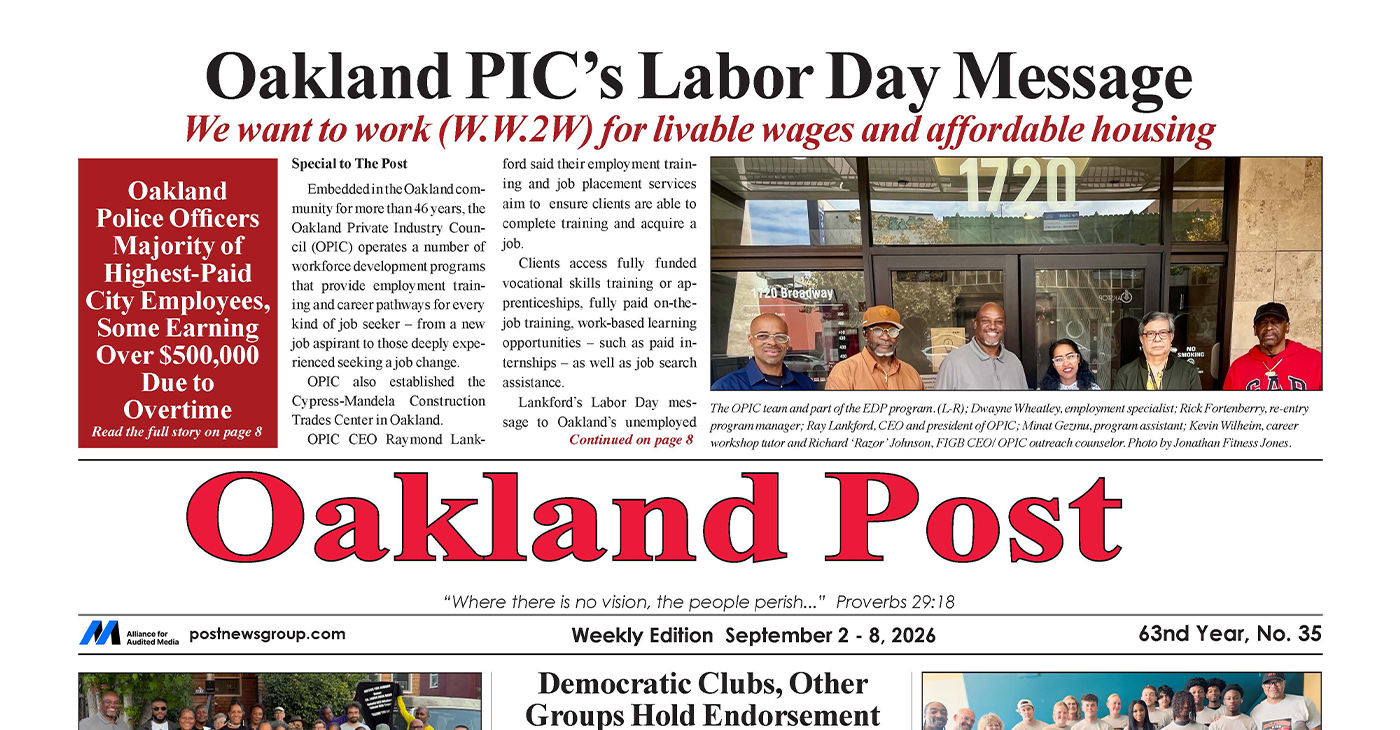
Oakland Post: Week of September 2 – 8, 2026
The printed Weekly Edition of the Oakland Post: Week of September 2 – 8, 2026
To enlarge your view of this issue, use the slider, magnifying glass icon or full page icon in the lower right corner of the browser window.
Black History
Jackie Wright Champions Bay Area Stories, Filmmakers and Cultural Institutions
As an award-winning communications professional, Wright has worked with corporations, nonprofits, government agencies, educational institutions, artists, and community organizations. In 2026, she expanded that work by launching an introductory public relations class for small businesses and nonprofits, offering practical tools for gaining visibility, shaping messages and building productive relationships with the media.

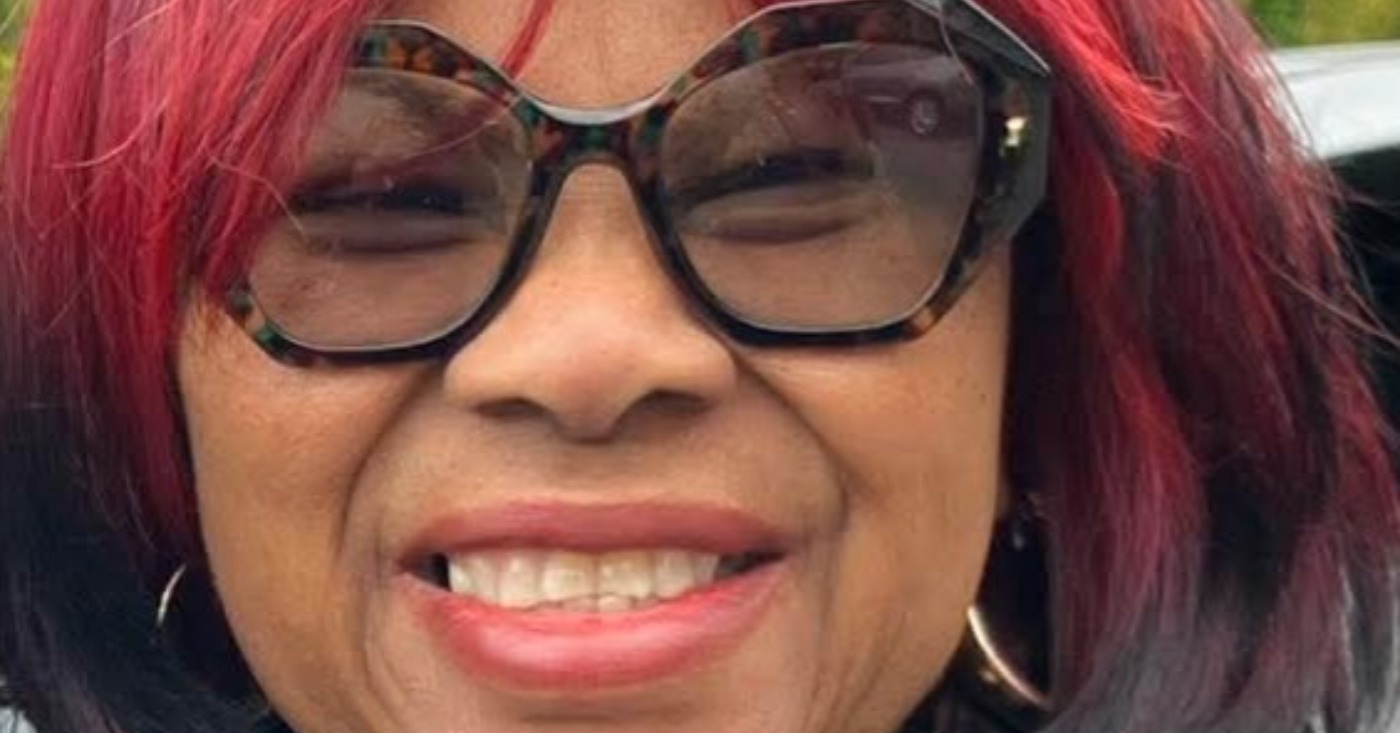
Jackie Wright has spent more than two decades helping people, organizations and communities understand the power of a well-told story.
As founder and president of Wright Enterprises, a San Francisco-based strategic communications and public affairs firm, Wright has built a career spanning journalism, public relations, media relations, crisis communications, community engagement and multimedia storytelling.
As an award-winning communications professional, Wright has worked with corporations, nonprofits, government agencies, educational institutions, artists, and community organizations. In 2026, she expanded that work by launching an introductory public relations class for small businesses and nonprofits, offering practical tools for gaining visibility, shaping messages and building productive relationships with the media.
Wright’s commitment to storytelling is also deeply personal. She wrote and co-directed the 15-minute documentary, “Love Separated in Life…Love Reunited in Honor,” which chronicles the story of her parents, Specialist Five (S5 Wyley Wright Jr. and Ouida Fay McClendon Wright. Her father, a U.S. Army helicopter crew chief, died in Vietnam in 1964 while serving as an honor guard during a visit by then-Secretary of Defense Robert McNamara. Decades later, Wright and her siblings had their father exhumed from a segregated cemetery in Jacksonville, Florida, and their mother moved from her burial place in Georgia so the couple could be reunited at Arlington National Cemetery in 2014.

The family journey later took Wright and her sister to Vietnam, where they discovered the former military compound that had been named in honor of their father and another fallen soldier. The documentary, centered on love, war, family, racial understanding, and remembrance, earned festival recognition at screenings.
“It was quite an honor to learn about my family’s history and share it on film,” said Wright.
That filmmaking experience complements Wright’s longstanding advocacy for independent cinema. She has served as a media partner and brand ambassador for Bay Area film festivals, including the San Francisco Black Film Festival, Oakland International Film Festival, and the Durban International Film Festival in South Africa.
“It’s important to help filmmakers and underrepresented stories reach broader audiences,” said Wright.
Whether promoting a neighborhood organization, championing an independent filmmaker or preserving her own family history, Wright has remained consistent. Through Wright Enterprises, she has turned communications into both a profession and a form of community service, telling stories that might otherwise go unheard.
“Our stories are an integral part of our history, and our history is not only American history, but worldwide,” she said.

Activism
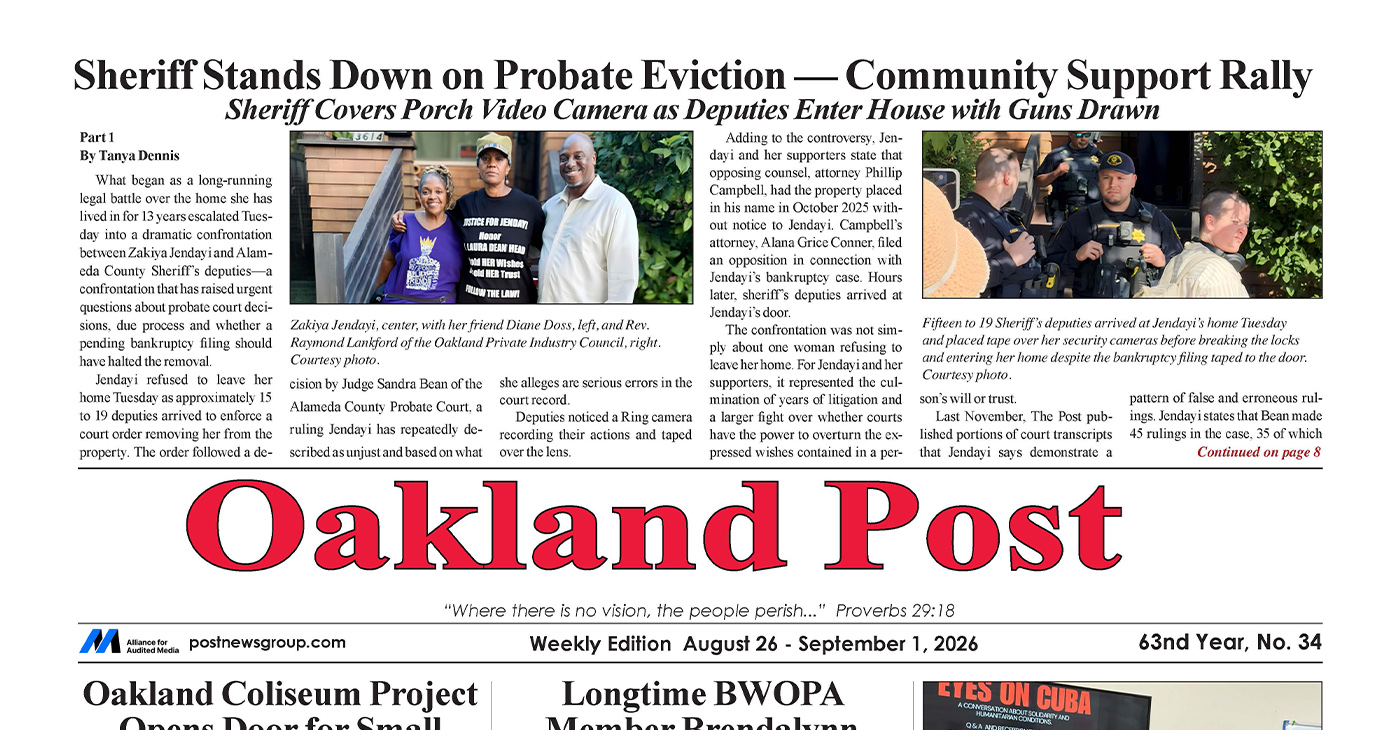
Oakland Post: Week of August 26 – September 1, 2026
The printed Weekly Edition of the Oakland Post: Week of August 26 – September 1, 2026
To enlarge your view of this issue, use the slider, magnifying glass icon or full page icon in the lower right corner of the browser window.


Prostate Cancer is Twice as Likely to Kill Black Men. Talking to Your Doctor Could Help Save Your Life

Oakland Post: Week of September 2 – 8, 2026

Longtime BWOPA Member Brendalyn Goodall Appointed to California Workforce Development Board

Jackie Wright Champions Bay Area Stories, Filmmakers and Cultural Institutions

Chef Sharon Lee Blends Culinary Excellence, Education and Empowerment

‘Passing a Law Isn’t The Finish Line’: California Assembly Evaluates Implementation, Results

OPINION: Angie Nixon Will Turn You Into a Democratic Socialist If Donald Trump Hasn’t Already

Gov. Newsom Signs Law Shielding Immigration Aid Workers From Doxing Threats

BOOK REVIEW: Every Inch of a Lady

Big City Mayors Ask for “Yes” Vote on Housing Bond Measure; Conservatives Say “No”

Madeline M. Turner: The Inventor Who Made Juicing Easier

Gubernatorial Candidate Steve Hilton Blasts California New Tire Rules; Newsom Hits Back

Frontier Airlines’ Return to Oakland Airport Brings Flights, Jobs and Opportunity

Secretary of State Shirley N. Weber Urges Californians to Vote Early as Voter ID Battle Intensifies

Gov. Newsom’s Latest Appointees Include Sacramento Advocate for Formerly Incarcerated Students; State’s New Tech Chief

Department of Homeland Security Demands California Secretary of State Shirley N. Weber Scrub Voter Rolls

New Judge Could Decide if Karmelo Anthony Gets a New Trial

“The Power to See Threats Sooner”: Gov. Newsom, Safety Officials Showcase California’s Investments in Hi-Tech Wildfire Prevention

Alpha Kappa Alpha Sorority, Inc. Celebrates New North Atlantic Regional Director

California Sen. Padilla Joins Colleagues to Introduce Bill Imposing Term Limits on Supreme Court Justices

Less Affluent School Districts, Including Sacramento City, Face Threat of State Takeover

Car Wash Workers Cope with Lingering Impacts of ICE Raids

COMMENTARY: You Are Already Paying for the AI Boom

California Bill Would Let Abuse Victims Use Trauma as Legal Defense for Violent Crime

Oakland Post: Week of July 29 – August 4, 2026

How Oakland’s Courtsmith is Scaling its Business and Local Impact

ESSAY: California Can Close Its Colorectal Cancer Gap

As Part of Your Back-to- School Checklist, Vaccinate

Oakland Post: Week of August 5 – 11, 2026

Oakland ‘Port Serves as a Powerful Engine for Good Jobs and Economic Development

The Conversation With Al McFarlane 6/23/26

Media Monday 6/22/26

LIVE! ASK ALMA! — TUES. 6.23.26 7PM EST

Car Buying Secrets: 4 Hidden Checks Before You Sign!

Is This 550 HP Charger Worth YOUR Money? AutoNetwork Review

Celebrating Juneteenth – Frederick Douglass on education and resistance

LIVE! — ASK ALMA! — TUES. 6.19.26 7PM EST

Hyundai Ioniq 5 Parking, Safety, and 360 View #shorts

2025 Ioniq 5 New Wiper & Powerful Performance! #shorts

Electric SUV Range: Is 259 Miles Enough? #shorts

EV Charging: How Fast Can You Charge an Electric Vehicle? #shorts

Biometric Cooling… Messaging Seats…Come on! 2025 Infiniti QX80 Autograph 4WD

Charged Up: Witness the Magic of a Fully Electric Car! #shorts

Range Rover Sport PHEV Included…: See What’s Inside This Luxury SUV! #shorts

Invisible Hood View: Perfect Parking with X-Ray Vision! #shorts
-
 Community4 weeks ago
Less Affluent School Districts, Including Sacramento City, Face Threat of State Takeover
-
 Commentary4 weeks ago
ESSAY: California Can Close Its Colorectal Cancer Gap
-
 Business4 weeks ago
California Hispanic Chambers of Commerce Unveils: ‘Powering the Future’ Theme for 47th Annual Statewide Convention
-

 Community4 weeks ago
Four Candidates, Including Incumbent Barbara Lee, Qualify for Oakland Mayor’s Race
-

 Business4 weeks ago
From Blueprint to Breakthrough: Tackling Affordable Housing in Oakland
-
 Activism4 weeks ago
Oakland Post: Week of August 12 – 18, 2026
-

 Black History4 weeks ago
Oakland Observes Black August with Block Parties, Film Showings, Workshops
-

 Commentary4 weeks ago
COMMENTARY: Why Local School Tax Measure G1 Will Not Be on the November Ballot
