
Entertainment
#CHIRAQ: More Than Just a Nickname, a Shameful and Tragic Reality for Many


A new movie, second term for mayor and summer approaching has all eyes on Chicago’s politicians, police, people, and body count
by Ashahed M. Muhammad
Special to the NNPA from The Final Call
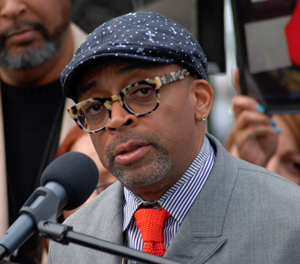
Filmmaker Spike Lee speaks at a press conference in Chicago after he came under fire for the working title of his next project is “Chiraq.”Photo: Haroon Rajaee
|
CHICAGO (FinalCall.com) – On Monday, May 18, Rahm Emanuel stood on stage at The Chicago Theatre, a landmark located on State Street in the famed Loop, to take the oath of office beginning his second term as mayor.
To all the pomp and circumstance—and with a heavy police presence throughout the entire area—the city’s political elite gathered in the city’s business center, to hear Mayor Emanuel’s vision for the future. In striking contrast to that scene, during the previous weekend 49 people were shot in Chicago. The vast majority of them in what are considered high-crime areas on the city’s South and West sides.
“Building a future requires us to focus on a difficult subject that is too often ignored during our civic conversation. It is ignored precisely because it is so hard to talk about,” said Mayor Emanuel seeming to have been stung by criticism during the most recent election painting him as a snobbish mayor responsive only to the rich and powerful with business interests in the city. In fact, his vanquished opponent, Jesus “Chuy” Garcia described Emanuel as the mayor of “the big money guys” which struck a nerve with many voters.


Chicago Mayor Rahm Emanuel
|
“I want to use this moment to shine a spotlight on preventing another lost generation of our city’s youth,” Mayor Emanuel said. “We all know who they are, although it is easier sometimes and more convenient to ignore them. Many are born into poverty, many come from broken homes, many have been on their own from very early on, and as a result, many of them drop out of school and therefore are jobless.”
He said many of these disconnected youth “lack the spark of hope” in their eyes and find lack of opportunity at every turn.
“The faces of these lost and unconnected young men and women are often invisible until we see them in a mugshot as a victim or the perpetrator of senseless violence. Their existence is avoided rather than confronted. They live in the shadows of our cities and in the recesses of our minds, but we must make them ever-present in our conversation. Too many of them become the victims of their circumstance,” Mayor Emanuel said.
Nice sounding words, but many are asking what he is planning to really do to change those circumstances. Can the mayor responsible for the closure of dozens of public schools—mainly in neighborhoods populated by Blacks and Latinos—really be responsive to the needs of the youth in areas where their support group is a street organization, and where praise from parents and teachers is almost non-existent?
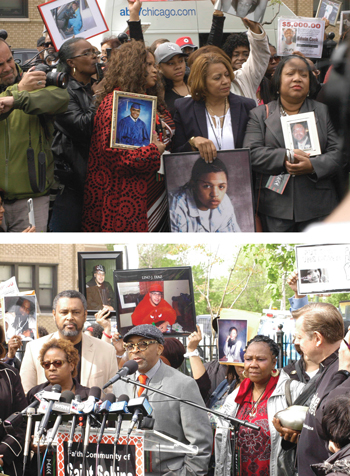
Many mothers who have lost their children to gunfire in Chicago joined Spike Lee and Father Michael Pfleger of the Faith Community of Saint Sabina to discuss the issues facing Black youth. Photos: Haroon Rajaee
|
Over the past few years, many have begun to refer to the city of Chicago as “Chiraq” comparing it to the war torn nation in the Persian Gulf. Hip-Hop albums and documentaries dealing with crime in the city have used it in titles, and for many of the youth, it has become something of a badge of honor to describe the strength it takes to survive in areas that resemble war zones.
Many believe “Chiraq” is a shamefully dishonorable designation with only negative associations and impact. Chicago Alderman Will Burns has even attempted to block tax breaks for acclaimed filmmaker Spike Lee’s company, 40 Acres and a Mule Filmworks, because an upcoming film he is shooting in Chicago has “Chiraq” as its working title.
Eric Wilkins is president of the Broken Winggz Foundation, an anti-violence support group for those who have been paralyzed by gunshots. Mr. Wilkins said there is the Chicago represented by the lights and tall buildings of downtown, then there is the Chicago made up of infamous areas with names like “Terror Town” and the “Wild Hundreds” that make up “Chiraq.”
“That’s exactly what it is. It is out here and ain’t no use in trying to get around it, you can sugarcoat it all you want to. You got kids that can’t cross the street! It’s saddens me that this is what we’ve become but it didn’t happen overnight,” said Mr. Wilkins. “You got these kids that get guns like you get Jimmy John’s (sandwiches), so if you never leave a four block radius and you never run out of bullets—what’s the real plan? And that’s the part they don’t want told,” Mr. Wilkins added.
Militarization & targeted surveillance

Anti-police brutality activists are of the opinion that the Chicago Police Department is one of the most highly militarized departments in the country.
|
Illinois is one of the states, according to the Department of Defense, to have received several Mine Resistant Ambush Protected armored vehicles (MRAPs). Additionally, The American Civil Liberties Union has identified 52 agencies in 21 states—of which Illinois is one—that own stingray tracking devices. Stingrays are also known as “cell site simulators.” The ACLU reports they “are invasive cell phone surveillance devices that mimic cell phone towers and send out signals to trick cell phones in the area into transmitting their locations and identifying information. When used to track a suspect’s cell phone, they also gather information about the phones of countless bystanders who happen to be nearby.”
It is believed this technology has been used in an overly broad manner in cities that have seen large protests, such as Ferguson, Missouri, Baltimore, Maryland, and New York, to keep track of protest organizers, eavesdrop on their plans and conduct warrantless surveillance on those using cell phones for voice or text communication in the targeted area. According to court records it was noted by the ACLU and the Electronic Frontier Foundation that stingray devices can also cause dropped cell phone calls, and disrupt other mobile devices that use the same cell network. The EFF called use of the technology tool an “unconstitutional, all you can eat data buffet.”
Black sites & torture—in Chicago
After September 11, 2001, the United States government stripped civil liberties, changed laws and created others with the publicly stated goal of preventing another deadly terrorist attack. During the administration of George W. Bush, he and his powerfully influential vice-president Dick Cheney used the euphemism “enhanced interrogation techniques” to describe what most would refer to as torture.
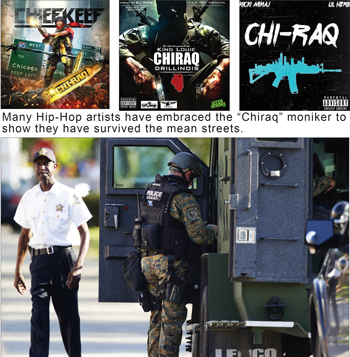
Police don body armor as authorities negotiate with two men who are barricaded in a home and holding a woman and five children hostage in Harvey, Ill., Aug. 19, 2014, south of Chicago. Officials say two Harvey police officers were wounded by gunfire Tuesday afternoon in the incident after responding to a call about a burglary. ‘You got these kids that get guns like you get Jimmy John’s (sandwiches), so if you never leave a four block radius and you never run out of bullets—what’s the real plan? And that’s the part they don’t want told.’ |
These techniques were used at many “Black sites” which are secret prisons located in various spots across the globe. Those determined to have knowledge of logistical information regarding the whereabouts of “high value targets” or potential terrorist operations became victims of “extraordinary rendition”—essentially kidnapping—and would be taken to these black sites and subjected to torture, in violation of international laws. A classified 2001 presidential directive granted these wide-ranging powers to the Central Intelligence Agency to detain individuals and take them to undisclosed locations.
If that is objectionable, then what about the recent revelation that the Chicago Police Department operated what activists say effectively could be considered a black site at a location known as Homan Square? After all, it is widely known that members of the Chicago Police Department have used “enhanced interrogation techniques” in the past. A $5.5 million reparations package, was approved unanimously by the Chicago City Council delivering a measure of justice for the approximately 120 Black men and women subjected to torture, which included electric shock to the genitals, mock executions, suffocation, and brutal beatings directed by the notorious former Chicago Police Commander Jon Burge and carried out by his henchmen from 1972 through 1991.
Forced confessions resulted in many young Black men in Chicago being implicated in crimes and sent to the penitentiary for crimes they did not commit. In the same manner, the argument rages as to whether torture of suspected terrorists yields “actionable intelligence” or simply results in an individual saying what his captors would like to hear in order to end the physical pain and mental anguish.
In many homicides in the city, the suspects are overwhelmingly Black, the victims are overwhelmingly Black, and their deaths are seen in areas considered fratricidal conflict zones, another uncanny similarity to the sectarian violence seen overseas.
What’s in a name? Economics
Many reacted in disbelief when the Chicago Urban League reported in 2014 that 92 percent of Black males between the ages of 16 and 19 were jobless. So far, in the first few months of 2015, homicides are up from the same period the previous year, and now, as summer approaches, many fear the worse. It is almost considered an irreversible reality that Memorial Day weekend—the unofficial start of summer—would result in widespread shootings and war-zone like casualty numbers.
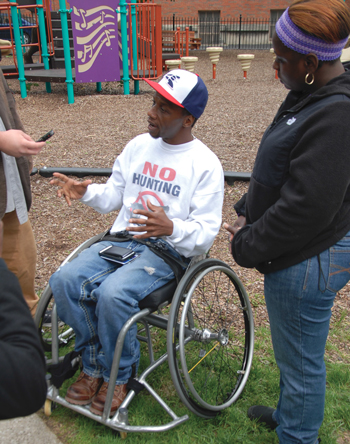
Eric Wilkins is president of the Broken Winggz Foundation, an anti-violence support group for those who have been paralyzed by gunshots
|
The predictions came true. Over the holiday weekend, 12 were shot and killed while at least 56 others were wounded. Many of them teens, the youngest victim, a 4 year-old girl.
It is into that atmosphere that acclaimed filmmaker Spike Lee faces criticism related to his upcoming project with the working title: “Chiraq.” Mr. Lee faced so much criticism he was forced to hold a May 13 press conference to address concerns of community members and politicians that his film would paint an unflattering view of Chicago, focusing only on crime.
Interestingly, from April 30 to May 2, Chicago’s Grant Park was transformed into “Draft Town.” National Football League executives, players and football fans traveled here to participate in several days of festivities in the middle of downtown. Police were visible, but not overbearing, and the event was fun for all ages. In terms of economic impact, financial analysts estimate the three days of activities brought in over $200 million.
“This has nothing to do with Chicago losing tourism. This is not about Chicago losing business,” said Mr. Lee. “Let’s not put property and profit over human life,” he added.
Chicago Bulls’ All-Star center Joakim Noah who was honored with the National Basketball Association’s 2015 J. Walter Kennedy Citizenship Award for his anti-violence work through the Noah’s Arc Foundation expressed support for Mr. Lee’s continued peace efforts by other organizations.
“I realize the title Chiraq could be perceived as a glorification of violence, but the reality of what is happening in the city of Chicago is not something any of us should hide from,” Mr. Noah said in a statement.
Kublai Toure, executive director of Amer-I-Can’s Illinois chapter, said what happened with Draft Town shows the different realities experienced by those that have the resources and have investments in the stock of the city and those who need resources and investments. Mr. Toure supports Mr. Lee’s efforts but said he has to bring in the peacekeepers and violence interrupters who work with the street organizations to make sure the full story is told.
“He’s got to get some men in there that’s actually been involved—and that’s who I represent,” said Mr. Toure.
Clearly, Gun manufacturers are profiting, security companies are profiting, and speedy gentrification efforts are seen in some of the most economically starved areas of Chicago, with real estate speculators making a killing, just like private contractors in global conflict zones overseas became rich receiving no bid contracts to rebuild that which was destroyed. America’s leading defense contractors such as Lockheed-Martin, Boeing, Northrop Grumman, Raytheon and BAE Systems are experiencing healthy profits resulting from seemingly endless wars.
Father Michael Pfleger, leader of the Faith Community at Saint Sabina stands with many mothers who have lost children to gun violence. As of May 25, there have been 883 shootings in 2015.
“We must face the reality of what’s going on not just in Chicago but going on across America,” said Father Pfleger. “Violence is real in America and we must face the reality. We must face the reality of guns in America where it’s easier in so many neighborhoods to get a gun than a computer. We’ve got to deal with the reality of guns and the proliferation of guns in this country and those that are making money off of guns. We can’t ignore this reality. This is proof of the reality” he added.
Although the subject is painful, Father Pfleger said there is value in dealing with it directly, and in his view, Spike Lee is the man for the job because of his proven track record in making thought-provoking films that courageously confront community issues.
“We’re not painting a city, we’re painting a reality that’s difficult, and it’s hard,” said Father Pfleger. “A man who is an African-American director and one of the best directors in America, who did casting in an African-American community, who is hiring from the African-American community, dealing with African -American issues, sounds real right to me,” he added.
Many of the mothers were critical of politicians who seem to care more about the city’s image than the lives of Black youth. The mothers all told tragic stories filled with pain. Instead of going to graduations, many of them are going to cemeteries to visit the graves of their dead children.
“I hear a lot of energy being put toward (discussing) the movie but place that same energy behind our children and their lives,” said Pamela Bosley, whose son Terrell was shot down in the parking lot of his church while unloading musical equipment. She leads an organization Purpose Over Pain which is a support group made up of parents who have lost children to violence. “No grounds are safe in Chicago. There are so many stories …I know you are saying ‘this is not a war zone’ but in my neighborhood, it sounds like a war zone to me!”
Brenda Mitchell also works with the organization. She had two sons. One son, Kelvin, actually fought in Operation Iraqi Freedom and survived three tours of duty. He is still alive, however, her other son Kenneth was killed in Chicago.
“For me, that is my reality. It is an irony that I would send a son to settle someone else’s freedom and lose my other son in a free country—it’s real,” said Ms. Mitchell.
“When I made ‘Doing the Right Thing’ there were people who said this film would cause riots all across America. That Black people were going to run amuck. People wrote that this film would stop David Dinkins from being the first African-American Mayor of New York City,” said Mr. Lee. “They wrote a whole bunch of things, but those people ended up being on the wrong side of history and the same is going to happen here in Chicago. They are going to look stupid and be on the wrong side of history. We’re here for peace, and we have to stop this,” Mr. Lee said.








Business
From Historic Memories to New Possibilities: Oakland Celebrates Coliseum 60
More than 75 people gathered at Youth UpRising in East Oakland on Friday, September 18, for Coliseum 60, an event marking six decades of sports, entertainment, employment, and community memories at the Oakland-Alameda County Coliseum Complex. Held 60 years to the day after the Coliseum first opened, the celebration featured cultural performances and a mini-documentary highlighting its history. Speakers reflected on the venue’s significant role in the community and its future possibilities. Read more to learn about the individuals and stories honored during this special event.

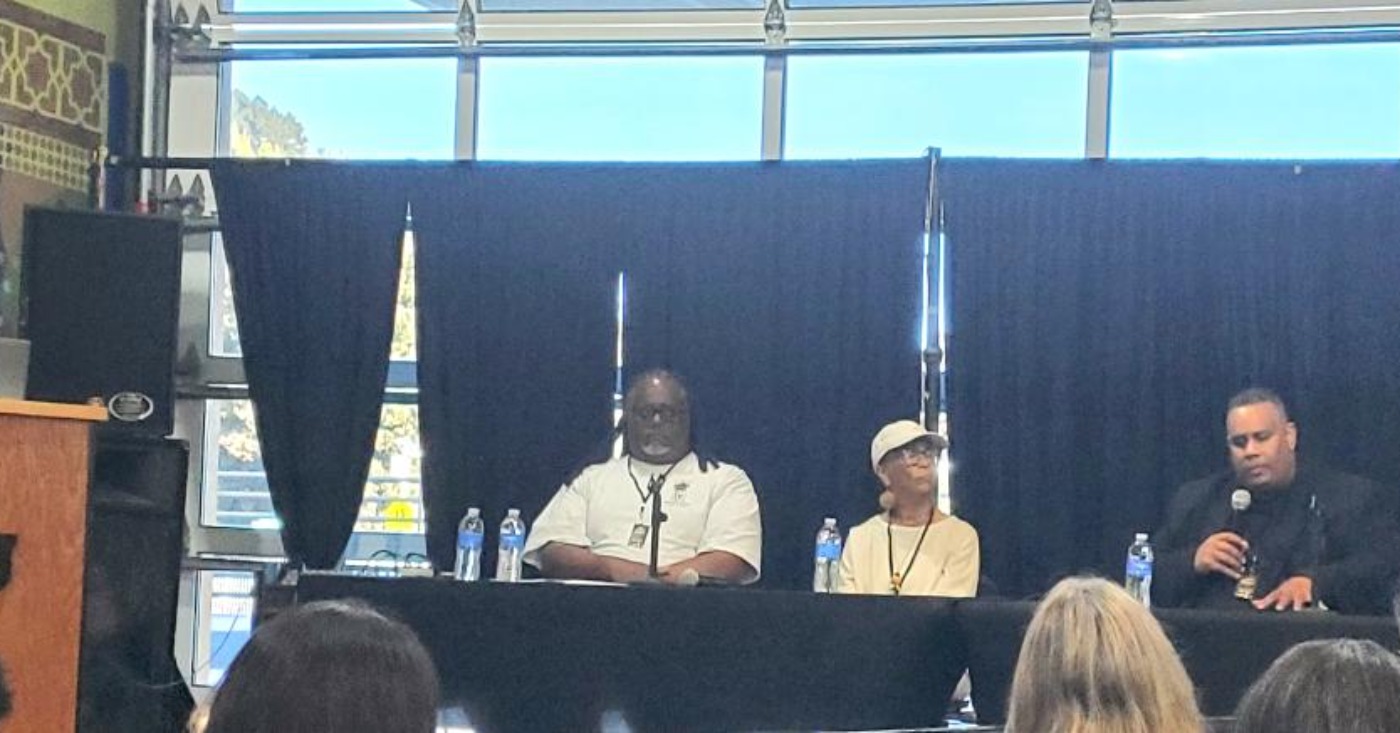
More than 75 people gathered at Youth UpRising in East Oakland on Friday, Sept. 18, for Coliseum 60, a celebration honoring six decades of sports, entertainment, employment and community memories connected to the Oakland-Alameda County Coliseum Complex.
Held 60 years to the day after the Coliseum opened, the event carried the theme, “One Community. One Legacy. One Future. Forward Together.”
The celebration opened with the national anthem performed by sisters Anese Jade, Amina Benjamin and Zaza Benjamin. Diamano Coura West African Dance Company contributed African dance and drumming, bringing movement, rhythm and cultural expression to the program.
A mini documentary highlighted the Coliseum’s sports history and its broader role as an entertainment destination. Archival material recalled performances by Prince and Tina Turner, along with memorable games featuring the Warriors, Oakland A’s and Raiders.
“The Coliseum 60 is about much more than celebrating a building or looking back at 60 years of history,” said event organizer Quixote Atkins of VillageGIVE.
“It’s about the people who made that history possible: the families, workers, athletes, artists, community leaders, fans and generations who gathered there and created memories together.”
A panel exploring that history featured author, historian and former Black Panther Party member Tareka Lewis; stagehand and union representative Keith Brown; and Ray Bobbitt, president of the African American Sports and Entertainment Group AASEG. Lewis described her family as fourth-generation Bay Area pioneers.
“My family and Black families who arrived even earlier helped build the Bay Area, grew businesses and established culture here,” Lewis said. “This should be taught in the public schools.”
Lewis recalled Oakland’s influence on sports, music and literature, from the Raiders’ beginnings at Laney College to stars such as The Pointer Sisters and Rickey Henderson who attended Oakland public schools. She also advocated for school museums, historical timelines, entrepreneurship training and investments benefiting corridors such as Bancroft Avenue and High Street.
Keith Brown, a member of Local 107 of the International Alliance of Theater and Stage Employees (IATSE) who began working at the Coliseum in 2011, remembered the Ringling Bros. and Barnum & Bailey Circus, the Ice Capades, baseball bat giveaways and Nelson Mandela’s 1990 appearance.
“The special events are amazing, but it’s the workers that make the memories real for everyone,” Brown said. “They make the magic happen at the Coliseum.”
The program recognized longtime workers, including beer-stand manager Robert Preston, who served for 40 years, and Kenyatta Gentry, who worked as a vendor for 24 years and used her earnings to purchase her first apartment. Union workers Jose Gonzales and Carmen Sandoval were also honored. Speakers emphasized that Coliseum employment provided generations of residents with union wages and benefits.
Dr. Denise Saddler, the superintendent of the Oakland Unified School District (OUSD) was also honored. Saddler shared her family’s history of working at the Coliseum.
District 7 Oakland City Councilmember Ken Houston discussed the complex ownership arrangements involving the city, county and private interests.
“This was the most complex deal of its kind in the country,” Houston said.
Prior to moving from the East Coast, Alameda County Supervisor and Coliseum Joint Powers Authority Chair Nate Miley recalled learning about Oakland through its three professional sports teams. As an elected official and public servant, Miley fought hard to keep the Golden State Warriors, Oakland As, and the Raiders, but he is hopeful for the future.
“The story is not over for the Coliseum,” Miley said. “We’re entering a new chapter.”
Bobbitt said the departure of three teams had once seemed unimaginable, but he maintained that Oakland’s future remains bright.
“Oakland is a cultural superpower worldwide,” Bobbitt said. “We’re going to write the future where we participate and drive the redevelopment.”
Bobbitt highlighted AASEG’s four-year partnership with Castlemont High School’s architecture program, which engages students in reimagining and creating redevelopment concepts for the Coliseum property. “The youth will always move us forward. They are the future.”
In closing, Atkins said, “September 18 is the celebration, but what we build together afterward is the legacy.”

Activism
Oakland Post: Week of September 23 – 29, 2026
The printed Weekly Edition of the Oakland Post: Week of September 23 – 29, 2026

To enlarge your view of this issue, use the slider, magnifying glass icon or full page icon in the lower right corner of the browser window.
Books
BOOK REVIEW: ‘Laws of Solomon’ Reveals Tender Heart of Former Child Soldier
The monsters that came to him early in his sleep were the easy ones. It was the later demons that stole Solomon Nangobi’s sleep, the spirits of all the people he killed when he was a child soldier in Uganda, and when he was a fixer in New York as an adult. Their ghosts called to him with urgent voices, though he left that life behind long ago.
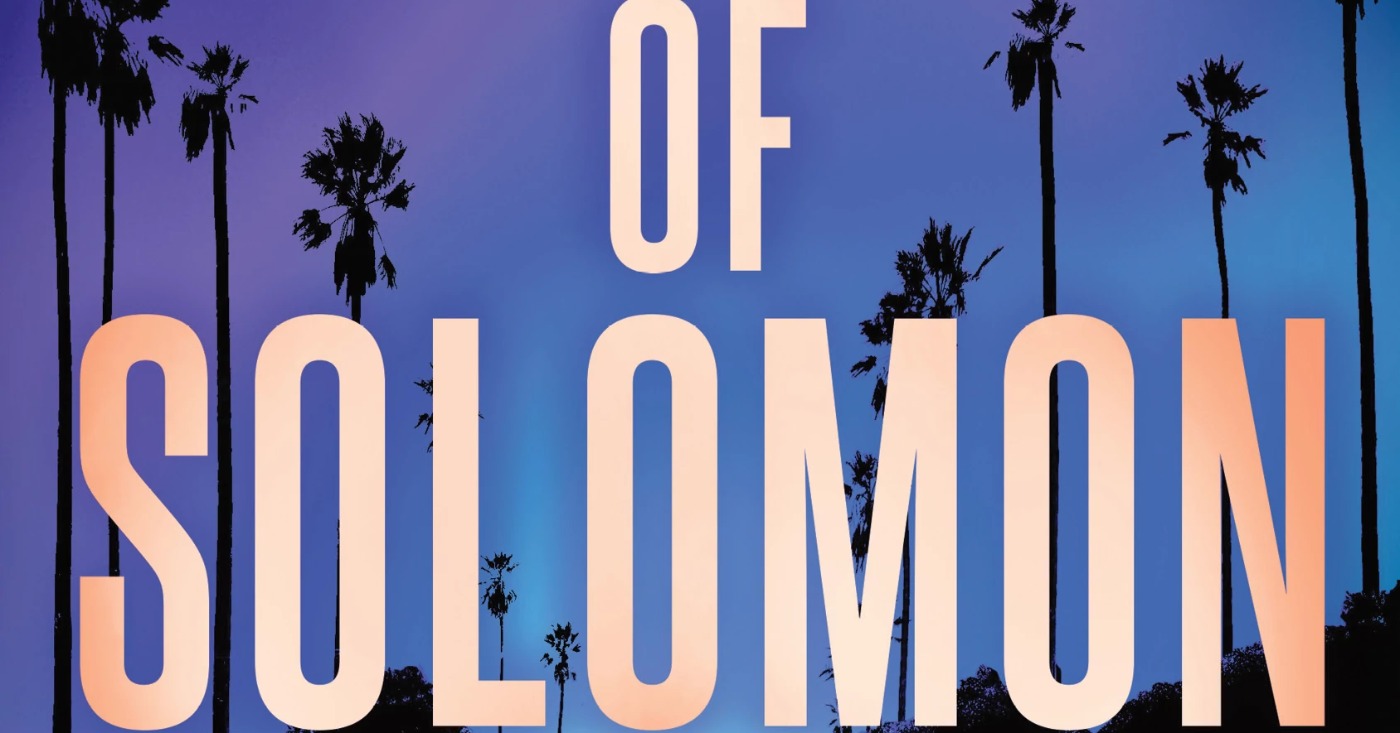
Author: Eriq La Salle, Copyright: c.2026, Publisher: Poisoned Pen Press, SRP: $18.99, Page Count: 304 pages
Finally, after so much work, you’ve left your past behind.
That’s what you tell yourself: what’s done is done and you can’t undo history. It’s over. You try not to think about last month, last year, a decade back because what does it matter? As in the new novel, “Laws of Solomon” by Eriq La Salle, remembering is too full of pain.
The monsters that came to him early in his sleep were the easy ones. It was the later demons that stole Solomon Nangobi’s sleep, the spirits of all the people he killed when he was a child soldier in Uganda, and when he was a fixer in New York as an adult. Their ghosts called to him with urgent voices, though he left that life behind long ago.
Now, his days were filled working the soil in gardens near Malibu, and he loved the quiet life.
Still, he kept his guns.

And he was glad: when Solomon recognized two Zeta gunmen stalking a well-dressed man, woman, and child through the gardens, he couldn’t walk away. He stopped the gangsters with bullets, but not before the adults and their bodyguards were dead. The child, an 8-year-old boy named Gaby, was safe, but Gaby couldn’t tell Solomon what was going on.
What became quickly certain, however, was that Solomon was now Gaby’s guardian, and the Zeta crime boss wanted them dead, too.
When he was the same age as Gaby, Solomon saw unspeakable things, the murder of his parents, the destruction of his homeland, and the atrocities that Uganda dictator Idi Amin’s soldiers committed. He learned to kill, he observed, and he was hardened, understanding as a small boy that revenge was often necessary and needed, and that blood would shed at those times.
But Gaby was pure, an innocent, a child.
Solomon reached out to his contacts to try to get the boy to safety, but being a contact of a marked man was likewise a dangerous thing: the monsters outside were worse than the ones inside him.
Two words for you: ‘Whoo weee.’ That’s what you’re going to say when you close the back cover of “Laws of Solomon,” knowing that you’ve just been taken on a wild up-and-down, around-and-round ride.
La Salle makes it impossible not to like Solomon, an African man who has, over time, lost nearly everything dear to him and who has no faith in much of anything. Readers get that part of the story eventually, and there’s historical authenticity in some of it, but we never really get to know Solomon, which makes the book feel dark and dangerous. Along the way, we meet and get to know his helpers, which buoys Solomon’s chase to find safety for the boy, and your heart won’t stop pounding.
Keep in mind that this is a thriller partially set in 1970s Uganda, so expect lots of violence but don’t expect a lot of people to live. If you’re up for that, find “Laws of Solomon.” You won’t be able to leave it behind.



Asm. Corey Jackson Announces Launch of 24-Hour Childcare in His District

IN MEMORIAM: The Rev. Leon “Sonny” Clark, Longtime Orange County Pastor and Community Leader, Dies at 72

Poll: Becerra Widens His Lead Over Hilton; Californians Split on Wealth Tax

From Historic Memories to New Possibilities: Oakland Celebrates Coliseum 60

County Office of Education Says OUSD Finances Are Getting Healthier, Materially Stronger

LIVE FREE Sunday Dinner Brings Faith, Fellowship and Civic Conversation to Oakland

Remembering Chauncey Bailey as Student Journalists Face Threats to Truth-Telling

BLACspace Cooperative Invites Bay Area to Experience Oakland’s Black Cultural Ecosystem Through a BLAC Map Tour + Party

In Wake of Death on Doorstep, Williams Chapel Baptist Church Calls for Better Care, Funding for Unhoused

Oakland Centenarian Nuna McKee Honored!

Caribbean Nations Produce Action Plan Calling for UK Reparations Over Slavery

Oakland Post: Week of September 23 – 29, 2026

Doulas Are Helping Black California Moms Navigate Pregnancy–Even as High Mortality Rates Persist

Newsom Signs Addictive Social Media Law to Protect Kids

On Your November Ballot: Prop 38 Would Allocate $8.4 Billion to Immunology and Immunotherapy Funding

Less Affluent School Districts, Including Sacramento City, Face Threat of State Takeover

ESSAY: California Can Close Its Colorectal Cancer Gap

California Hispanic Chambers of Commerce Unveils: ‘Powering the Future’ Theme for 47th Annual Statewide Convention

Four Candidates, Including Incumbent Barbara Lee, Qualify for Oakland Mayor’s Race

Oakland Post: Week of August 12 – 18, 2026

From Blueprint to Breakthrough: Tackling Affordable Housing in Oakland

Oakland Observes Black August with Block Parties, Film Showings, Workshops

COMMENTARY: Why Local School Tax Measure G1 Will Not Be on the November Ballot

Standoff for Justice: Our Homes Are Worth Fighting For

Returning to Its Roots, the Oakland Black-Eyed Pea Festival Partners with the Freedom Farmers Market Sept. 12

Oakland Post: Week of August 26 – September 1, 2026

NPRC Scores First Advocacy Victory: David Shaw Finally Gets His Wish to ‘Go Home’

Frontier Airlines’ Return to Oakland Airport Brings Flights, Jobs and Opportunity

Gubernatorial Candidate Steve Hilton Blasts California New Tire Rules; Newsom Hits Back

Chef Sharon Lee Blends Culinary Excellence, Education and Empowerment

The Conversation With Al McFarlane 6/23/26

Media Monday 6/22/26

LIVE! ASK ALMA! — TUES. 6.23.26 7PM EST

Car Buying Secrets: 4 Hidden Checks Before You Sign!

Is This 550 HP Charger Worth YOUR Money? AutoNetwork Review

Celebrating Juneteenth – Frederick Douglass on education and resistance

LIVE! — ASK ALMA! — TUES. 6.19.26 7PM EST

Hyundai Ioniq 5 Parking, Safety, and 360 View #shorts

2025 Ioniq 5 New Wiper & Powerful Performance! #shorts

Electric SUV Range: Is 259 Miles Enough? #shorts

EV Charging: How Fast Can You Charge an Electric Vehicle? #shorts

Biometric Cooling… Messaging Seats…Come on! 2025 Infiniti QX80 Autograph 4WD

Charged Up: Witness the Magic of a Fully Electric Car! #shorts

Range Rover Sport PHEV Included…: See What’s Inside This Luxury SUV! #shorts

Invisible Hood View: Perfect Parking with X-Ray Vision! #shorts
-
 Commentary4 weeks ago
Standoff for Justice: Our Homes Are Worth Fighting For
-
 Activism4 weeks ago
Oakland Post: Week of August 26 – September 1, 2026
-
 Business4 weeks ago
Frontier Airlines’ Return to Oakland Airport Brings Flights, Jobs and Opportunity
-
 Business4 weeks ago
Gubernatorial Candidate Steve Hilton Blasts California New Tire Rules; Newsom Hits Back
-
 Business4 weeks ago
Chef Sharon Lee Blends Culinary Excellence, Education and Empowerment
-

 Community4 weeks ago
Big City Mayors Ask for “Yes” Vote on Housing Bond Measure; Conservatives Say “No”
-

 Black History4 weeks ago
Jackie Wright Champions Bay Area Stories, Filmmakers and Cultural Institutions
-

 Education4 weeks ago
Gov. Newsom’s Latest Appointees Include Sacramento Advocate for Formerly Incarcerated Students; State’s New Tech Chief
