
Politics
Prosecutors Fight for Eric Garner Grand Jury Record Secrecy


In this Dec. 3, 2014, photo, security personnel stand outside Richmond County Supreme Court after a grand jury’s decision not to indict a New York police officer involved in the police-chokehold death of Eric Garner, in the Staten Island borough of New York. (AP Photo/John Minchillo, File)
TOM HAYS, Associated Press
NEW YORK (AP) — Lawyers battling over whether the grand jury record in the chokehold death of an unarmed black man should stay sealed came under sharp questioning by an appeals court on Tuesday, with one judge asking whether secrecy was a way of glossing over prosecutors’ role in a decision not to charge a white police officer in the case.

The four-judge state panel in Brooklyn heard the arguments in the Eric Garner case after the New York Civil Liberties Union and others appealed a March ruling keeping the minutes under seal. A lower-court judge agreed with the Staten Island district attorney’s office that lifting the veil of secrecy in grand jury proceedings could subject witnesses to harassment or retaliation after they were promised anonymity, an argument repeated on Tuesday.
“The intense public scrutiny of this case should result not in disclosure but even more zealous protection,” Assistant District Attorney Anne Grady said.
But Judge Leonard Austin zeroed in on accusations that then-District Attorney Daniel Donovan was being duplicitous in the Garner case for going to court to get permission for a partial disclosure of details like the number of witnesses, only to turn around and argue against the release of more meaningful information like the testimony of Officer Daniel Pantaleo and prosecutors’ instructions to the grand jury.
“Your office seems to have wanted to put a very pretty gloss on what happened and kind of sweep everything under the rug and use grand jury secrecy as its protection,” Austin said.
Pantaleo and other officers stopped Garner last July 17 on suspicion of selling loose, untaxed cigarettes. A video shot by an onlooker and widely watched online shows Garner telling the officers to leave him alone and refusing to be handcuffed.
The officer responded by wrapping his arm around Garner’s neck in what he said was a sanctioned takedown move and not a banned chokehold. The heavyset Garner, who had asthma, is heard on the tape gasping, “I can’t breathe.” He later was pronounced dead at a hospital.
The medical examiner ruled Garner’s death a homicide and found that a chokehold contributed to it. The death helped spark nationwide debate about the role of race in policing.
The judges on Tuesday also pressed the NYCLU and others on whether they had established a “compelling and particularized need” for the release of the grand jury record as required by law, a standard the lower-court judge found they failed to meet. Attorney Arthur Eisenberg responded that the disclosure was needed to better inform legislative proposals aimed at making grand jury deliberations more transparent.
NAACP attorney James Meyerson went further, saying disclosure was needed because allowing secrecy “reinforces the perception, if not the reality, that the system is rigged.”
Copyright 2015 The Associated Press. All rights reserved. This material may not be published, broadcast, rewritten or redistributed.


Activism
Oakland Post: Week of February 25 – March 3, 2026
The printed Weekly Edition of the Oakland Post: Week of – February 25 – March 3, 2026

To enlarge your view of this issue, use the slider, magnifying glass icon or full page icon in the lower right corner of the browser window.
Activism
Oakland Post: Week of February 18 – 24, 2026
The printed Weekly Edition of the Oakland Post: Week of – February 18 – 24, 2026
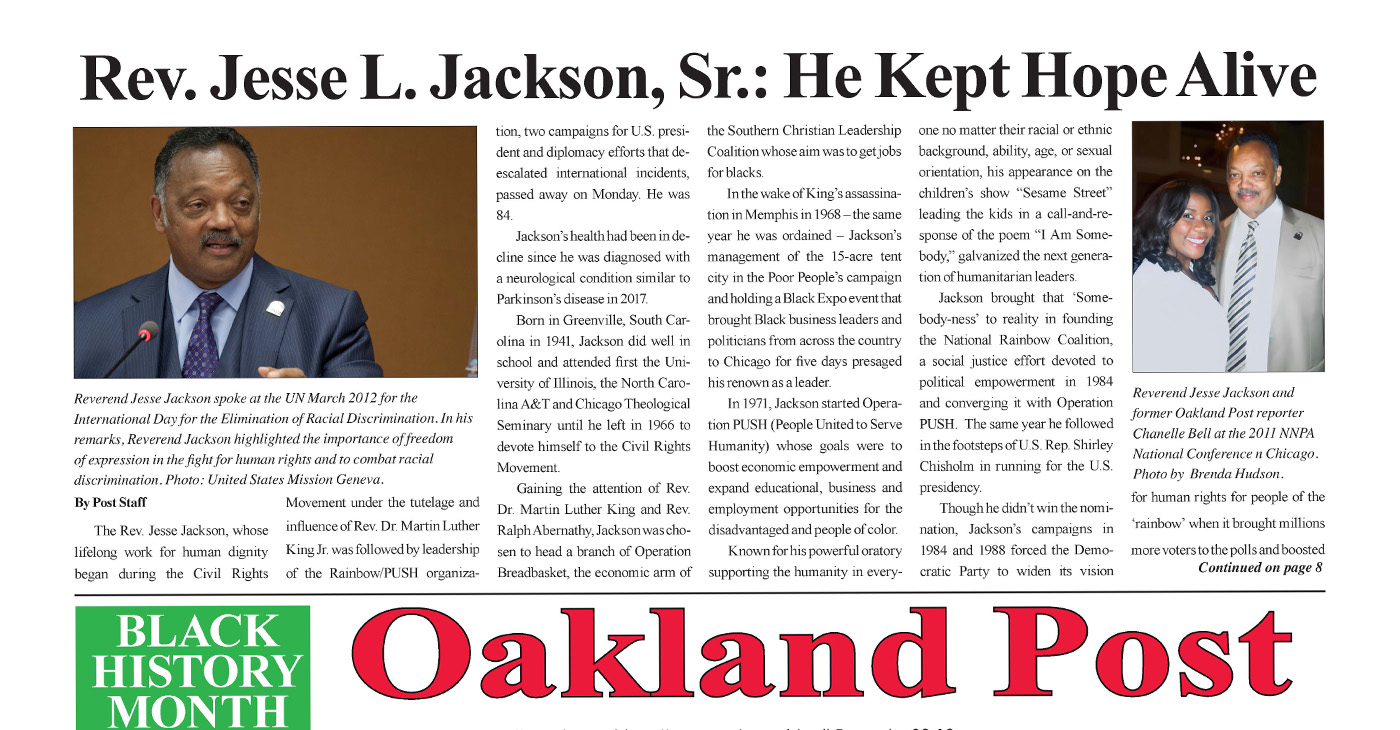
To enlarge your view of this issue, use the slider, magnifying glass icon or full page icon in the lower right corner of the browser window.
Activism
Oakland Post: Week of February 11 – 17, 2026
The printed Weekly Edition of the Oakland Post: Week of – February 11 – 17, 2026

To enlarge your view of this issue, use the slider, magnifying glass icon or full page icon in the lower right corner of the browser window.

WORK FROM HOME
Home-based business with potential monthly income of $10K+ per month. A proven training system and website provided to maximize business effectiveness. Perfect job to earn side and primary income. Contact Lynne for more details: Lynne4npusa@gmail.com 800-334-0540


Poll Shows Support for Policies That Help Families Afford Child Care

Oakland Post: Week of February 25 – March 3, 2026

Trump’s MAGA Allies are Creating Executive Order Plan to Steal the 2026 Midterms

PRESS ROOM: NBA Hall of Fame Nominee Terry Cummings Joins 100 Black Men of DeKalb County to Launch Victory & Values Initiative

Reflecting on Black History Milestones in Birmingham AL

OP-ED: One Hundred Years of Black Workers Telling the Truth

PRESS ROOM: Civil Rights TV Launches in Selma as the World’s First 24/7 Civil Rights Television Network

Advancements in solar technology that are changing the way we power the world

U.S. manufacturing rebounds – how foundry services are adapting to rising demand

Why has blood testing become so popular in today’s world?

Ghana Mourns a Son of the African World

OP-ED: Trump’s Policies Hurt Black America—and Everyone Else

OP-ED: Meta Deleted Me. I Still Don’t Know Why. And neither will you.

More than a Mission: Paying It Forward for the Future of Education

Avoid Eviction This Season: Landlord Checklist for Stable Tenancies

Life Expectancy in Marin City, a Black Community, Is 15-17 Years Less than the Rest of Marin County

Oakland Post: Week of January 28, 2025 – February 3, 2026

Community Celebrates Turner Group Construction Company as Collins Drive Becomes Turner Group Drive

California Launches Study on Mileage Tax to Potentially Replace Gas Tax as Republicans Push Back

Discrimination in City Contracts

Oakland Post: Week of January 21 – 27, 2026

Book Review: Books on Black History and Black Life for Kids

Medi-Cal Cares for You and Your Baby Every Step of the Way

COMMENTARY: The Biases We Don’t See — Preventing AI-Driven Inequality in Health Care

Post Newspaper Invites NNPA to Join Nationwide Probate Reform Initiative

After Don Lemon’s Arrest, Black Officials Raise Concerns About Independent Black Media

OP-ED: The Dream Cannot be Realized Without Financial Freedom

COMMENTARY: The National Protest Must Be Accompanied with Our Votes

Black History Events in the East Bay

Art of the African Diaspora Celebrates Legacy and Community at Richmond Art Center

Hyundai Ioniq 5 Parking, Safety, and 360 View #shorts

2025 Ioniq 5 New Wiper & Powerful Performance! #shorts

Electric SUV Range: Is 259 Miles Enough? #shorts

EV Charging: How Fast Can You Charge an Electric Vehicle? #shorts

Biometric Cooling… Messaging Seats…Come on! 2025 Infiniti QX80 Autograph 4WD

Charged Up: Witness the Magic of a Fully Electric Car! #shorts

Range Rover Sport PHEV Included…: See What’s Inside This Luxury SUV! #shorts

Invisible Hood View: Perfect Parking with X-Ray Vision! #shorts

AI Is Reshaping Black Healthcare: Promise, Peril, and the Push for Improved Results in California

ESSAY: Technology and Medicine, a Primary Care Point of View

Sanctuary Cities

The RESISTANCE – FREEDOM NOW

STATE OF THE PEOPLE: Freddie

ECONOMIC BOYCOTT DAY!!!!!

I told You So

-
 Activism4 weeks ago
Life Expectancy in Marin City, a Black Community, Is 15-17 Years Less than the Rest of Marin County
-
 Activism4 weeks ago
Oakland Post: Week of January 28, 2025 – February 3, 2026
-
 Activism3 weeks ago
Community Celebrates Turner Group Construction Company as Collins Drive Becomes Turner Group Drive
-
 Business3 weeks ago
California Launches Study on Mileage Tax to Potentially Replace Gas Tax as Republicans Push Back
-
 Activism3 weeks ago
Discrimination in City Contracts
-
 Arts and Culture3 weeks ago
Book Review: Books on Black History and Black Life for Kids
-
 Activism4 weeks ago
Medi-Cal Cares for You and Your Baby Every Step of the Way
-
 Activism3 weeks ago
COMMENTARY: The Biases We Don’t See — Preventing AI-Driven Inequality in Health Care
