
Activism
OPINION: Let the Voters Vote! Citizens Should Decide on Proposal to Build New Ballpark for Oakland A’s
When the Raiders asked the city to close a $400 million funding gap for additional renovations at the Coliseum in 2015, Mayor Libby Schaaf said no way. In 2015, she told SFGate “we could spend (that money) on police, parks and libraries.” Oakland’s need to address citywide problems is even more dire now than it was seven years ago. How then, can the city consider spending twice as much public money today than was unthinkable seven years ago?


By Paul Cobb, Post Publisher
We applaud Councilmember Carroll Fife’s decision to honor the wishes of Oakland residents and let the voters determine whether it is appropriate to use public funds to support building the Oakland A’s privately owned baseball park and 3,000 luxury condominiums at Howard Terminal.
Oakland faces many challenges including school closures, an ever-increasing homelessness crisis, spiking crime, desperately needed infrastructure repairs of roads, and fire safety investment. Voters should be given the opportunity to decide whether this is the right time to spend hundreds of millions of dollars of public funds on billionaire John Fisher’s privately owned luxury project.
For the past several years, the Oakland A’s have pursued building a new stadium. A strong contingent of Oakland residents wants the stadium to be built at the existing Oakland Coliseum site. For decades, the Coliseum was home to the A’s, Raiders, and Warriors. Each of these teams had great success, sellout crowds, and championship seasons at the Coliseum site.
They also argue that the Coliseum site is shovel-ready, accessible by public transportation, and bordered by two major freeways. It does not have the huge infrastructure costs, estimated at over $800 million, that Howard Terminal requires. But the A’s reject the Coliseum site without good justification, prompting many residents to believe that their objection is really based on not wanting to have a baseball park in a Black neighborhood.

The A’s have set their sights on Howard Terminal, located in West Oakland’s industrial zone, and the heart of the Port of Oakland. Many critics complain that building at Howard Terminal would threaten the viability of the Port of Oakland, and good-paying union jobs.
These complaints were validated when the Seaport Planning Advisory Committee (SPAC) — a committee of the Bay Conservation and Development Commission (BCDC) — said that it was inappropriate to transition lands that are essential for maritime purposes to private use. To support their position, they stated that under the law, if maritime property is needed for current or future maritime use, it cannot be transferred to private non-maritime use.
As well, the International Longshoremen and Warehouse Union (ILWU), Oakland’s largely Black union at the port, convened a work stoppage to protest giving valuable port land to the A’s because it could lead to the loss of hundreds of union jobs, and disrupt port activities at a time where the entire nation is reeling from supply chain issues.
Nobody wants to lose the A’s, but Oakland taxpayers are still smarting from the $200 million debt they will be paying until 2026 for Oakland Coliseum renovations in the 1990s, when Oakland lured the Raiders back from Los Angeles.
When the Raiders asked the city to close a $400 million funding gap for additional renovations at the Coliseum in 2015, Mayor Libby Schaaf said no way. In 2015, she told SFGate “we could spend (that money) on police, parks and libraries.”
Oakland’s need to address citywide problems is even more dire now than it was seven years ago. How then, can the city consider spending twice as much public money today than was unthinkable seven years ago?
This is one of the most divisive issues Oakland will face. It puts the needs of the city against the desires of a wealthy businessman to build luxury housing and a baseball field at a location that will hurt workers and the Port.
Councilmember Noel Gallo is also concerned about the cost and impact of the proposed project to the city and its residents. On March 24, he introduced legislation to require the A’s to provide the City Council with a full and complete economic analysis of the benefits and risks associated with the project. He insisted that this analysis be presented at a public City Council meeting, so the information will be available to all Oakland residents.
We think that Councilmembers Fife’s and Gallo’s proposals are complementary. Every member of the Council should support Councilmember Fife’s call to let the voters decide whether to use public funds to help build the baseball stadium and luxury condominiums at Howard Terminal. They should also support Councilmember Gallo’s legislation requesting a full and complete publicly disclosed economic analysis.
Some opponents argue that this is too complex an issue for the voters to consider. That is wrong for many reasons, but the two most important are these.
Oakland voters have considered and voted on major financial issues in many elections. More importantly, if the voters are smart enough to elect a mayor and City Council members, they are smart enough to evaluate whether it is appropriate to spend public funds on a billionaire’s folly when the city has so many other needs.
We urge the voters of Oakland to demand that the City Council place the question of whether to spend public funds on baseball and luxury housing before the voters on the November 2022 ballot.
We also urge the City Council to schedule a public meeting for a full and complete economic analysis of the benefits and risks of the project to the city. If the City Council refuses to do so, the voters should assess whether people running for office, who refuse to let the voters vote, should be elected.
Thank you, Councilmembers Fife and Gallo, for bringing these issues to the attention of the voters.
Let the voter’s vote.












Activism
Oakland Post: Week of September 16 – 22, 2026
The printed Weekly Edition of the Oakland Post: Week of September 16 – 22, 2026

To enlarge your view of this issue, use the slider, magnifying glass icon or full page icon in the lower right corner of the browser window.
Activism
Oakland Post: Week of September 9 – 15, 2026
The printed Weekly Edition of the Oakland Post: Week of September 9 – 15, 2026

To enlarge your view of this issue, use the slider, magnifying glass icon or full page icon in the lower right corner of the browser window.
Activism
Oakland Post: Week of September 2 – 8, 2026
The printed Weekly Edition of the Oakland Post: Week of September 2 – 8, 2026
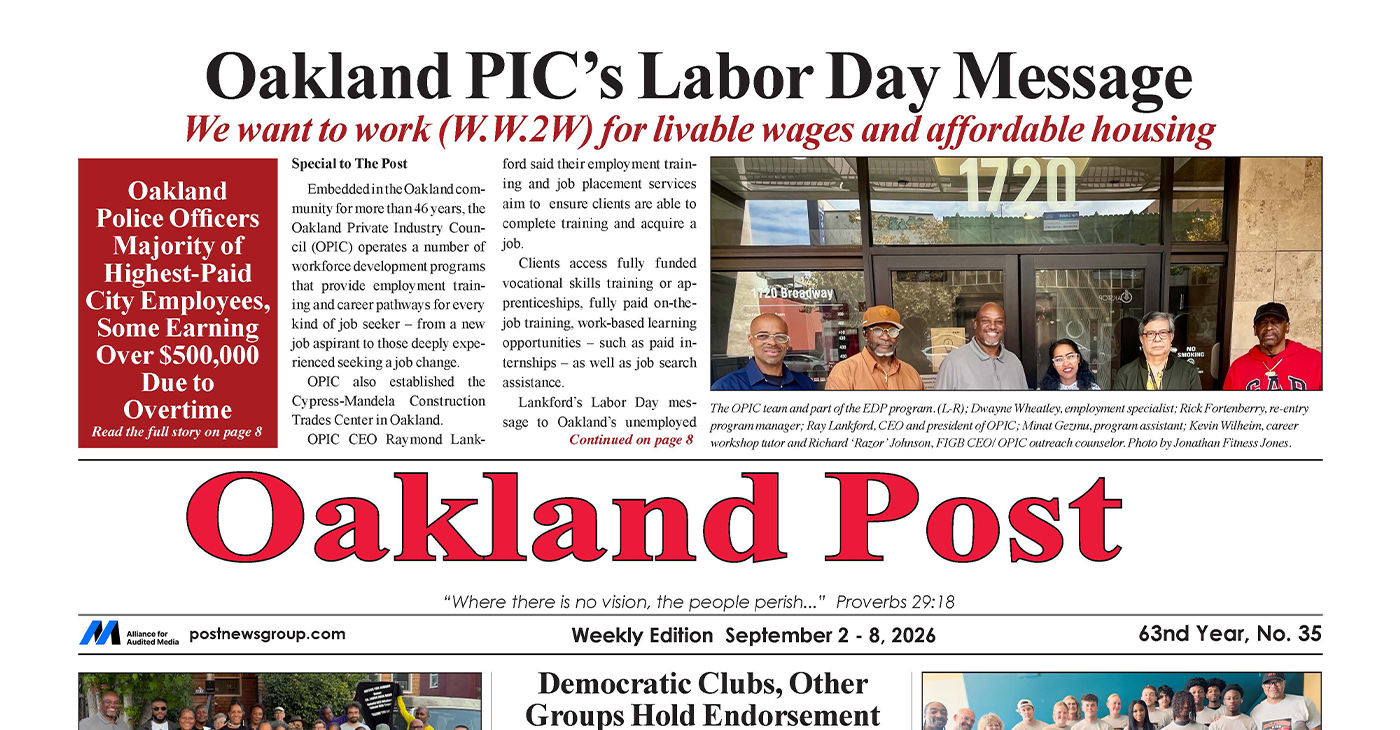
To enlarge your view of this issue, use the slider, magnifying glass icon or full page icon in the lower right corner of the browser window.



Doulas Are Helping Black California Moms Navigate Pregnancy–Even as High Mortality Rates Persist

Newsom Signs Addictive Social Media Law to Protect Kids

On Your November Ballot: Prop 38 Would Allocate $8.4 Billion to Immunology and Immunotherapy Funding

Ask California: Golden State Releases New AI Chatbot

Asm. Isaac Bryan’s Bill Banning California Police From ICE Side Jobs Reaches Newsom’s Desk

Assemblymember LaShae Sharp-Collins’s Bill Would Pause Law Enforcement’s Use of Shock Gloves Pending Study

BOOK REVIEW: ‘Laws of Solomon’ Reveals Tender Heart of Former Child Soldier

OPINION: The New American Fear – From 9-11 to AI

Passing for White, Fighting for Black America: The Courage of Walter White

Oakland People’s Arms Embargo Coalition Demands End to Military Shipments Thru Oakland

Barbara Lee Mourns Gloria Steinem, Remembers a Friendship Rooted in Equality

Event Preview: ‘Fashion v. Fascism’ – A Runway Revolution Is Coming to the Bay Area

Two Looming Threats Every Alameda County Elder Should Know About

Oakland Mayor Reads to Children at Bookout Block Party at Marcus Books Store

Tradition Comes to the Streets in 11th Annual Black-Eyed Pea Festival at the Freedom Farmers Market

Less Affluent School Districts, Including Sacramento City, Face Threat of State Takeover

ESSAY: California Can Close Its Colorectal Cancer Gap

California Hispanic Chambers of Commerce Unveils: ‘Powering the Future’ Theme for 47th Annual Statewide Convention

Four Candidates, Including Incumbent Barbara Lee, Qualify for Oakland Mayor’s Race

Oakland Post: Week of August 12 – 18, 2026

From Blueprint to Breakthrough: Tackling Affordable Housing in Oakland

Oakland Observes Black August with Block Parties, Film Showings, Workshops

COMMENTARY: Why Local School Tax Measure G1 Will Not Be on the November Ballot

Standoff for Justice: Our Homes Are Worth Fighting For

Returning to Its Roots, the Oakland Black-Eyed Pea Festival Partners with the Freedom Farmers Market Sept. 12

NPRC Scores First Advocacy Victory: David Shaw Finally Gets His Wish to ‘Go Home’

Oakland Post: Week of August 26 – September 1, 2026

Frontier Airlines’ Return to Oakland Airport Brings Flights, Jobs and Opportunity

Gubernatorial Candidate Steve Hilton Blasts California New Tire Rules; Newsom Hits Back

Chef Sharon Lee Blends Culinary Excellence, Education and Empowerment

The Conversation With Al McFarlane 6/23/26

Media Monday 6/22/26

LIVE! ASK ALMA! — TUES. 6.23.26 7PM EST

Car Buying Secrets: 4 Hidden Checks Before You Sign!

Is This 550 HP Charger Worth YOUR Money? AutoNetwork Review

Celebrating Juneteenth – Frederick Douglass on education and resistance

LIVE! — ASK ALMA! — TUES. 6.19.26 7PM EST

Hyundai Ioniq 5 Parking, Safety, and 360 View #shorts

2025 Ioniq 5 New Wiper & Powerful Performance! #shorts

Electric SUV Range: Is 259 Miles Enough? #shorts

EV Charging: How Fast Can You Charge an Electric Vehicle? #shorts

Biometric Cooling… Messaging Seats…Come on! 2025 Infiniti QX80 Autograph 4WD

Charged Up: Witness the Magic of a Fully Electric Car! #shorts

Range Rover Sport PHEV Included…: See What’s Inside This Luxury SUV! #shorts

Invisible Hood View: Perfect Parking with X-Ray Vision! #shorts
-
 Commentary4 weeks ago
Standoff for Justice: Our Homes Are Worth Fighting For
-
 Activism4 weeks ago
Oakland Post: Week of August 26 – September 1, 2026
-
 Business4 weeks ago
Frontier Airlines’ Return to Oakland Airport Brings Flights, Jobs and Opportunity
-
 Business4 weeks ago
Gubernatorial Candidate Steve Hilton Blasts California New Tire Rules; Newsom Hits Back
-
 Business4 weeks ago
Chef Sharon Lee Blends Culinary Excellence, Education and Empowerment
-

 Education4 weeks ago
Gov. Newsom’s Latest Appointees Include Sacramento Advocate for Formerly Incarcerated Students; State’s New Tech Chief
-

 Community4 weeks ago
Big City Mayors Ask for “Yes” Vote on Housing Bond Measure; Conservatives Say “No”
-

 Business4 weeks ago
Oakland Coliseum Project Opens Door for Small Businesses to Build Bigger
