
Bay Area
Oakland Doctors Question Vandalism

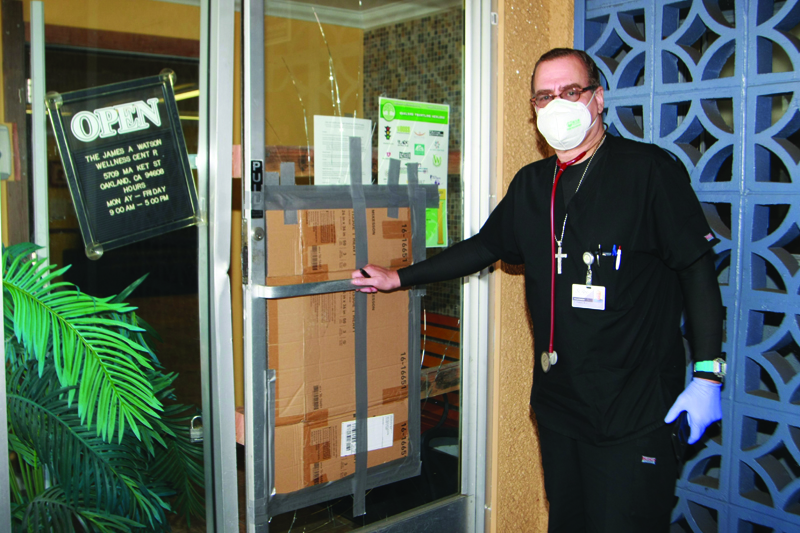
On Monday, Dr. Geoffrey Watson surveyed the damage to his North Oakland medical facility caused by looters Saturday and Sunday nights, under the guise of protesting the brutal murder of George Floyd on May 25th by four Minneapolis police officers.
Gastroenterologist Dr. Ralph Peterson’s East Oakland office located at 10520 MacArthur Blvd was also vandalized. Peterson questions why people responsible for healing and caring for the community are being targeted.
“The security video shows it wasn’t the population we serve. They were young, largely Hispanic and white, all under the age of 23, and were organized with cars pulling up to take what they could.” said Peterson. “Thank goodness our doors held with only three getting through two windows.” Peterson feels the broken glass deterred the group of 15 milling outside who, he observed by video footage, were very organized in their intent.
The James A Watson Wellness Center, located at 5709 Market Street and Peterson’s office continue to remain open to serve the community while other doctors have closed their offices because of COVID-19.
“We’re one of the few facilities still seeing patients,” said Dr. Watson, “Most doctors are teleconferencing with their patients. In addition to being open, as a member of the Oakland Frontline Healers organization, we’re testing, distributing food and PPE.”
A neighbor reported seeing six to eight African American men break down the front door, knocking the door off its hinges. They managed to access and break a second gate, ransacking the office and stealing two computers.
A saddened Watson noted, ”Whoever broke in knew this was a Black business as soon as they stepped in the door. Pictures of past doctors are on the walls as well as African artwork.
“(People need to realize that) Black Lives Matter, Black businesses matter and Black businesses take care of Black lives.”
“It’s unfortunate the very population we’re serving would prey upon Dr. Watson who is providing valuable service to them,” said Tanya Dennis an Oakland Frontline Healer leader “Oakland Frontline Healers is one of the most powerful organizations our people have in the community right now. We’re on the front line distributing PPE, food and testing.
“We represent the leadership the Oakland community has been seeking,” she continued. “As important as our work is right now, what we will be doing to rebuild the Black community after COVID-19 will be essential. We need the community to support us, not undermine our efforts by looting. Looters are dishonoring George Floyd’s memory.”
When you think about police shootings, there are more of us shooting each other,” Watson said. “We want the police to do their job, but we have to do our job and respect each other. This is the time to come together and stop destroying property and killing each other. It’s time for Black-on-Black support. People are not thinking. When we had the Panthers and the NAACP we had a 10-point plan and we had direction. I joined Oakland Frontline Healers because they are our new leadership in the community. Please respect the movement.”
Dr. Peterson shared his observances about the vandalism. “We’re Black doctors and all we do is heal. We were targeted because they don’t know us. I’ve been serving the community since 1983, Dr. Watson’s office even longer.”









Activism
Oakland Post: Week of February 11 = 17, 2026
The printed Weekly Edition of the Oakland Post: Week of – February 11 – 17, 2026


To enlarge your view of this issue, use the slider, magnifying glass icon or full page icon in the lower right corner of the browser window.

Advice
Rising Optimism Among Small And Middle Market Business Leaders Suggests Growth for California
“Business leaders across the Pacific region continue to demonstrate a unique blend of resilience and forward-thinking, even in the face of ongoing economic uncertainty,” said Brennon Crist, Managing Director and Head of the Pacific Segment, Commercial Banking, J.P. Morgan. “Their commitment to innovation and growth is evident in the way they adapt to challenges and seize new opportunities. It’s this spirit that keeps our region at the forefront of business leadership and progress. We look forward to helping our clients navigate all that’s ahead in 2026.”

Sponsored by JPMorganChase
Business optimism is returning for small and midsize business leaders at the start of 2026, fueling confidence and growth plans.
The 2026 Business Leaders Outlook survey, released in January by JPMorganChase reveals a turnaround from last June, when economic headwinds and uncertainty about shifting policies and tariffs caused some leaders to put their business plans on hold.
Midsize companies, who often find themselves more exposed to geopolitical shifts and policy changes, experienced a significant dip in business and economic confidence in June of 2025. As they have become more comfortable with the complexities of today’s environment, we are seeing optimism rebounding in the middle market nationwide – an encouraging sign for growth, hiring, and innovation. Small businesses, meanwhile, maintained steady optimism throughout 2025, but they aren’t shielded from domestic concerns. Many cited inflation and wage pressures as the top challenges for 2026 and are taking steps to ensure their businesses are prepared for what’s ahead.
“Business leaders across the Pacific region continue to demonstrate a unique blend of resilience and forward-thinking, even in the face of ongoing economic uncertainty,” said Brennon Crist, Managing Director and Head of the Pacific Segment, Commercial Banking, J.P. Morgan. “Their commitment to innovation and growth is evident in the way they adapt to challenges and seize new opportunities. It’s this spirit that keeps our region at the forefront of business leadership and progress. We look forward to helping our clients navigate all that’s ahead in 2026.”

Overall, both small and midsize business leaders are feeling more confident to pursue growth opportunities, embrace emerging technologies and, in some cases, forge new strategic partnerships. That bodes well for entrepreneurs in California. Here are a few other key findings from the Business Leaders Outlook about trends expected to drive activity this year:
- Inflation remains the top concern for small business owners. Following the 2024 U.S. presidential election, many anticipated a favorable business environment. By June 2025, however, that feeling shifted amid concerns about political dynamics, tariffs, evolving regulations and global economic headwinds.
Going into 2026, 37% of respondents cited inflation as their top concern. Rising taxes came in second at 27% and the impact of tariffs was third at 22%. Other concerns included managing cash flow, hiring and labor costs.
- For middle market leaders, uncertainty remains an issue. Almost half (49%) of all midsize business leaders surveyed cited “economic uncertainty” as their top concern – even with an improved outlook from a few months ago. Revenue and sales growth was second at 33%, while tariffs and labor both were third at 31%.
- And tariffs are impacting businesses costs. Sixty-one percent of midsize business leaders said tariffs have had a negative impact on the cost of doing business.
- Despite challenges, leaders are bullish on their own enterprises. Though the overall outlook is mixed, 74% of small business owners and 71% of middle market companies are optimistic about their company’s prospects for 2026.
- Adaption is the theme. For small business owners surveyed across the U.S., responding to continuing pressures is important in 2026. Building cash reserves (47%), renegotiating supplier terms (36%) and ramping up investments in marketing and technology are among the top priorities.
- Big plans are on the horizon. A majority midsized company leaders expect revenue growth this year, and nearly three out of five of (58%) plan to introduce new products or services in the coming year, while 53% look to expand into new domestic and/or international markets. Forty-nine percentsay they’re pursuing strategic partnerships or investments.
The bottom line
Rebounding optimism among U.S. business leaders at the start of the year is setting the stage for an active 2026. With business leaders looking to implement ambitious growth plans that position themselves for the future, momentum in California could be beneficial for leaders looking to launch, grow or scale their business this year.
Activism
Discrimination in City Contracts
The report was made public by Councilmember Carroll Fife, who brought it this week to the Council’s Life Enrichment Committee, which she chairs. Councilmembers, angry at the conditions revealed, unanimously approved the informational report, which is scheduled to go to an upcoming council meeting for discussion and action. The current study covers five years, 2016-2021, roughly overlapping the two tenures of Libby Schaaf, who served as mayor from January 2015 to January 2023.

Disparity Study Exposes Oakland’s Lack of Race and Equity Inclusion
Part 1
By Ken Epstein
A long-awaited disparity study funded by the City of Oakland shows dramatic evidence that city government is practicing a deeply embedded pattern of systemic discrimination in the spending of public money on outside contracts that excludes minority- and woman-owned businesses, especially African Americans.
Instead, a majority of public money goes to a disproportionate handful of white male-owned companies that are based outside of Oakland, according to the 369-page report produced for the city by Mason Tillman Associates, an Oakland-based firm that performs statistical, legal and economic analyses of contracting and hiring.
The report was made public by Councilmember Carroll Fife, who brought it this week to the Council’s Life Enrichment Committee, which she chairs. Councilmembers, angry at the conditions revealed, unanimously approved the informational report, which is scheduled to go to an upcoming council meeting for discussion and action.
The current study covers five years, 2016-2021, roughly overlapping the two tenures of Libby Schaaf, who served as mayor from January 2015 to January 2023.
The amount of dollars at stake in these contracts was significant in the four areas that were studied, a total of $486.7 million including $214.6 million on construction, $28.6 million on architecture, and engineering, $78.9 million on professional services, and $164.6 million on goods and services.
While the city’s policies are good, “the practices are not consistent with policy,” said Dr. Eleanor Ramsey, founder and CEO of Mason Tillman Associates.
There have been four disparity studies during the last 20 years, all showing a pattern of discrimination against women and minorities, especially African Americans, she said. “You have good procurement policy but poor enforcement.”
“Most minority- and women-owned businesses did not receive their fair share of city-funded contracts,” she continued. “Over 50% of the city’s prime contract dollars were awarded to white-owned male businesses that controlled most subcontracting awards. And nearly 65% of the city’s prime contracts were awarded to non-Oakland businesses.”
As a result, she said, “there is a direct loss of revenue to Oakland businesses and to business tax in the city… There is also an indirect loss of sales and property taxes (and) increased commercial office vacancies and empty retail space.”
Much of the discrimination occurs in the methods used by individual city departments when issuing outside contracts. Many departments have found “creative” ways to circumvent policies, including issuing “emergency” contracts for emergencies that do not exist and providing waivers to requirements to contract with women- and minority-owned businesses, Ramsey said.
Many of the smaller contracts – 59% of total contracts issued – never go to the City Council for approval.
Some people argue that the contracts go to a few big companies because small businesses either do not exist or cannot do the work. But the reality is that a majority of city contracts are small, under $100,000, and there are many Black-, woman- and minority-owned companies available in Oakland, said Ramsey.
“Until we address the disparities that we are seeing, not just in this report but with our own eyes, we will be consistently challenged to create safety, to create equity, and to create the city that we all deserve,” said Fife.
A special issue highlighted in the disparity report was the way city departments handled spending of federal money issued in grants through a state agency, Caltrans. Under federal guidelines, 17.06%. of the dollars should go to Disadvantaged Business Enterprises (DBEs).
“The fact is that only 2.16% of all the dollars awarded on contracts (went to) DBEs,” Ramsey said.
Speaking at the committee meeting, City Councilmember Ken Houston said, “It’s not fair, it’s not right. If we had implemented (city policies) 24 years ago, we wouldn’t be sitting here (now) waiving (policies).”
“What about us? We want vacations. We want to have savings for our children. We’re dying out here,” he said.
Councilmember Charlene Wang said that she noticed when reading the report that “two types of business owners that are consistently experiencing the most appalling discrimination” are African Americans and minority females.
“It’s gotten worse” over the past 20 years, she said. “It’s notable that businesses have survived despite the fact that they have not been able to do business with their own city.”
Also speaking at the meeting, Brenda Harbin-Forte, a retired Alameda County Superior Court judge, and chair of the Legal Redress Committee for the Oakland NAACP, said, “I am so glad this disparity study finally was made public. These findings … are not just troubling, they are appalling, that we have let these things go on in our city.”
“We need action, we need activity,” she said. “We need for the City Council and others to recognize that you must immediately do something to rectify the situation that has been allowed to go on. The report says that the city was an active or inactive or unintentional or whatever participant in what has been going on in the city. We need fairness.”
Cathy Adams, president of the Oakland African American Chamber of Commerce, said, “The report in my opinion was very clear. It gave directions, and I feel that we should accept the consultant Dr. Ramsey’s recommendations.
“We understand what the disparities are; it’s going to be upon the city, our councilmembers, and our department heads to just get in alignment,” she said.
Said West Oakland activist Carol Wyatt, “For a diverse city to produce these results is a disgrace. The study shows that roughly 83% of the city contracting dollars went to non-minority white male-owned firms under so-called race neutral policies
These conditions are not “a reflection of a lack of qualified local firms,” she continued. “Oakland does not have a workforce shortage; it has a training, local hire, and capacity-building problem.”
“That failure must be examined and corrected,” she said. “The length of time the study sat without action, only further heightens the need for accountability.”

WORK FROM HOME
Home-based business with potential monthly income of $10K+ per month. A proven training system and website provided to maximize business effectiveness. Perfect job to earn side and primary income. Contact Lynne for more details: Lynne4npusa@gmail.com 800-334-0540


Oakland Post: Week of February 11 = 17, 2026

Rising Optimism Among Small And Middle Market Business Leaders Suggests Growth for California

Discrimination in City Contracts

COMMENTARY: The National Protest Must Be Accompanied with Our Votes

Congresswoman Simon Votes Against Department of Homeland Security, ICE Funding

Post Newspaper Invites NNPA to Join Nationwide Probate Reform Initiative

Community Celebrates Turner Group Construction Company as Collins Drive Becomes Turner Group Drive

New Bill, the RIDER Safety Act, Would Support Transit Ambassadors and Safety on Public Transit

Trump’s White House Pushes to Control California Wildfire Recovery

Gov. Newsom, AG Bonta to Local Law Enforcement: You Have Authority to Investigate Federal Agents

Dorothy Lee Bolden: Uniting Domestic Workers

Cracking Down on Human Trafficking, California DOJ Announces 120 Arrests

COMMENTARY: The Biases We Don’t See — Preventing AI-Driven Inequality in Health Care

California Launches Study on Mileage Tax to Potentially Replace Gas Tax as Republicans Push Back

Book Review: Books on Black History and Black Life for Kids

OP-ED: AB 1349 Puts Corporate Power Over Community

Protecting California’s Black Moms and Babies: Policies and Programs Struggle to Fix Deep-Rooted Maternal Health Inequities

Oakland Post: Week of December 31, 2025 – January 6, 2026

Why Peace on Earth Begins with Birth, a Q&A with Midwife Nikki Helms

Jefferson County (AL) Democrats Open Qualifying for 2026 Primary Elections

Skater Emmanuel Savary Sharpens Routines for the 2026 U.S. Championships

COMMENTARY: With Gratitude and Praise for 2026

From Civil Rights to ICE Raids, Trump’s Unchecked Power Puts Every Community at Risk
From Civil Rights to ICE Raids, Trump’s Unchecked Power Puts Every Community at Risk

OP-ED: The Dream Cannot be Realized Without Financial Freedom

Travis Scott Teaches Us How to Give Forward

Four Stolen Futures: Will H-E-B Do The Right Thing?

Newsom’s Finance Director Joe Stephenshaw Opens 2026-27 Budget Debate with Cautious Plan

Street Lines: 2025 Jeep Wagoneer S Limited 4XE

Street Lines: 2025 Jeep Wagoneer S Limited 4XE

Hyundai Ioniq 5 Parking, Safety, and 360 View #shorts

2025 Ioniq 5 New Wiper & Powerful Performance! #shorts

Electric SUV Range: Is 259 Miles Enough? #shorts

EV Charging: How Fast Can You Charge an Electric Vehicle? #shorts

Biometric Cooling… Messaging Seats…Come on! 2025 Infiniti QX80 Autograph 4WD

Charged Up: Witness the Magic of a Fully Electric Car! #shorts

Range Rover Sport PHEV Included…: See What’s Inside This Luxury SUV! #shorts

Invisible Hood View: Perfect Parking with X-Ray Vision! #shorts

AI Is Reshaping Black Healthcare: Promise, Peril, and the Push for Improved Results in California

ESSAY: Technology and Medicine, a Primary Care Point of View

Sanctuary Cities

The RESISTANCE – FREEDOM NOW

STATE OF THE PEOPLE: Freddie

ECONOMIC BOYCOTT DAY!!!!!

I told You So

-
 #NNPA BlackPress4 weeks ago
OP-ED: The Dream Cannot be Realized Without Financial Freedom
-
 #NNPA BlackPress4 weeks ago
Four Stolen Futures: Will H-E-B Do The Right Thing?
-
 Activism2 weeks ago
Oakland Post: Week of January 28, 2025 – February 3, 2026
-

 Activism2 weeks ago
Life Expectancy in Marin City, a Black Community, Is 15-17 Years Less than the Rest of Marin County
-
 Activism3 weeks ago
Oakland Post: Week of January 21 – 27, 2026
-

 Activism2 weeks ago
Medi-Cal Cares for You and Your Baby Every Step of the Way
-
Uncategorized2 weeks ago
Homegoing Service for Education Advocate Oscar Wright, 101
-

 Activism7 days ago
After Don Lemon’s Arrest, Black Officials Raise Concerns About Independent Black Media
