
Bay Area
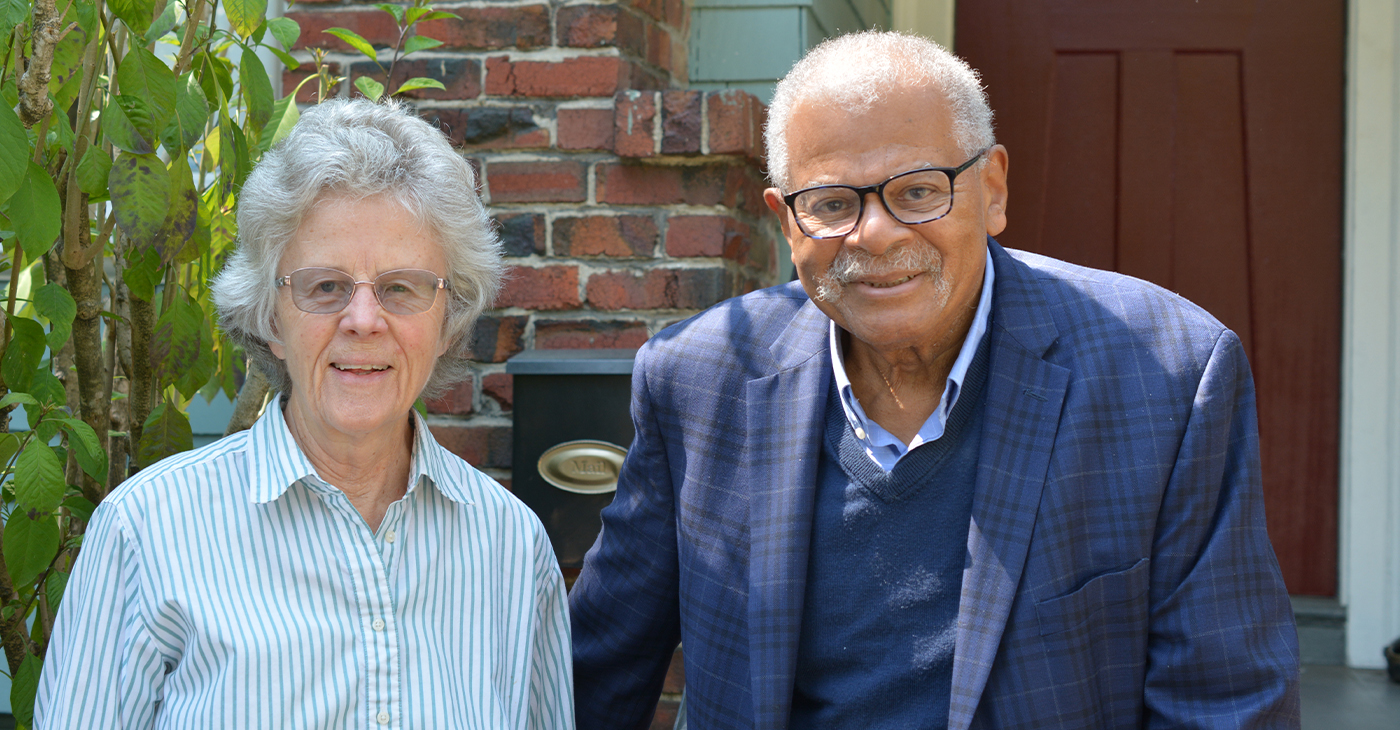
Gus Newport: A Soldier for Justice
One year ago, on June 12, 2023, my husband of 35 years was picked up by a van at our house in Oakland. It was the last time I saw him alive. The van was owned by Owl Transport, a company used by the Department of Veterans Affairs. It was to take my husband to the San Francisco VA Medical Center to see about getting a new hearing aid. Within a half hour of leaving the house, a San Francisco Fire Department ambulance was called to 8th and Harrison streets because Gus was unconscious. When they arrived at San Francisco General Hospital, Gus’s cell phone, wheelchair and tote bag had all gone missing. An enterprising social worker Googled Gus and found a phone number for his daughter in Atlanta; she called her brother in Oakland, and he immediately called me.

By Kathryn Kasch

One year ago, on June 12, 2023, my husband of 35 years was picked up by a van at our house in Oakland. It was the last time I saw him alive.
The van was owned by Owl Transport, a company used by the Department of Veterans Affairs. It was to take my husband to the San Francisco VA Medical Center to see about getting a new hearing aid.
Eugene “Gus” Newport was 88 years old and wheelchair-bound because he had lost a leg in 2021, but my husband remained as active as I had always known him, forever engaged in civil rights and community development work, just as he had been as mayor of Berkeley from 1979 to 1986.
Gus had a busy week ahead of him: on June 16 he was going to be interviewed for a film about his friendship with Malcolm X; on the following day he was scheduled to fly to Atlanta for a weekend board meeting.
Within a half hour of leaving the house, a San Francisco Fire Department ambulance was called to 8th and Harrison streets because Gus was unconscious. When they arrived at San Francisco General Hospital, Gus’s cell phone, wheelchair and tote bag had all gone missing. An enterprising social worker Googled Gus and found a phone number for his daughter in Atlanta; she called her brother in Oakland, and he immediately called me.
The next morning, I called Owl; they said they were investigating and had notified the VA, but the VA never called the family. I was able to reach Gus’s VA doctor, who works primarily at UCSF, and she told me to call the Patient Advocate number, but they never called me back.
The doctors at the hospital determined that Gus had suffered a severe neck and spinal injury and that if he ever regained consciousness, he would be a permanent quadriplegic. On June 17, we decided to let him go. The VA doctor helped me convince the San Francisco Medical Examiner to carry out an autopsy, which was finally done on June 30, and it confirmed that Gus’s injuries were the result of somehow falling backward in the van.
Three weeks after the accident, someone finally called me from the Veterans Transportation Service office in San Francisco — but he would not tell me anything about what they thought happened in the van, though he said they were working to make sure this never happens again. They had never looked for a second phone number to reach the family and continued to call Gus’s missing cell phone after he died.
In July 2023 the family filed a wrongful death lawsuit against Owl in San Francisco Superior Court, and we are waiting for a trial date to be set. In December 2023, the Chronicle ran an investigative article about the poor billing system for the SFFD ambulances, and sure enough, when I asked our lawyers if they had seen a bill, they showed me an invoice “addressed” to “Eugene Doe, Homeless, San Francisco, CA 94107” — adding insult to injury, even though the driver had Gus’s name and address on his log sheet since he had just picked him up.
Congresswoman Barbara Lee made some inquiries to the VA on our behalf, and in February, eight months after the accident, an undersecretary of the VA called me — but only to offer me his condolences. He still said nothing about what their investigation had revealed. After I asked him some questions, he said they are still using Owl because they have not been able to find another company to serve the Oakland area — more discouraging news.
And in September 2023 our attorney filed a claim for wrongful death with the VA, but when he called the Office of the General Counsel in February, he learned that the claim had been received but had never been downloaded into their system, let alone assigned to a claim agent!
Gus was drafted into the Army in 1956 and was sent from his hometown of Rochester, N.Y., to Fort Knox, KY, giving him his first exposure to racist Jim Crow rules in Indiana and Kentucky. From there he was stationed in Heidelberg, Germany, where he worked in intelligence and logistics and played football for the base team, injuring his right knee — “playing football for my country,” he said. He also uncovered corruption among American officers who were skimming money from payments to German civilian workers. He threatened to go to the Stars and Stripes newspaper and was abruptly discharged and put on a plane back to the U.S.
Gus was a civil rights and peace activist all his life, starting with protesting police violence against Blacks in Rochester in the 1960s. He came to Berkeley in the 1970s and in the spring of 1979 was drafted by Berkeley Citizens Action to run for mayor. He won that election and was re-elected in 1982 by the biggest plurality in Berkeley history. He challenged unnecessary wars and budget priorities that consistently fund excessive Pentagon spending instead of our domestic needs and security. He supported sanctuary for refugees from Central America, divested from apartheid South Africa, and pioneered in providing domestic benefits for unwed partners.
Countless times in his life, Gus stepped up when his voice was needed. On April 5, 1977, his birthday, a group of protestors in San Francisco began the longest occupation of a federal building in U.S. history, and Gus showed up to support the dozens of disabled activists who were demanding their civil rights. Specifically, they called for implementation of Section 504 of the 1973 Rehabilitation Act, which was designed to help returning Vietnam veterans and included language stipulating that no person should be discriminated against on the basis of disability in any program receiving federal assistance — from schools to transportation and public buildings. After 25 days the “504 occupation” succeeded.
When Gus was elected mayor, his administration created the Mayor’s Task Force on Persons with Disabilities, passed ordinances to ensure access to all public meetings and non-discrimination in City hiring and provided funding for programs serving people with disabilities.
Now we are still faced with the task of uncovering the truth of what happened to Gus in the Owl van and seeking justice for our loss. Unfortunately, except for the one doctor, the Veterans Administration has done nothing to answer our questions or help with our plight.
Years ago, I remember Gus’s granddaughter had just learned the Pledge of Allegiance in kindergarten. She was declaiming some of it in the back seat of our car — “with liberty and justice for all” — and she paused. She asked us, “What’s justice?”
Kathryn Kasch is a retired housing planner who was born and raised in Oakland. For more information, go to gusnewport.com.











Activism
Oakland Post: Week of September 30 – October 6, 2026
The printed Weekly Edition of the Oakland Post: Week of September 30 – October 6, 2026
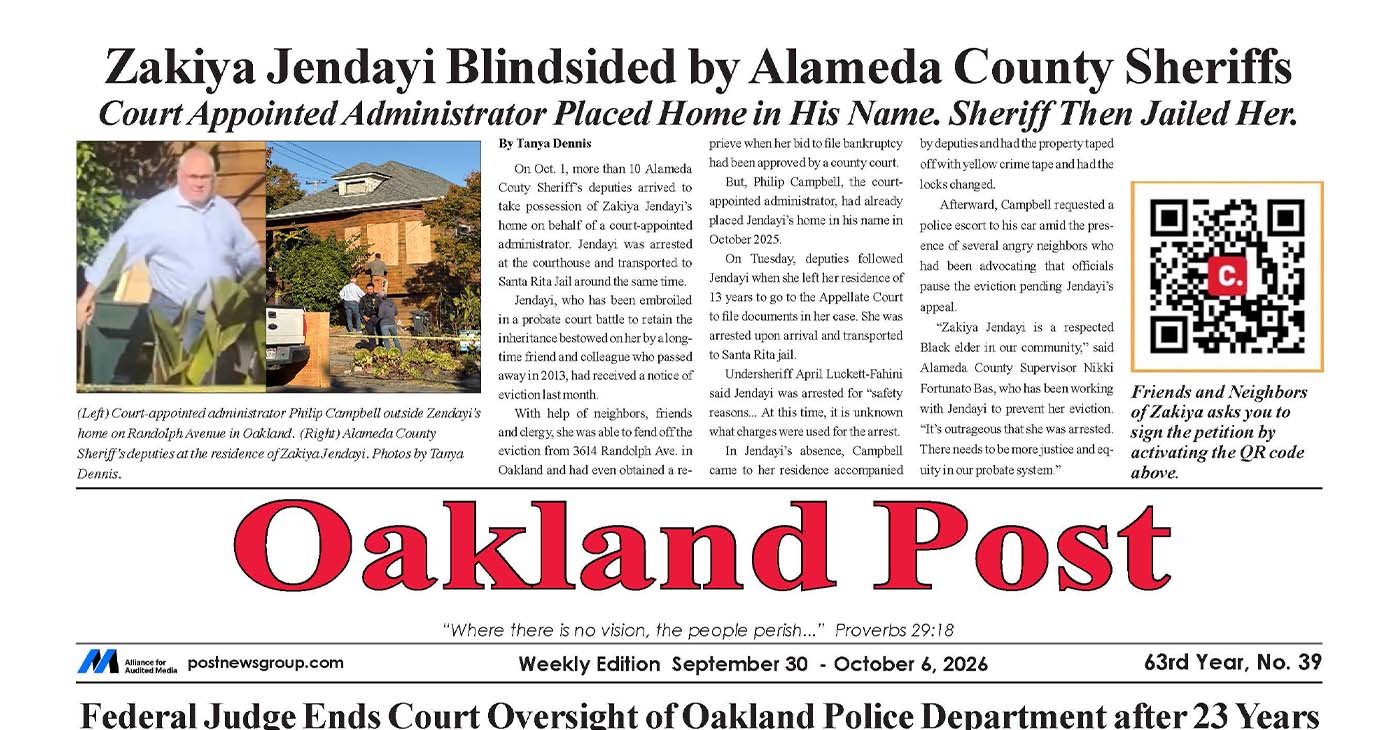
To enlarge your view of this issue, use the slider, magnifying glass icon or full page icon in the lower right corner of the browser window.
Activism
Oakland Post: Week of September 23 – 29, 2026
The printed Weekly Edition of the Oakland Post: Week of September 23 – 29, 2026

To enlarge your view of this issue, use the slider, magnifying glass icon or full page icon in the lower right corner of the browser window.
Activism
Oakland Post: Week of September 16 – 22, 2026
The printed Weekly Edition of the Oakland Post: Week of September 16 – 22, 2026

To enlarge your view of this issue, use the slider, magnifying glass icon or full page icon in the lower right corner of the browser window.


OP-ED: Proposition 44 Would Put a Price on Trust

OP-ED: Proposition 40: It’s Time to Play Chess, Not Checkers

Listening as a Lifeline: A Doula’s Witness to Black Maternal Health

New Protections for Ticket Buyers: Gov. Newsom Signs Assemblymember Isaac Bryan’s Bill

‘We Don’t Talk Trash — We Pick Up Trash!’

Zakiya Jendayi Arrested, Locked Out of Home by Sheriff’s Deputies

Oakland Post: Week of September 30 – October 6, 2026

Asm. Corey Jackson Announces Launch of 24-Hour Childcare in His District

IN MEMORIAM: The Rev. Leon “Sonny” Clark, Longtime Orange County Pastor and Community Leader, Dies at 72

Poll: Becerra Widens His Lead Over Hilton; Californians Split on Wealth Tax

From Historic Memories to New Possibilities: Oakland Celebrates Coliseum 60

County Office of Education Says OUSD Finances Are Getting Healthier, Materially Stronger

LIVE FREE Sunday Dinner Brings Faith, Fellowship and Civic Conversation to Oakland

Remembering Chauncey Bailey as Student Journalists Face Threats to Truth-Telling

BLACspace Cooperative Invites Bay Area to Experience Oakland’s Black Cultural Ecosystem Through a BLAC Map Tour + Party

Standoff for Justice: Our Homes Are Worth Fighting For

Oakland Post: Week of August 26 – September 1, 2026

Frontier Airlines’ Return to Oakland Airport Brings Flights, Jobs and Opportunity

Jackie Wright Champions Bay Area Stories, Filmmakers and Cultural Institutions

Gubernatorial Candidate Steve Hilton Blasts California New Tire Rules; Newsom Hits Back

Chef Sharon Lee Blends Culinary Excellence, Education and Empowerment

Misnamed ‘Parent’ PAC Seeks to Influence Oakland School Board Elections

Oakland Coliseum Project Opens Door for Small Businesses to Build Bigger

Big City Mayors Ask for “Yes” Vote on Housing Bond Measure; Conservatives Say “No”

Gov. Newsom’s Latest Appointees Include Sacramento Advocate for Formerly Incarcerated Students; State’s New Tech Chief

Oakland Post: Week of September 2 – 8, 2026

Longtime BWOPA Member Brendalyn Goodall Appointed to California Workforce Development Board

Gov. Newsom Signs Law Shielding Immigration Aid Workers From Doxing Threats

Secretary of State Shirley N. Weber Urges Californians to Vote Early as Voter ID Battle Intensifies

Oakland Post: Week of September 9 – 15, 2026

The Conversation With Al McFarlane 6/23/26

Media Monday 6/22/26

LIVE! ASK ALMA! — TUES. 6.23.26 7PM EST

Car Buying Secrets: 4 Hidden Checks Before You Sign!

Is This 550 HP Charger Worth YOUR Money? AutoNetwork Review

Celebrating Juneteenth – Frederick Douglass on education and resistance

LIVE! — ASK ALMA! — TUES. 6.19.26 7PM EST

Hyundai Ioniq 5 Parking, Safety, and 360 View #shorts

2025 Ioniq 5 New Wiper & Powerful Performance! #shorts

Electric SUV Range: Is 259 Miles Enough? #shorts

EV Charging: How Fast Can You Charge an Electric Vehicle? #shorts

Biometric Cooling… Messaging Seats…Come on! 2025 Infiniti QX80 Autograph 4WD

Charged Up: Witness the Magic of a Fully Electric Car! #shorts

Range Rover Sport PHEV Included…: See What’s Inside This Luxury SUV! #shorts

Invisible Hood View: Perfect Parking with X-Ray Vision! #shorts
-
 Community4 weeks ago
Misnamed ‘Parent’ PAC Seeks to Influence Oakland School Board Elections
-
 Activism4 weeks ago
Oakland Post: Week of September 9 – 15, 2026
-

 Community4 weeks ago
Richmond Tiny House Village Farm & Garden Set to Open Gates on Sept. 26
-

 Black History4 weeks ago
Latest Massacre in Haiti Reveals Cruelty U.S. Deportations
-

 Black History4 weeks ago
OPINION: Nolan Wells’ Death One of Several Signifying Racial Terror Lives on in U.S. South
-

 Business3 weeks ago
Mayor Lee Announces $1 Million Kaiser Permanente Grant for Pilot Program to Address Homelessness, Clean Up Public Spaces throughout Oakland
-
 Economy2 weeks ago
Poll: Becerra Widens His Lead Over Hilton; Californians Split on Wealth Tax
-
 Business2 weeks ago
County Office of Education Says OUSD Finances Are Getting Healthier, Materially Stronger
