
Activism
Democrats in Sacramento Take Steps to Make Voting Easier
Recently, in some states, most notoriously Georgia and Florida, lawmakers have taken steps to restrict voting access and rights for many Americans. But in California, policymakers and legislators are doing the opposite, making proposals to simplify the voting process and expand access to the polls.


The electoral process is foundational to the durability of America’s democratic structure.
And as the battle for fairer voting laws rages on, politicians and activists on the political Right claim they are responding to allegations of widespread voter and election fraud. Those on the Left say they are rallying to fight a coordinated political offensive to restrict access to the polls and increasing reports of voter suppression.
Recently, in some states, most notoriously Georgia and Florida, lawmakers have taken steps to restrict voting access and rights for many Americans.
But in California, policymakers and legislators are doing the opposite, making proposals to simplify the voting process and expand access to the polls.
Invoking the violent history of voter suppression in the South that her parents endured, which sometimes involved murders — California Secretary of State Shirley Weber says it is a priority of hers to “ensure the right to vote.”
“I tell people all the time that no number is good unless it’s 100% in terms of voter participation,” Weber told the Public Policy Institute of California. “Why didn’t 5 million go to the polls? We need to figure out where they are and what stopped them from going.”
In the California Legislature, an amendment to Senate Bill (SB) 29, which passed earlier this year, was one bill in a broader legislative effort to secure the right to vote in vulnerable communities.
Before that amendment passed, California law dictated that a ballot would be mailed to all eligible voters for the November 3 statewide general election in 2020 as well as use a Secretary of State vote-by-mail tracking system to ensure votes are counted.
SB 29, which the governor signed into law in February, extended those requirements to any election “proclaimed or conducted” prior to Jan. 1, 2022.
A record number of voters participated in California elections in 2020. Some political observers attribute that spike to the vote-by-mail system instituted last year.
“To maintain a healthy democracy in California, it is important to encourage eligible voters to vote and to ensure that residents of the state have the tools needed to participate in every election,” the bill reads.
Senate Bill (SB) 583, introduced by California State Sen. Josh Newman (D-Fullerton), would require the Secretary of State to register or preregister eligible citizens to vote upon retrieving the necessary paperwork from the Department of Motor Vehicles (DMV).
Citizens who do not wish to be registered can opt-out of the process altogether.
Newman stressed the importance of access and simplifying the voter registration process.
“In our state there are an estimated 4.6 million U.S. citizens who are eligible to vote who have not yet registered,” Newman said. “Our obligation as the people’s elected representatives is to make the process simpler and more accessible for them.”
On April 27, the Senate Transportation Committee passed SB 583 with a 13 to 3 vote. The Appropriations Committee has set a hearing for May 10.
Senate Bill (SB) 503, introduced by Sen. Josh Becker (D-Menlo Park), proposes that if a signature shares enough characteristics with a previous signature from the same voter, then it would be recognized as official on voting paperwork.
Current law dictates that a signature has to match exactly for it to be considered valid.
Disability Rights California (DRC), a non-profit advocacy organization that advances and protects the rights of Californians living with disabilities, has come out in support of SB 503.
“Studies have shown that signature matches disproportionately impact voters with disabilities,” Eric Harris, director of public policy for the DRC wrote in a letter.
“Voters with disabilities, including seniors, are more likely to vote by mail and would have to sign their name on their ballots,” Harris argued. “A voter’s signature changes over time and for people with disabilities, a signature can change nearly every other time one is written. Some people with disabilities might have conditions that make it difficult to sign your name the same way multiple times.”
For now, the Senate Appropriations Committee has tabled SB 503, placing the bill in what the Legislature calls a “suspense file,” where it awaits further action by lawmakers.
At the federal level, lawmakers have introduced two bills in the U.S. Congress to expand voting rights, the For The People Act of 2021 and the John L. Lewis Voting Rights Advancement Act.
The For The People Act, or H.R.1, proposes a three-pronged approach to expanding election access: Voting, campaign finance, and ethics.
Hilary Shelton, director of the NAACP’s Washington Bureau and senior vice president for Advocacy and Policy, compared the current voting rights battle to that of the Civil Rights Movement in a press conference about H.R.1 and the John L. Lewis Voting Rights Advancement Act.
“If you look at some of those 1960s shots of the C.T. Vivians of the world, of the Joe Lowerys and so many others that helped lead Americans to those registration sites, you’ll see them actually literally being beaten to the ground,” Shelton said, referring to well-known Civil Rights Movement activists.
The John L. Lewis Voting Rights Advancement Act of 2021, or S.4263, would amend the Voting Rights Act of 1965 to restore the powers it lost after the Supreme Court’s 2013 ruling in Shelby v. Holder. In that case, the U.S. Supreme Court ruled that laws requiring states and local communities to first clear any changes to voting their local laws with the feds, was unlawful.
“Well, we’ve become more sophisticated in our disenfranchisement,” Shelton continued. “We want to make sure that we stop that disenfranchisement all along the way and that’s why we’re convinced that a bill named for John Lewis and a bill that speaks for the people are bills that need to pass.”






Activism
Oakland Post: Week of March 11 -17, 2026
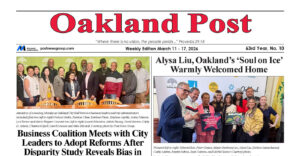
The printed Weekly Edition of the Oakland Post: Week of March 11 – 17, 2026

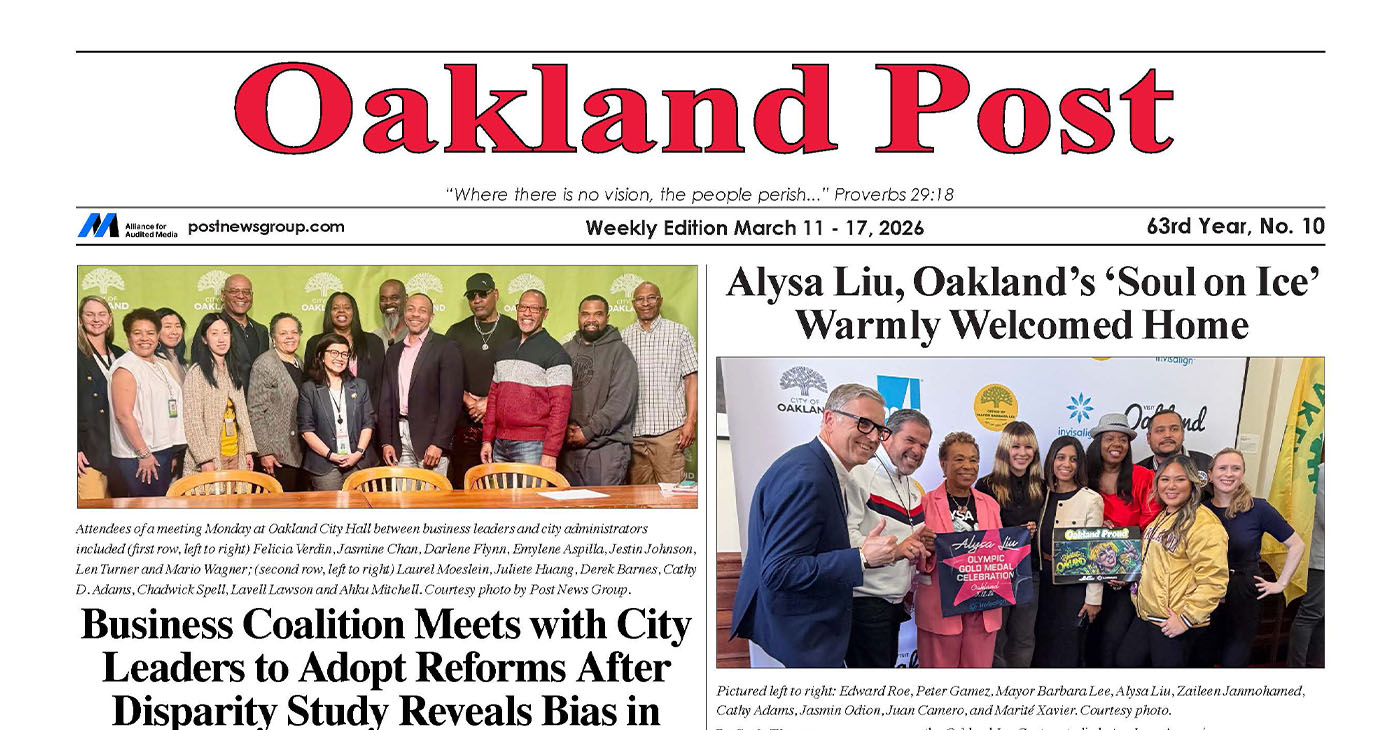
To enlarge your view of this issue, use the slider, magnifying glass icon or full page icon in the lower right corner of the browser window.

Activism
Oakland Post: Week of March 4 – 10, 2026
The printed Weekly Edition of the Oakland Post: Week of March 4 – 10, 2026
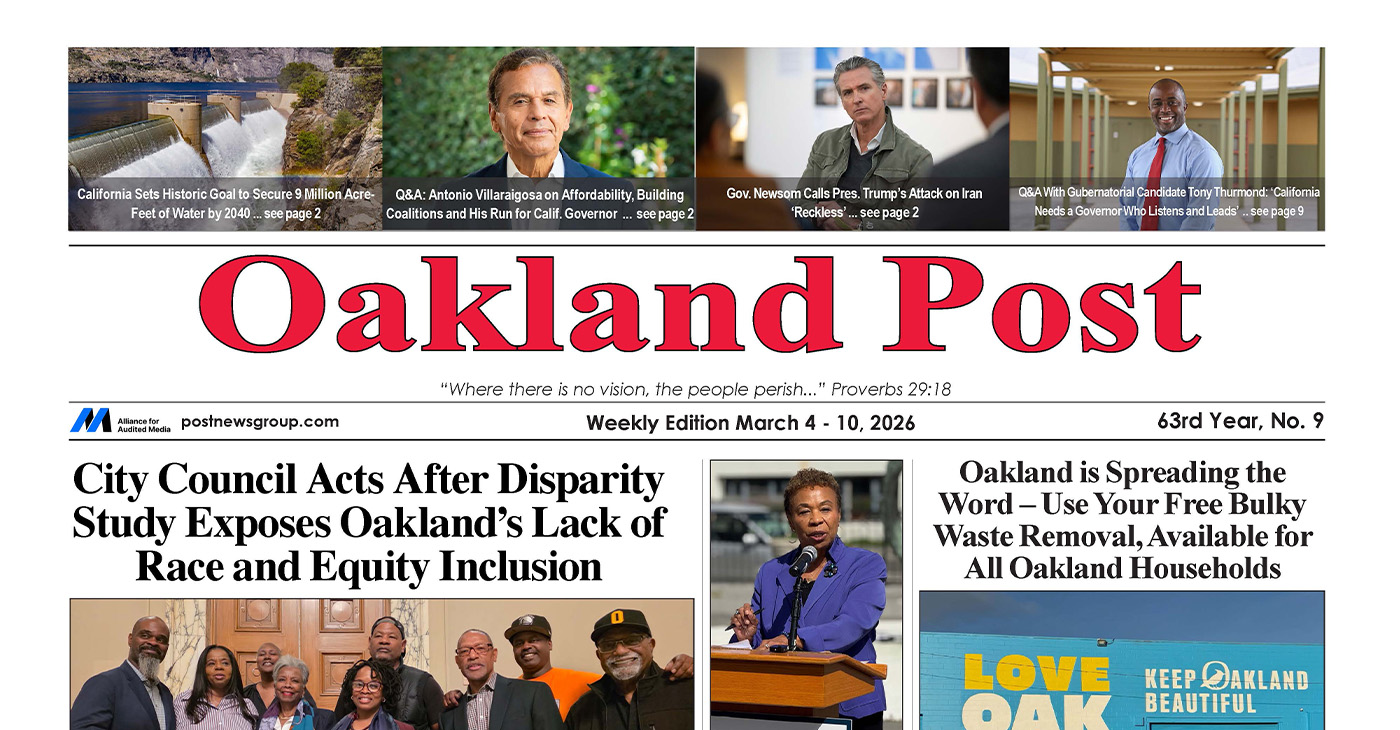
To enlarge your view of this issue, use the slider, magnifying glass icon or full page icon in the lower right corner of the browser window.
Activism
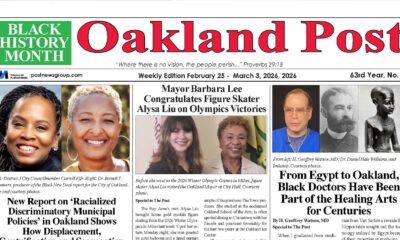
Oakland Post: Week of February 25 – March 3, 2026
The printed Weekly Edition of the Oakland Post: Week of – February 25 – March 3, 2026
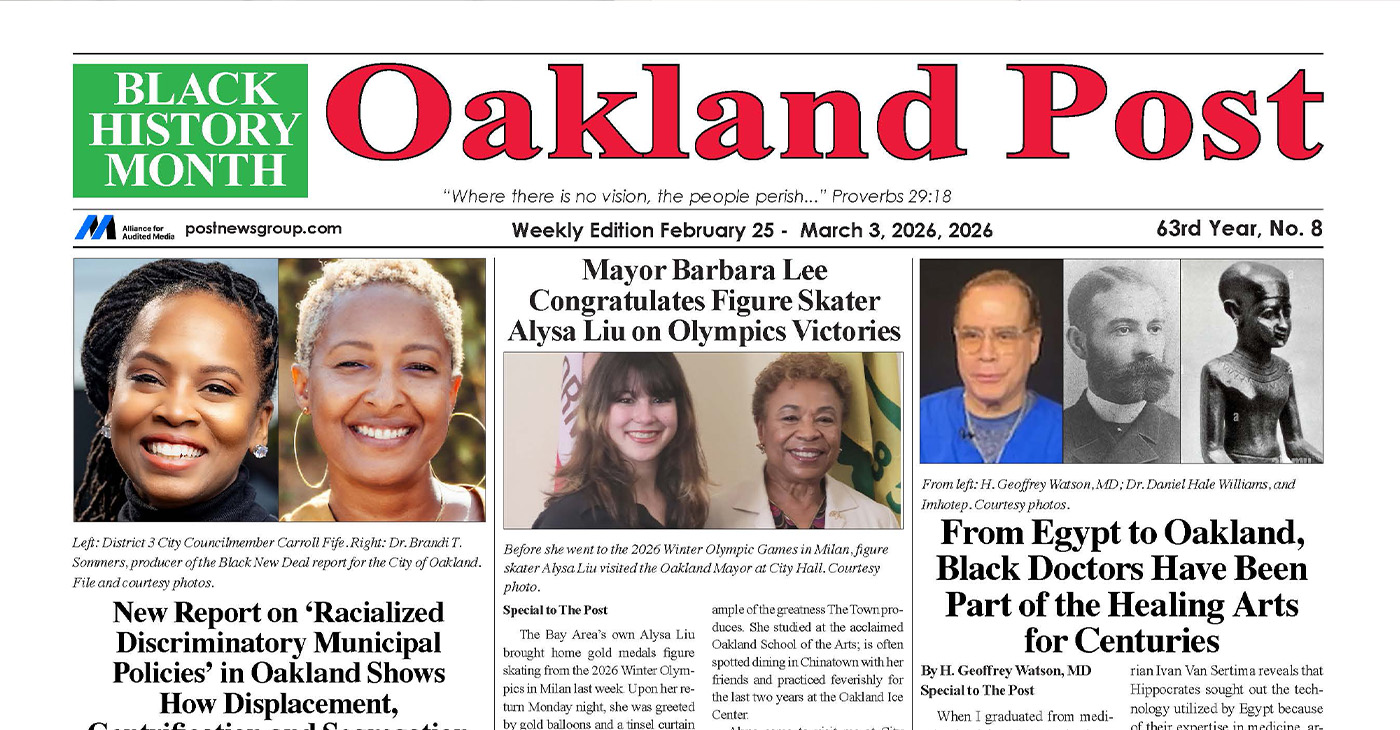
To enlarge your view of this issue, use the slider, magnifying glass icon or full page icon in the lower right corner of the browser window.

WORK FROM HOME
Home-based business with potential monthly income of $10K+ per month. A proven training system and website provided to maximize business effectiveness. Perfect job to earn side and primary income. Contact Lynne for more details: Lynne4npusa@gmail.com 800-334-0540


Financial Wellness and Mental Health: Managing Money Stress in College

Oakland Post: Week of March 11 -17, 2026

Women & Wealth: Tips for Navigating Your Lifelong Financial Journey

COMMENTARY: Women of Color Shape Our Past and Future

Woman’s Search for Family’s Roots Leads to Ancestor John T. Ward – A Successful Entrepreneur and Conductor on the Underground Railroad

Advocates Raise Alarm Over ICE Operation, MOU and Detention Risks in Baltimore County

Pete Buttigieg to Join Mayor Randall Woodfin for Community Town Hall in Birmingham

WATCH: Week One – NNPA’s “Leadership Matters” Video Series

Oakland Post: Week of March 4 – 10, 2026

OP-ED: NNPA Launches 2026 “Leadership Matters” Video Series

PRESS ROOM: PMG and Cranbrook Horizons-Upward Bound Launch Journey Fellowship Cohort 2

Los Angeles Summit Brings Together Leaders to Tackle Poverty and Affordability

Civil Rights TV Launches 24/7 Network Focused on Black History, Education and Equity

REVIEW: The Ultimate Hot Girl Summer Getaway: Sunseeker Resort Florida

COMMENTARY: How You Stop a Prescription Medicine is as Important as How You Start

Book Review: Books on Black History and Black Life for Kids

Community Celebrates Turner Group Construction Company as Collins Drive Becomes Turner Group Drive

Discrimination in City Contracts

California Launches Study on Mileage Tax to Potentially Replace Gas Tax as Republicans Push Back

COMMENTARY: The Biases We Don’t See — Preventing AI-Driven Inequality in Health Care

Black History Events in the East Bay

Post Newspaper Invites NNPA to Join Nationwide Probate Reform Initiative

Art of the African Diaspora Celebrates Legacy and Community at Richmond Art Center

New Bill, the RIDER Safety Act, Would Support Transit Ambassadors and Safety on Public Transit

COMMENTARY: The National Protest Must Be Accompanied with Our Votes

Oakland Post: Week of February 4 – 10, 2026

Oakland Post: Week of February 11 – 17, 2026

Dorothy Lee Bolden: Uniting Domestic Workers

After Don Lemon’s Arrest, Black Officials Raise Concerns About Independent Black Media

Reflecting on Black History Milestones in Birmingham AL

Hyundai Ioniq 5 Parking, Safety, and 360 View #shorts

2025 Ioniq 5 New Wiper & Powerful Performance! #shorts

Electric SUV Range: Is 259 Miles Enough? #shorts

EV Charging: How Fast Can You Charge an Electric Vehicle? #shorts

Biometric Cooling… Messaging Seats…Come on! 2025 Infiniti QX80 Autograph 4WD

Charged Up: Witness the Magic of a Fully Electric Car! #shorts

Range Rover Sport PHEV Included…: See What’s Inside This Luxury SUV! #shorts

Invisible Hood View: Perfect Parking with X-Ray Vision! #shorts

AI Is Reshaping Black Healthcare: Promise, Peril, and the Push for Improved Results in California

ESSAY: Technology and Medicine, a Primary Care Point of View

Sanctuary Cities

The RESISTANCE – FREEDOM NOW

STATE OF THE PEOPLE: Freddie

ECONOMIC BOYCOTT DAY!!!!!

I told You So
-
 #NNPA BlackPress3 weeks ago
Reflecting on Black History Milestones in Birmingham AL
-
 #NNPA BlackPress3 weeks ago
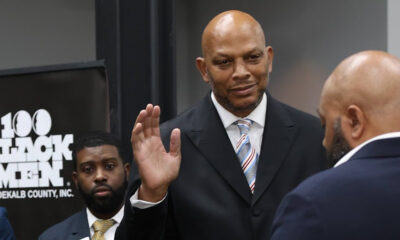
PRESS ROOM: NBA Hall of Fame Nominee Terry Cummings Joins 100 Black Men of DeKalb County to Launch Victory & Values Initiative
-

 #NNPA BlackPress4 weeks ago
U.S. manufacturing rebounds – how foundry services are adapting to rising demand
-

 #NNPA BlackPress4 weeks ago
OP-ED: One Hundred Years of Black Workers Telling the Truth
-
 Activism3 weeks ago
Oakland Post: Week of February 25 – March 3, 2026
-

 #NNPA BlackPress4 weeks ago
Advancements in solar technology that are changing the way we power the world
-

 #NNPA BlackPress3 weeks ago
Trump’s MAGA Allies are Creating Executive Order Plan to Steal the 2026 Midterms
-

 #NNPA BlackPress4 weeks ago
PRESS ROOM: Civil Rights TV Launches in Selma as the World’s First 24/7 Civil Rights Television Network
