
Commentary
COMMENTARY: Muslims in France Face Worsening Climate of Hate Under Leadership of President Macron
For France, which colonized Algeria for more than a century, the idea that people from the former colonies should live the life they want seems unbearable. Many white French people seem to have a fear that those from the former colonies may want to treat the descendants of the European French in the same way that the colonial masters treated us. Assuming always the worst for its Muslim citizens says a lot about the country and its beliefs.


By Larbi Ben Krima
Editor’s Note: We are accustomed to hearing travel advisories telling us to avoid countries in the midst of civil war or government repression. Last month a Muslim civil rights organization warned Muslims not to travel to a country that many consider to be the birthplace of liberty. The author of this article, a French citizen, explains how France has become an oppressive place for Muslims.
I was born and raised in France to an Algerian family. I, like millions of other French citizens, heard about colonization and the mistreatment it created. There was some progress made, and now, piece by piece, that is being erased.
One year ago, in October 2020, French President Macron decided to launch his 2022 re-election campaign with a speech targeting Muslim people. He used terrorism as an excuse. Everybody in France knew it was really about politics, although the citizens of the world did not know that.
Macron’s government followed up by dissolving organizations that had criticized his Islamophobic government.
Schools, humanitarian NGO’s, mosques, publishing offices, and civil right movements with Muslim participants have been shut down by a government looking for Far Right votes in the next election.
France is still pretending to fight for rights around the world, but these rights are never really applied to its Muslim citizens, who are always seen as a Fifth Column and who always have to prove that they are French enough.

Every Muslim act is seen as a danger to the country. It seems that Muslim prayers threaten the French republic; Muslim food is seen as a challenge to the religion of other French people; and Muslim clothes are seen as an attempt to change France’s way of life. Most religions have special foods, and prayers and clothing. Having these customs should not be made so difficult for us after all these years. What’s the big deal?
For France, which colonized Algeria for more than a century, the idea that people from the former colonies should live the life they want seems unbearable. Many white French people seem to have a fear that those from the former colonies may want to treat the descendants of the European French in the same way that the colonial masters treated us. Assuming always the worst for its Muslim citizens says a lot about the country and its beliefs.
That may explain why this country, which refuses to take accountability for its colonial past, can’t accept the kids who are born and raised here.
Quoting the world-famous psychiatrist and political philosopher Frantz Fanon, “It should not be said that such and such a country is racist, but there are no lynchings or extermination camps there. The truth is, all of this and something more is on the horizon.”
We can say that racism runs deep in France’s institutions and politics, cheered on by the media, with applause from a substantial group who likes what they are hearing.
This is a country where an openly racist media pundit has growing support in his campaign for president, just as Donald Trump did.
France, which always despised the USA, has now became one of the United States of Islamophobia, along with China and India.
A former great country, known for its ideals, France has used its former glory around the world. Recently, the world has come to know what a very small country France has actually become a country that should stop preaching to others what it obviously refuses to apply to itself.











Activism
Oakland Post: Week of February 18 – 24, 2026
The printed Weekly Edition of the Oakland Post: Week of – February 18 – 24, 2026
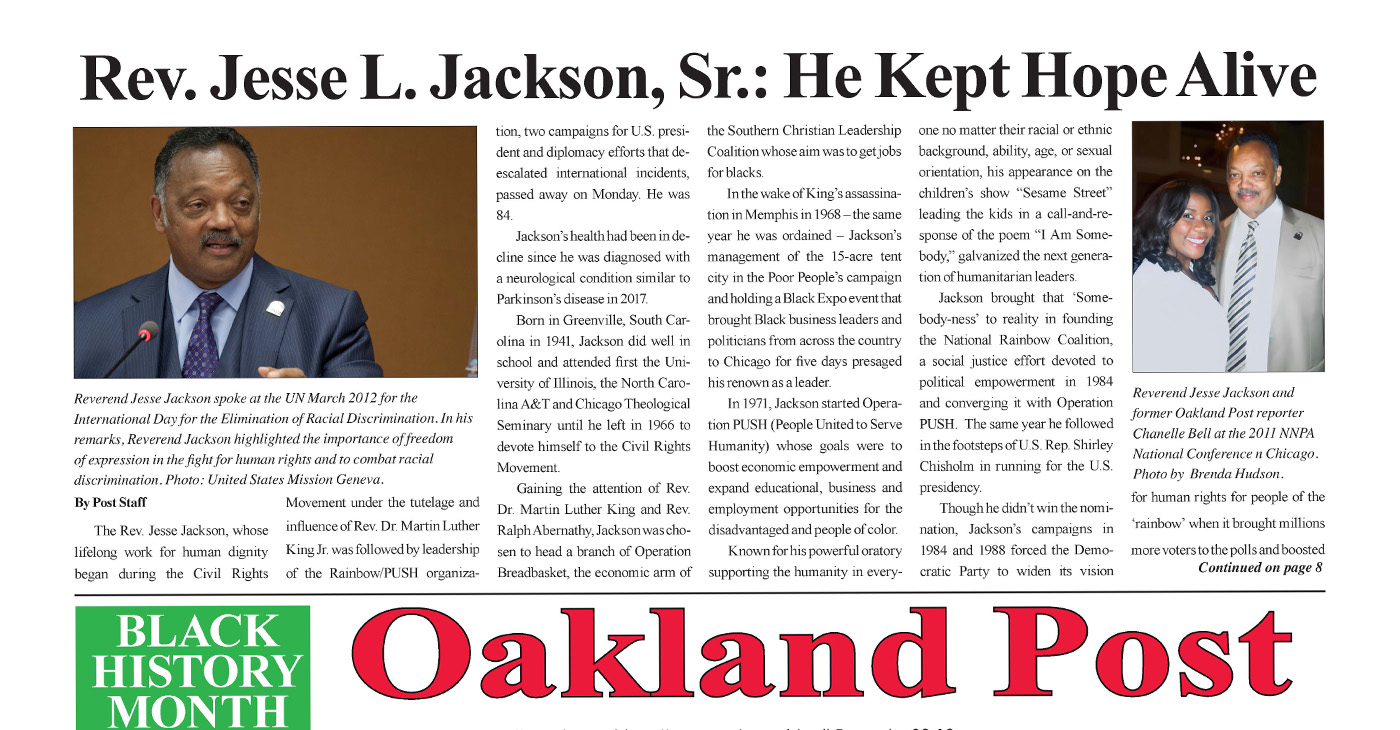
To enlarge your view of this issue, use the slider, magnifying glass icon or full page icon in the lower right corner of the browser window.

Activism
Oakland Post: Week of February 11 – 17, 2026
The printed Weekly Edition of the Oakland Post: Week of – February 11 – 17, 2026

To enlarge your view of this issue, use the slider, magnifying glass icon or full page icon in the lower right corner of the browser window.
Advice
Rising Optimism Among Small And Middle Market Business Leaders Suggests Growth for California
“Business leaders across the Pacific region continue to demonstrate a unique blend of resilience and forward-thinking, even in the face of ongoing economic uncertainty,” said Brennon Crist, Managing Director and Head of the Pacific Segment, Commercial Banking, J.P. Morgan. “Their commitment to innovation and growth is evident in the way they adapt to challenges and seize new opportunities. It’s this spirit that keeps our region at the forefront of business leadership and progress. We look forward to helping our clients navigate all that’s ahead in 2026.”

Sponsored by JPMorganChase
Business optimism is returning for small and midsize business leaders at the start of 2026, fueling confidence and growth plans.
The 2026 Business Leaders Outlook survey, released in January by JPMorganChase reveals a turnaround from last June, when economic headwinds and uncertainty about shifting policies and tariffs caused some leaders to put their business plans on hold.
Midsize companies, who often find themselves more exposed to geopolitical shifts and policy changes, experienced a significant dip in business and economic confidence in June of 2025. As they have become more comfortable with the complexities of today’s environment, we are seeing optimism rebounding in the middle market nationwide – an encouraging sign for growth, hiring, and innovation. Small businesses, meanwhile, maintained steady optimism throughout 2025, but they aren’t shielded from domestic concerns. Many cited inflation and wage pressures as the top challenges for 2026 and are taking steps to ensure their businesses are prepared for what’s ahead.
“Business leaders across the Pacific region continue to demonstrate a unique blend of resilience and forward-thinking, even in the face of ongoing economic uncertainty,” said Brennon Crist, Managing Director and Head of the Pacific Segment, Commercial Banking, J.P. Morgan. “Their commitment to innovation and growth is evident in the way they adapt to challenges and seize new opportunities. It’s this spirit that keeps our region at the forefront of business leadership and progress. We look forward to helping our clients navigate all that’s ahead in 2026.”
Overall, both small and midsize business leaders are feeling more confident to pursue growth opportunities, embrace emerging technologies and, in some cases, forge new strategic partnerships. That bodes well for entrepreneurs in California. Here are a few other key findings from the Business Leaders Outlook about trends expected to drive activity this year:
- Inflation remains the top concern for small business owners. Following the 2024 U.S. presidential election, many anticipated a favorable business environment. By June 2025, however, that feeling shifted amid concerns about political dynamics, tariffs, evolving regulations and global economic headwinds.
Going into 2026, 37% of respondents cited inflation as their top concern. Rising taxes came in second at 27% and the impact of tariffs was third at 22%. Other concerns included managing cash flow, hiring and labor costs.
- For middle market leaders, uncertainty remains an issue. Almost half (49%) of all midsize business leaders surveyed cited “economic uncertainty” as their top concern – even with an improved outlook from a few months ago. Revenue and sales growth was second at 33%, while tariffs and labor both were third at 31%.
- And tariffs are impacting businesses costs. Sixty-one percent of midsize business leaders said tariffs have had a negative impact on the cost of doing business.
- Despite challenges, leaders are bullish on their own enterprises. Though the overall outlook is mixed, 74% of small business owners and 71% of middle market companies are optimistic about their company’s prospects for 2026.
- Adaption is the theme. For small business owners surveyed across the U.S., responding to continuing pressures is important in 2026. Building cash reserves (47%), renegotiating supplier terms (36%) and ramping up investments in marketing and technology are among the top priorities.
- Big plans are on the horizon. A majority midsized company leaders expect revenue growth this year, and nearly three out of five of (58%) plan to introduce new products or services in the coming year, while 53% look to expand into new domestic and/or international markets. Forty-nine percentsay they’re pursuing strategic partnerships or investments.
The bottom line
Rebounding optimism among U.S. business leaders at the start of the year is setting the stage for an active 2026. With business leaders looking to implement ambitious growth plans that position themselves for the future, momentum in California could be beneficial for leaders looking to launch, grow or scale their business this year.
WORK FROM HOME
Home-based business with potential monthly income of $10K+ per month. A proven training system and website provided to maximize business effectiveness. Perfect job to earn side and primary income. Contact Lynne for more details: Lynne4npusa@gmail.com 800-334-0540


PRESS ROOM: NBA Hall of Fame Nominee Terry Cummings Joins 100 Black Men of DeKalb County to Launch Victory & Values Initiative

Reflecting on Black History Milestones in Birmingham AL

OP-ED: One Hundred Years of Black Workers Telling the Truth

PRESS ROOM: Civil Rights TV Launches in Selma as the World’s First 24/7 Civil Rights Television Network

Advancements in solar technology that are changing the way we power the world

U.S. manufacturing rebounds – how foundry services are adapting to rising demand

Why has blood testing become so popular in today’s world?

Ghana Mourns a Son of the African World

OP-ED: Trump’s Policies Hurt Black America—and Everyone Else

OP-ED: Meta Deleted Me. I Still Don’t Know Why. And neither will you.

More than a Mission: Paying It Forward for the Future of Education

Avoid Eviction This Season: Landlord Checklist for Stable Tenancies

How chronic back problems affect Black communities differently

How cancer care is evolving with modern medicine

Diabetes disparity: Understanding Type 2 risks for Black Americans

Life Expectancy in Marin City, a Black Community, Is 15-17 Years Less than the Rest of Marin County

Oakland Post: Week of January 28, 2025 – February 3, 2026

Community Celebrates Turner Group Construction Company as Collins Drive Becomes Turner Group Drive

California Launches Study on Mileage Tax to Potentially Replace Gas Tax as Republicans Push Back

Discrimination in City Contracts

Oakland Post: Week of January 21 – 27, 2026

Book Review: Books on Black History and Black Life for Kids

Medi-Cal Cares for You and Your Baby Every Step of the Way

COMMENTARY: The Biases We Don’t See — Preventing AI-Driven Inequality in Health Care

After Don Lemon’s Arrest, Black Officials Raise Concerns About Independent Black Media

Post Newspaper Invites NNPA to Join Nationwide Probate Reform Initiative

OP-ED: The Dream Cannot be Realized Without Financial Freedom

COMMENTARY: The National Protest Must Be Accompanied with Our Votes

Four Stolen Futures: Will H-E-B Do The Right Thing?

Black History Events in the East Bay

Hyundai Ioniq 5 Parking, Safety, and 360 View #shorts

2025 Ioniq 5 New Wiper & Powerful Performance! #shorts

Electric SUV Range: Is 259 Miles Enough? #shorts

EV Charging: How Fast Can You Charge an Electric Vehicle? #shorts

Biometric Cooling… Messaging Seats…Come on! 2025 Infiniti QX80 Autograph 4WD

Charged Up: Witness the Magic of a Fully Electric Car! #shorts

Range Rover Sport PHEV Included…: See What’s Inside This Luxury SUV! #shorts

Invisible Hood View: Perfect Parking with X-Ray Vision! #shorts

AI Is Reshaping Black Healthcare: Promise, Peril, and the Push for Improved Results in California

ESSAY: Technology and Medicine, a Primary Care Point of View

Sanctuary Cities

The RESISTANCE – FREEDOM NOW

STATE OF THE PEOPLE: Freddie

ECONOMIC BOYCOTT DAY!!!!!

I told You So

-
 Activism4 weeks ago
Life Expectancy in Marin City, a Black Community, Is 15-17 Years Less than the Rest of Marin County
-
 Activism4 weeks ago
Oakland Post: Week of January 28, 2025 – February 3, 2026
-
 Activism3 weeks ago
Community Celebrates Turner Group Construction Company as Collins Drive Becomes Turner Group Drive
-
 Business3 weeks ago
California Launches Study on Mileage Tax to Potentially Replace Gas Tax as Republicans Push Back
-
 Activism3 weeks ago
Discrimination in City Contracts
-
 Arts and Culture3 weeks ago
Book Review: Books on Black History and Black Life for Kids
-
 Activism4 weeks ago
Medi-Cal Cares for You and Your Baby Every Step of the Way
-
 Activism3 weeks ago
COMMENTARY: The Biases We Don’t See — Preventing AI-Driven Inequality in Health Care
