
Art
Antonio ‘Tony’ Minifield on his picture perfect photography business
THE BIRMINGHAM TIMES — Antonio “Tony” Minifield, photographer, has always been creative, especially when it came to visual arts.

By Erica Wright
Antonio “Tony” Minifield, photographer, has always been creative, especially when it came to visual arts.
“My first hustle was painting and doing silk portraits of people,” he said. “I wanted to do something where I could draw and be creative.”
He also had a love for architecture, which he pursued and would lead to his current line of work. In high school, he was part of an architectural, construction, and engineering program that mentors students and inspires them to pursue careers in design and construction.
“Photography and architecture combined, and then my love for photography really just out-powered my love for architecture,” he said.
Minifield, 27, a professional full-time photographer for the past two years, owns YNOT iMages, which specializes in photography for weddings and engagements; maternity, graduation, and family portraits; as well as food photography and other work.
“We average about 30 weddings a year,” he said. “In 2019, we’re pretty much booked, so we’re looking at 2020 for more weddings.”
Fifty percent of his work is done in Alabama; forty percent in Atlanta and other locations in Georgia; and 10 percent in other parts of the country “and this year we have two international weddings,” Minifield said.
Business is so strong that he even has help from his wife, Haley.
“My wife ended up joining the team, and she’s now like my full-time assistant,” Minifield said. “She’s a school teacher, but she’s my main second shooter when we do weddings.”
City Schools
Minifield grew up in Birmingham and lived in the Inglenook neighborhood with his parents and siblings before moving to Center Point. He attended W.J. Christian K-8 School, Huffman Middle School, and Ramsay High School.
“I was kind of a nerd, I would say, because I was always striving to be in the honor societies,” he said. “I was the only guy to be inducted into the honor society in seventh grade, and I maintained that in eighth grade. That carried over when I went to Ramsay, … [where] I played baseball: I started in my sophomore year [and played] up until my senior year. I [also] was in the … ACE Mentor Program.”
The ACE Mentor Program—an architectural, construction, and engineering program that inspires students to pursue careers in design and construction—inspired Minifield to go into architecture after he graduated from high school in 2009. He went on to pursue a degree in architecture at Tuskegee University.
“I got in choir. I actually had a choir scholarship. I also was involved in the Student Government Association [SGA] … and pursued and won the position of president,” he said.
Though he was an architecture major, Minifield’s photography business took off at Tuskegee.
“My line brother is a graphic designer and photographer, and he inspired me to get into photography,” said Minifield, who is a member of Alpha Phi Alpha Fraternity Inc. “Architecture at Tuskegee really taught you how to hustle because everybody had their own skill sets to really make money. I started photography as a hobby.”
Minifield recalled his first photo shoot: “I did it in a Target parking lot [in the Birmingham area] when I got my first camera. I was just playing around with it. I just took some shots of my home girl because she was trying to get into modeling.”
He and his friend shared the photos on their social media pages, and their friends began asking Minifield about his photography. After that shoot, which was just about having fun, he said, “People were like, ‘How much do you charge?’
“My parents invested in me. They bought my first camera, a [Canon Rebel T3i], for my birthday in 2010. From there . . . the business just took off.”
Minifield began taking pictures for his friends and family, saving money to invest in additional equipment like extra lenses and a tripod, while learning the ins and outs of photography.
YNOT
The name of Minifield’s business, comes from a play on words of his nickname, ‘Tony,’ but it also has a deeper meaning than just his name being spelled backward.
“I started YNOT as a branding for myself in 2010,” he said. “It came from trying to figure out a Twitter name: ynot_b_tony. So, it started there. When I ran for SGA president in 2011, my slogan was ‘YNOT,’ which stood for Young Noble Outstanding Tuskegee. That was not only an acronym; I created a deeper meaning for it—YNOT, meaning using your God-given potential to the best of your ability and not letting anyone tell you that you can’t do anything.”
At Tuskegee, Minifield started the nonprofit YNOT Foundation in 2013 for high school students planning to attend college. His foundation, which officially became a nonprofit in 2016, has given away almost $5,000 in scholarships.
Minifield graduated from Tuskegee in 2014 and took a job with an architecture firm in Tuscaloosa, while taking photos on the side. He worked there for three years before going full-time with his photography business. He didn’t get his architecture license because of his love and passion for photography.
Recently, Minifield has worked with model and actress Eva Marcille, for a shoot with B Collective magazine, and actor and humanitarian Don Cheadle, during the 2018 Magic City Classic.
“I was hired by Woke Vote, so my team and I were able to do some video work for Woke Vote with Don Cheadle because he’s a spokesman for the [organization]. We followed him [for a whole day during] Classic weekend,” Minifield said.
For the cover of B Collective magazine featuring America’s Next Top Model winner and Real Housewives of Atlanta cast member Marcille, “We did a behind-the-scenes video,” Minifield said.
“Just being behind the scenes and watching one of my favorite photographers in the wedding industry, [StanLo Photography], work and do his thing was an amazing experience.”
Growth
Since going full time with photography, Minifield has seen growth both in his business and in himself.
“I studied other people’s work, I studied my work, and I studied ways to develop. I got new equipment and studied different techniques. I’ve seen growth in my style of editing,” he said. “My main growth came from when I got married on [Feb. 24, 2018]. That passion to capture love really grew because I found love, so it made it easier to capture that moment [for others].”
Minifield uses his gift also in his ministry. He is a member of the Church of the Highlands West Birmingham campus, which holds services at A.H. Parker High School.
“I first started serving at the Tuscaloosa campus, [working] on cameras there,” he said. “I really loved it, then I got the opportunity to become the production coach at the West Birmingham campus. Pastor Mayo [Sowell] has definitely been a blessing and a growth in my faith. Just knowing where he’s coming from, [his] challenging me to grow [personally] and grow spiritually has been a really great thing.”
Minifield credits his faith in God for his success and allowing him to be a blessing to others: “I give it all to God. That comes from being faithful to the kingdom, being faithful to God, being faithful to my wife. That’s really where my success comes from. Photography is a passion of mine, [and] being able to do it alongside my wife is even greater. That’s where I owe my success.”
Minifield and his work can be found online at www.ynotimages.com, on Instagram @ynot_images, and on Facebook at YNOT iMages.
This article originally appeared in The Birmingham Times.












Art
Misty Copeland Shapes Ballet’s Tomorrow
THE POSITIVE COMMUNITY — Misty Copeland will curate the 2026 Joyce Ballet Festival, a two-week event in New York City from August 4-16. This role allows her to influence the future of ballet by showcasing a wide range of dancers, choreographers, and companies. The festival will present both established and contemporary works, blending classical traditions with new artistic expressions.


This summer, Misty Copeland will step into a different kind of spotlight. Instead of taking center stage as a dancer, she will help determine what audiences see onstage as curator of the 2026 Joyce Ballet Festival. Taking place August 4 through August 16 at The Joyce Theater in New York City, the two-week celebration will bring together dancers, choreographers and companies representing a broad spectrum of ballet. The festival gives Copeland an opportunity to share not only her appreciation for ballet’s traditions, but also her vision for its future.
Copeland understands better than most how powerful a ballet stage can be. Her historic career with American Ballet Theatre changed the conversation about representation in one of the world’s most traditional performing arts. When she became the company’s first Black woman to reach the rank of principal dancer, her achievement carried significance far beyond a personal milestone. It gave young dancers of color a new image of what was possible and challenged the industry to reconsider who belonged at the center of ballet.
That history informs the perspective she brings to the festival. Copeland has spent much of her career moving between performance, mentorship, advocacy and storytelling. Her curatorial role allows her to bring those interests together by creating a program that does not treat ballet as a museum piece. Instead, the festival presents dance as an evolving language capable of carrying classical traditions into new cultural and artistic territory.
Audiences will encounter a mixture of established works and contemporary creations during the festival. Classical ballet vocabulary will share space with choreography that pushes dancers toward different physical, emotional and theatrical possibilities. The result is intended to give audiences a broader understanding of the art form while demonstrating that tradition and innovation do not have to be competing forces.
The lineup also provides an opportunity to see dancers from different artistic environments. Performers connected to organizations including American Ballet Theatre, New York City Ballet, Paris Opera Ballet, Houston Ballet, Dance Theatre of Harlem and Complexions Contemporary Ballet are among those represented in the festival. Each company carries its own history and artistic identity, making their participation part of a larger conversation about the many ways ballet can be performed and interpreted.
The presence of Dance Theatre of Harlem is particularly meaningful within the larger story of Copeland’s career and the evolution of Black representation in ballet. Founded during a period when opportunities for Black dancers were severely limited, the company helped demonstrate that excellence and classical training could flourish in a Black cultural environment. Its legacy continues to influence dancers and audiences, making its connection to a festival curated by Copeland especially resonant.
The program also reaches beyond a single definition of contemporary ballet. Choreographers with different backgrounds and artistic philosophies contribute to an evening that can move from recognizable classical structures to works shaped by modern dance, theater, popular culture and new approaches to movement. That diversity reflects a generation of artists who increasingly see ballet not as a rigid vocabulary but as a foundation from which they can explore.
For New York audiences, the festival offers something that is increasingly valuable: the opportunity to experience outstanding dancers in an intimate setting. The Joyce is known for presenting dance in a theater where audiences can see movement and artistry up close. That environment can make a familiar ballet work feel newly personal while allowing experimental pieces to communicate with unusual immediacy.
Copeland’s role as curator also sends a message about the importance of artistic leadership. The people who select performers and choreography help determine which stories receive attention and which artists receive opportunities. By bringing a range of voices into the festival, Copeland is using that responsibility to broaden the conversation around ballet. Her choices can introduce audiences to artists they may not otherwise encounter while encouraging longtime ballet followers to look at the form from a different perspective.
The 2026 Joyce Ballet Festival ultimately arrives at an important moment for the art form. Ballet is carrying centuries of tradition into an era defined by changing audiences, broader representation and increasingly adventurous choreography. Copeland’s festival reflects that transition. For two weeks in August, The Joyce will become a meeting place for the familiar and the unexpected—a celebration of where ballet came from and a preview of where it may be going. And with Misty Copeland helping shape the conversation, the future of ballet promises to be as expansive as the dancers who are defining it.
Based on reporting by The Positive Community.

Art
BOOK REVIEW: Never Tell a Black Girl How to Black Girl: Essays
Growing up in North Carolina, she Black Girled her hair her entire life. Her grandma made her sit for box braids when she was small, telling Brown that she was “tenderheaded.” Later, Brown had relaxed hair until she “went broke” and couldn’t afford the process anymore. That was when she got acquainted with her natural hair – although she returned to box braids at least once, and loved them all over again.

Author: Amena Brown, Copyright: c.2026, Publisher: Tiny Rep Books, SRP: $30.00, Page Count: 320 pages
Some things can really make you cross.
People telling you your business, for instance. People asking questions they have no reason to know the answers to. Folks who criticize your hair or clothes or life. These things would set anyone off; they’d be the last straw for anybody. As in the new book, “Never Tell a Black Girl How to Black Girl” by Amena Brown, some folks just cross the line.
In a way, it’s a matter of grammar.
Depending on how you say it, “Black Girl is a noun and a verb,” says Brown. A Black Girl can be a Black Girl… and she can Black Girl. Brown herself has done it “in six countries.”

Growing up in North Carolina, she Black Girled her hair her entire life. Her grandma made her sit for box braids when she was small, telling Brown that she was “tenderheaded.” Later, Brown had relaxed hair until she “went broke” and couldn’t afford the process anymore. That was when she got acquainted with her natural hair – although she returned to box braids at least once, and loved them all over again.

As the child of a strict Pentecostal mother, Brown was a “late bloomer.” She didn’t drink alcohol until she was in her twenties. She was chaste while dating and a better church girl than a party girl. After she left the church, she began experimenting with wine first, then cocktails. She learned to cook, reasoning that the path to finding love started in a kitchen, one that happened to be her grandmother’s. And yes, love did eventually come in the form of a red-headed White man who was her friend before he became her boyfriend — and before he became her mother-sanctioned, grandma-approved husband.
Overall, says Brown, there is no single right method for doing this.
“There are so many ways to Black Girl, which means the way you Black Girl is beautiful, and the way I Black Girl is beautiful too.”
Looking for a collection of addictive, can’t-read-just-one essays that’ll make you laugh but that also feel like author Amena Brown is peeking at your life? Want a book that speaks to every corner of your existence?
Yeah, then you want “Never Tell a Black Girl How to Black Girl.”
You know how it is when you spot something so profound, so right, that you just have to call your friends and read it out loud to them? That’s what you’ll find here: truth told with humor that’s also oozing with warmth. Add honesty that’s smart and bold and practically begging for a “Heck, YES!” and you’ve got your new favorite book.
The essays here are short enough to read in a few minutes, but compelling enough to make you want more, so give yourself room.
This is a book for twenty- and thirty-somethings, but also for their mothers and grandmas who can handle respectful irreverence and surefooted playfulness. Can men enjoy “Never Tell a Black Girl How to Black Girl”? Sure, but it’s more for women, cross your heart.
Art
Eric Murphy’s ‘City of Stars’ Honors Culture and Community
Murphy’s artistic journey is grounded in a lifelong passion for storytelling through visuals. Beginning as a child sketching celebrities, he later expanded into collage, blending illustration with found imagery and photography.
Eric Murphy’s latest exhibition, “Oakland City of Stars: From the Archives,” on view through Aug. 31, offers more than a visual tribute to Oakland; it presents history and a global connection rooted in the city’s cultural legacy.
Curated by Veda Silva at the African American Museum and Library at Oakland (AAMLO), the mixed-media solo show builds on Murphy’s evolving “Oakland All-Stars” series, highlighting figures rooted in community history.
Murphy’s artistic journey is grounded in a lifelong passion for storytelling through visuals. Beginning as a child sketching celebrities, he later expanded into collage, blending illustration with found imagery and photography.
His formal training at Laney College sharpened his photography skills, while his early career as a fashion photographer exposed him to broader creative networks. At the same time, his decade-long work with Pro Arts Gallery in Oakland expanded his artistic journey.
These experiences converge in “City of Stars,” where Murphy combines photography, digital collage, and graphic design into distinctive portraits. Each subject is embedded within a stylized map of Oakland, marked by district lines, and layered with visual references tied to their personal and cultural narratives.

Presented in a ‘playing card’ format, the works replace traditional suits with the City of Oakland logo, while multilingual elements and hand-painted details deepen the storytelling. The result is a series that feels both archival and contemporary, an artistic documentation of Oakland’s influence across generations.
The exhibit’s opening reception was also Murphy’s birthday celebration. “I’m celebrating my birthday, Oakland history, cultural ties, and art.”
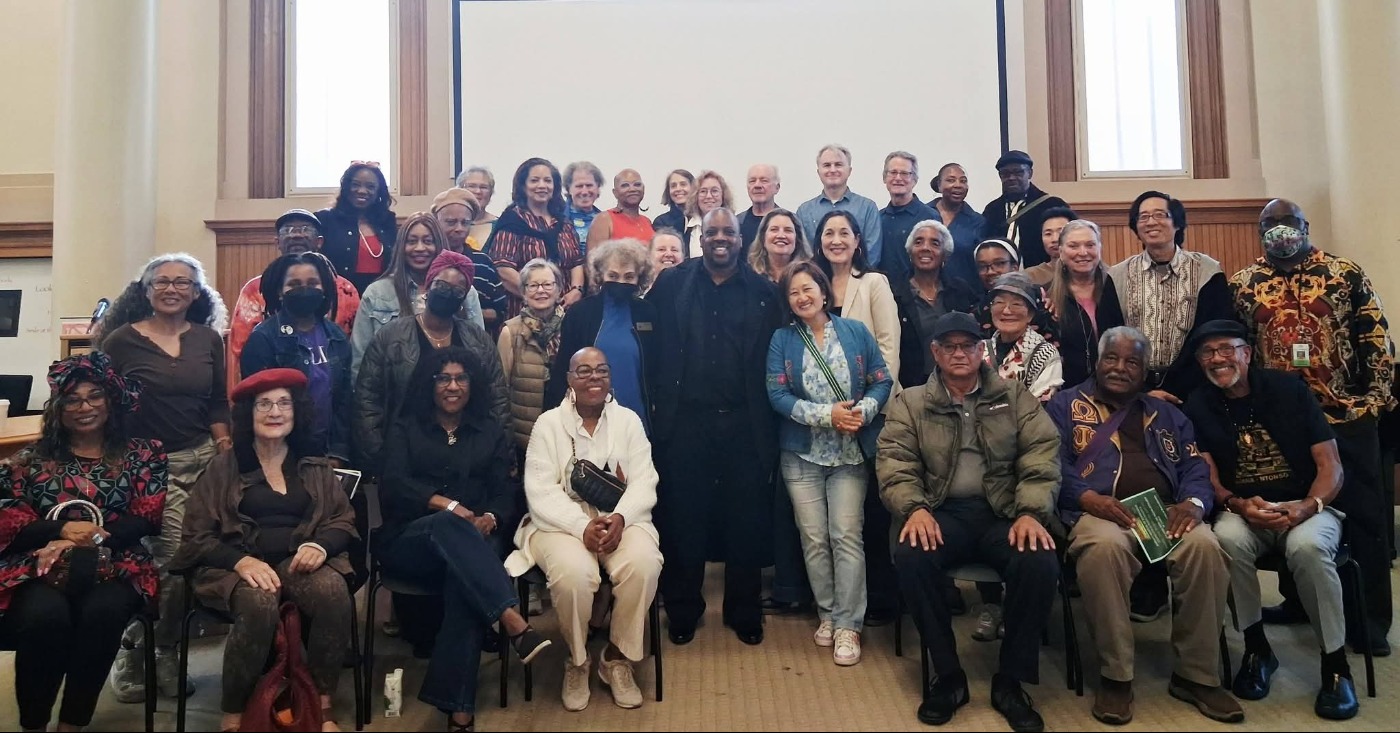
About 50 guests attended the exhibit, including Joyce Gordon of Joyce Gordon Gallery, entertainer Zina Escovedo, and activists Alan Banks and Inez Banks. “We loaned one of our pieces to the exhibit,” said Alan Banks proudly.
Murphy credits much of his inspiration to his deep interest in Oakland history and its global intersections. Murphy also created a line of Oakland International language shirts. The concept originated in 2012 during a cultural exchange exhibition he managed between Oakland and its sister city, Fukuoka, Japan, celebrating their 50th anniversary.
Working with artists such as Emmy Award-winner James Gayles and photographer Hiroko To, Murphy began exploring language as a bridge between cultures. After studying Japanese at Laney College, he became fascinated with how “Oakland” could be expressed across languages.
That curiosity evolved into a design series beginning in 2019 with “Oakland” translated into Japanese as “Okurando.” From there, Murphy collaborated with community members and translators to create versions in multiple languages. By incorporating archival materials, cultural symbols, and historical references, Murphy transformed each shirt into a narrative artifact rather than a simple translation.
“Each design allowed me to show how rich our history is and how connected Oakland is to the world,” said Murphy.
This same philosophy drives the “Oakland All-Stars” series. Inspired by a moment of pride watching actor Shemar Moore acknowledge his Oakland roots on national television, Murphy began researching other successful people connected to the city. The series now includes former U.S. Vice President Kamala Harris, actress Zendaya, and the late comedian Paul Mooney, among others linked to Oakland.
“I am proud to feature Oakland in my artwork,” said Murphy. “Oakland is a special place, and art is a great way of showing the world what we are about.”


Port of Oakland, Army Corps Sign Historic Harbor Design Agreement

Democratic Clubs Interview Candidates for Oakland School Board

Nuna Phillips-McKee Celebrates 100 Years: ‘A Century of Faith, Family and God’s Amazing Grace!’

D.A. Ursula Jones Dickson: Terminix to Pay $3.15 Million Over Illegal Disposal of Pesticides, Customer Records

REPORT: Community Level Policy Is Impacting Homelessness and Drug Abuse in California

OPINION: AI Needs to Know Who Is the Boss
Goldi-Locs and Two (or Three) Bears in the Forest in California Hills

Election Watch 2026: 85% of Eligible Voters in California Are Registered

Don’t Let scammers Crash Your School Year

BOOK REVIEW — Curved Air: A Biography of Sickle Cell Anemia and the Quest to Cure the First Molecular Disease

California’s Legal Cannabis Market Hits $8 Billion as State Touts Progress on Fighting Drugs, Crime

Blacks and Latinos Clash Over LA’s Barrio Run; Mayor Karen Bass Calls for Dialogue Across Racial, Neighborhood Lines

Asm. Smallwood-Cuevas’s Bill Repealing ‘Racist’ CalWORKs ‘Man-in-the-House’ Rule Clears Legislature

Asm. Smallwood-Cuevas’s Bill Repealing ‘Racist’ CalWORKs ‘Man-in-the-House’ Rule Clears Legislature

‘Ready to See These Bills Become Law’: Sen. Weber’s Package of 15 Bills Advance to Gov. Newsom’s Desk

Department of Homeland Security Demands California Secretary of State Shirley N. Weber Scrub Voter Rolls

“The Power to See Threats Sooner”: Gov. Newsom, Safety Officials Showcase California’s Investments in Hi-Tech Wildfire Prevention

Alpha Kappa Alpha Sorority, Inc. Celebrates New North Atlantic Regional Director

California Sen. Padilla Joins Colleagues to Introduce Bill Imposing Term Limits on Supreme Court Justices

Less Affluent School Districts, Including Sacramento City, Face Threat of State Takeover

Car Wash Workers Cope with Lingering Impacts of ICE Raids

ESSAY: California Can Close Its Colorectal Cancer Gap

Oakland Post: Week of August 5 – 11, 2026

As Part of Your Back-to- School Checklist, Vaccinate

Oakland ‘Port Serves as a Powerful Engine for Good Jobs and Economic Development

Gov. Newsom Signs New Affordable Housing Legislation

Gov. Newsom Announces $109.6 Million in Funding for 278 Supportive Homes in Bakersfield, Contra Costa, Sacramento and Fresno

California Hispanic Chambers of Commerce Unveils: ‘Powering the Future’ Theme for 47th Annual Statewide Convention

Closing the Gap: What the Data and Frontline Experiences Reveal About Cancer in Black California

Congresswoman Simon Demands Investigation into Trump’s Abuse of Emergency Powers for Coal Export Terminal in West Oakland

The Conversation With Al McFarlane 6/23/26

Media Monday 6/22/26

LIVE! ASK ALMA! — TUES. 6.23.26 7PM EST

Car Buying Secrets: 4 Hidden Checks Before You Sign!

Is This 550 HP Charger Worth YOUR Money? AutoNetwork Review

Celebrating Juneteenth – Frederick Douglass on education and resistance

LIVE! — ASK ALMA! — TUES. 6.19.26 7PM EST

Hyundai Ioniq 5 Parking, Safety, and 360 View #shorts

2025 Ioniq 5 New Wiper & Powerful Performance! #shorts

Electric SUV Range: Is 259 Miles Enough? #shorts

EV Charging: How Fast Can You Charge an Electric Vehicle? #shorts

Biometric Cooling… Messaging Seats…Come on! 2025 Infiniti QX80 Autograph 4WD

Charged Up: Witness the Magic of a Fully Electric Car! #shorts

Range Rover Sport PHEV Included…: See What’s Inside This Luxury SUV! #shorts

Invisible Hood View: Perfect Parking with X-Ray Vision! #shorts
-

 Commentary2 weeks ago
Standoff for Justice: Our Homes Are Worth Fighting For
-

 Business2 weeks ago
Gubernatorial Candidate Steve Hilton Blasts California New Tire Rules; Newsom Hits Back
-

 Activism2 weeks ago
Oakland Post: Week of August 26 – September 1, 2026
-

 Education2 weeks ago
Gov. Newsom’s Latest Appointees Include Sacramento Advocate for Formerly Incarcerated Students; State’s New Tech Chief
-

 Business2 weeks ago
Frontier Airlines’ Return to Oakland Airport Brings Flights, Jobs and Opportunity
-

 Business2 weeks ago
Chef Sharon Lee Blends Culinary Excellence, Education and Empowerment
-

 Business2 weeks ago
Oakland Coliseum Project Opens Door for Small Businesses to Build Bigger
-

 Community2 weeks ago
Big City Mayors Ask for “Yes” Vote on Housing Bond Measure; Conservatives Say “No”
