
Activism
Mayor Breed Declares State of Emergency in Tenderloin as Part of Crackdown Efforts
“The emergency declaration is really about removing obstacles so that we can go in and conduct the work we need to do [to] help the residents of the Tenderloin. Our goal is to get those services coordinated as quickly as we can in order to alleviate the overall suffering that people are experiencing in the neighborhood,” said Department of Emergency Management Executive Director Mary Ellen Carroll.


San Francisco (BCN)
San Francisco Mayor London Breed doubled down on efforts to crack down on public drug use and other disturbances in the city’s Tenderloin, announcing an official State of Emergency in the neighborhood Friday.
According to Breed’s office, the emergency declaration would work similarly to the city’s COVID-19 Declaration of Emergency and allow the city to respond to health and safety concerns on the streets quickly and without bureaucratic barriers.
Specifically, the declaration allows the city to waive rules around contract procurement and zoning codes in order to quickly open a “linkage site” to voluntarily connect people who are living on the streets and struggling with substance use and mental health issues to services.
The declaration comes just two days after Breed, along with emergency and law enforcement officials, announced several new initiatives to address the neighborhood’s health and safety concerns, including public drug use and illegal street vendors selling stolen items.
“When we look at the conditions on our streets it is really unfortunate; it is sad; it’s heartbreaking,” Breed said during a briefing Friday at City Hall. “We have to move quickly. Too many people are dying in this city. Too many people are sprawled out all over our streets. And now we have a plan to address it.”

According to Breed, an emergency response is needed in the area, as the opioid drug crisis has worsened in recent years, with the highly addictive synthetic opioid fentanyl contributing to a sharp rise in overdose deaths.
“This is necessary in order to see a difference, in order to reverse some of the deaths from overdoses, and the assaults and attacks happening in this community,” she said. “When people walk down the streets of San Francisco, they should feel safe. They shouldn’t have to look over their shoulders; they shouldn’t have to be punched in the face randomly; they shouldn’t have to see someone sticking a needle in various parts of their body; they shouldn’t have to see someone laying out in the street…”
The Board of Supervisors must approve the emergency declaration within the next week, and if approved, the declaration would last for 90 days, according to Breed’s office.
Supervisor Matt Haney, whose district includes the Tenderloin, is in support of the declaration.
“The overdose epidemic is taking the lives of nearly two people a day in our city. Most of those people are in the Tenderloin and South of Market and mostly from fentanyl,” he said. “As the supervisor of the Tenderloin, but also as a resident of the Tenderloin, we need an emergency crisis-level response to confront this deadly epidemic at the scale of the problem that we’re facing.”
Department of Emergency Management Executive Director Mary Ellen Carroll said the linkage site will not only help people coordinate health services from community organizations and the San Francisco Department of Public Health, but the site will also help people get food, hygiene products, and connect them with housing programs.
“The emergency declaration is really about removing obstacles so that we can go in and conduct the work we need to do [to] help the residents of the Tenderloin. Our goal is to get those services coordinated as quickly as we can in order to alleviate the overall suffering that people are experiencing in the neighborhood,” she said.
On Wednesday, Breed announced the Tenderloin Emergency Intervention plan, which involves several approaches to address the crime and public drug use and improve the neighborhood. Part of that is increasing the police presence in the area.
In addition, Breed on Wednesday proposed amending the city’s Surveillance Technology Ordinance — passed in by supervisors in 2019 — to allow police to access more surveillance cameras throughout the city. She also proposed increased funding for law enforcement training, hiring, and increased overtime.
“At the end of the day, the people in this community are not safe and it’s not right. Part of the response to this is definitely police officers,” Breed said Friday.
“We have to arrest drug dealers. We have to arrest people who are assaulting people,” Police Chief William Scott said. “Our officers have said time and time again, ‘Let’s have a system where we can get the social workers involved,’ and that’s exactly what this does at the front end so that we can go and do all the things that the public wants us to do: arrest people who are hurting people; stop the open-air drug use; and stop some of the craziness that’s going on in our streets.”
On Friday, the group Defund SFPD Now criticized Breed’s newly announced initiatives.
“The mayor’s plan includes moves to appropriate additional money to the San Francisco Police Department, expand coordinated sweeps of unhoused people, expand surveillance, and target unlicensed street vendors. While we believe in doing whatever we can to secure basic resources and dignity, Mayor Breed’s latest proposal deflects from the failures of the city’s neoliberal policies by imprisoning vulnerable people in the Tenderloin,” Defund SFPD Now said in a statement.
“We are disappointed that Mayor Breed would use the declaration of a state of emergency to increase the reach of criminalization rather than using it to meet people’s needs with respect and compassion,” the group said.














Activism
Oakland Post: Week of September 16 – 22, 2026
The printed Weekly Edition of the Oakland Post: Week of September 16 – 22, 2026

To enlarge your view of this issue, use the slider, magnifying glass icon or full page icon in the lower right corner of the browser window.
Activism
Oakland Post: Week of September 9 – 15, 2026
The printed Weekly Edition of the Oakland Post: Week of September 9 – 15, 2026

To enlarge your view of this issue, use the slider, magnifying glass icon or full page icon in the lower right corner of the browser window.
Activism
Oakland Post: Week of September 2 – 8, 2026
The printed Weekly Edition of the Oakland Post: Week of September 2 – 8, 2026
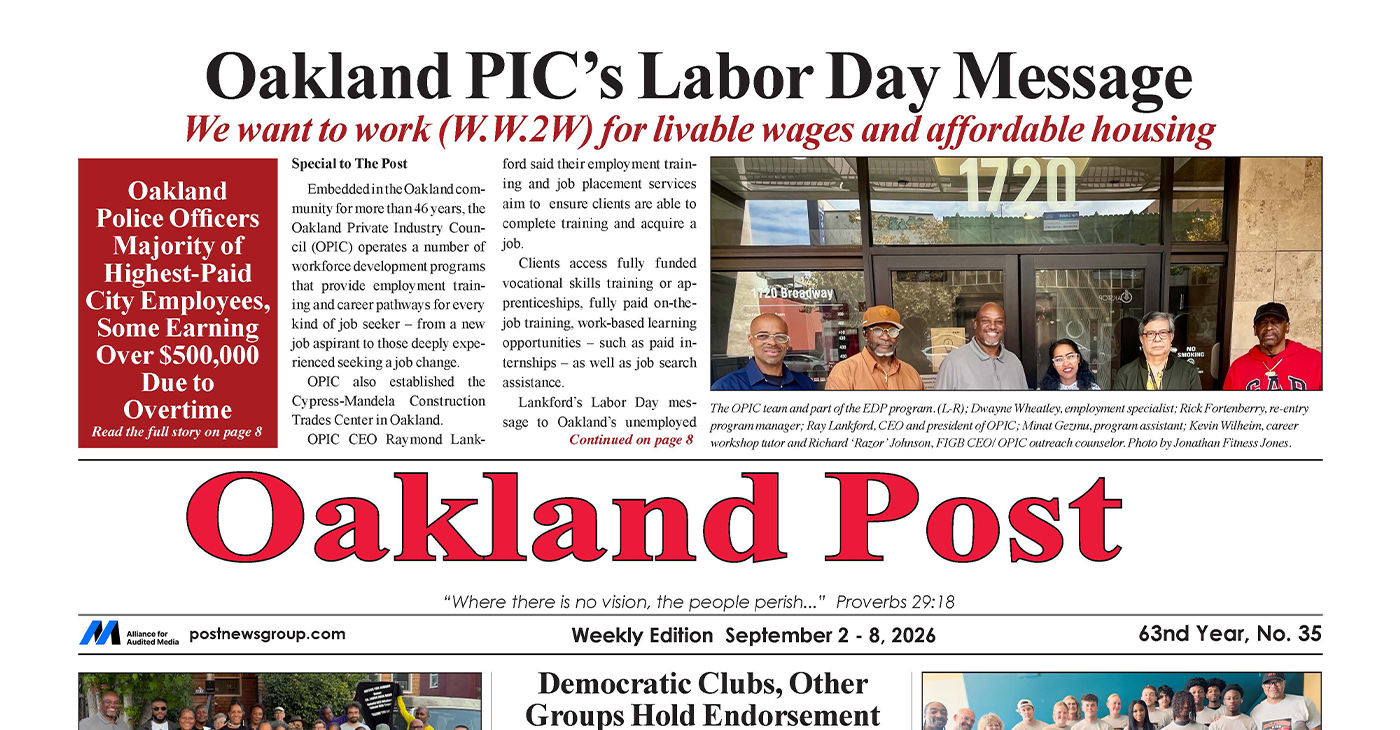
To enlarge your view of this issue, use the slider, magnifying glass icon or full page icon in the lower right corner of the browser window.


Doulas Are Helping Black California Moms Navigate Pregnancy–Even as High Mortality Rates Persist

Newsom Signs Addictive Social Media Law to Protect Kids

On Your November Ballot: Prop 38 Would Allocate $8.4 Billion to Immunology and Immunotherapy Funding

Ask California: Golden State Releases New AI Chatbot

Asm. Isaac Bryan’s Bill Banning California Police From ICE Side Jobs Reaches Newsom’s Desk

Assemblymember LaShae Sharp-Collins’s Bill Would Pause Law Enforcement’s Use of Shock Gloves Pending Study

BOOK REVIEW: ‘Laws of Solomon’ Reveals Tender Heart of Former Child Soldier

OPINION: The New American Fear – From 9-11 to AI

Passing for White, Fighting for Black America: The Courage of Walter White

Oakland People’s Arms Embargo Coalition Demands End to Military Shipments Thru Oakland

Barbara Lee Mourns Gloria Steinem, Remembers a Friendship Rooted in Equality

Event Preview: ‘Fashion v. Fascism’ – A Runway Revolution Is Coming to the Bay Area

Two Looming Threats Every Alameda County Elder Should Know About

Oakland Mayor Reads to Children at Bookout Block Party at Marcus Books Store

Tradition Comes to the Streets in 11th Annual Black-Eyed Pea Festival at the Freedom Farmers Market

Less Affluent School Districts, Including Sacramento City, Face Threat of State Takeover

ESSAY: California Can Close Its Colorectal Cancer Gap

California Hispanic Chambers of Commerce Unveils: ‘Powering the Future’ Theme for 47th Annual Statewide Convention

Four Candidates, Including Incumbent Barbara Lee, Qualify for Oakland Mayor’s Race

Oakland Post: Week of August 12 – 18, 2026

From Blueprint to Breakthrough: Tackling Affordable Housing in Oakland

Oakland Observes Black August with Block Parties, Film Showings, Workshops

COMMENTARY: Why Local School Tax Measure G1 Will Not Be on the November Ballot

Standoff for Justice: Our Homes Are Worth Fighting For

Returning to Its Roots, the Oakland Black-Eyed Pea Festival Partners with the Freedom Farmers Market Sept. 12

NPRC Scores First Advocacy Victory: David Shaw Finally Gets His Wish to ‘Go Home’

Oakland Post: Week of August 26 – September 1, 2026

Frontier Airlines’ Return to Oakland Airport Brings Flights, Jobs and Opportunity

Gubernatorial Candidate Steve Hilton Blasts California New Tire Rules; Newsom Hits Back

Chef Sharon Lee Blends Culinary Excellence, Education and Empowerment

The Conversation With Al McFarlane 6/23/26

Media Monday 6/22/26

LIVE! ASK ALMA! — TUES. 6.23.26 7PM EST

Car Buying Secrets: 4 Hidden Checks Before You Sign!

Is This 550 HP Charger Worth YOUR Money? AutoNetwork Review

Celebrating Juneteenth – Frederick Douglass on education and resistance

LIVE! — ASK ALMA! — TUES. 6.19.26 7PM EST

Hyundai Ioniq 5 Parking, Safety, and 360 View #shorts

2025 Ioniq 5 New Wiper & Powerful Performance! #shorts

Electric SUV Range: Is 259 Miles Enough? #shorts

EV Charging: How Fast Can You Charge an Electric Vehicle? #shorts

Biometric Cooling… Messaging Seats…Come on! 2025 Infiniti QX80 Autograph 4WD

Charged Up: Witness the Magic of a Fully Electric Car! #shorts

Range Rover Sport PHEV Included…: See What’s Inside This Luxury SUV! #shorts

Invisible Hood View: Perfect Parking with X-Ray Vision! #shorts
-
 Commentary4 weeks ago
Standoff for Justice: Our Homes Are Worth Fighting For
-
 Activism4 weeks ago
Oakland Post: Week of August 26 – September 1, 2026
-
 Business4 weeks ago
Frontier Airlines’ Return to Oakland Airport Brings Flights, Jobs and Opportunity
-
 Business4 weeks ago
Gubernatorial Candidate Steve Hilton Blasts California New Tire Rules; Newsom Hits Back
-
 Business4 weeks ago
Chef Sharon Lee Blends Culinary Excellence, Education and Empowerment
-

 Education4 weeks ago
Gov. Newsom’s Latest Appointees Include Sacramento Advocate for Formerly Incarcerated Students; State’s New Tech Chief
-

 Community4 weeks ago
Big City Mayors Ask for “Yes” Vote on Housing Bond Measure; Conservatives Say “No”
-

 Business4 weeks ago
Oakland Coliseum Project Opens Door for Small Businesses to Build Bigger
