
Activism
Protesters Demand Hotel Rooms for Homeless During Rally and Occupation

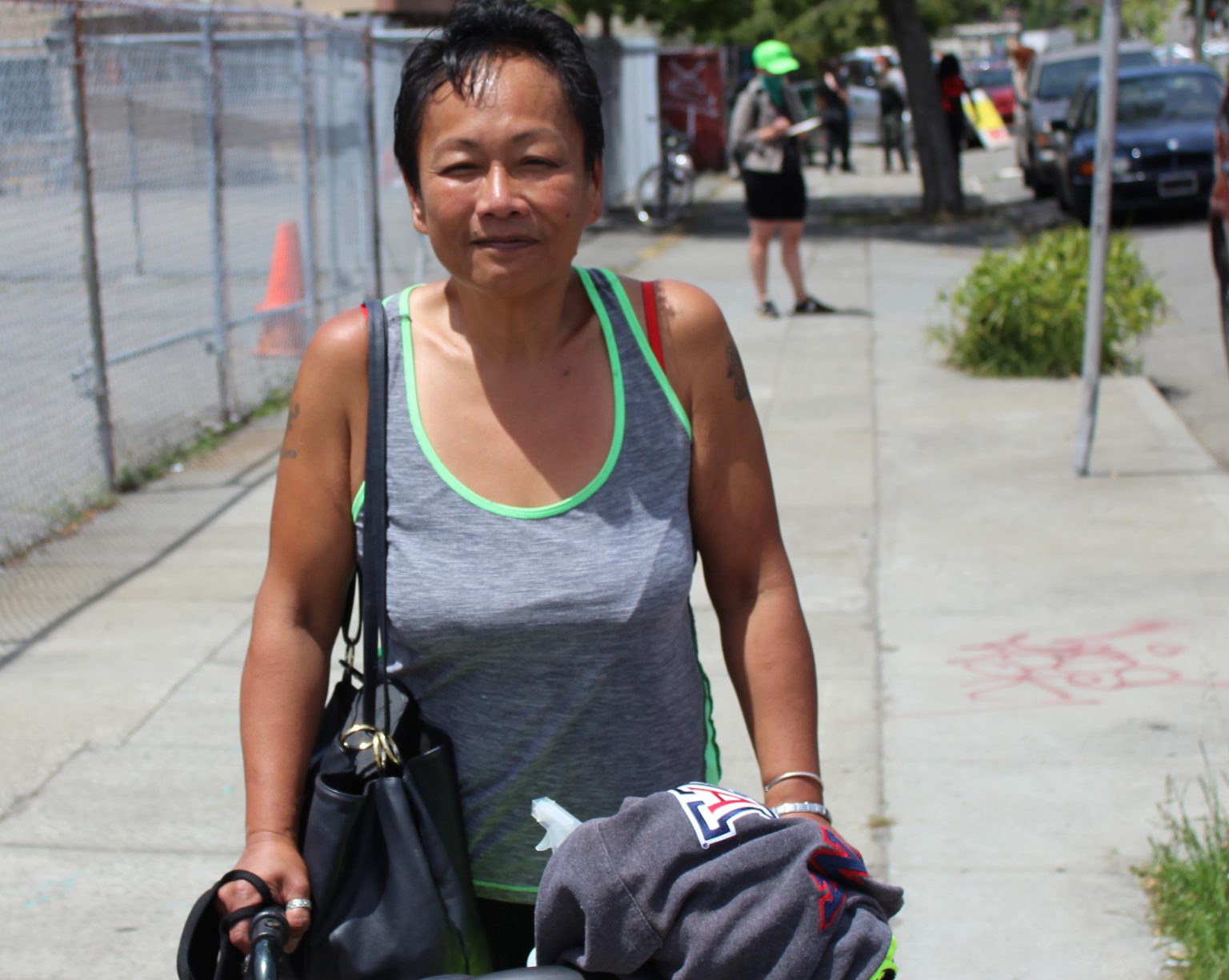
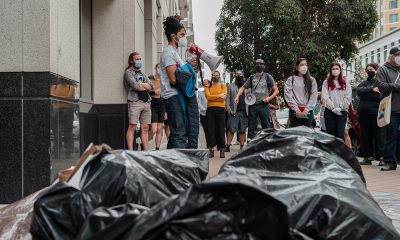
On Fri May 22 to Sat May 23, housed and unhoused protestors gathered outside Palms Motel for a little over 16 hours to call for 37MLK, a community of mostly elder female lifelong Bay Area unhoused residents, to be sheltered in hotel rooms during the COVID-19 pandemic. Over 40 people showed up throughout the 16 hours, with the peak crowd reaching around 30 as one protester, Stefani Echeverría-Fenn, occupied a Palms Motel room by barricading herself to security bars in the room’s bathroom.
The protest started around 11 a.m. People displayed signs emphasizing the urgency of sheltering homeless people. Signs read “HOTELS NOT GRAVES,” and “KEEP US ALIVE.” Echeverría-Fenn wore a shirt that read “I WON’T LET MY UNHOUSED FAM DIE QUIETLY.”
Some 37MLK residents are especially at risk to the dangers of the outdoors and to COVID-19 due to medical conditions and disabilities. Alice, who’s 52, relies on a colostomy bag to digest properly.
“[Cleaning the bag] is a pretty easy procedure but it’s not so easy when you can’t just go turn on water,” she said.
Alice also works as a certified nursing assistant doing in-home care. Her inability to isolate puts her and her client at a heightened risk for contracting COVID-19.

“My main thing is to keep [my colonoscopy bag] clean so I can be healthy for my client,” she said.
Romalita is 53 and is badly in need of hip surgery. She can’t stand for more than 10 minutes at a time. At the protest, she told The Oakland Post the doctors wouldn’t perform the surgery if she didn’t have stable shelter.
“The surgical doctor doesn’t want me to get an infection being outside,” she said.
Both Alice and Romalita had stayed at Palms Hotel for a week, but on Friday, funds that had been acquired through donations had run out, and they planned to live outdoors at 37MLK, where they’d sleep in tents.
Another sign at the protest read “CALL LIBBY OPEN THE EMPTY ROOMS 510-238-3141,” listing Mayor Libby Schaaf’s work phone number. 37MLK residents as well as the mutual aid and housing justice group, Love and Justice in The Streets (LAJITS), have been encouraging residents to call Mayor Schaaf to use hotel rooms, the vast majority of which sit empty due to COVID-19, to shelter homeless people.
LAJITS has pointed out that Oakland Code of Ordinance 8.50.050 allows the city administration of Oakland to “obtain vital supplies, equipment and such properties found lacking and needed for the protection of life and property,” during a state or local emergency, both of which have been declared due to the COVID 19 pandemic. Under the code, Oakland city administration has the power to commandeer such resources.
The Oakland Post emailed Justin Berton, spokesperson for Mayor Schaaf, mentioned Oakland Code of Ordinance 8.50.050, and asked: “Are hotel rooms considered vital and found lacking to protect life in Oakland?” and “If so, are their plans to obtain hotel rooms through the city for homeless residents?”
Berton sent a prepared statement from the director of communications, Karen Boyd.
Boyd’s statement did not say if the city was providing funds for hotels, or if the city planned to obtain or commandeer hotel rooms but said, “We continue to support the county in making referrals into their hotel programs.”
Project Roomkey, which is funded by the state and the county, has secured space for about 520 people including homeless, COVID positive, and high-risk Alameda County residents. In a meeting in mid-May, the county revealed about a third of Project Roomkey’s rooms were still vacant. The program moved its first Oakland homeless resident in on March 25, who showed symptoms of COVID-19. The 2019 point in time (PIT) count lists Alameda County’s homeless population at 8,022, though activists and policymakers largely agree that PIT counts undercount homeless populations, so the true number is likely higher.
Boyd’s statement also said, “our emergency COVID-19 budget proposed additional support for motel vouchers and for funding to help people exit homelessness into permanent housing.” The proposed voucher program would offer 50,000$ in state funds for hotels, less the yearly salary of a first-year Oakland Police officer. The statement also said 56 people are currently being sheltered in trailers provided by the state through Operation Homebase.
Due to the number of hotel rooms available and the slow pace in which the county is filling them, activists are continuing to push the city of Oakland to secure rooms itself while collecting private donations to lease them at loveandjusticeinthestreets.com and through Venmo at @ars_hoetica.
Echeverría-Fenn remained barricaded in the Palms Motel room until around 3 a.m, as protestors continued to be present outside to ensure her safety, when she voluntarily left. Oakland Police came between around and 11:30 pm till 12:30 am but made no arrest nor forced her to leave.
Although she was not arrested, the threat of arrest was real as she hadn’t paid for the room. In a livestream on Facebook as police were present, she said “There can be no business as usual while Oakland is in a public health crisis, a human rights crisis, a civil rights crisis. Members of the unhoused community who are very dear to me personally are literally dying on the street. We lost three of our unhoused comrades in the last one month alone. So I feel like whatever can happen to me in the course of my arrest cannot possibly be as traumatizing as the day to day experience of unhoused folks in Oakland.”




To enlarge your view of this issue, use the slider, magnifying glass icon or full page icon in the lower right corner of the browser window.

To enlarge your view of this issue, use the slider, magnifying glass icon or full page icon in the lower right corner of the browser window.

Activism
Oakland Post: Week of September 30 – October 6, 2026
The printed Weekly Edition of the Oakland Post: Week of September 30 – October 6, 2026


To enlarge your view of this issue, use the slider, magnifying glass icon or full page icon in the lower right corner of the browser window.



Mayor Barbara Lee Holds Special State of the City Address in Deep East Oakland

Practitioners of African Traditional Spirituality Offer Ancestral Reverence Ritual Oct. 31

It’s Time to Lose Weight Before the Holidays

Trader Vic’s Returns to Its Oakland Roots

Oakland Coal Terminal Backed by Trump Would Be Bigger, Dirtier Than Promised, Says Report

Opponents Smear Effective African American Transit Director as Election Nears

Oakland Post: Week of October 14 – 20, 2026

OP-ED: The Black Church Writes AI’s Next Chapter

OP-ED: The Black Church Writes AI’s Next Chapter

WCCUSD Joins Statewide Organic School Food Purchasing Cooperative

Democrats, Community Groups Back Measure EE to Change How Oakland Is Governed

Four Tips to Help You Plan a Holiday “Staycation”

Veterans Housing Project Proposed for South Richmond
PRESS ROOM: Transformative Justice Coalition 2026 Voting Rights Champion Awards Reception ‘Yesterday Is Today: The Battle For Voting Rights

Mayor Lee Delivers 2026 State of the City Address: ‘Oakland Continues to Be on the Move’

Misnamed ‘Parent’ PAC Seeks to Influence Oakland School Board Elections

Poll: Becerra Widens His Lead Over Hilton; Californians Split on Wealth Tax

Listening as a Lifeline: A Doula’s Witness to Black Maternal Health

Oakland Post: Week of September 9 – 15, 2026

County Office of Education Says OUSD Finances Are Getting Healthier, Materially Stronger

Richmond Tiny House Village Farm & Garden Set to Open Gates on Sept. 26

Mayor Lee Announces $1 Million Kaiser Permanente Grant for Pilot Program to Address Homelessness, Clean Up Public Spaces throughout Oakland

Latest Massacre in Haiti Reveals Cruelty U.S. Deportations

Zakiya Jendayi Arrested, Locked Out of Home by Sheriff’s Deputies

OPINION: Nolan Wells’ Death One of Several Signifying Racial Terror Lives on in U.S. South

BLACspace Cooperative Invites Bay Area to Experience Oakland’s Black Cultural Ecosystem Through a BLAC Map Tour + Party

Doulas Are Helping Black California Moms Navigate Pregnancy–Even as High Mortality Rates Persist

Oakland Post: Week of September 16 – 22, 2026

Oakland People’s Arms Embargo Coalition Demands End to Military Shipments Thru Oakland

Democratic Clubs Interview Candidates for Oakland School Board

The Conversation With Al McFarlane 6/23/26

Media Monday 6/22/26

LIVE! ASK ALMA! — TUES. 6.23.26 7PM EST

Car Buying Secrets: 4 Hidden Checks Before You Sign!

Is This 550 HP Charger Worth YOUR Money? AutoNetwork Review

Celebrating Juneteenth – Frederick Douglass on education and resistance

LIVE! — ASK ALMA! — TUES. 6.19.26 7PM EST

Hyundai Ioniq 5 Parking, Safety, and 360 View #shorts

2025 Ioniq 5 New Wiper & Powerful Performance! #shorts

Electric SUV Range: Is 259 Miles Enough? #shorts

EV Charging: How Fast Can You Charge an Electric Vehicle? #shorts

Biometric Cooling… Messaging Seats…Come on! 2025 Infiniti QX80 Autograph 4WD

Charged Up: Witness the Magic of a Fully Electric Car! #shorts

Range Rover Sport PHEV Included…: See What’s Inside This Luxury SUV! #shorts

Invisible Hood View: Perfect Parking with X-Ray Vision! #shorts
-
 Economy4 weeks ago
Poll: Becerra Widens His Lead Over Hilton; Californians Split on Wealth Tax
-
 Black History3 weeks ago
Listening as a Lifeline: A Doula’s Witness to Black Maternal Health
-
 Business4 weeks ago
County Office of Education Says OUSD Finances Are Getting Healthier, Materially Stronger
-
 Lead Story3 weeks ago
Zakiya Jendayi Arrested, Locked Out of Home by Sheriff’s Deputies
-
 Art4 weeks ago
BLACspace Cooperative Invites Bay Area to Experience Oakland’s Black Cultural Ecosystem Through a BLAC Map Tour + Party
-
 Black History4 weeks ago
Doulas Are Helping Black California Moms Navigate Pregnancy–Even as High Mortality Rates Persist
-

 Business4 weeks ago
From Historic Memories to New Possibilities: Oakland Celebrates Coliseum 60
-

 Community4 weeks ago
Asm. Corey Jackson Announces Launch of 24-Hour Childcare in His District
