
City Government
As Oakland Allows Luxury Development, Advocates Question ‘Trickle-Down Housing’


In the wake of a Nov. 5 City Council meeting during which the City of Oakland denied the East 12th Street Coalition’s (E12SC) appeal to stop UrbanCore from building a luxury housing tower on public land next to Lake Merritt, housing justice advocates are questioning the city’s ongoing plans to construct far more market-rate units than affordable ones.
“We are advocating for maximizing affordable housing on this precious piece of public land and Mayor Libby Schaaf and half the City Council is ensuring that a luxury tower will be put in our community,” said Dunya Alwan, a member of E12SC and a neighbor to the site. She says the luxury tower would contribute to “trickle-down gentrification” in her neighborhood, which she describes as “the single remaining working-class community by the lake.”
Her statements came after Schaaf gave a final vote to deny E12SC’s appeal, clearing the way for UrbanCore’s luxury housing tower. Schaaf’s vote was necessary as a tie-breaker as Council President Rebecca Kaplan and councilmembers Nikki Fortunato Bas, Noel Gallo and Sheng Thao voted to approve the appeal, while Council Members Larry Reid, Lynette Gibson-McElhaney, Loren Taylor, and Dan Kalb voted to deny the appeal.
UrbanCore’s luxury tower plans to have 253 market-rate housing units and 18 units for those that make 80 to 120 percent of the area median income. On the same public land, the East Bay Asian Local Development Corporation will build a mid-rise building with 90 affordable units. The E12SC had proposed an alternate development that would have 133 homes housing nearly 700 people entirely in affordable housing.
Schaaf’s vote aligns with public statements she has recently made claiming that constructing market-rate housing for those moving into Oakland helps to keep Oakland residents from being displaced and helps the city to construct more affordable units.
“New people are moving to Oakland…and we’re Oakland, we welcome all,” said Schaaf during a Sept. 18 recording of the Podcast “Gimme Shelter: The California Housing Crisis.”
“If I don’t build new housing for the new people, they are going to push you out and price you out of the lovely Lake Merritt apartment you have today. That is a rule of supply and demand.”
Peter Cohen, who for 10 years has co-directed the Council of Community Housing Organizations — a non-profit coalition that promotes developing permanently low-income housing — said Schaaf’s method is called “filtering.”
He said the method could be effective in helping to create affordable housing in some suburbs where land is cheaper and development is slower but it doesn’t work in crowded cities with expensive land. Some advocates have called filtering “trickle down housing.” The Alliance for California Community Empowerment Action (ACCE Action) has planned the March For Housing Now which is calling for East Bay residents to come to Mosswood Park on Nov. 23 to protest against “trickle-down solutions” to housing.
“When people throw filtering out there as a validation for market-rate development policy,” said Cohen, “it’s essentially a fallacy when you’re mostly talking about urban markets.”
Councilmember Bas called filtering into question at the Nov. 5 council meeting.
“Over the last four years we have approved over 9,000 units of luxury housing,” Bas said, “in that same time our homeless population has doubled. Luxury housing is not working in terms of fixing our housing affordability and displacement crisis.”
The Mercury News reported in March that in the last three years only 7 percent of new Oakland housing units were affordable, although Schaaf had originally pledged that 28 percent of new housing construction would be affordable.
Despite the shortfall, Schaaf has stuck to her plan and has begun adopting impact fees for market-rate developers to help create affordable units.
“Market-rate units create a need for protected affordable units,” said Schaaf in the Gimme Shelter Podcast, “so developers have to include protected affordable units in those new buildings or they have to write a nice big check to our affordable housing fund.”
Cohen is weary of relying on market-rate developers to fund affordable housing.
“[Local mayors] have started this narrative that market-rate housing is how you pay for affordable housing,” said Cohen. “I don’t agree with that, but I also think it’s a very risky place to go…because what it means for housing advocates is you’re now putting all your outcomes (dependent on) the private real estate market.”










Activism
Oakland Post: Week of September 9 – 15, 2026
The printed Weekly Edition of the Oakland Post: Week of September 9 – 15, 2026


To enlarge your view of this issue, use the slider, magnifying glass icon or full page icon in the lower right corner of the browser window.

Activism
Oakland Post: Week of September 2 – 8, 2026
The printed Weekly Edition of the Oakland Post: Week of September 2 – 8, 2026
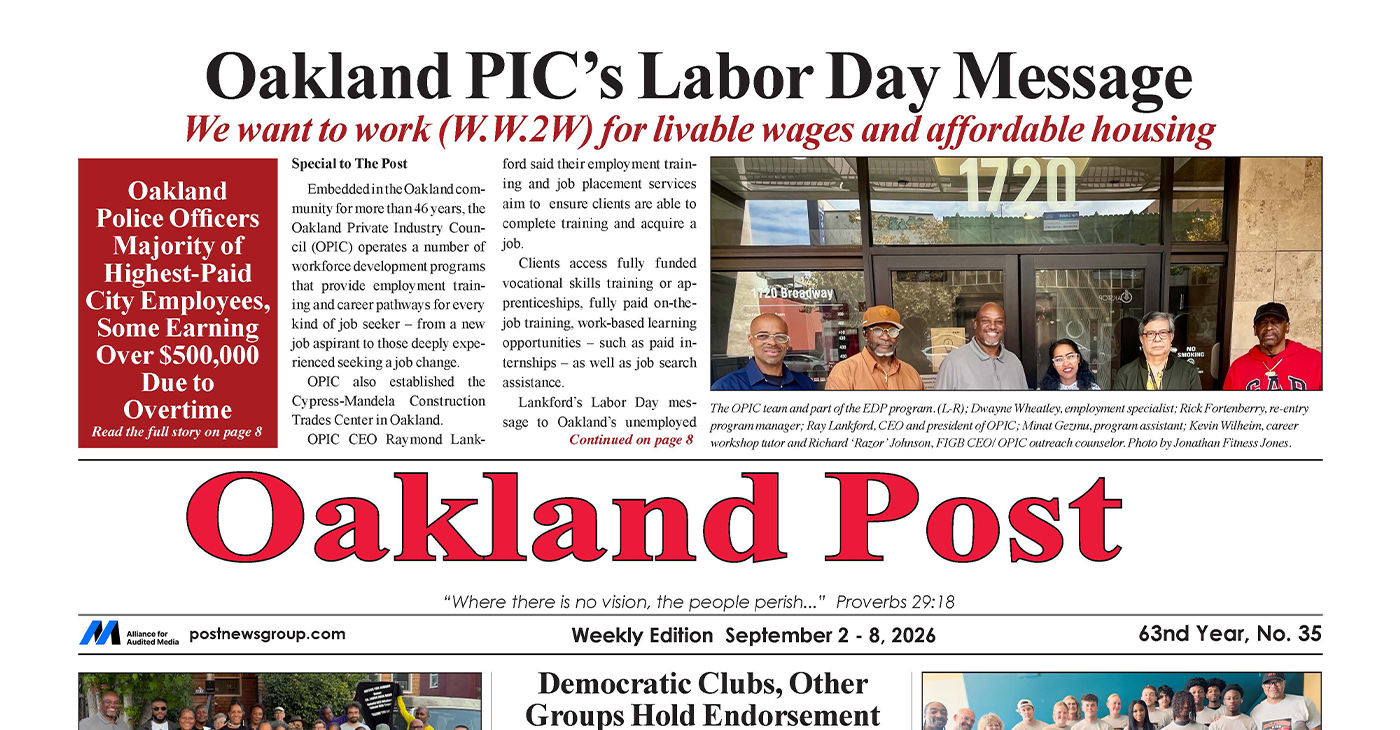
To enlarge your view of this issue, use the slider, magnifying glass icon or full page icon in the lower right corner of the browser window.
Activism
Oakland Post: Week of August 26 – September 1, 2026
The printed Weekly Edition of the Oakland Post: Week of August 26 – September 1, 2026
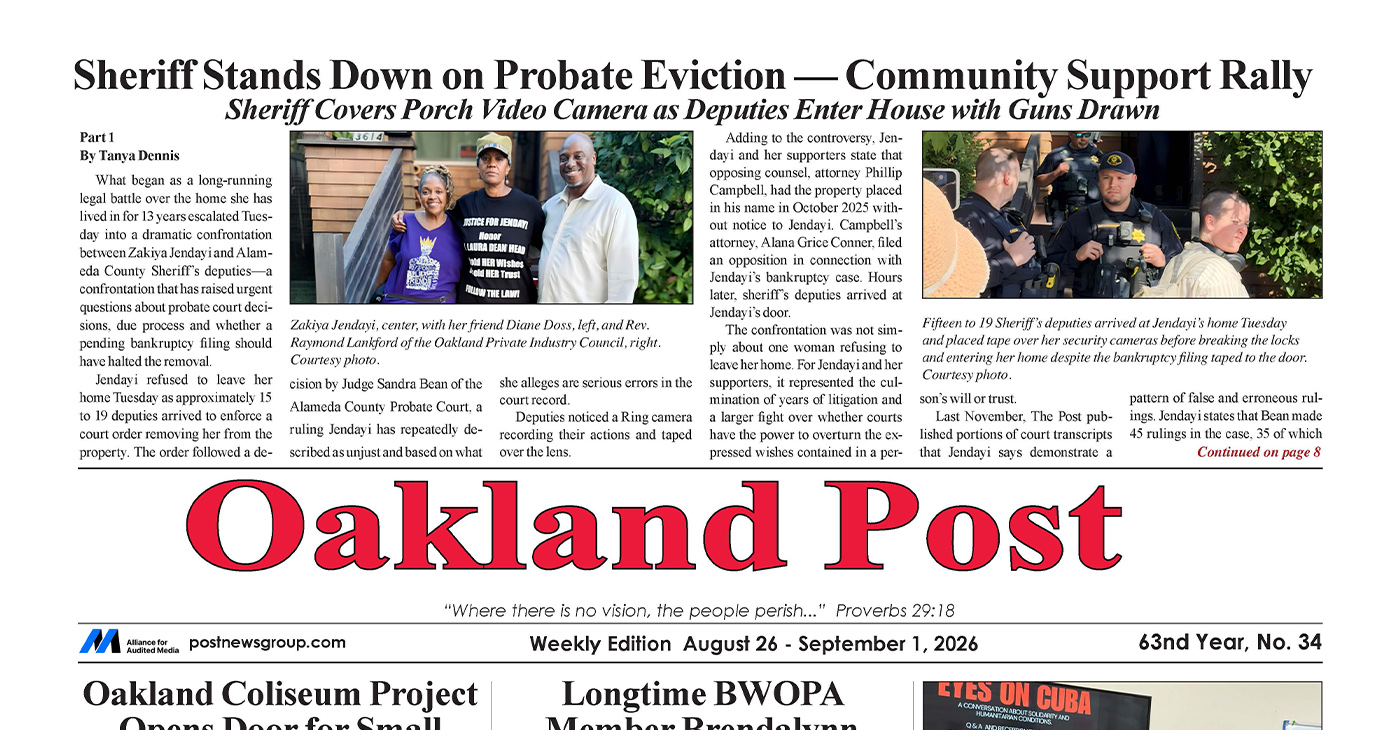
To enlarge your view of this issue, use the slider, magnifying glass icon or full page icon in the lower right corner of the browser window.



Event Preview: ‘Fashion v. Fascism’ – A Runway Revolution Is Coming to the Bay Area

Port of Oakland, Army Corps Sign Historic Harbor Design Agreement

Democratic Clubs Interview Candidates for Oakland School Board

Nuna Phillips-McKee Celebrates 100 Years: ‘A Century of Faith, Family and God’s Amazing Grace!’

D.A. Ursula Jones Dickson: Terminix to Pay $3.15 Million Over Illegal Disposal of Pesticides, Customer Records

REPORT: Community Level Policy Is Impacting Homelessness and Drug Abuse in California

OPINION: AI Needs to Know Who Is the Boss
Goldi-Locs and Two (or Three) Bears in the Forest in California Hills

Election Watch 2026: 85% of Eligible Voters in California Are Registered

Don’t Let scammers Crash Your School Year

BOOK REVIEW — Curved Air: A Biography of Sickle Cell Anemia and the Quest to Cure the First Molecular Disease

California’s Legal Cannabis Market Hits $8 Billion as State Touts Progress on Fighting Drugs, Crime

Blacks and Latinos Clash Over LA’s Barrio Run; Mayor Karen Bass Calls for Dialogue Across Racial, Neighborhood Lines

Asm. Smallwood-Cuevas’s Bill Repealing ‘Racist’ CalWORKs ‘Man-in-the-House’ Rule Clears Legislature

Asm. Smallwood-Cuevas’s Bill Repealing ‘Racist’ CalWORKs ‘Man-in-the-House’ Rule Clears Legislature

Department of Homeland Security Demands California Secretary of State Shirley N. Weber Scrub Voter Rolls

“The Power to See Threats Sooner”: Gov. Newsom, Safety Officials Showcase California’s Investments in Hi-Tech Wildfire Prevention

California Sen. Padilla Joins Colleagues to Introduce Bill Imposing Term Limits on Supreme Court Justices

Less Affluent School Districts, Including Sacramento City, Face Threat of State Takeover

Car Wash Workers Cope with Lingering Impacts of ICE Raids

ESSAY: California Can Close Its Colorectal Cancer Gap

As Part of Your Back-to- School Checklist, Vaccinate

Oakland ‘Port Serves as a Powerful Engine for Good Jobs and Economic Development

Gov. Newsom Announces $109.6 Million in Funding for 278 Supportive Homes in Bakersfield, Contra Costa, Sacramento and Fresno

California Hispanic Chambers of Commerce Unveils: ‘Powering the Future’ Theme for 47th Annual Statewide Convention

Closing the Gap: What the Data and Frontline Experiences Reveal About Cancer in Black California

Congresswoman Simon Demands Investigation into Trump’s Abuse of Emergency Powers for Coal Export Terminal in West Oakland

Four Candidates, Including Incumbent Barbara Lee, Qualify for Oakland Mayor’s Race

Oakland Post: Week of August 12 – 18, 2026

From Blueprint to Breakthrough: Tackling Affordable Housing in Oakland

The Conversation With Al McFarlane 6/23/26

Media Monday 6/22/26

LIVE! ASK ALMA! — TUES. 6.23.26 7PM EST

Car Buying Secrets: 4 Hidden Checks Before You Sign!

Is This 550 HP Charger Worth YOUR Money? AutoNetwork Review

Celebrating Juneteenth – Frederick Douglass on education and resistance

LIVE! — ASK ALMA! — TUES. 6.19.26 7PM EST

Hyundai Ioniq 5 Parking, Safety, and 360 View #shorts

2025 Ioniq 5 New Wiper & Powerful Performance! #shorts

Electric SUV Range: Is 259 Miles Enough? #shorts

EV Charging: How Fast Can You Charge an Electric Vehicle? #shorts

Biometric Cooling… Messaging Seats…Come on! 2025 Infiniti QX80 Autograph 4WD

Charged Up: Witness the Magic of a Fully Electric Car! #shorts

Range Rover Sport PHEV Included…: See What’s Inside This Luxury SUV! #shorts

Invisible Hood View: Perfect Parking with X-Ray Vision! #shorts
-

 Commentary3 weeks ago
Standoff for Justice: Our Homes Are Worth Fighting For
-

 Activism3 weeks ago
Oakland Post: Week of August 26 – September 1, 2026
-

 Business3 weeks ago
Gubernatorial Candidate Steve Hilton Blasts California New Tire Rules; Newsom Hits Back
-

 Business3 weeks ago
Frontier Airlines’ Return to Oakland Airport Brings Flights, Jobs and Opportunity
-

 Business3 weeks ago
Chef Sharon Lee Blends Culinary Excellence, Education and Empowerment
-

 Education3 weeks ago
Gov. Newsom’s Latest Appointees Include Sacramento Advocate for Formerly Incarcerated Students; State’s New Tech Chief
-

 Business3 weeks ago
Oakland Coliseum Project Opens Door for Small Businesses to Build Bigger
-

 Community3 weeks ago
Big City Mayors Ask for “Yes” Vote on Housing Bond Measure; Conservatives Say “No”
