
Bay Area
Oakland Finishes Final Draft of Downtown Specific Plan for Potential City Improvements
In late March, Oakland’s city administration announced the final draft of their Downtown Specific Plan, a blueprint for city improvements and developments over the next 20 years. The comprehensive 474-page plan lays out policies for downtown developments that will increase economic, social and cultural, and communal opportunities for residents and workers who frequent this essential hub in Oakland.


By Magaly Muñoz
In late March, Oakland’s city administration announced the final draft of their Downtown Specific Plan, a blueprint for city improvements and developments over the next 20 years.
The comprehensive 474-page plan lays out policies for downtown developments that will increase economic, social and cultural, and communal opportunities for residents and workers who frequent this essential hub in Oakland.
Several departments over the course of eight years developed the plan, with two phases that emphasized a need for community input from local stakeholders, such as leaders and residents, and a focus on the role of social and racial equity in past and future developments.
Throughout the extensive plan, the concept of equity for marginalized communities is embedded with each goal and priority for the improvements to downtown. It acknowledges that social and racial barriers are preventing these communities from thriving on an equal playing field.
The authors identified six key disparities, or ‘equity indicators’, that set the baseline for how success will be measured for the improvements. These indicators include the burden of housing costs, homelessness, displacement, disconnected youth, unemployment rate and median income.
The plan is also broken up into chapters, each describing a major issue or topic that is plaguing downtown residents and workers, such as mobility, culture preservation, community health and sustainability, and land use and urban design.
Within each chapter, the authors dedicate a section to the impacts of the COVID-19 pandemic for the various areas of interest, illustrating how disparities and inequities increased before and after the disease’s peak.
Two major issues highlighted in the plan are economic opportunity and housing and homelessness. Both of these issues have been aggravated by the pandemic and require substantial support and resources to move forward.
Many reports coming out of the commercial and residential districts downtown have blamed the rise in crime and cost of living as reasons for leaving Oakland for other cities or closing down indefinitely.
The plan attributes rising rents of both residential and commercial properties to the displacement of local businesses and entrepreneurs. Downtown also has an imbalance in the jobs to housing ratio, which limits access to jobs as commuting distances increase.
Other concerns for the local economy are barriers to employment opportunities for workers of color, non-English speakers, and those with limited access to transportation. As stated in the plan, downtown also has a lack of vacancies near public transit hubs, such as BART, bus stops or ferry terminals, which could save workers money and time for their commutes into the city.
According to the downtown plan, the average unemployment rate for the white population was 5.9%, but the Asian population was at 6.7%, and for the Black population it was even higher at 10.4%.
The proposed solutions for the lack of economic prosperity include providing assistance to local businesses owned by people of color, reinforcing downtown as the ‘place to be’ for nightlife entertainment, and building businesses closer to public transit.
The addition of over 18.3 million (m) sq. ft. of new commercial space, 1.3m sq. ft. of new institutional space, and 500,000 sq. ft. of new industrial space, could potentially create almost 57,000 jobs downtown.
Housing and homelessness, issues closely tied to economic prosperity, are top concerns for Oakland residents. High rents have led to displacement and homelessness for those unable to keep up with the rising costs of the Bay Area.
Over 5,000 people are currently experiencing homelessness in Oakland, according to 2022 Point In Time data. 60% of this population is Black despite only making up nearly 20% of the total city population.
The plan explains that by adding nearly 29,000 new homes and expanding affordable housing units across the city by 2040, this would help alleviate the stress of obtaining and affording a home.
Strategies proposed to tackle the housing and homelessness crisis include increasing renter protections, providing additional shelters and services for homeless residents, and promoting homeownership in downtown with first-time buyer assistance and proactive assistance to vulnerable homeowners.
The plan acknowledges that the implementation of changes and developments amongst the several concerns outlined in the document will take time, both in short and long term periods.
To better explain how and when each project will be addressed over the course of the next two decades, a detailed 123-page graph shows which agencies, potential funding sources, and costs come with the goals.
The Oakland Planning Commission and Landmarks Preservation Advisory Board will each hold public hearings regarding the final draft of the Downtown Plan in May and June.














Activism
Oakland Post: Week of September 23 – 29, 2026
The printed Weekly Edition of the Oakland Post: Week of September 23 – 29, 2026

To enlarge your view of this issue, use the slider, magnifying glass icon or full page icon in the lower right corner of the browser window.
Activism
Oakland Post: Week of September 16 – 22, 2026
The printed Weekly Edition of the Oakland Post: Week of September 16 – 22, 2026
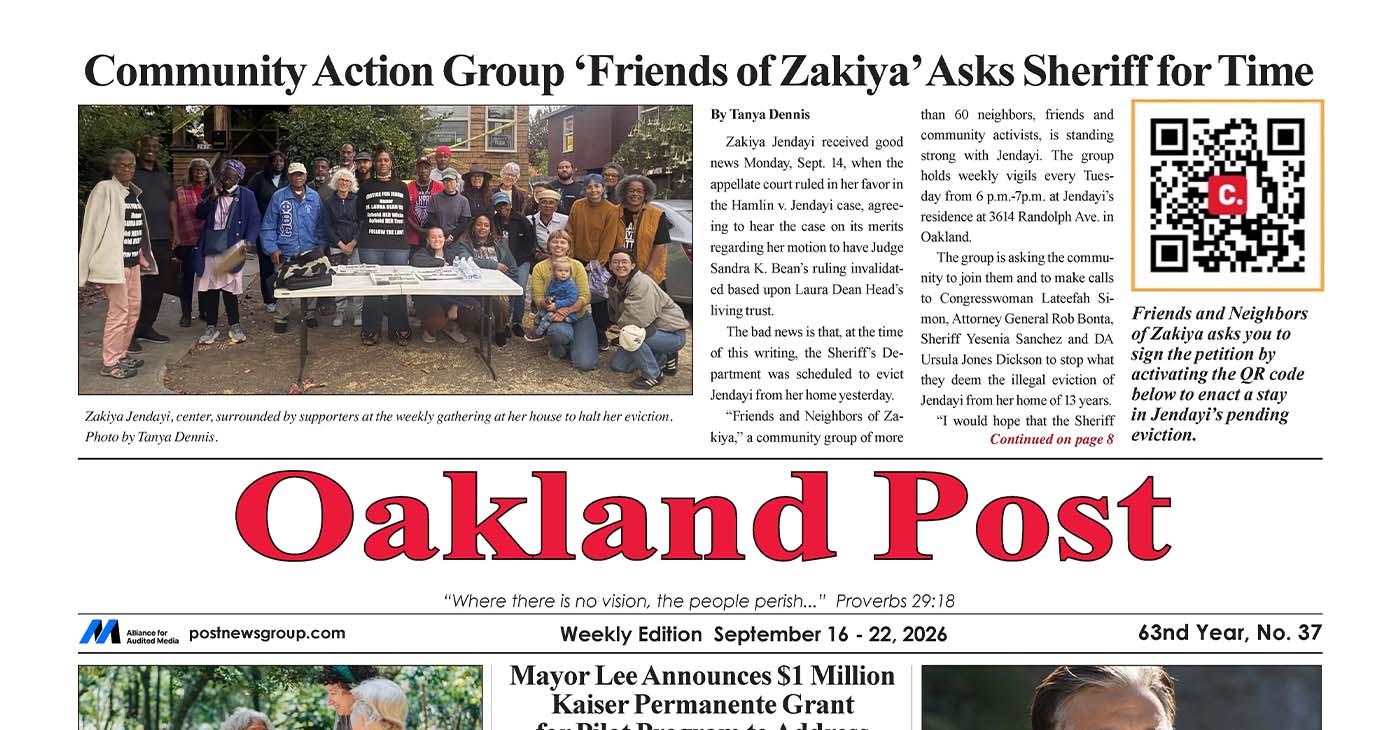
To enlarge your view of this issue, use the slider, magnifying glass icon or full page icon in the lower right corner of the browser window.
Activism
Oakland Post: Week of September 9 – 15, 2026
The printed Weekly Edition of the Oakland Post: Week of September 9 – 15, 2026

To enlarge your view of this issue, use the slider, magnifying glass icon or full page icon in the lower right corner of the browser window.



Asm. Corey Jackson Announces Launch of 24-Hour Childcare in His District

IN MEMORIAM: The Rev. Leon “Sonny” Clark, Longtime Orange County Pastor and Community Leader, Dies at 72

Poll: Becerra Widens His Lead Over Hilton; Californians Split on Wealth Tax

From Historic Memories to New Possibilities: Oakland Celebrates Coliseum 60

County Office of Education Says OUSD Finances Are Getting Healthier, Materially Stronger

LIVE FREE Sunday Dinner Brings Faith, Fellowship and Civic Conversation to Oakland

Remembering Chauncey Bailey as Student Journalists Face Threats to Truth-Telling

BLACspace Cooperative Invites Bay Area to Experience Oakland’s Black Cultural Ecosystem Through a BLAC Map Tour + Party

In Wake of Death on Doorstep, Williams Chapel Baptist Church Calls for Better Care, Funding for Unhoused

Oakland Centenarian Nuna McKee Honored!

Caribbean Nations Produce Action Plan Calling for UK Reparations Over Slavery

Oakland Post: Week of September 23 – 29, 2026

Doulas Are Helping Black California Moms Navigate Pregnancy–Even as High Mortality Rates Persist

Newsom Signs Addictive Social Media Law to Protect Kids

On Your November Ballot: Prop 38 Would Allocate $8.4 Billion to Immunology and Immunotherapy Funding

Less Affluent School Districts, Including Sacramento City, Face Threat of State Takeover

ESSAY: California Can Close Its Colorectal Cancer Gap

California Hispanic Chambers of Commerce Unveils: ‘Powering the Future’ Theme for 47th Annual Statewide Convention

Four Candidates, Including Incumbent Barbara Lee, Qualify for Oakland Mayor’s Race

Oakland Post: Week of August 12 – 18, 2026

From Blueprint to Breakthrough: Tackling Affordable Housing in Oakland

Oakland Observes Black August with Block Parties, Film Showings, Workshops

COMMENTARY: Why Local School Tax Measure G1 Will Not Be on the November Ballot

Standoff for Justice: Our Homes Are Worth Fighting For

Returning to Its Roots, the Oakland Black-Eyed Pea Festival Partners with the Freedom Farmers Market Sept. 12

Oakland Post: Week of August 26 – September 1, 2026

NPRC Scores First Advocacy Victory: David Shaw Finally Gets His Wish to ‘Go Home’

Frontier Airlines’ Return to Oakland Airport Brings Flights, Jobs and Opportunity

Gubernatorial Candidate Steve Hilton Blasts California New Tire Rules; Newsom Hits Back

Chef Sharon Lee Blends Culinary Excellence, Education and Empowerment

The Conversation With Al McFarlane 6/23/26

Media Monday 6/22/26

LIVE! ASK ALMA! — TUES. 6.23.26 7PM EST

Car Buying Secrets: 4 Hidden Checks Before You Sign!

Is This 550 HP Charger Worth YOUR Money? AutoNetwork Review

Celebrating Juneteenth – Frederick Douglass on education and resistance

LIVE! — ASK ALMA! — TUES. 6.19.26 7PM EST

Hyundai Ioniq 5 Parking, Safety, and 360 View #shorts

2025 Ioniq 5 New Wiper & Powerful Performance! #shorts

Electric SUV Range: Is 259 Miles Enough? #shorts

EV Charging: How Fast Can You Charge an Electric Vehicle? #shorts

Biometric Cooling… Messaging Seats…Come on! 2025 Infiniti QX80 Autograph 4WD

Charged Up: Witness the Magic of a Fully Electric Car! #shorts

Range Rover Sport PHEV Included…: See What’s Inside This Luxury SUV! #shorts

Invisible Hood View: Perfect Parking with X-Ray Vision! #shorts
-
 Commentary4 weeks ago
Standoff for Justice: Our Homes Are Worth Fighting For
-
 Activism4 weeks ago
Oakland Post: Week of August 26 – September 1, 2026
-
 Business4 weeks ago
Frontier Airlines’ Return to Oakland Airport Brings Flights, Jobs and Opportunity
-
 Business4 weeks ago
Gubernatorial Candidate Steve Hilton Blasts California New Tire Rules; Newsom Hits Back
-
 Business4 weeks ago
Chef Sharon Lee Blends Culinary Excellence, Education and Empowerment
-

 Community4 weeks ago
Big City Mayors Ask for “Yes” Vote on Housing Bond Measure; Conservatives Say “No”
-

 Black History4 weeks ago
Jackie Wright Champions Bay Area Stories, Filmmakers and Cultural Institutions
-

 Education4 weeks ago
Gov. Newsom’s Latest Appointees Include Sacramento Advocate for Formerly Incarcerated Students; State’s New Tech Chief
