
Activism
Womanist Theology: Recognizing Black Women’s Leadership, Contributions to the Black Church
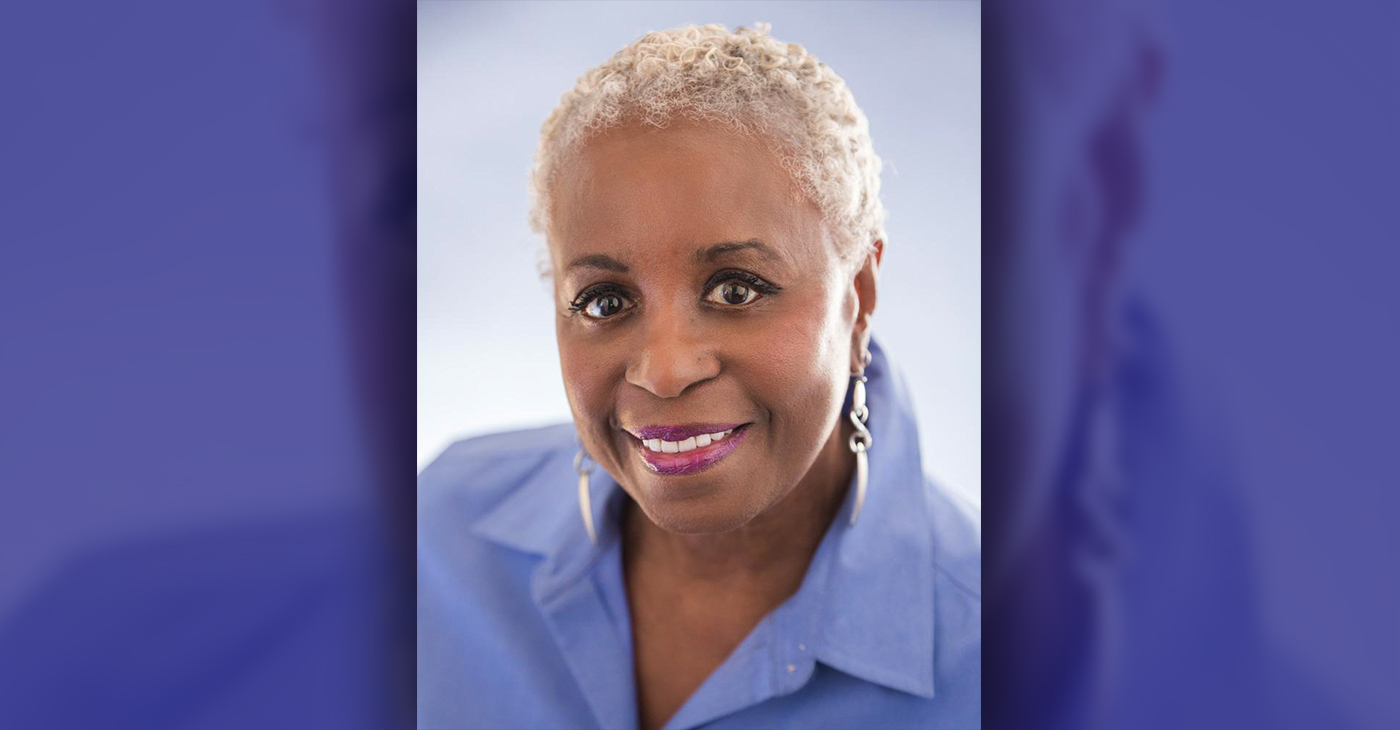
“To do womanist theology, we must read and hear the Bible and engage it within the context of our own experience,” Dr. Jacquelyn Grant said. “This is the only way that it can make sense to people who are oppressed. Black women of the past did not hesitate in doing this and we must do no less…”

Part One
By Rev. Dr. Martha C. Taylor
During this Women’s History Month as we review the history of the Black Church we are reminded of the development of Womanist Theology that recognizes the lived experiences and contributions of Black Women.
The white, middle class Feminist Movement did not perceive Black women as their “sisters.” The focus was on their equality to white men in the workplace. They were not concerned with racism and class that impacted Black women.
James Cone, the “father” of Black Theology and renowned professor, critiqued the teachings of theology in seminaries that overlooked the lived experiences of Black people and the Black church.
Drs. Jacquelyn Grant, Katie Cannon and Delores Williams, Ph.D. students of Cone, told him that Black Theology excluded the lived experiences of Black women. Cone later said, “When I read my book today, I am embarrassed by its sexist language and patriarchal perspective. There is not even one reference to a woman in the whole book!”
These women scholars began to develop a theology that considered the lived experiences of Black Women using the oppressors of racism, classism and sexism. Womanist Theology affirms the previously ignored historical contributions of Black women who have been silenced and ignored in other theologies.
“To do womanist theology, we must read and hear the Bible and engage it within the context of our own experience,” Dr. Jacquelyn Grant said. “This is the only way that it can make sense to people who are oppressed. Black women of the past did not hesitate in doing this and we must do no less…”
In the Fall of 2011, when I was serving as an adjunct professor in the Doctor of Ministry and the Master of Divinity Programs at the San Francisco Theological Seminary, I approached the late Rev. James Noel, PhD, the only African American to head a department, namely Black Church/Africana Religious Studies Certificate Program.
With his support, I gathered a group of Bay Area Black women scholars, professors, and pastors. To our authenticity as Black mothers, grandmothers, other mothers, sisters, and aunties, who lived in the Black Community, we brought our theological education and lived experiences as Black women to the “kitchen table” and brainstormed about how we could bridge the divide between the seminary and our beloved Black community.
We were not naïve that sexism was alive and well in the majority of Black churches. However, not all male pastors practice sexism.
We linked theology, anthropology and sociology in terms that could be understood by non-seminarians. We used the words of Jesus who posed a question to His disciples: “But who do they say I am?” [Matthew 16:15] to brand our symposiums.’
Workshops did not focus on pain and sorrow only. We emphasized the strides of Black women across the board. Congresswoman Barbara Lee was the guest speaker at our first conference.
The Womanist Project was an anchor in the community that shed light on understanding the history of womanist theology including using stories in the Bible and in our everyday lives. The work of the symposium lasted more than five years and was one-of-a-kind in the Bay Area.
There were times that sessions were standing-room-only, and attended by all peoples. Students at the Graduate Theological Union began to write on womanist thought.
The birth of Black churches in the Bay Area would not have emerged if it weren’t for Black women. Black women opened up their homes for prayer meetings, Bible study and more.
For instance, the Market Street Seventh Day Adventist Church in Oakland was founded in 1923 by three pioneering Black women. The same holds true for Oakland’s Bethlehem Lutheran Church, founded in 1929 by three Black women.
Though these women founded churches, they did not lead the church as pastors. Bishop Ernestine Reems opened the Center of Hope Church in 1968 in Oakland. I dare say there would not be a single Black church in the Bay Area or otherwise if it were not for the women.
Rev. Dr. Martha C. Taylor, is a long-time member of Allen Temple Baptist Church and serves as the historian/archivist. She is the past historian/archivist for the Progressive National Baptist Convention Inc, Washington, D.C. She authored a first-of-its-kind epic history book “From Labor to Reward, Black Church Beginnings in San Francisco, Oakland, Berkeley, and Richmond 1849-1972.”
A former adjunct professor at the San Francisco Theological Seminary she continues as an advisor to students writing their doctoral dissertations. Dr. Taylor is dually ordained Baptist and Presbyterian and served as “installed” pastor at Elmhurst Presbyterian Church and pulpit supply for the Bethlehem Lutheran Church.









Activism
Oakland Post: Week of April 8 – 14, 2026
The printed Weekly Edition of the Oakland Post: Week of April 8 – 14, 2026
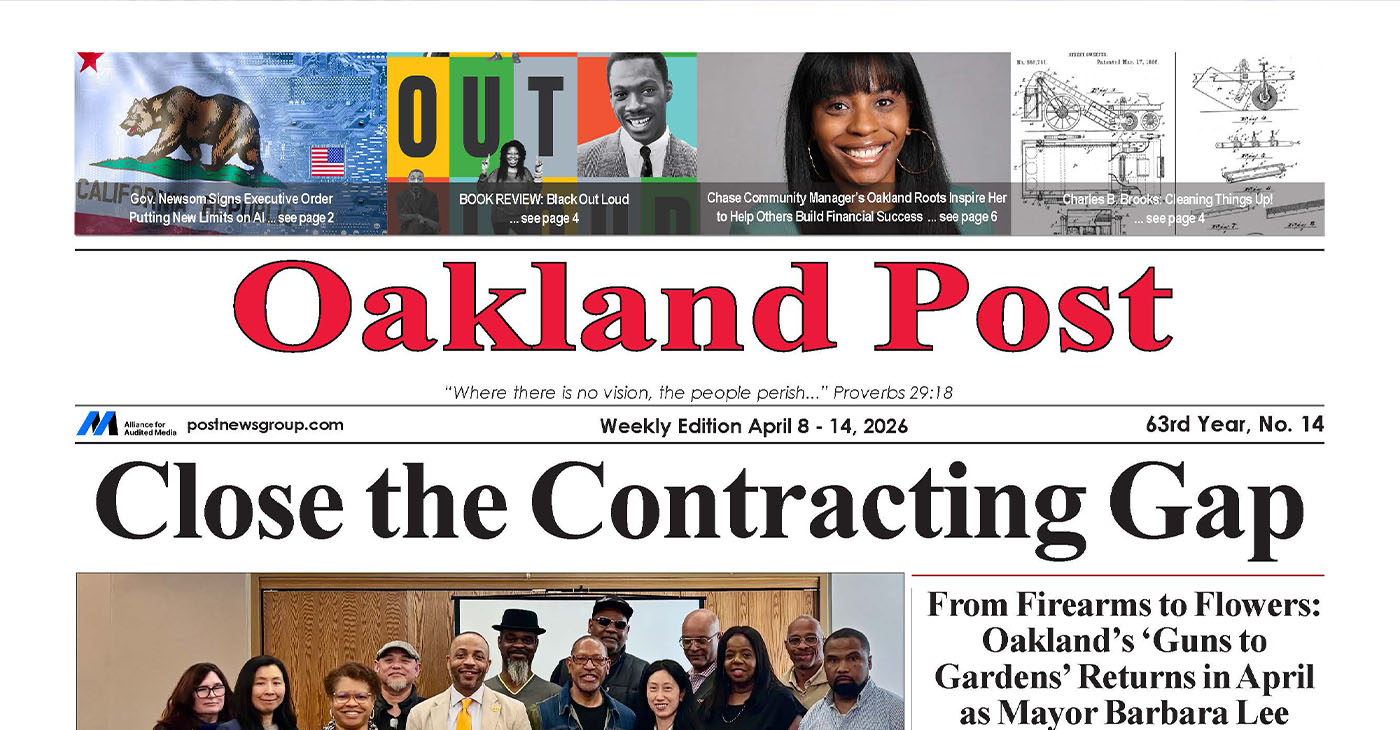
To enlarge your view of this issue, use the slider, magnifying glass icon or full page icon in the lower right corner of the browser window.
Activism
Oakland Post: Week of April 1 – 7, 2026
The printed Weekly Edition of the Oakland Post: Week of April 1 – 7, 2026
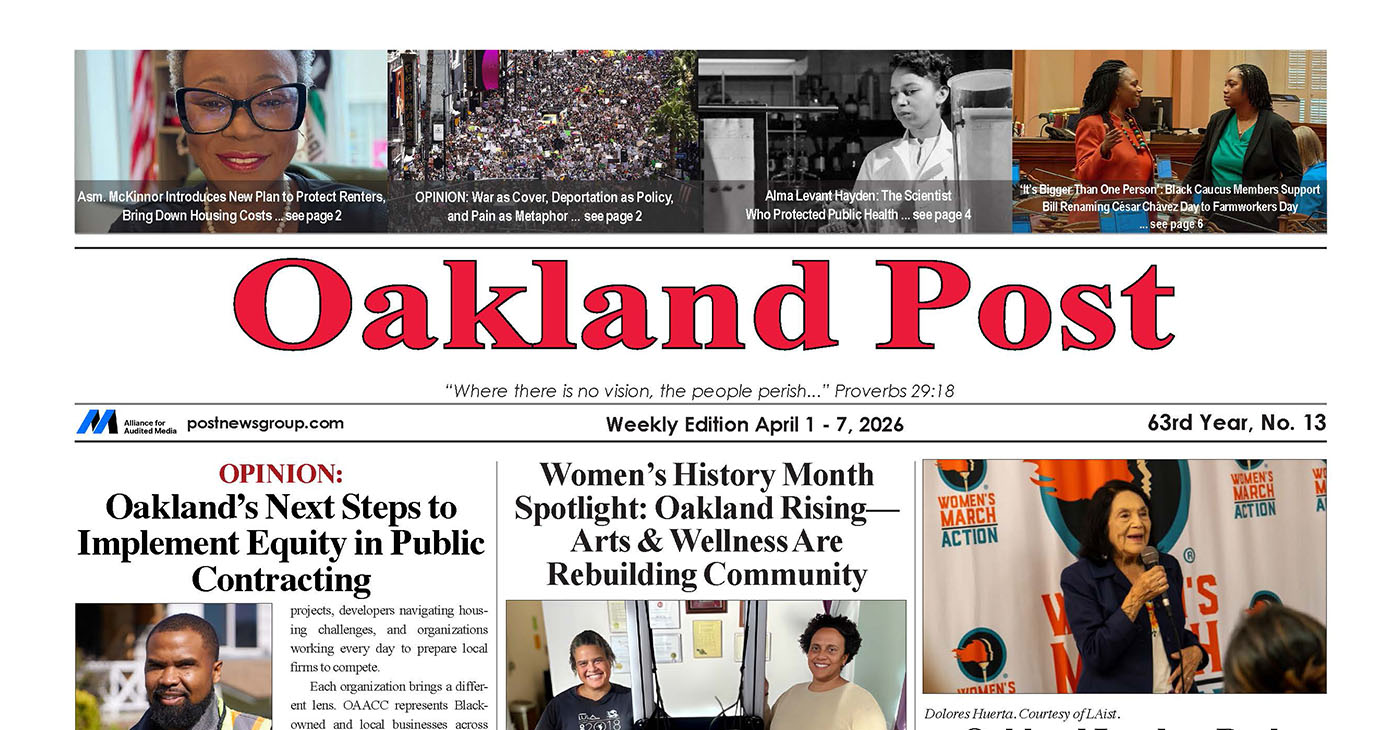
To enlarge your view of this issue, use the slider, magnifying glass icon or full page icon in the lower right corner of the browser window.
Activism
Oakland Post: Week of March 18 – 24, 2026
The printed Weekly Edition of the Oakland Post: Week of March 18 – 24, 2026
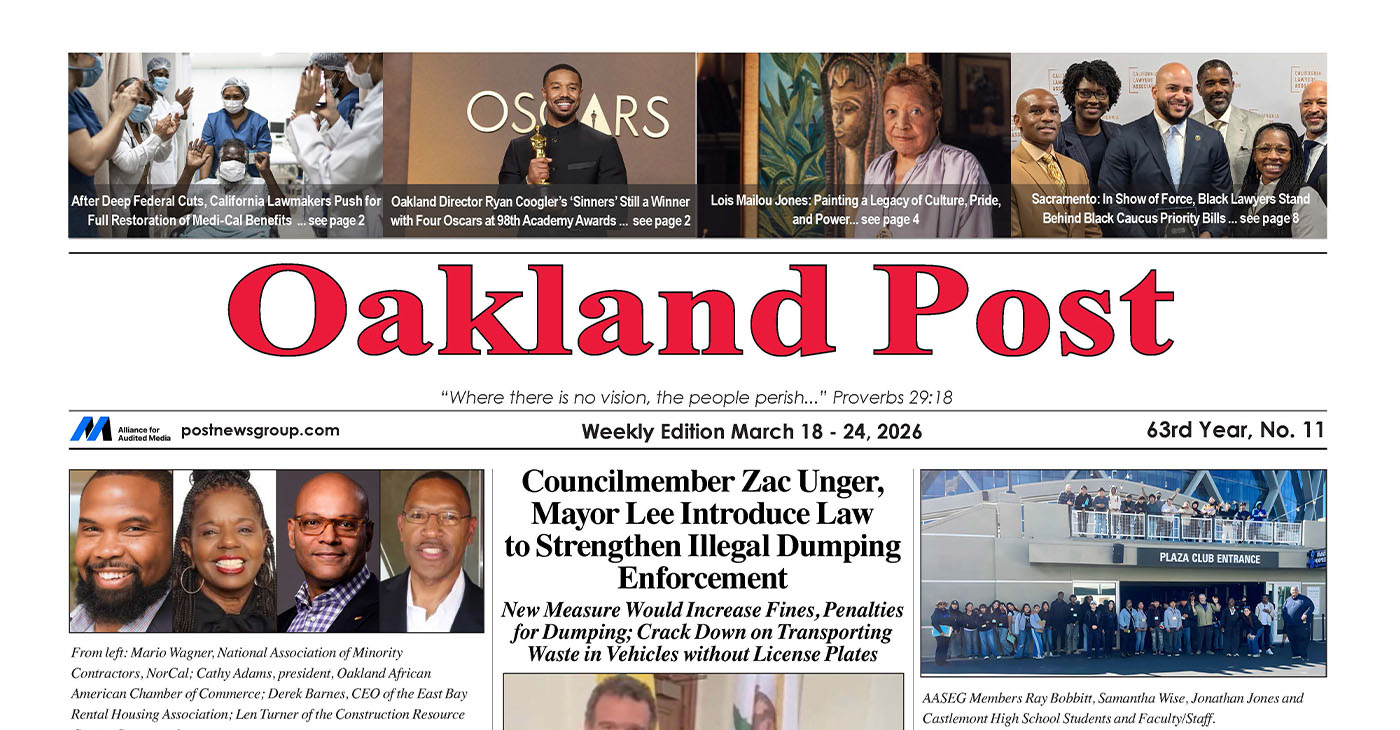
To enlarge your view of this issue, use the slider, magnifying glass icon or full page icon in the lower right corner of the browser window.
WORK FROM HOME
Home-based business with potential monthly income of $10K+ per month. A proven training system and website provided to maximize business effectiveness. Perfect job to earn side and primary income. Contact Lynne for more details: Lynne4npusa@gmail.com 800-334-0540


Oakland Post: Week of April 8 – 14, 2026

Oakland Post: Week of April 1 – 7, 2026

Black Artists in America, Installation Three Wraps at the Dixon Gallery and Gardens

Grief, Advocacy, and Education: A Counselor Reflects on Black Maternal Health

Future of Florida’s Black History Museum in Limbo

New Research Shows the Many Benefits of Early Learning

South Hampton K-8 Students Among Top 10 Finalists for Samsung’s ‘Solve for Tomorrow’ Competition

Cuba: No Negotiation with US on the President or Political System

Brooklyn Academy of Music Names Jamaican-Born Tamara McCaw as President

Trinidad & Tobego – U.S. Launches WhatsApp Channel for American Citizens in the Country

Oakland Post: Week of March 18 – 24, 2026

AI Innovation vs. Ethics and Environmental Impact

AI, Web3, and Digital Reparations

What If You Owned Your AI Agent?

Season 7, Episode 3 – January Reporter’s Roundtable 📱

Reflecting on Black History Milestones in Birmingham AL

Oakland Post: Week of February 25 – March 3, 2026

Oakland Post: Week of March 4 – 10, 2026

PRESS ROOM: NBA Hall of Fame Nominee Terry Cummings Joins 100 Black Men of DeKalb County to Launch Victory & Values Initiative

Trump’s MAGA Allies are Creating Executive Order Plan to Steal the 2026 Midterms
Oakland Post: Week of March 18 – 24, 2026

Oakland Post: Week of March 11 -17, 2026

Poll Shows Support for Policies That Help Families Afford Child Care

OP-ED: One Hundred Years of Black Workers Telling the Truth

Financial Wellness and Mental Health: Managing Money Stress in College

Woman’s Search for Family’s Roots Leads to Ancestor John T. Ward – A Successful Entrepreneur and Conductor on the Underground Railroad
New Research Shows the Many Benefits of Early Learning
Brooklyn Academy of Music Names Jamaican-Born Tamara McCaw as President
Grief, Advocacy, and Education: A Counselor Reflects on Black Maternal Health

COMMENTARY: Women of Color Shape Our Past and Future

Hyundai Ioniq 5 Parking, Safety, and 360 View #shorts

2025 Ioniq 5 New Wiper & Powerful Performance! #shorts

Electric SUV Range: Is 259 Miles Enough? #shorts

EV Charging: How Fast Can You Charge an Electric Vehicle? #shorts

Biometric Cooling… Messaging Seats…Come on! 2025 Infiniti QX80 Autograph 4WD

Charged Up: Witness the Magic of a Fully Electric Car! #shorts

Range Rover Sport PHEV Included…: See What’s Inside This Luxury SUV! #shorts

Invisible Hood View: Perfect Parking with X-Ray Vision! #shorts

AI Is Reshaping Black Healthcare: Promise, Peril, and the Push for Improved Results in California

ESSAY: Technology and Medicine, a Primary Care Point of View

Sanctuary Cities

The RESISTANCE – FREEDOM NOW

STATE OF THE PEOPLE: Freddie

ECONOMIC BOYCOTT DAY!!!!!

I told You So

-
 Activism3 weeks ago
Oakland Post: Week of March 18 – 24, 2026
-
 Activism4 weeks ago
Oakland Post: Week of March 11 -17, 2026
-
 Advice4 weeks ago
Financial Wellness and Mental Health: Managing Money Stress in College
-
 #NNPA BlackPress3 weeks ago
New Research Shows the Many Benefits of Early Learning
-
 #NNPA BlackPress3 weeks ago
Brooklyn Academy of Music Names Jamaican-Born Tamara McCaw as President
-
 #NNPA BlackPress3 weeks ago
Grief, Advocacy, and Education: A Counselor Reflects on Black Maternal Health
-
 #NNPA BlackPress3 weeks ago
Future of Florida’s Black History Museum in Limbo
-
 #NNPA BlackPress3 weeks ago
Black Artists in America, Installation Three Wraps at the Dixon Gallery and Gardens
