
Bay Area
Rich Lyons, Longtime Campus Business, Innovation Leader, Will Be UC Berkeley’s Next Chancellor
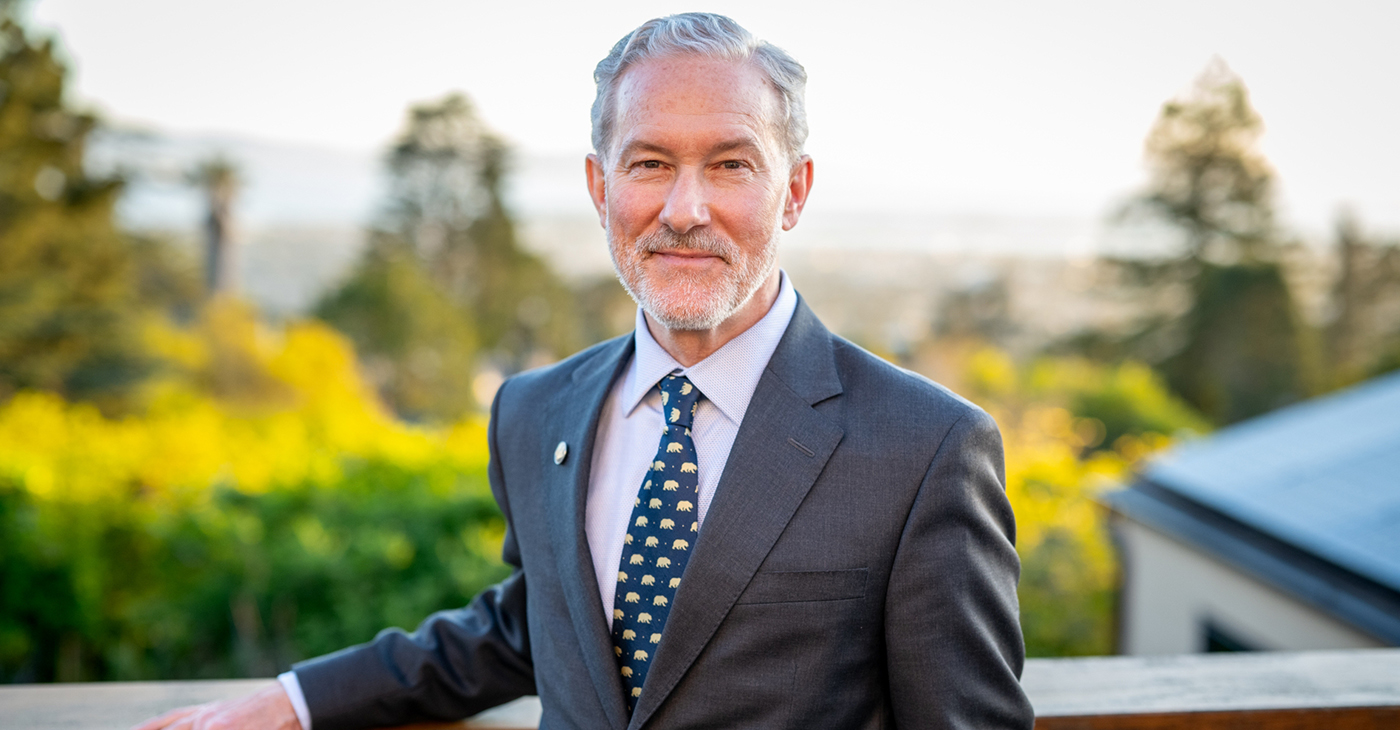
Rich Lyons, an established economist, former dean of the Haas School of Business and the campus’s current leader for innovation and entrepreneurship, will become the next chancellor at the University of California, Berkeley, the UC Board of Regents announced on April 10.

By Jason Pohl
Rich Lyons, an established economist, former dean of the Haas School of Business and the campus’s current leader for innovation and entrepreneurship, will become the next chancellor at the University of California, Berkeley, the UC Board of Regents announced on April 10.
The board’s unanimous confirmation makes Lyons, 63, the first UC Berkeley undergraduate alumnus since 1930 to become the campus’s top leader. In an interview this week, Lyons said he credits his Berkeley roots and his campus mentors with encouraging him to ask big questions, advance institutional culture and enhance public education — all priorities of his for the years to come.
Lyons, who will be Berkeley’s 12th chancellor, will succeed Chancellor Carol Christ, who announced last year that she’d step down as chancellor on July 1.
“I am both thrilled and reassured by this excellent choice. In so many ways, Rich embodies Berkeley’s very best attributes, and his dedication to the university’s public mission and values could not be stronger,” Christ said. “I am confident he will bring to the office visionary aspirations for Berkeley’s future that are informed by, and deeply respectful of, our past.”
Rising through the Berkeley ranks
Born in 1961, Lyons grew up in Los Altos in the early days of the Silicon Valley start-up boom.
He attended Berkeley, where he graduated in 1982 with a Bachelor of Science degree in business and finance. Lyons went on to earn his Ph.D. in 1987 in economics from MIT. After six years teaching at Columbia Business School, Lyons returned west, where in 1993 he joined the Berkeley faculty as a professor of economics and finance, specializing in the study of international finance and global exchange rates.
He’s remained on campus since, with one notable exception.
Starting in 2006, Lyons spent two years working at Goldman Sachs as the chief learning officer. It was a period that instilled in him an appreciation for leadership and the importance of organizational culture.
He carried those lessons with him when he returned to campus in 2008 and became the dean of the Haas School of Business.
While dean, Lyons oversaw the construction of Connie & Kevin Chou Hall, a state-of-the-art academic building that opened in 2017 and is celebrated for its sustainability. He also helped establish two new degree programs, linking the business school with both the College of Engineering and the Department of Molecular and Cell Biology.
But it was his creation of four distinct defining leadership principles that spurred a sweeping culture initiative at the school that stands out in the minds of many. Those values — question the status quo, confidence without attitude, students always, and beyond yourself — became a creed of sorts for new students and alumni alike.
Those values are important, Lyons said, because they shape and support the cohesive structure of a strong, connected community — spanning science and technology to the arts and humanities. They also convey the story about what it means to be at Berkeley and to believe in the university’s public mission.
“When we are great as educators, it’s identity-making,” Lyons said. “We’re helping students and others see identities in themselves that they couldn’t see.”
Lyons in January 2020 became Berkeley’s first-ever chief officer of innovation and entrepreneurship.
Building on his research exploring how leaders drive innovation and set behavioral norms and culture, Lyons worked to expand and champion Berkeley’s rich portfolio of innovation and entrepreneurship activities for the benefit of students, faculty, staff, startups and external partners.
It was a major commitment to thinking outside the box, he said. One need only look to the Berkeley Changemaker program that he helped launch in 2020 to see innovation and entrepreneurship in action.
The campuswide program with some 30 courses tells the story of what Berkeley is — the story that members of the Berkeley community can tell long into the future. Berkeley Changemaker started as an idea and its courses quickly became among the most popular academic offerings on campus.
“Over 500 students showed up,” he said. “Why? Because it’s a narrative. It’s not just a name. It’s not just a curriculum. It’s not just a course. It’s a way of living, and it’s a way of living that Berkeley has occupied forever. This idea that there’s got to be a better way to do this, question the status quo.”











Activism
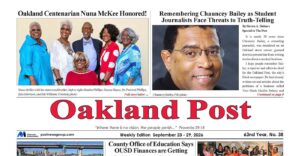
Oakland Post: Week of September 23 – 29, 2026
The printed Weekly Edition of the Oakland Post: Week of September 23 – 29, 2026

To enlarge your view of this issue, use the slider, magnifying glass icon or full page icon in the lower right corner of the browser window.
Activism
Oakland Post: Week of September 16 – 22, 2026
The printed Weekly Edition of the Oakland Post: Week of September 16 – 22, 2026

To enlarge your view of this issue, use the slider, magnifying glass icon or full page icon in the lower right corner of the browser window.
Activism
Oakland Post: Week of September 9 – 15, 2026
The printed Weekly Edition of the Oakland Post: Week of September 9 – 15, 2026

To enlarge your view of this issue, use the slider, magnifying glass icon or full page icon in the lower right corner of the browser window.


Asm. Corey Jackson Announces Launch of 24-Hour Childcare in His District

IN MEMORIAM: The Rev. Leon “Sonny” Clark, Longtime Orange County Pastor and Community Leader, Dies at 72

Poll: Becerra Widens His Lead Over Hilton; Californians Split on Wealth Tax

From Historic Memories to New Possibilities: Oakland Celebrates Coliseum 60

County Office of Education Says OUSD Finances Are Getting Healthier, Materially Stronger

LIVE FREE Sunday Dinner Brings Faith, Fellowship and Civic Conversation to Oakland

Remembering Chauncey Bailey as Student Journalists Face Threats to Truth-Telling

BLACspace Cooperative Invites Bay Area to Experience Oakland’s Black Cultural Ecosystem Through a BLAC Map Tour + Party

In Wake of Death on Doorstep, Williams Chapel Baptist Church Calls for Better Care, Funding for Unhoused

Oakland Centenarian Nuna McKee Honored!

Caribbean Nations Produce Action Plan Calling for UK Reparations Over Slavery

Oakland Post: Week of September 23 – 29, 2026

Doulas Are Helping Black California Moms Navigate Pregnancy–Even as High Mortality Rates Persist

Newsom Signs Addictive Social Media Law to Protect Kids

On Your November Ballot: Prop 38 Would Allocate $8.4 Billion to Immunology and Immunotherapy Funding

Standoff for Justice: Our Homes Are Worth Fighting For

Oakland Post: Week of August 26 – September 1, 2026

Frontier Airlines’ Return to Oakland Airport Brings Flights, Jobs and Opportunity

Gubernatorial Candidate Steve Hilton Blasts California New Tire Rules; Newsom Hits Back

Chef Sharon Lee Blends Culinary Excellence, Education and Empowerment

Jackie Wright Champions Bay Area Stories, Filmmakers and Cultural Institutions

Big City Mayors Ask for “Yes” Vote on Housing Bond Measure; Conservatives Say “No”

Oakland Coliseum Project Opens Door for Small Businesses to Build Bigger

Gov. Newsom’s Latest Appointees Include Sacramento Advocate for Formerly Incarcerated Students; State’s New Tech Chief

Misnamed ‘Parent’ PAC Seeks to Influence Oakland School Board Elections

Longtime BWOPA Member Brendalyn Goodall Appointed to California Workforce Development Board

Gov. Newsom Signs Law Shielding Immigration Aid Workers From Doxing Threats

Secretary of State Shirley N. Weber Urges Californians to Vote Early as Voter ID Battle Intensifies

From Palestine to Oakland: Seeds for Liberation Examines Shared Struggles for Freedom

IN MEMORIAM: Dolly Parton Dead at 80 — How She Built a Legacy of Love and Earned Her Place in Black Culture

The Conversation With Al McFarlane 6/23/26

Media Monday 6/22/26

LIVE! ASK ALMA! — TUES. 6.23.26 7PM EST

Car Buying Secrets: 4 Hidden Checks Before You Sign!

Is This 550 HP Charger Worth YOUR Money? AutoNetwork Review

Celebrating Juneteenth – Frederick Douglass on education and resistance

LIVE! — ASK ALMA! — TUES. 6.19.26 7PM EST

Hyundai Ioniq 5 Parking, Safety, and 360 View #shorts

2025 Ioniq 5 New Wiper & Powerful Performance! #shorts

Electric SUV Range: Is 259 Miles Enough? #shorts

EV Charging: How Fast Can You Charge an Electric Vehicle? #shorts

Biometric Cooling… Messaging Seats…Come on! 2025 Infiniti QX80 Autograph 4WD

Charged Up: Witness the Magic of a Fully Electric Car! #shorts

Range Rover Sport PHEV Included…: See What’s Inside This Luxury SUV! #shorts

Invisible Hood View: Perfect Parking with X-Ray Vision! #shorts
-
 Community2 weeks ago
Misnamed ‘Parent’ PAC Seeks to Influence Oakland School Board Elections
-

 Activism3 weeks ago
Oakland Post: Week of September 2 – 8, 2026
-

 Community2 weeks ago
Richmond Tiny House Village Farm & Garden Set to Open Gates on Sept. 26
-

 Black History2 weeks ago
OPINION: Nolan Wells’ Death One of Several Signifying Racial Terror Lives on in U.S. South
-

 Black History2 weeks ago
Latest Massacre in Haiti Reveals Cruelty U.S. Deportations
-

 Activism2 weeks ago
Oakland Post: Week of September 9 – 15, 2026
-

 Community2 weeks ago
Democratic Clubs Interview Candidates for Oakland School Board
-
 Featured2 weeks ago
‘Ready to See These Bills Become Law’: Sen. Weber’s Package of 15 Bills Advance to Gov. Newsom’s Desk
