
Bay Area
Nigerian Bank Chief Killed in Helicopter Crash on Way to Superbowl XVIII
According to the San Bernardino County Sheriff’s Dept., the crash occurred near Nipton, on the edge of the Mojave Desert Preserve. The poor weather conditions — rain, wind and snow showers—may have contributed to the accident, although the investigation is not complete. All six aboard were killed. Herbert Wigwe, 57, founded Access Bank in 1989, and it became the country’s largest competitor, Diamond Bank in 2018.


By Post Staff
The co-founder of one of Nigeria’s largest banks died with his wife, son and three others when the helicopter transporting them from Palm Springs, Ca., to Boulder City, Nev. to attend the fifty-eighth SuperBowl at the stadium outside Las Vegas crashed on Feb. 9.
According to the San Bernardino County Sheriff’s Dept., the crash occurred near Nipton, on the edge of the Mojave Desert Preserve. The poor weather conditions — rain, wind and snow showers—may have contributed to the accident, although the investigation is not complete. All six aboard were killed
Herbert Wigwe, 57, founded Access Bank in 1989, and it became the country’s largest competitor, Diamond Bank in 2018.
More recently, Wigwe was planning to open a banking service in Asia this year after making successful expansions to other parts of Africa, including South Africa, Kenya, and Botswana.
Nigerian President Bola Tinubu described Wigwe’s death as an ‘overwhelming tragedy.”
Oakland resident and Nigerian immigrant Kayode Gbadebo agrees with Tinubu. He met Wigwe in Nigeria but crossed paths with him in London in 2006. Wigwe, he said, “took risks.”
He was young and people thought he couldn’t do what he intended, which was not so much about money but community.
“He was more like Jesus in washing the feet of the poor– Wigwe was culturizing community,” Gbadebo said.
“There will never be another like him. This is a deep, deep loss” and he hopes everyone will eventually “be comforted.”
He was also disappointed that a replacement has already been named even before Wigwe is buried. “It is not reasonable. You don’t want a vacuum, but it’s” not fair to the family, Gbadebo observed.
Wigwe had also been working to solve the migration issues from African countries, believing that “investing in higher education was key to controlling mass migration, which “is destabilising countries across the world,” BBC News reported.
“We need to take a holistic approach to address global migration, starting with our traditional framework for international development,” Wigwe wrote.
To that end, according to BBC News, Wigwe was preparing to open Wigwe University in Niger, where he was from.
“The best place to limit migration is not in the middle of the Mediterranean or the English Channel or the Rio Grande. It is in the home countries that so many migrants are so desperate to leave,” he wrote, saying his university was an opportunity for him “to give back to society.”
Besides Wigwe and his wife, Chizoba Nwuba Wigwe, and one son, two crew members and Bimbo Ogunbanjo, former group chairman of the Nigerian Exchange Group Plc, were also killed in the crash.
According to Wikipedia, three other children survive Wigwe.
In his statement reported in People magazine, Tinubu described Wigwe as “a distinguished banker, humanitarian, and entrepreneur.”
“I pray for the peaceful repose of the departed and ask God Almighty to comfort the multitude of Nigerians who are grieving and the families of the deceased at this deeply agonizing moment,” the president said.
He added, “Their passing is an overwhelming tragedy that is shocking beyond comprehension.”
Besides feeling the tremendous loss, Gbadebo fears the disorder and greed that will follow. “It’s a mess,” he said.
People magazine, BBC News and Wikipedia were the sources for this report.











Activism
Oakland Post: Week of September 23 – 29, 2026
The printed Weekly Edition of the Oakland Post: Week of September 23 – 29, 2026

To enlarge your view of this issue, use the slider, magnifying glass icon or full page icon in the lower right corner of the browser window.
Activism
Oakland Post: Week of September 16 – 22, 2026
The printed Weekly Edition of the Oakland Post: Week of September 16 – 22, 2026

To enlarge your view of this issue, use the slider, magnifying glass icon or full page icon in the lower right corner of the browser window.
Activism
Oakland Post: Week of September 9 – 15, 2026
The printed Weekly Edition of the Oakland Post: Week of September 9 – 15, 2026
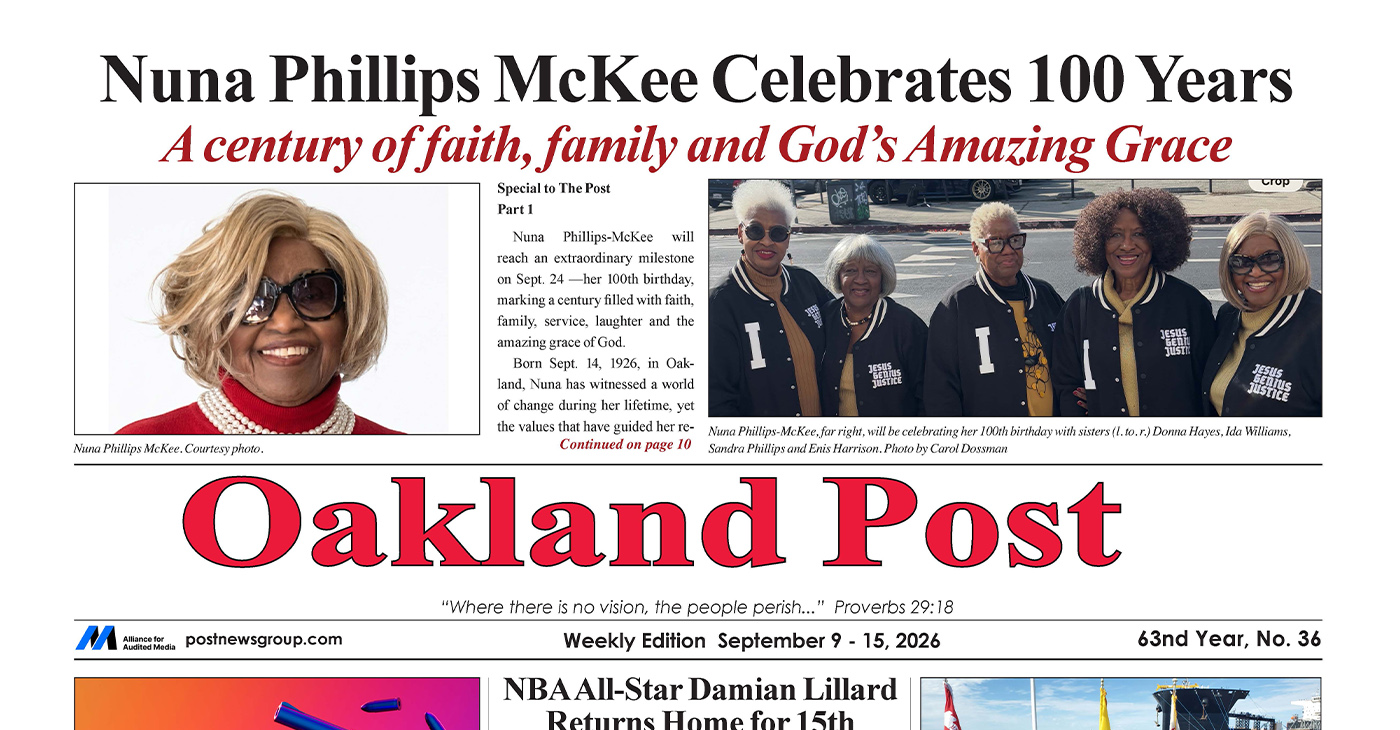
To enlarge your view of this issue, use the slider, magnifying glass icon or full page icon in the lower right corner of the browser window.



Asm. Corey Jackson Announces Launch of 24-Hour Childcare in His District

IN MEMORIAM: The Rev. Leon “Sonny” Clark, Longtime Orange County Pastor and Community Leader, Dies at 72

Poll: Becerra Widens His Lead Over Hilton; Californians Split on Wealth Tax

From Historic Memories to New Possibilities: Oakland Celebrates Coliseum 60

County Office of Education Says OUSD Finances Are Getting Healthier, Materially Stronger

LIVE FREE Sunday Dinner Brings Faith, Fellowship and Civic Conversation to Oakland

Remembering Chauncey Bailey as Student Journalists Face Threats to Truth-Telling

BLACspace Cooperative Invites Bay Area to Experience Oakland’s Black Cultural Ecosystem Through a BLAC Map Tour + Party

In Wake of Death on Doorstep, Williams Chapel Baptist Church Calls for Better Care, Funding for Unhoused

Oakland Centenarian Nuna McKee Honored!

Caribbean Nations Produce Action Plan Calling for UK Reparations Over Slavery

Oakland Post: Week of September 23 – 29, 2026

Doulas Are Helping Black California Moms Navigate Pregnancy–Even as High Mortality Rates Persist

Newsom Signs Addictive Social Media Law to Protect Kids

On Your November Ballot: Prop 38 Would Allocate $8.4 Billion to Immunology and Immunotherapy Funding

Four Candidates, Including Incumbent Barbara Lee, Qualify for Oakland Mayor’s Race

Standoff for Justice: Our Homes Are Worth Fighting For

Oakland Post: Week of August 26 – September 1, 2026

Frontier Airlines’ Return to Oakland Airport Brings Flights, Jobs and Opportunity

Gubernatorial Candidate Steve Hilton Blasts California New Tire Rules; Newsom Hits Back

Chef Sharon Lee Blends Culinary Excellence, Education and Empowerment

Jackie Wright Champions Bay Area Stories, Filmmakers and Cultural Institutions

Big City Mayors Ask for “Yes” Vote on Housing Bond Measure; Conservatives Say “No”

Gov. Newsom’s Latest Appointees Include Sacramento Advocate for Formerly Incarcerated Students; State’s New Tech Chief

Oakland Coliseum Project Opens Door for Small Businesses to Build Bigger

Misnamed ‘Parent’ PAC Seeks to Influence Oakland School Board Elections

Longtime BWOPA Member Brendalyn Goodall Appointed to California Workforce Development Board

Gov. Newsom Signs Law Shielding Immigration Aid Workers From Doxing Threats

Secretary of State Shirley N. Weber Urges Californians to Vote Early as Voter ID Battle Intensifies

From Palestine to Oakland: Seeds for Liberation Examines Shared Struggles for Freedom

The Conversation With Al McFarlane 6/23/26

Media Monday 6/22/26

LIVE! ASK ALMA! — TUES. 6.23.26 7PM EST

Car Buying Secrets: 4 Hidden Checks Before You Sign!

Is This 550 HP Charger Worth YOUR Money? AutoNetwork Review

Celebrating Juneteenth – Frederick Douglass on education and resistance

LIVE! — ASK ALMA! — TUES. 6.19.26 7PM EST

Hyundai Ioniq 5 Parking, Safety, and 360 View #shorts

2025 Ioniq 5 New Wiper & Powerful Performance! #shorts

Electric SUV Range: Is 259 Miles Enough? #shorts

EV Charging: How Fast Can You Charge an Electric Vehicle? #shorts

Biometric Cooling… Messaging Seats…Come on! 2025 Infiniti QX80 Autograph 4WD

Charged Up: Witness the Magic of a Fully Electric Car! #shorts

Range Rover Sport PHEV Included…: See What’s Inside This Luxury SUV! #shorts

Invisible Hood View: Perfect Parking with X-Ray Vision! #shorts
-
 Business4 weeks ago
Frontier Airlines’ Return to Oakland Airport Brings Flights, Jobs and Opportunity
-
 Business4 weeks ago
Gubernatorial Candidate Steve Hilton Blasts California New Tire Rules; Newsom Hits Back
-
 Business4 weeks ago
Chef Sharon Lee Blends Culinary Excellence, Education and Empowerment
-
 Black History4 weeks ago
Jackie Wright Champions Bay Area Stories, Filmmakers and Cultural Institutions
-
 Community4 weeks ago
Big City Mayors Ask for “Yes” Vote on Housing Bond Measure; Conservatives Say “No”
-
 Community2 weeks ago
Misnamed ‘Parent’ PAC Seeks to Influence Oakland School Board Elections
-
 Business4 weeks ago
Longtime BWOPA Member Brendalyn Goodall Appointed to California Workforce Development Board
-
 Community4 weeks ago
Gov. Newsom Signs Law Shielding Immigration Aid Workers From Doxing Threats
