
Business
Where are the Black hemp farmers?
FLORIDA COURIER — Although hemp is legal, regulatory risks complicate the crop’s long-term outlook. Some states are positioning themselves to compete, but it’s unlikely the market can sustain hemp production in every state — unless there’s a significant increase in product demand, according to a February 2019 report from the College of Agriculture, Food and Environment at the University of Kentucky.

By April Simpson

COLUMBIA, Md. – Clarenda Stanley-Anderson will be the featured farmer of Hemp History Week, an educational campaign in June focused on a newly legal crop that’s at the center of a risky, potentially billion-dollar industry.
Stanley-Anderson is considered a pioneer in the nascent hemp agricultural community, for educating others and encouraging young farmers to bring hemp back to the U.S. agrarian landscape, according to history week organizers.
It’ll be the first time that the Hemp Industries Association annual initiative, which boasts celebrity endorsements and events across the country, will feature a non-white farmer.
Stanley-Anderson wants to expand the representation of hemp farmers, even if she’s far from the average industry insider. Black farmers are a mere 1.4 percent of the country’s 3.2 million farmers, according to the 2012 U.S. Department of Agriculture Census of Agriculture.
In North Carolina, where Stanley-Anderson and her husband own Green Heffa Farms in the town of Liberty, Black farm operators are nearly 3 percent of farmers.
While Black farmers aren’t as visible, Stanley-Anderson is part of a developing community. As growers, processors and entrepreneurs, Black professionals across the country are working to carve out a space in a trendy industry that’s projected to reach $1.9 billion in U.S. hemp-based product sales by 2022, according to the Hemp Business Journal, an online publication that tracks the industry.
‘BECOMING EXTINCT’
Individuals and organizations are in the early stages of building networks of Black farmers and processors to ensure Black agriculture professionals get their share of hemp riches. But it’s hard for everyone to take on the risk.
Black farmers have long been discriminated against by lending institutions like the USDA. And with a limited population of growers, land, resources and sometimes access to the information networks that enable farmers to move quickly, they could be left behind again with hemp.
“Black farmers are becoming extinct,” said Lamar Wilson, founder of SunJoined, a nationwide network of hemp growers and processors with farmers in Kentucky, Kansas and Colorado. “This is an opportunity to bring them back and to actually provide a profitable resource, but also a resource that can be used for so many different things.”
Not everyone is optimistic hemp is the future for the small and under-resourced farmer, unless there are regulatory efforts to ensure they can be competitive.
“Most minority farms are on the verge of survival,” said Joe Trigg, a farmer and city council member in Glasgow, Kentucky, who’s running as a Democrat for state commissioner of agriculture. “The last thing they need is something else to drag them down.”
Hemp has been touted by Democratic and Republican senators as a lifeline nationwide to farmers, many of whom are struggling under declining commodity prices. Farmers can harvest three types of hemp: fiber; grain or seed; or floral material extracted for plant resin, including cannabidiol, popularly known as CBD. Hemp’s uses span more than 25,000 products, including textiles, biofuel, ropes, cosmetics, food and beverages.
REGULATORY RISKS
Agriculture professionals say the high-value crop can be particularly well-suited to Black landowners, who typically have smaller farms and less overall sales than White farmers.
Black farmland accounts for 0.4 percent of U.S. farmland, and sales account for 0.2 percent of total U.S. agriculture sales, according to the USDA. Hemp can be cultivated in tight spaces, especially when harvested for fiber and seed, which are planted in narrow rows.
“We’re just seeing Black farmers emerge in the market,” said Bonita Money, founder of the Los Angeles-based National Diversity Inclusion and Cannabis Alliance, another group connecting hemp farmers of color.
Although hemp is legal, regulatory risks complicate the crop’s long-term outlook. Some states are positioning themselves to compete, but it’s unlikely the market can sustain hemp production in every state — unless there’s a significant increase in product demand, according to a February 2019 report from the College of Agriculture, Food and Environment at the University of Kentucky.
“Technology may dictate that production will ultimately be concentrated in relatively few states where hemp can be grown at the lowest cost of production and transported shorter distances for processing,” the report said.
GOT IN EARLY
Some states, including North Carolina and Kentucky, adopted hemp early and began growing it in research or pilot programs prior to Congress’ passage of the 2018 farm bill, which legalized hemp widely.
Before December, when President Donald Trump signed the bill, federal law treated hemp as a quasi-controlled substance because of its relation to marijuana.
Neither Kentucky nor North Carolina tracks the race of growers or processors, according to spokespeople from the states’ departments of agriculture.
With federal legalization, many states are launching hemp pilot programs, transitioning from pilot to large-scale programs, while some are choosing to keep hemp farming illegal. Regardless, competition is increasing as growing hemp becomes more accessible.
Roscoe M. Moore, Jr., a former assistant U.S. surgeon general who attended a recent hemp workshop in Columbia, Maryland, thinks that as more money enters the hemp market, there will be few minorities involved.
MARIJUANA STIGMA
He pointed to the Maryland state law that called on regulators to reflect racial, ethnic and geographic diversity among those licensed to work in the medical marijuana industry. No Black applicant was awarded a grower’s license, according to news reports, and there were no repercussions, Moore said.
“Business relationships are the gold standard for America,” said Moore, who advises several biotechnology and pharmaceutical companies. “Business is based on commerce. There’s not any excuse why we’re not involved, we just haven’t had the experience.”
But even when approached, Black farmers sometimes decline the opportunity. Trigg, the Kentucky city council member, said a state official encouraged him to participate early in Kentucky’s pilot program.
Trigg declined because of the crop’s association with marijuana and law enforcement oversight.
Even though marijuana and hemp are separate strains of cannabis, with hemp having a lower level of tetrahydrocannabinol, or THC — the main psychoactive component in the cannabis plant — farmers like Trigg worried about a stigma in being associated with the crop.
“There was still so much skepticism associated with it, and everyone was worried,” said Trigg, who plans to grow his first hemp plant this year. “You start growing marijuana on your farm and you’re Black?”
WHITE MALE COMMISSION
Stanley-Anderson, whose nickname is Farmer Cee, didn’t initially connect hemp to equity until she didn’t see herself reflected among decision makers. The North Carolina Industrial Hemp Commission, for example, whose nine members develop rules and licensing fee structures for the industry, is all male.
Eight members are White. Two are from law enforcement. None are African American.
Members, who serve as volunteers, are appointed by the governor, commissioner of agriculture and General Assembly. Their selection criteria are written into state law.
“I agree. It’s all White. It’s all male. But that’s the way it was set up,” said commission Chairman Tom Melton, also deputy director of the North Carolina Cooperative Extension Service at North Carolina State University. “Maybe the law needs to change to indicate some sort of representation. That’s beyond the scope of our commission.”
Federal law requires applicants for hemp licenses to not have had a drug felony in the past 10 years. The advocacy groups Vote Hemp, Drug Policy Alliance and others were able to get that decreased from a lifetime ban, but were unsuccessful in getting removed, said Eric Steenstra, president of Vote Hemp, in an email to Stateline.
“Our goal is to allow all farmers who want to grow hemp to do so with as limited restrictions as possible,” Steenstra wrote. Vote Hemp, based in Washington, D.C., is a national nonprofit advocacy organization that supports a free market for industrial hemp.
BACKGROUND CHECKS
For some Black farmers, the felony restriction on hemp is a lost opportunity. Blacks and Latinos are far more likely to have marijuana-related drug felonies, according to the Drug Policy Alliance.
People coming out of prison desperately need jobs, said Ashley Smith, co-founder of Black Soil: Our Better Nature, an organization that supports Black farmers, growers and producers in Kentucky.
“There has to be some compromise where we can bring folks who are in need of jobs working land that is in need of labor,” Smith said. In Kentucky, hemp laborers are subject to background checks.
Some places are trying a system to offer some restitution for the disproportionate impact of drug enforcement on Black communities.
Some California cities, for example, have adopted cannabis equity programs that provide business development, loan assistance and mentorships for minority and low-income entrepreneurs. Oakland has permits set aside for people of color.
“No one is doing that with hemp,” said Stanley-Anderson, who grew up on a farm in Alabama.
ORLANDO ADVOCACY GROUP
Jackson Garth, national director for industrial hemp for Minorities for Medical Marijuana, an advocacy group based in Orlando, has been working to get equity goals or requirements written into hemp legislation in Georgia and South Carolina. While the measures never made it into legislation, he’s encouraged South Carolina has awarded licenses to farmers of color he’s worked with.
“We’re going to have to have set-asides for Black and brown farmers, so farmers aren’t forgotten,” Garth said.
Garth’s group, known as M4MM, is in the early stages of setting up a co-op program for hemp. Garth, who’s also an executive of an industrial hemp processing company in Atlanta, is educating farmers on the crop and helping them get licenses.
“A lot of times,” Garth said, “it’s a lack of information that we’re receiving, and even when we get the information, it’s too late.”
FARMER EQUITY ACT
At least two states — Illinois and California — have enacted a Farmer Equity Act in recent years to ensure socially disadvantaged farmers and ranchers are included in food and agriculture laws.
States with programs to support minority-owned businesses, new and beginning farmers and other targeted groups, could potentially apply to commercial industrial hemp producers unless there are restrictions in place to exclude hemp production, according to the National Conference of State Legislatures.
Some critics argue that these programs can feel like a Band-Aid.
“There’s a slew of people who fall under minority,” said Kentucky farmer Charles Jones, citing White women, veterans and other farmers of color. “So, they can say they’re doing this for minorities, but the Black farmer still gets left out within this.”
More than 100 people attended the recent daylong hemp informational event organized by Morgan State University, a historically Black university in Baltimore, Maryland. A handful of the attendees were Black. Among them, few were farmers. Instead, most were entrepreneurs or academics connected to Morgan State.
This article originally appeared in the Florida Courier.










Black History
Listening as a Lifeline: A Doula’s Witness to Black Maternal Health
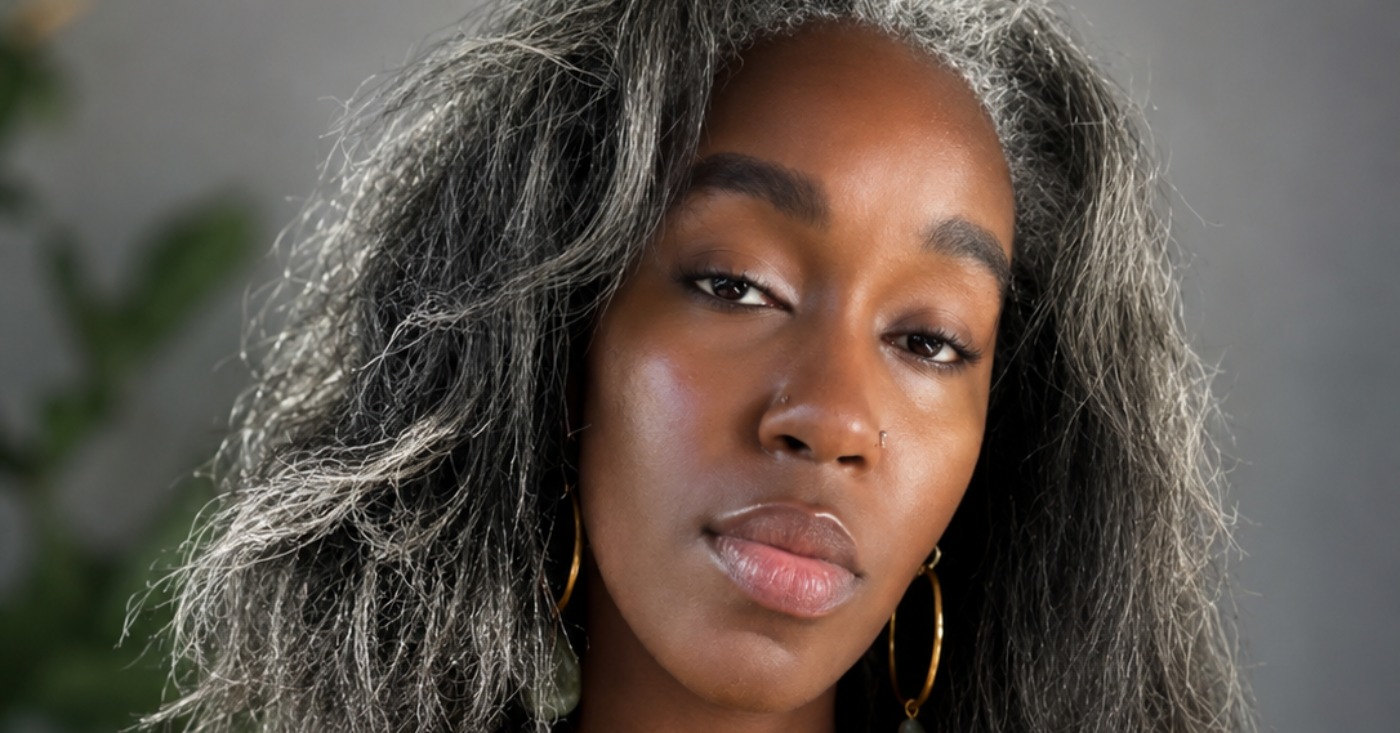
OAKLAND POST — Maternal mortality and pregnancy-related mortality use different time frames and methods and are not interchangeable. Finalized 2024 CDC data recorded 649 maternal deaths nationally. The overall rate was 17.9 deaths per 100,000 live births, but for non-Hispanic Black women it was 44.8, compared with 14.2 for White women and 12.1 for Hispanic women.

Word Count: 1058
Note: Client A, B & C, names are withheld for privacy; these accounts reflect my recollections as their Doula.
Client A rocked her hips on a birthing ball, surrounded by pale wood and warm textiles in a softly lit Scandinavian-style office. I was her doula through a Southern California maternal health company combining nurse-led care, technology, and wraparound support.
She was a healthy Black woman in her thirties. Her baby girl was doing well; her partner took notes as we discussed labor and advocacy.
Then we turned to their chosen hospital. I knew it well—and remembered a phrase from another client’s experience: “Policy of Sovereignty.”
Client B had been told she needed a repeat cesarean as a precaution, though the reasoning was unclear. Her obstetrician, who performed her first cesarean two years earlier, had assured her throughout pregnancy that she was healthy, healed, and ready for a vaginal birth. We asked staff to review her chart, consult her obstetrician, and reconsider immediate surgery. Instead, they invoked the “Policy of Sovereignty.”
The physician on duty, we were told, had final authority, regardless of her established care plan. I asked whether an ultrasound or reassessing the baby’s position could offer clarity. Cesareans can be lifesaving. But were Client B’s history, informed consent, and circumstances guiding this decision—or was routine overriding individualized care? We kept asking for her obstetrician. Beneath every request was a deeper question: Was she being heard?
The Numbers Behind the Stories
Statistics arrive in clean columns. The experiences behind them do not.
Maternal mortality and pregnancy-related mortality use different time frames and methods and are not interchangeable. Finalized 2024 CDC data recorded 649 maternal deaths nationally. The overall rate was 17.9 deaths per 100,000 live births, but for non-Hispanic Black women it was 44.8, compared with 14.2 for White women and 12.1 for Hispanic women.
In California, Black birthing people experienced 56.5 pregnancy-related deaths per 100,000 live births during 2020–2022—3.8 times the White rate and four times the Asian rate.
As a doula serving Los Angeles and San Bernardino Counties, I see faces behind those numbers. I remember concerns raised softly, then firmly, then desperately. I am tired of watching Black families enter spaces meant to protect them, only to discover they must defend themselves while laboring, bleeding, trembling, or recovering.
Returning to Client A
Client A’s labor stretched nearly 48 hours. As her condition worsened, she, her partner, and I asked whether a cesarean should happen sooner. A provider questioned my place as a doula, then said she was next.
Six more hours passed.
She entered surgery visibly ill with a serious uterine infection, her baby malpositioned and stuck. Her partner later recalled the provider saying, “This baby would never have made it through the birth canal.”
Those words landed like a blow. Our urgency had been treated as ignorance. With Client B, we questioned why surgery was inevitable. With Client A, why it was delayed. Doula advocacy is not about one kind of birth. It is about informed consent, individualized care, and timely action. Hospital routine should never outweigh the person carrying the risk.
Survival Cannot Be the Standard
The Black maternal health crisis includes unequal care, untreated conditions, racial bias, delayed referrals, poor communication, and inadequate postpartum support. It is about birth plans respected only until a hospital becomes less busy and postpartum care that asks whether a mother survived, not whether she has what she needs to recover.
Survival cannot be the standard. Technology can support care, but it cannot replace human connection. An algorithm cannot detect fear in a patient’s eyes, and a mission statement alone cannot ensure adequate staffing or culturally responsive care.
The Story of Client C
Before I arrived, I heard the chaos through Client C’s phone. Staff struggled to locate her baby’s heartbeat on an external monitor as her fear and blood pressure rose. I pleaded for an internal electrode before surgery.
“There’s not enough time,” a nurse said.
“I would like to wait for my doula,” Client C called out.
But she was medicated, hurried through consent, and wheeled away while I listened.
In the operating room, after a shift change, another nurse placed an internal electrode and said, “The previous monitor wasn’t working.”
No one responded.
According to her father, the obstetrician avoided eye contact: “We need to move forward.”
Surgery may still have been necessary; that was not mine to determine. But if faulty equipment helped create the emergency, the family deserved acknowledgment and explanation—not silence. No family should have to wonder whether major surgery followed an unavoidable crisis or a machine failure no one recognized in time.
From Prevention to Accountability
After supporting nearly 100 families, I have learned that danger often begins before admission. I have urged clients to seek care—and heard why they feared returning: dismissed pain, harsh words, shame for asking questions.
Care cannot be holistic where Black families do not feel safe enough to speak or return. Representation matters, but providers of color cannot repair inequity alone. They need adequate staffing, mentorship, culturally responsive training, reliable equipment, and colleagues that are reflective of all the aforementioned. It’s not the Black providers job to care for just the Black patients, everyone should have the same goal.
The Momnibus Act, California’s Medi-Cal doula benefit, the Transforming Maternal Health Model and the Perinatal Equity Initiative require more than promises; they need sustained funding, reliable reimbursement and accountable implementation.
Birth should be sacred. Yet too many Black birthing people arrive carrying the burden of proving their pain is real. A doula can listen, educate, comfort, and advocate—but cannot repair a system that refuses to listen. The true measure of progress is what happens when a Black birthing person says, “Something is wrong.”
Are they believed? When equipment fails, is that failure acknowledged? Do families leave not merely alive, but safe, respected, supported, and whole?
Until those answers are consistently yes, California’s maternal health success story remains unfinished.
About the Author
Antoinette Stewart-Eneh is a mother of two, holistic maternal wellness advocate, and birth and postpartum doula who has supported families since 2019. She serves as program operations coordinator for Frontline Doulas, a volunteer client coordinator with the Joy in Birthing Foundation and a childbirth educator in South Los Angeles. She is studying to become a midwife and lactation educator.

Activism
Oakland Post: Week of September 30 – October 6, 2026
The printed Weekly Edition of the Oakland Post: Week of September 30 – October 6, 2026
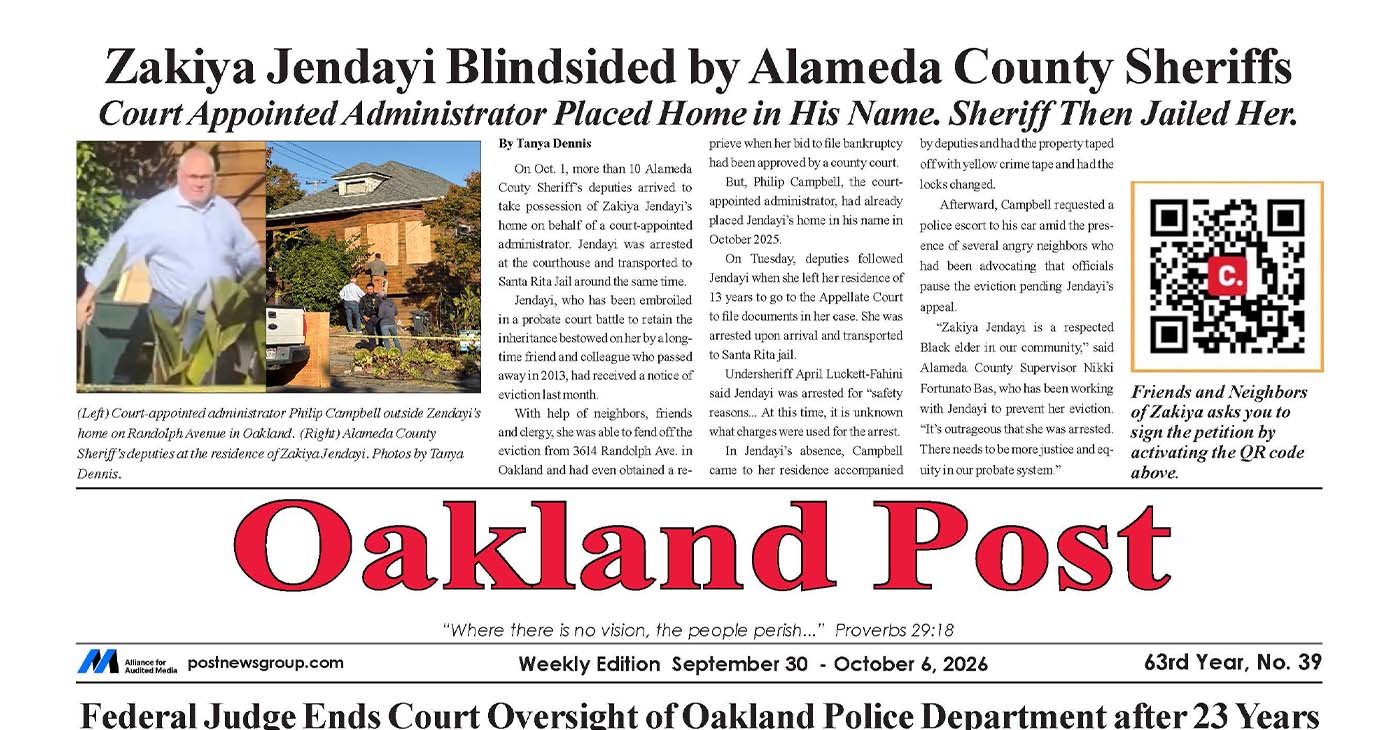
To enlarge your view of this issue, use the slider, magnifying glass icon or full page icon in the lower right corner of the browser window.
Business
From Historic Memories to New Possibilities: Oakland Celebrates Coliseum 60
More than 75 people gathered at Youth UpRising in East Oakland on Friday, September 18, for Coliseum 60, an event marking six decades of sports, entertainment, employment, and community memories at the Oakland-Alameda County Coliseum Complex. Held 60 years to the day after the Coliseum first opened, the celebration featured cultural performances and a mini-documentary highlighting its history. Speakers reflected on the venue’s significant role in the community and its future possibilities. Read more to learn about the individuals and stories honored during this special event.
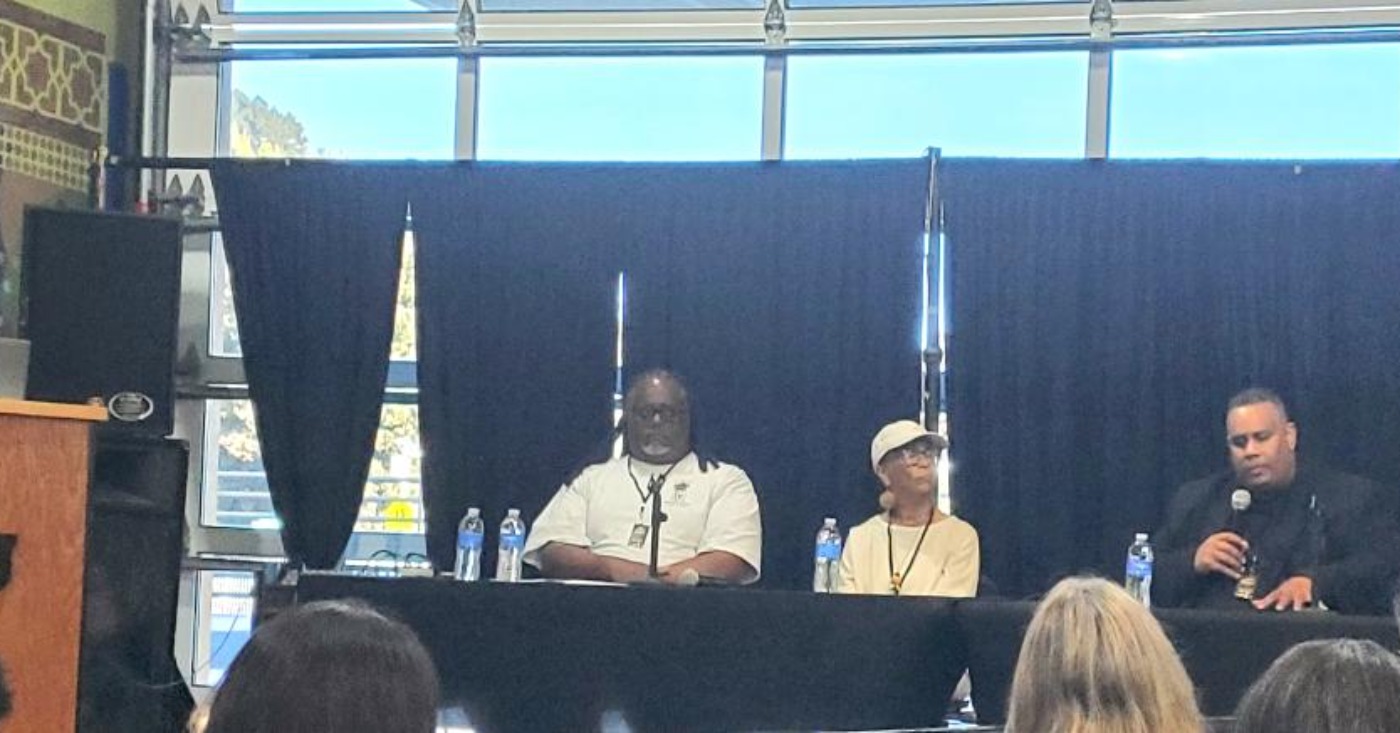
More than 75 people gathered at Youth UpRising in East Oakland on Friday, Sept. 18, for Coliseum 60, a celebration honoring six decades of sports, entertainment, employment and community memories connected to the Oakland-Alameda County Coliseum Complex.
Held 60 years to the day after the Coliseum opened, the event carried the theme, “One Community. One Legacy. One Future. Forward Together.”
The celebration opened with the national anthem performed by sisters Anese Jade, Amina Benjamin and Zaza Benjamin. Diamano Coura West African Dance Company contributed African dance and drumming, bringing movement, rhythm and cultural expression to the program.
A mini documentary highlighted the Coliseum’s sports history and its broader role as an entertainment destination. Archival material recalled performances by Prince and Tina Turner, along with memorable games featuring the Warriors, Oakland A’s and Raiders.
“The Coliseum 60 is about much more than celebrating a building or looking back at 60 years of history,” said event organizer Quixote Atkins of VillageGIVE.
“It’s about the people who made that history possible: the families, workers, athletes, artists, community leaders, fans and generations who gathered there and created memories together.”

A panel exploring that history featured author, historian and former Black Panther Party member Tareka Lewis; stagehand and union representative Keith Brown; and Ray Bobbitt, president of the African American Sports and Entertainment Group AASEG. Lewis described her family as fourth-generation Bay Area pioneers.
“My family and Black families who arrived even earlier helped build the Bay Area, grew businesses and established culture here,” Lewis said. “This should be taught in the public schools.”
Lewis recalled Oakland’s influence on sports, music and literature, from the Raiders’ beginnings at Laney College to stars such as The Pointer Sisters and Rickey Henderson who attended Oakland public schools. She also advocated for school museums, historical timelines, entrepreneurship training and investments benefiting corridors such as Bancroft Avenue and High Street.
Keith Brown, a member of Local 107 of the International Alliance of Theater and Stage Employees (IATSE) who began working at the Coliseum in 2011, remembered the Ringling Bros. and Barnum & Bailey Circus, the Ice Capades, baseball bat giveaways and Nelson Mandela’s 1990 appearance.
“The special events are amazing, but it’s the workers that make the memories real for everyone,” Brown said. “They make the magic happen at the Coliseum.”
The program recognized longtime workers, including beer-stand manager Robert Preston, who served for 40 years, and Kenyatta Gentry, who worked as a vendor for 24 years and used her earnings to purchase her first apartment. Union workers Jose Gonzales and Carmen Sandoval were also honored. Speakers emphasized that Coliseum employment provided generations of residents with union wages and benefits.
Dr. Denise Saddler, the superintendent of the Oakland Unified School District (OUSD) was also honored. Saddler shared her family’s history of working at the Coliseum.
District 7 Oakland City Councilmember Ken Houston discussed the complex ownership arrangements involving the city, county and private interests.
“This was the most complex deal of its kind in the country,” Houston said.
Prior to moving from the East Coast, Alameda County Supervisor and Coliseum Joint Powers Authority Chair Nate Miley recalled learning about Oakland through its three professional sports teams. As an elected official and public servant, Miley fought hard to keep the Golden State Warriors, Oakland As, and the Raiders, but he is hopeful for the future.
“The story is not over for the Coliseum,” Miley said. “We’re entering a new chapter.”
Bobbitt said the departure of three teams had once seemed unimaginable, but he maintained that Oakland’s future remains bright.
“Oakland is a cultural superpower worldwide,” Bobbitt said. “We’re going to write the future where we participate and drive the redevelopment.”
Bobbitt highlighted AASEG’s four-year partnership with Castlemont High School’s architecture program, which engages students in reimagining and creating redevelopment concepts for the Coliseum property. “The youth will always move us forward. They are the future.”
In closing, Atkins said, “September 18 is the celebration, but what we build together afterward is the legacy.”


Listening as a Lifeline: A Doula’s Witness to Black Maternal Health

New Protections for Ticket Buyers: Gov. Newsom Signs Assemblymember Isaac Bryan’s Bill

‘We Don’t Talk Trash — We Pick Up Trash!’

Zakiya Jendayi Arrested, Locked Out of Home by Sheriff’s Deputies

Oakland Post: Week of September 30 – October 6, 2026

Asm. Corey Jackson Announces Launch of 24-Hour Childcare in His District

IN MEMORIAM: The Rev. Leon “Sonny” Clark, Longtime Orange County Pastor and Community Leader, Dies at 72

Poll: Becerra Widens His Lead Over Hilton; Californians Split on Wealth Tax

From Historic Memories to New Possibilities: Oakland Celebrates Coliseum 60

County Office of Education Says OUSD Finances Are Getting Healthier, Materially Stronger

LIVE FREE Sunday Dinner Brings Faith, Fellowship and Civic Conversation to Oakland

Remembering Chauncey Bailey as Student Journalists Face Threats to Truth-Telling

BLACspace Cooperative Invites Bay Area to Experience Oakland’s Black Cultural Ecosystem Through a BLAC Map Tour + Party

In Wake of Death on Doorstep, Williams Chapel Baptist Church Calls for Better Care, Funding for Unhoused

Oakland Centenarian Nuna McKee Honored!

Standoff for Justice: Our Homes Are Worth Fighting For

Oakland Post: Week of August 26 – September 1, 2026

Frontier Airlines’ Return to Oakland Airport Brings Flights, Jobs and Opportunity

Gubernatorial Candidate Steve Hilton Blasts California New Tire Rules; Newsom Hits Back

Chef Sharon Lee Blends Culinary Excellence, Education and Empowerment

Jackie Wright Champions Bay Area Stories, Filmmakers and Cultural Institutions

Big City Mayors Ask for “Yes” Vote on Housing Bond Measure; Conservatives Say “No”

Oakland Coliseum Project Opens Door for Small Businesses to Build Bigger

Gov. Newsom’s Latest Appointees Include Sacramento Advocate for Formerly Incarcerated Students; State’s New Tech Chief

Misnamed ‘Parent’ PAC Seeks to Influence Oakland School Board Elections

Longtime BWOPA Member Brendalyn Goodall Appointed to California Workforce Development Board

Gov. Newsom Signs Law Shielding Immigration Aid Workers From Doxing Threats

Secretary of State Shirley N. Weber Urges Californians to Vote Early as Voter ID Battle Intensifies

Oakland Post: Week of September 2 – 8, 2026

IN MEMORIAM: Dolly Parton Dead at 80 — How She Built a Legacy of Love and Earned Her Place in Black Culture

The Conversation With Al McFarlane 6/23/26

Media Monday 6/22/26

LIVE! ASK ALMA! — TUES. 6.23.26 7PM EST

Car Buying Secrets: 4 Hidden Checks Before You Sign!

Is This 550 HP Charger Worth YOUR Money? AutoNetwork Review

Celebrating Juneteenth – Frederick Douglass on education and resistance

LIVE! — ASK ALMA! — TUES. 6.19.26 7PM EST

Hyundai Ioniq 5 Parking, Safety, and 360 View #shorts

2025 Ioniq 5 New Wiper & Powerful Performance! #shorts

Electric SUV Range: Is 259 Miles Enough? #shorts

EV Charging: How Fast Can You Charge an Electric Vehicle? #shorts

Biometric Cooling… Messaging Seats…Come on! 2025 Infiniti QX80 Autograph 4WD

Charged Up: Witness the Magic of a Fully Electric Car! #shorts

Range Rover Sport PHEV Included…: See What’s Inside This Luxury SUV! #shorts

Invisible Hood View: Perfect Parking with X-Ray Vision! #shorts
-
 Community3 weeks ago
Misnamed ‘Parent’ PAC Seeks to Influence Oakland School Board Elections
-
 Activism4 weeks ago
Oakland Post: Week of September 2 – 8, 2026
-

 Community3 weeks ago
Richmond Tiny House Village Farm & Garden Set to Open Gates on Sept. 26
-

 Activism3 weeks ago
Oakland Post: Week of September 9 – 15, 2026
-

 Black History3 weeks ago
Latest Massacre in Haiti Reveals Cruelty U.S. Deportations
-

 Black History3 weeks ago
OPINION: Nolan Wells’ Death One of Several Signifying Racial Terror Lives on in U.S. South
-

 Community3 weeks ago
Democratic Clubs Interview Candidates for Oakland School Board
-

 Business2 weeks ago
Mayor Lee Announces $1 Million Kaiser Permanente Grant for Pilot Program to Address Homelessness, Clean Up Public Spaces throughout Oakland
