
Activism
We Will Not Incarcerate Our Way Out of This
Housing is a human right. We can use public resources to ensure everyone has a safe place to live and effective mental health and substance use treatment. Instead, we’ve gutted our social programs to the point where they don’t function and assume this lack of functionality means there’s no solution.


People Are Liberating Public Spaces to Fight the Criminalization of Poverty
By Cat Brooks
How many times have you walked by an unhoused neighbor and told yourself it’s their fault, that they made the wrong life choices?
But the truth is that our unhoused crisis is the result of decades-long policies that criminalize poverty, addiction and mental health disabilities and treat human beings like garbage to be swept away with Friday’s trash while ignoring root causes.
Every city in the U.S. responds to visible poverty with fences, fines, cops, courts, and cages. These shortsighted responses make great photo ops, and let politicians pontificate, but all only accomplish terrorizing the most vulnerable, who move into new neighborhoods and reestablish their right to exist.
No matter how many arrests or evictions, the people will continue to be, and as part of that being — reclaim public spaces.
When San Francisco Supervisor Hillary Ronen called for the erection of fences around the 24th Street Bart Plaza, the community struck back and retook the plaza. @MissionDeFence_SF posted a statement in solidarity with other current public land struggles, including: People’s Park in Berkeley, Parker Elementary in Oakland, Echo Park in Los Angeles and Mystic Garden in Daly City.

These struggles are proof positive that the power lies with the people who will rise up, resist and reclaim the people’s space.
Last week, California Highway Patrol (CHP) and CalTrans violently evicted the Wood Street community, the largest encampment in the Bay Area. CHP (the 4th most murderous law enforcement agency in California) descended on the camp for phase one of an armed eviction that will cost hundreds of thousands of dollars.
Wood Street’s estimated 200-300 residents are being offered little relocation support or resources. Only a fraction has been given shelters or RV spots. Two were arrested for non-violent civil disobedience amidst an outpouring of community support.
Most of the Wood Street folks are Black, several are elders, many extremely vulnerable, and almost all are victims of gentrification and criminalization.
I was there to bear witness as the state demolished a tiny home, towed RVs, and destroyed lives. No effort was made to move their homes and belongings. Mayor Libby Schaaf doesn’t believe the city has any obligation to do so.
In an open letter to Schaaf, Governor Gavin Newsom, and others, residents offered concrete solutions and laid out their needs. They’ve been asking for sanitation services and fire safety for years. They’ve been ignored.
In their letter, they wrote, “The Wood Street community stands strong in our determination to keep our community together. We plan to continue organizing and fighting for long-term and permanent housing solutions.”
For now, they’ll be forced to move into residential areas where NIMBYS will call cops to protect their fragile senses from the brutality of visible poverty. Wash. Rinse. Repeat.
This story is playing out across California. Instead of meeting people’s basic needs, the state legislature does things like “CARE Courts” — to force unhoused people into court-ordered treatment that will cost millions and target Black and brown folks. The bill is Governor Newsom’s brainchild and a continuation of criminalizing the unhoused under the guise of “care” which he’s done since his days as mayor of San Francisco.
Housing is a human right. We can use public resources to ensure everyone has a safe place to live and effective mental health and substance use treatment. Instead, we’ve gutted our social programs to the point where they don’t function and assume this lack of functionality means there’s no solution.
Poverty is a political choice. Oakland’s unhoused population increased 24% since 2019 (thank you Libby), yet the Town spends 10 times as much on police as it does on housing.
As we’ve overfunded police and underfunded housing, treatment, and other essential services, we’ve seen more policing but less safety. We are less safe when we build walls to keep unhoused neighbors out of public spaces. We are less safe when we respond to mental health crises with a badge and gun.
We are less safe when the treatment plan for substance use problems is a cage.
If seeing unhoused people makes us uncomfortable, then we should invest in housing for all. If public drug use offends us, then we should invest in safe injection facilities (a proven public health intervention that Newsom just vetoed).
If watching someone experience a mental health crisis is distressing, then we should invest in community-driven approaches to support individuals in crisis.
Until we do these things, no matter how much our elected officials try to sanitize the crises we face, the people will keep knocking down fences to liberate public spaces.
Cat Brooks is co-founder of the Anti Police-Terror Project, executive director of the Justice Teams Network and host of Law & Disorder on KPFA, a new show that exposes the cracks in our system and agitates for resistance.













Activism
Oakland Post: Week of September 16 – 22, 2026
The printed Weekly Edition of the Oakland Post: Week of September 16 – 22, 2026

To enlarge your view of this issue, use the slider, magnifying glass icon or full page icon in the lower right corner of the browser window.
Activism
Oakland Post: Week of September 9 – 15, 2026
The printed Weekly Edition of the Oakland Post: Week of September 9 – 15, 2026

To enlarge your view of this issue, use the slider, magnifying glass icon or full page icon in the lower right corner of the browser window.
Activism
Oakland Post: Week of September 2 – 8, 2026
The printed Weekly Edition of the Oakland Post: Week of September 2 – 8, 2026
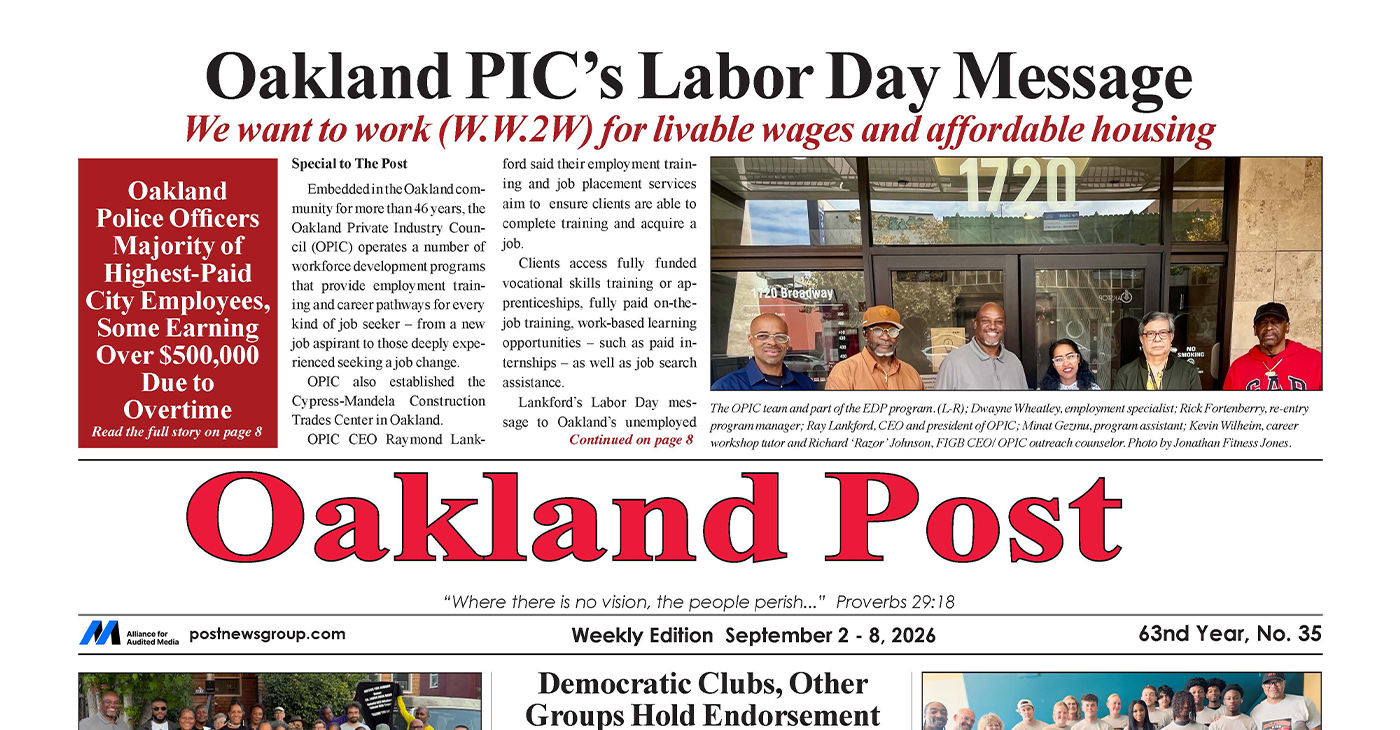
To enlarge your view of this issue, use the slider, magnifying glass icon or full page icon in the lower right corner of the browser window.



Doulas Are Helping Black California Moms Navigate Pregnancy–Even as High Mortality Rates Persist

Newsom Signs Addictive Social Media Law to Protect Kids

On Your November Ballot: Prop 38 Would Allocate $8.4 Billion to Immunology and Immunotherapy Funding

Ask California: Golden State Releases New AI Chatbot

Asm. Isaac Bryan’s Bill Banning California Police From ICE Side Jobs Reaches Newsom’s Desk

Assemblymember LaShae Sharp-Collins’s Bill Would Pause Law Enforcement’s Use of Shock Gloves Pending Study

BOOK REVIEW: ‘Laws of Solomon’ Reveals Tender Heart of Former Child Soldier

OPINION: The New American Fear – From 9-11 to AI

Passing for White, Fighting for Black America: The Courage of Walter White

Oakland People’s Arms Embargo Coalition Demands End to Military Shipments Thru Oakland

Barbara Lee Mourns Gloria Steinem, Remembers a Friendship Rooted in Equality

Event Preview: ‘Fashion v. Fascism’ – A Runway Revolution Is Coming to the Bay Area

Two Looming Threats Every Alameda County Elder Should Know About

Oakland Mayor Reads to Children at Bookout Block Party at Marcus Books Store

Tradition Comes to the Streets in 11th Annual Black-Eyed Pea Festival at the Freedom Farmers Market

Less Affluent School Districts, Including Sacramento City, Face Threat of State Takeover

ESSAY: California Can Close Its Colorectal Cancer Gap

California Hispanic Chambers of Commerce Unveils: ‘Powering the Future’ Theme for 47th Annual Statewide Convention

Four Candidates, Including Incumbent Barbara Lee, Qualify for Oakland Mayor’s Race

Oakland Post: Week of August 12 – 18, 2026

From Blueprint to Breakthrough: Tackling Affordable Housing in Oakland

Oakland Observes Black August with Block Parties, Film Showings, Workshops

COMMENTARY: Why Local School Tax Measure G1 Will Not Be on the November Ballot

Standoff for Justice: Our Homes Are Worth Fighting For

Returning to Its Roots, the Oakland Black-Eyed Pea Festival Partners with the Freedom Farmers Market Sept. 12

NPRC Scores First Advocacy Victory: David Shaw Finally Gets His Wish to ‘Go Home’

Oakland Post: Week of August 26 – September 1, 2026

Frontier Airlines’ Return to Oakland Airport Brings Flights, Jobs and Opportunity

Gubernatorial Candidate Steve Hilton Blasts California New Tire Rules; Newsom Hits Back

Chef Sharon Lee Blends Culinary Excellence, Education and Empowerment

The Conversation With Al McFarlane 6/23/26

Media Monday 6/22/26

LIVE! ASK ALMA! — TUES. 6.23.26 7PM EST

Car Buying Secrets: 4 Hidden Checks Before You Sign!

Is This 550 HP Charger Worth YOUR Money? AutoNetwork Review

Celebrating Juneteenth – Frederick Douglass on education and resistance

LIVE! — ASK ALMA! — TUES. 6.19.26 7PM EST

Hyundai Ioniq 5 Parking, Safety, and 360 View #shorts

2025 Ioniq 5 New Wiper & Powerful Performance! #shorts

Electric SUV Range: Is 259 Miles Enough? #shorts

EV Charging: How Fast Can You Charge an Electric Vehicle? #shorts

Biometric Cooling… Messaging Seats…Come on! 2025 Infiniti QX80 Autograph 4WD

Charged Up: Witness the Magic of a Fully Electric Car! #shorts

Range Rover Sport PHEV Included…: See What’s Inside This Luxury SUV! #shorts

Invisible Hood View: Perfect Parking with X-Ray Vision! #shorts
-
 Commentary4 weeks ago
Standoff for Justice: Our Homes Are Worth Fighting For
-
 Activism4 weeks ago
Oakland Post: Week of August 26 – September 1, 2026
-
 Business4 weeks ago
Frontier Airlines’ Return to Oakland Airport Brings Flights, Jobs and Opportunity
-
 Business4 weeks ago
Gubernatorial Candidate Steve Hilton Blasts California New Tire Rules; Newsom Hits Back
-
 Business4 weeks ago
Chef Sharon Lee Blends Culinary Excellence, Education and Empowerment
-

 Education4 weeks ago
Gov. Newsom’s Latest Appointees Include Sacramento Advocate for Formerly Incarcerated Students; State’s New Tech Chief
-

 Community4 weeks ago
Big City Mayors Ask for “Yes” Vote on Housing Bond Measure; Conservatives Say “No”
-

 Business4 weeks ago
Oakland Coliseum Project Opens Door for Small Businesses to Build Bigger
