
Activism
We Fought on Opposite Sides of the Sheng Thao Recall. Here’s Why We’re Uniting Behind Barbara Lee for Oakland Mayor
Today, we are coming together to do all we can to make sure Barbara Lee is elected Mayor in the April 15 Oakland special election. Here’s why. Now more than ever, Oakland needs a respected, hands-on leader who will unite residents behind a clear vision for change. The next mayor will have to hit the ground running with leaders and stakeholders across our political divide to get to work solving the problems standing in the way of Oakland’s progress. Job No. 1: improving public safety. Everyone agrees that all Oaklanders deserve to feel safe in their neighborhoods. But sadly, too many of us do not.


By Robert Harris and Richard Fuentes
Special to The Post
The City of Oakland is facing a number of urgent challenges, from housing and public safety to a pressing need for jobs and economic development. One of us, Robert Harris, supported the November recall vote that removed Mayor Sheng Thao from office. Meanwhile, Richard Fuentes believed the recall was the wrong strategy to tackle Oakland’s challenges.
Today, we are coming together to do all we can to make sure Barbara Lee is elected Mayor in the April 15 Oakland special election. Here’s why.
Now more than ever, Oakland needs a respected, hands-on leader who will unite residents behind a clear vision for change.
The next mayor will have to hit the ground running with leaders and stakeholders across our political divide to get to work solving the problems standing in the way of Oakland’s progress.
Job No. 1: improving public safety. Everyone agrees that all Oaklanders deserve to feel safe in their neighborhoods. But sadly, too many of us do not.

During her three decades in the state Legislature and Congress, Lee made public safety a priority, securing funding for police and firefighters in Oakland, delivering $15.8 million in community safety funding, and more. Today, she has a plan for making Oakland safer. It starts with making sure police are resourced, ready, and on patrol to stop the most dangerous criminals on our streets.
Oakland residents and business owners are feeling the impact of too many assaults, smash/grabs, retail thefts, and home robberies. Lee will increase the number of police on the streets, make sure they are focused on the biggest threats, and invest in violence prevention and proven alternatives that prevent crime and violence in the first place.
In addition, on day one, Barbara Lee will focus on Oakland’s business community, creating an advisory cabinet of business owners and pushing to ensure Oakland can attract and keep businesses of all sizes.
The other top issue facing Oakland is housing and homelessness. As of May 2024, over 5,500 people were unhoused in the city. Oaklanders are just 25% of the population of Alameda County, but the city has 57% of the unhoused population.
Unhoused people include seniors, veterans, single women, women with children, people who suffer physical and mental illness, unemployed and undereducated people, and individuals addicted to drugs. Some are students under 18 living on the streets without their parents or a guardian. Research shows that 53% of Oakland’s homeless population is Black.
Starting on her first day in office, Lee will use her national profile and experience to bring new resources to the city to reduce homelessness and expand affordable housing. And she will forge new public/private partnerships and collaboration between the City, Alameda County, other public agencies, and local nonprofits to ensure that Oakland gets its fair share of resources for everything from supportive services to affordable housing.
Besides a public safety and housing crisis, Oakland has a reputational crisis at hand. Too many people locally and nationally believe Oakland does not have the ability to tackle its problems.
Lee has the national reputation and the relationships she can use to assert a new narrative about our beloved Oakland – a vibrant, diverse, and culturally rich city with a deep history of activism and innovation.
Everyone remembers how Lee stood up for Oakland values as the only member of Congress not to authorize the disastrous Iraq War in 2001. She has led the fight in Congress for ethics reform and changes to the nation’s pay-to-play campaign finance laws.
Lee stands alone among the candidates for mayor as a longtime champion of honest, transparent, and accountable government—and she has the reputation and the skills to lead an Oakland transformation that puts people first.
The past few years have been a trying period for our hometown.
Robert Harris supported the recall because of Thao’s decision to fire LeRonne Armstrong; her refusal to meet with certain organizations, such as the Oakland Branch of the NAACP; and the city missing the deadline for filing for a state grant to deal with serious retail thefts in Oakland.
Richard Fuentes opposed the recall, believing that Oakland was making progress in reducing crime. The voters have had their say; now, it is time for us to move forward together and turn the page to a new era.
The two of us don’t agree on everything, but we agree on this: the next few years will be safer, stronger, and more prosperous if Oaklanders elect Barbara Lee as our next mayor on April 15.
Robert Harris is a retired attorney at PG&E and former legal counsel for NAACP.
Richard Fuentes is co-owner of FLUID510 and chair of the Political Action Committee, American Federation of State, County, and Municipal Employees (AFSCME) Council 57.













Activism
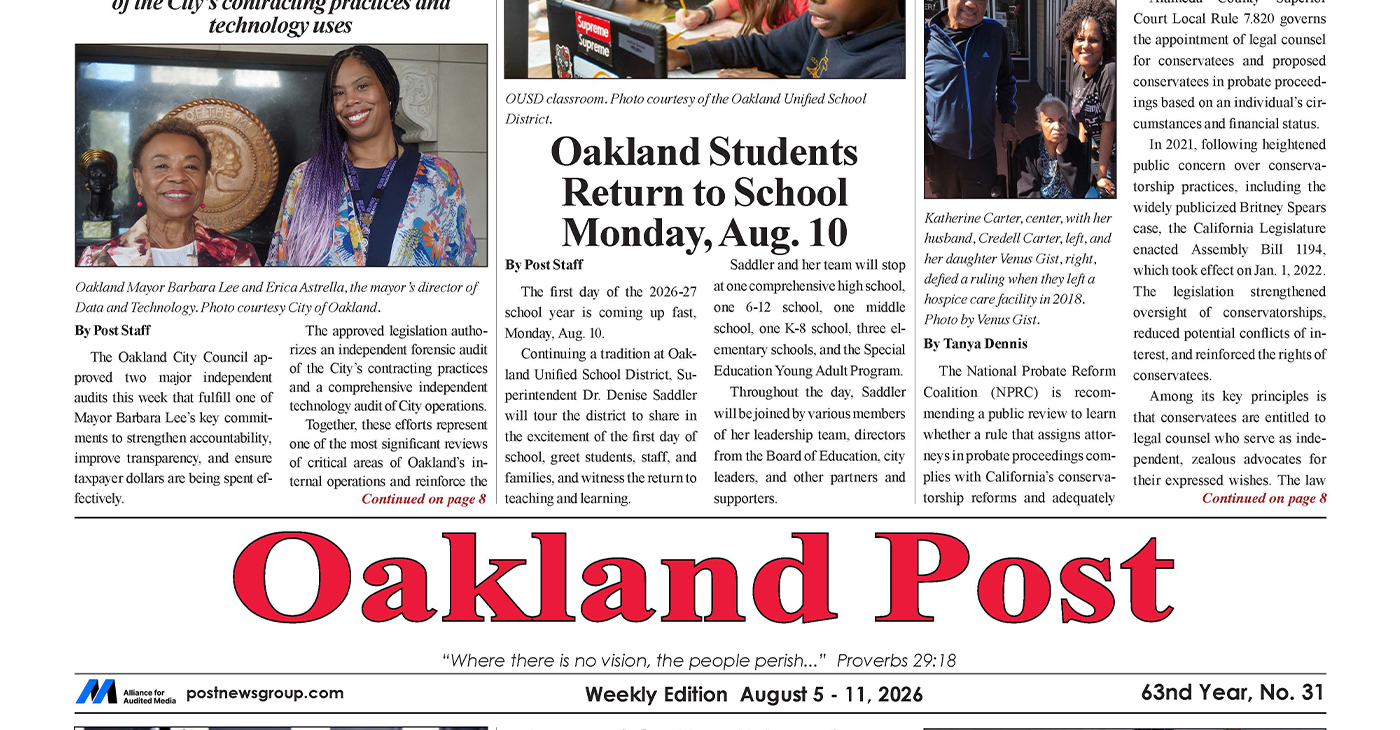
Oakland Post: Week of August 5 – 11, 2026
The printed Weekly Edition of the Oakland Post: Week of August 5 – 11, 2026
To enlarge your view of this issue, use the slider, magnifying glass icon or full page icon in the lower right corner of the browser window.
Activism
Oakland Post: Week of July 29 – August 4, 2026
The printed Weekly Edition of the Oakland Post: Week of July 29 – August 4, 2026

To enlarge your view of this issue, use the slider, magnifying glass icon or full page icon in the lower right corner of the browser window.
Activism
Oakland Post: Week of July 22 – 28, 2026
The printed Weekly Edition of the Oakland Post: Week of July 22 – 28, 2026

To enlarge your view of this issue, use the slider, magnifying glass icon or full page icon in the lower right corner of the browser window.

WORK FROM HOME
Home-based business with potential monthly income of $10K+ per month. A proven training system and website provided to maximize business effectiveness. Perfect job to earn side and primary income. Contact Lynne for more details: Lynne4npusa@gmail.com 800-334-0540


Misty Copeland Shapes Ballet’s Tomorrow

As Part of Your Back-to- School Checklist, Vaccinate

As Part of Your Back-to- School Checklist, Vaccinate

Congresswoman Simon Demands Investigation into Trump’s Abuse of Emergency Powers for Coal Export Terminal in West Oakland

OPINION: The Philippines Isn’t Foreign When Your Family Still Lives There

Asm. McKinnor’s Bill Banning Drones Above Outdoor Entertainment Events Awaits Senate Decision

California Sen. Padilla Joins Colleagues to Introduce Bill Imposing Term Limits on Supreme Court Justices

Department of Homeland Security Demands California Secretary of State Shirley N. Weber Scrub Voter Rolls

George Cook: The Inventor Who Made Fishing Smarter

Gov. Newsom Announces $109.6 Million in Funding for 278 Supportive Homes in Bakersfield, Contra Costa, Sacramento and Fresno

Rep. Kamlager Dove Demands Care, Justice for Man Shot by ICE

“The Power to See Threats Sooner”: Gov. Newsom, Safety Officials Showcase California’s Investments in Hi-Tech Wildfire Prevention

100 Black Wings’ Team Oakland Youth Athletes Heading to Taiwan for 2026 International Children’s Games

Oakland ‘Port Serves as a Powerful Engine for Good Jobs and Economic Development

Oakland Faith Leaders Welcome New Police Chief, Mobilize Around Housing and Civic Action
Department of Homeland Security Demands California Secretary of State Shirley N. Weber Scrub Voter Rolls

Oakland Children’s Hospital Workers and Patients Rally for Pediatric Medical Care
“The Power to See Threats Sooner”: Gov. Newsom, Safety Officials Showcase California’s Investments in Hi-Tech Wildfire Prevention

New Judge Could Decide if Karmelo Anthony Gets a New Trial

Surveillance Pricing Fight: State Senate Debates Bill Banning Retailers from Using AI to Set Prices Based on a Buyer’s Profile

Mount Zion MBC, Church of Jesus Christ of Latter-day Saints Partner to Bring 29,000 Meals to Alameda County

Alpha Kappa Alpha Sorority, Inc. Celebrates New North Atlantic Regional Director
California Sen. Padilla Joins Colleagues to Introduce Bill Imposing Term Limits on Supreme Court Justices

Starting This Summer, California Car Buyers Can Get an Instant $3500 Off the Cost of Electric Vehicles

COMMENTARY: You Are Already Paying for the AI Boom

California Bill Would Let Abuse Victims Use Trauma as Legal Defense for Violent Crime

Fed Court to Decide Landmark First Amendment Case

Gov. Gavin Newsom Signs Law Streamlining Affordable Housing Rules

Oakland Celebrates $125 Million Coliseum Sale

Saving Black Mothers Starts Outside the Hospital

The Conversation With Al McFarlane 6/23/26

Media Monday 6/22/26

LIVE! ASK ALMA! — TUES. 6.23.26 7PM EST

Car Buying Secrets: 4 Hidden Checks Before You Sign!

Is This 550 HP Charger Worth YOUR Money? AutoNetwork Review

Celebrating Juneteenth – Frederick Douglass on education and resistance

LIVE! — ASK ALMA! — TUES. 6.19.26 7PM EST

Hyundai Ioniq 5 Parking, Safety, and 360 View #shorts

2025 Ioniq 5 New Wiper & Powerful Performance! #shorts

Electric SUV Range: Is 259 Miles Enough? #shorts

EV Charging: How Fast Can You Charge an Electric Vehicle? #shorts

Biometric Cooling… Messaging Seats…Come on! 2025 Infiniti QX80 Autograph 4WD

Charged Up: Witness the Magic of a Fully Electric Car! #shorts

Range Rover Sport PHEV Included…: See What’s Inside This Luxury SUV! #shorts

Invisible Hood View: Perfect Parking with X-Ray Vision! #shorts
-
 Featured3 days ago
Department of Homeland Security Demands California Secretary of State Shirley N. Weber Scrub Voter Rolls
-
 Business2 weeks ago
Oakland Children’s Hospital Workers and Patients Rally for Pediatric Medical Care
-
 Environment3 days ago
“The Power to See Threats Sooner”: Gov. Newsom, Safety Officials Showcase California’s Investments in Hi-Tech Wildfire Prevention
-
 #NNPA BlackPress2 weeks ago
New Judge Could Decide if Karmelo Anthony Gets a New Trial
-
 Business2 weeks ago
Surveillance Pricing Fight: State Senate Debates Bill Banning Retailers from Using AI to Set Prices Based on a Buyer’s Profile
-
 Business2 weeks ago
Mount Zion MBC, Church of Jesus Christ of Latter-day Saints Partner to Bring 29,000 Meals to Alameda County
-
 Black History1 week ago
Alpha Kappa Alpha Sorority, Inc. Celebrates New North Atlantic Regional Director
-
 Featured3 days ago
California Sen. Padilla Joins Colleagues to Introduce Bill Imposing Term Limits on Supreme Court Justices
