
Activism
Town Nights Events for Oakland Families Living in Violent Hot Spots
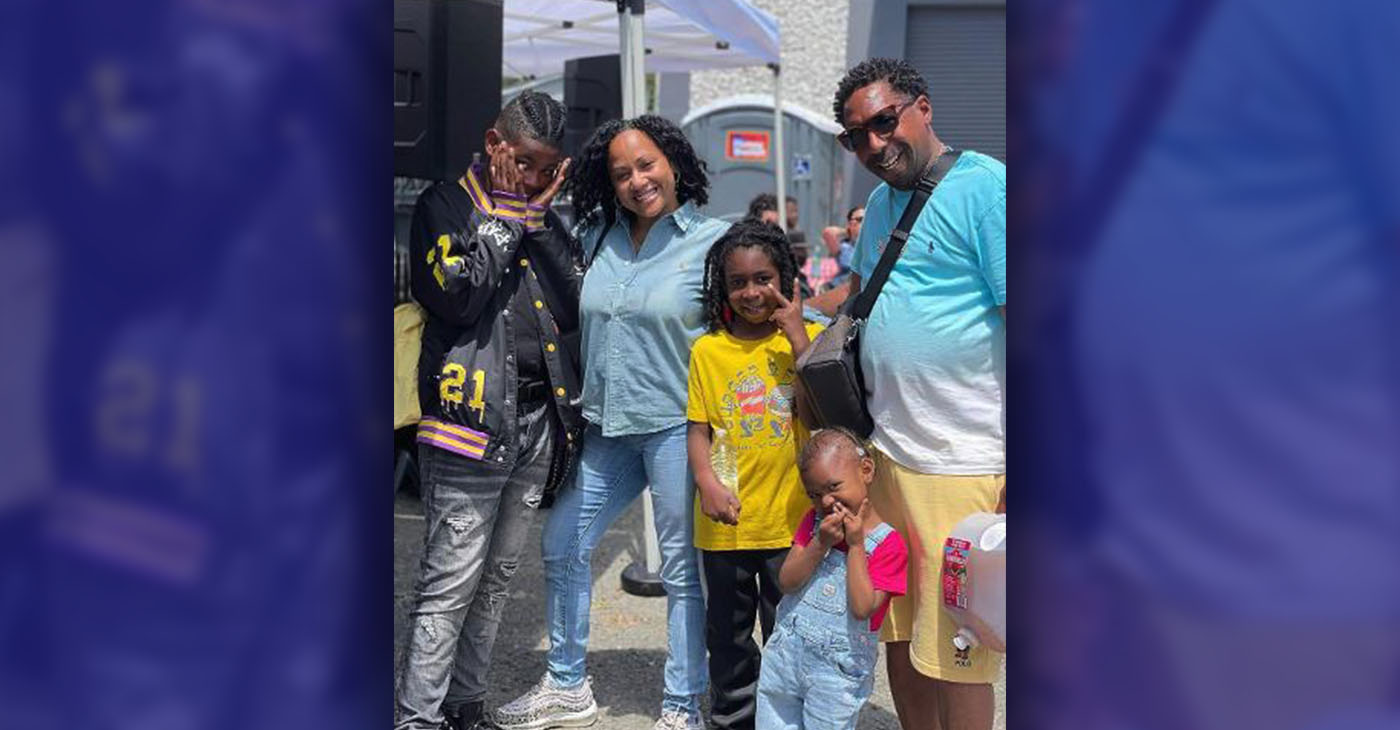
Adamika Village founder Daryle Allums explains why their Town Nights event at Sunnyside Park is unique and different. “Adamika Village is a victim-led organization, so everything we do is in honor of loved ones lost to violence or to honor their families,” Allums said. Last winter, their event was hosted at Castlemont High School, and paid tribute to Michael Franklin, Castlemont’s star basketball forward who lost his life in a double-homicide on Edes and 90th Avenue in 2018. They dubbed the school, whose mascot is the knight, “Mike’s Knight’s.”

By Tanya Dennis
Oakland’s Department of Violence Prevention (DVP) is sponsoring a second round of Town Nights events beginning June 16 throughout the city of Oakland to support community and family-oriented activities in areas that have been identified as hot spots for violence. Town Nights’ successful outreach began last November, kicked off with free turkey dinner giveaways, basketball tournaments, COVID-19 services and much more.
The mission of the DVP is to decrease violence in specific communities that have been identified as hot spots in Oakland. The events are hosted by grassroots community organizations.
Adamika Village founder Daryle Allums explains why their Town Nights event at Sunnyside Park is unique and different. “Adamika Village is a victim-led organization, so everything we do is in honor of loved ones lost to violence or to honor their families,” Allums said. Last winter, their event was hosted at Castlemont High School, and paid tribute to Michael Franklin, Castlemont’s star basketball forward who lost his life in a double-homicide on Edes and 90th Avenue in 2018. They dubbed the school, whose mascot is the knight, “Mike’s Knight’s.”
This year, Allums says, “I chose Bernice Carter Park, also known as Sunnyside Park, because this is the place I sold my first piece of crack. I’m back to build up what I destroyed and tore down.”

Allums has orchestrated beautification and restoration of Sunnyside Park in anticipation of the four weeks of activities. “We’re replacing basketball rims, weeding the community garden that now has weeds 8 feet high, we’re painting over graffiti, and giving stipends to the community to assist us [in cleaning] out the sand box on the 15th [of June] from 12 p.m. – 5 p.m. I’m going back to my community to clean it up because I left a toxic residue,” Allums said.
The Sunnyside Park Town Nights event is unique from the others, Allums says, because they plan to give away cash money and prizes. “We are asking people to dress in African attire, and we’re giving away free dashikis to the first twenty people that come.”
Each night will begin with what Allums terms the “African Way,” with a blessing of the park and activities with libation, African dancers and drummers. Games and activities will feature the city’s biggest obstacle course for “Wipe Out” with Whipple balls and water guns, with one winner walking away with a $100 prize. Double Dutch, dance contests and a DJ challenge are other activities participants can look forward to. Red, black and green liberation peace flags will be mounted at each corner of the park and Adamika Villages’ Credible Messengers will patrol for safety.
The main attraction of each Town Nights event will be a basketball tournament with people bringing their five-on-five team for a chance to win $1,000, winner take all. Free food will be provided by Amazing Bar Be Cue, a group comprising mothers and fathers that have lost their children to community violence. Town Nights are from 6 p.m. – 10 p.m. and will be hosted four consecutive Fridays, June 17, June 24, July 1 and July 8.
Allums, in reflection, shared that, “at Town Nights, we honor our lost loved ones. Last year it was Michael Franklin. This year, Evry Season Town Nights is in honor of my son, Keandre Allums. Sunnyside Park is where he grew up at, this was his safe place because everybody knew him. He was little D.”










Activism
Oakland Post: Week of September 30 – October 6, 2026
The printed Weekly Edition of the Oakland Post: Week of September 30 – October 6, 2026
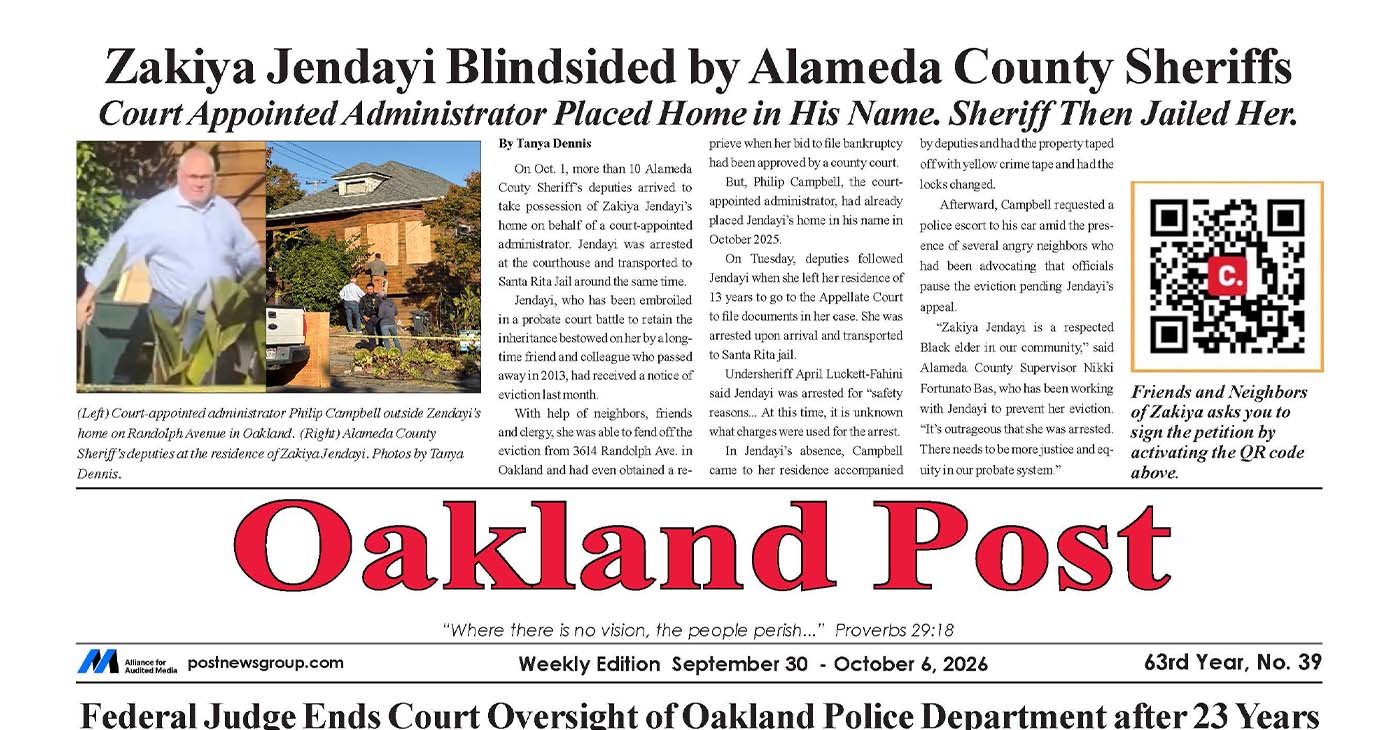
To enlarge your view of this issue, use the slider, magnifying glass icon or full page icon in the lower right corner of the browser window.
Activism
Oakland Post: Week of September 23 – 29, 2026
The printed Weekly Edition of the Oakland Post: Week of September 23 – 29, 2026

To enlarge your view of this issue, use the slider, magnifying glass icon or full page icon in the lower right corner of the browser window.
Activism
Oakland Post: Week of September 16 – 22, 2026
The printed Weekly Edition of the Oakland Post: Week of September 16 – 22, 2026

To enlarge your view of this issue, use the slider, magnifying glass icon or full page icon in the lower right corner of the browser window.



OP-ED: Proposition 44 Would Put a Price on Trust

OP-ED: Proposition 40: It’s Time to Play Chess, Not Checkers

Listening as a Lifeline: A Doula’s Witness to Black Maternal Health

New Protections for Ticket Buyers: Gov. Newsom Signs Assemblymember Isaac Bryan’s Bill

‘We Don’t Talk Trash — We Pick Up Trash!’

Zakiya Jendayi Arrested, Locked Out of Home by Sheriff’s Deputies

Oakland Post: Week of September 30 – October 6, 2026

Asm. Corey Jackson Announces Launch of 24-Hour Childcare in His District

IN MEMORIAM: The Rev. Leon “Sonny” Clark, Longtime Orange County Pastor and Community Leader, Dies at 72

Poll: Becerra Widens His Lead Over Hilton; Californians Split on Wealth Tax

From Historic Memories to New Possibilities: Oakland Celebrates Coliseum 60

County Office of Education Says OUSD Finances Are Getting Healthier, Materially Stronger

LIVE FREE Sunday Dinner Brings Faith, Fellowship and Civic Conversation to Oakland

Remembering Chauncey Bailey as Student Journalists Face Threats to Truth-Telling

BLACspace Cooperative Invites Bay Area to Experience Oakland’s Black Cultural Ecosystem Through a BLAC Map Tour + Party

Standoff for Justice: Our Homes Are Worth Fighting For

Oakland Post: Week of August 26 – September 1, 2026

Frontier Airlines’ Return to Oakland Airport Brings Flights, Jobs and Opportunity

Gubernatorial Candidate Steve Hilton Blasts California New Tire Rules; Newsom Hits Back

Chef Sharon Lee Blends Culinary Excellence, Education and Empowerment

Jackie Wright Champions Bay Area Stories, Filmmakers and Cultural Institutions

Misnamed ‘Parent’ PAC Seeks to Influence Oakland School Board Elections

Oakland Coliseum Project Opens Door for Small Businesses to Build Bigger

Gov. Newsom’s Latest Appointees Include Sacramento Advocate for Formerly Incarcerated Students; State’s New Tech Chief

Big City Mayors Ask for “Yes” Vote on Housing Bond Measure; Conservatives Say “No”

Longtime BWOPA Member Brendalyn Goodall Appointed to California Workforce Development Board

Oakland Post: Week of September 2 – 8, 2026

Gov. Newsom Signs Law Shielding Immigration Aid Workers From Doxing Threats

Secretary of State Shirley N. Weber Urges Californians to Vote Early as Voter ID Battle Intensifies

IN MEMORIAM: Dolly Parton Dead at 80 — How She Built a Legacy of Love and Earned Her Place in Black Culture

The Conversation With Al McFarlane 6/23/26

Media Monday 6/22/26

LIVE! ASK ALMA! — TUES. 6.23.26 7PM EST

Car Buying Secrets: 4 Hidden Checks Before You Sign!

Is This 550 HP Charger Worth YOUR Money? AutoNetwork Review

Celebrating Juneteenth – Frederick Douglass on education and resistance

LIVE! — ASK ALMA! — TUES. 6.19.26 7PM EST

Hyundai Ioniq 5 Parking, Safety, and 360 View #shorts

2025 Ioniq 5 New Wiper & Powerful Performance! #shorts

Electric SUV Range: Is 259 Miles Enough? #shorts

EV Charging: How Fast Can You Charge an Electric Vehicle? #shorts

Biometric Cooling… Messaging Seats…Come on! 2025 Infiniti QX80 Autograph 4WD

Charged Up: Witness the Magic of a Fully Electric Car! #shorts

Range Rover Sport PHEV Included…: See What’s Inside This Luxury SUV! #shorts

Invisible Hood View: Perfect Parking with X-Ray Vision! #shorts
-
 Community4 weeks ago
Misnamed ‘Parent’ PAC Seeks to Influence Oakland School Board Elections
-

 Activism4 weeks ago
Oakland Post: Week of September 9 – 15, 2026
-

 Community4 weeks ago
Richmond Tiny House Village Farm & Garden Set to Open Gates on Sept. 26
-

 Black History4 weeks ago
Latest Massacre in Haiti Reveals Cruelty U.S. Deportations
-

 Black History4 weeks ago
OPINION: Nolan Wells’ Death One of Several Signifying Racial Terror Lives on in U.S. South
-

 Business3 weeks ago
Mayor Lee Announces $1 Million Kaiser Permanente Grant for Pilot Program to Address Homelessness, Clean Up Public Spaces throughout Oakland
-

 Community4 weeks ago
Democratic Clubs Interview Candidates for Oakland School Board
-
 Uncategorized2 weeks ago
Oakland People’s Arms Embargo Coalition Demands End to Military Shipments Thru Oakland
