
Bay Area
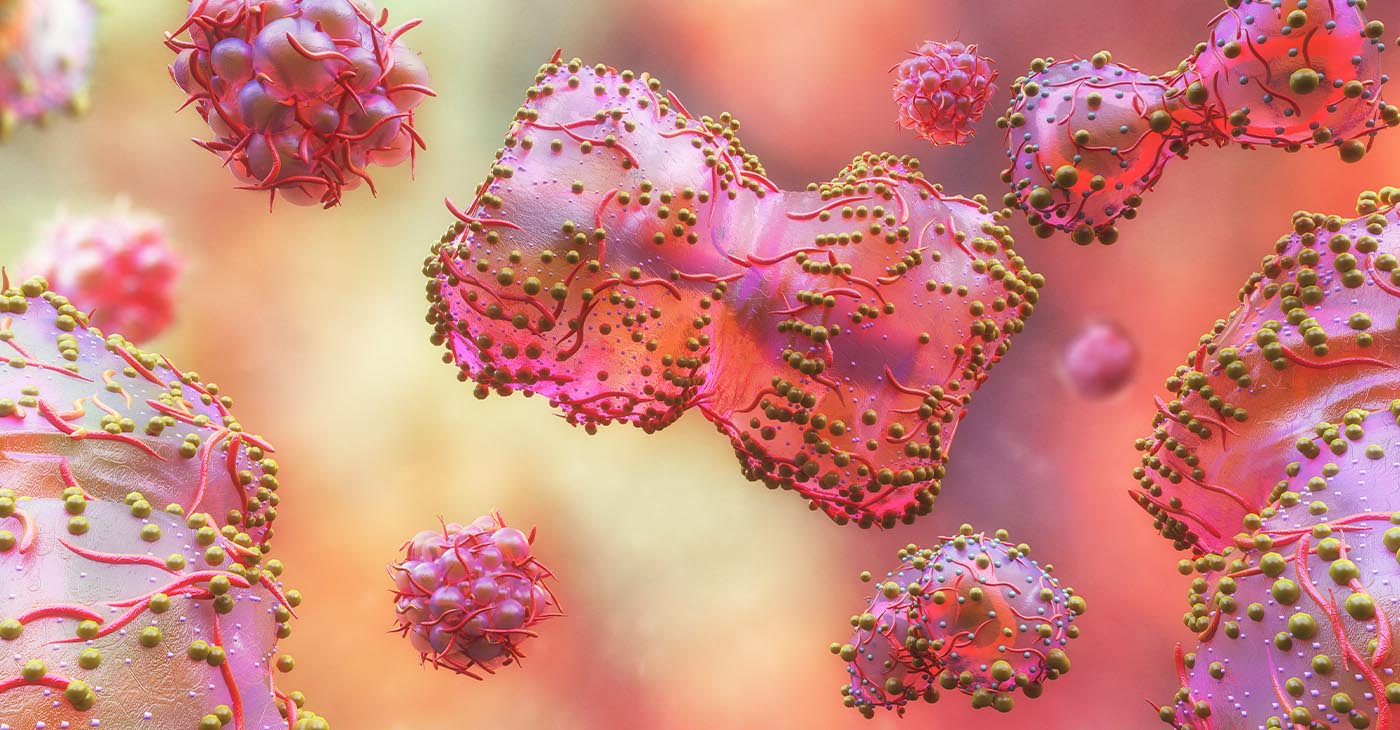
The Monkeypox Health Crisis: How California Is Responding
“Over 99% of people who get this form of the disease are likely to survive. However, people with weakened immune systems, children under 8 years of age, people with a history of eczema, and people who are pregnant or breastfeeding may be more likely to get seriously ill or die,” the CDC reports.

By Tanu Henry | California Black Media
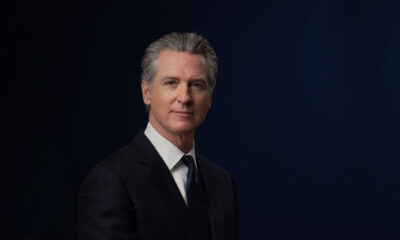
As the monkeypox virus outbreak spreads around the globe, Gov. Gavin Newsom says California will need to galvanize forces across regions and relax some state regulations and statutes to combat a disease that poses a threat greater than local authorities may be able to respond to effectively.
“California is working urgently across all levels of government to slow the spread of monkeypox, leveraging our robust testing, contact tracing and community partnerships strengthened during the pandemic to ensure that those most at risk are our focus for vaccines, treatment and outreach,” the governor said August 1 as he declared a State of Emergency in California.
The California Department of Public Health (CDPH) has begun to collect and report racial and other demographic data, tracking how the disease is impacting various groups across the state.
The Governor’s State of Emergency follows similar actions taken in San Francisco, New York City, and Illinois. On July 23, the World Health Organization declared monkeypox a “public health emergency.”
On August 4, the federal government also declared monkeypox a national public health emergency.
“We are prepared to take our response to the next level in addressing this virus and we urge every American to take monkeypox seriously,” said U.S. Health and Human Services Secretary and former California Attorney General Xavier Becerra.

CDPH Director and State Public Health Officer Dr. Tomás J. Aragón says he welcomes the federal health emergency because it opens up channels for California to get more access to resources to slow the spread of the disease.
“We hope today’s action injects additional federal funding and resources into our collective response efforts. The state remains focused on slowing the spread of the virus in impacted communities, administering the limited number of vaccine doses we have, and raising awareness about prevention measures and access to treatment,” Aragón said, before adding that California is “well-positioned” to tackle the outbreak.
Although monkeypox is not considered deadly, the disease can be fatal for some categories of people, according to public health authorities. Symptoms of the disease — lesions and blisters — can be extremely painful in some cases as well.
“Over 99% of people who get this form of the disease are likely to survive. However, people with weakened immune systems, children under 8 years of age, people with a history of eczema, and people who are pregnant or breastfeeding may be more likely to get seriously ill or die,” the CDC reports.
According to the governor’s office, CDPH has taken a number of steps to expand access to vaccinations and the state has launched a public information campaign, mostly relying on webinars and town hall meetings to get information about monkeypox out to people across the state.
“CDPH is also expanding treatment options. Access to the antiviral prescription drug tecovirimat (Tpoxx) used to treat monkeypox is limited, but the treatment can now be administered at more than 30 facilities and providers across the state,” a press release issued by Newsom’s office states.
As of August 2, the state had distributed nearly 1,713 treatment courses and 168 IV doses of tecovirimat to health centers in various locations across the state.
So far, CDPH has received a little over 109,000 monkeypox vaccines – of which 51,000 doses have been distributed to local health departments across the state.
Among Black Californians, there have been 129 cases reported so far, accounting for about 11% of all confirmed cases in the state. African Americans make up about 6.5% of the state’s total population.
As of August 5, CDPH reports that there have been 1,310 confirmed cases of monkeypox in the state with the most confirmed cases being reported in Los Angeles (431) followed by San Francisco (398) and Alameda County (83). There have been 7,509 confirmed cases in the United States and 28,220 around the world.
Shortly after the governor declared a State of Emergency, Shane Harris of the Peoples Association of Justice Activists, a San Diego-based advocacy group, called on San Diego County officials to release demographic data on monkeypox cases there.
“The governor has declared a State of Emergency as of last night and constituents deserve to know the truth about this virus in our region,” said Harris speaking at a press conference. “My office led this argument during COVID that we needed more demographic data, and the county’s response is that we did not have enough cases at that time. I want them to know that that response will not work this time. There is never too few of cases.”
At the state level, the CDPH has begun to disaggregate the Monkeypox data it is collecting by race, city, hospitalizations, gender, age and sexual orientation.
The age group with the highest number of reported monkeypox cases (482) are 25-to-34-year-olds, who make up about 36.8 % of all confirmed infections in California.
“We’ll continue to work with the federal government to secure more vaccines, raise awareness about reducing risk, and stand with the LGBTQ community fighting stigmatization,” Newsom added.
Aragón echoed the governor’s statement.
“Our team is also committed to reducing stigma among the LGBTQ community, which has been singled out and treated unfairly because of this outbreak. No single individual or community is to blame for the spread of any virus,” Aragón reinforced.
When it comes to race, Harris said it is important to approach the containment and treatment of monkeypox with the same “perspective and passion” that characterized the state government’s response during the COVID-19 pandemic.
“Race and ethnicity were very important during COVID because we studied the very impact of cultural competency pertaining to COVID – how different communities dealt with it. It is still significantly important today,” Harris emphasized.











Activism
Oakland Post: Week of September 16 – 22, 2026
The printed Weekly Edition of the Oakland Post: Week of September 16 – 22, 2026

To enlarge your view of this issue, use the slider, magnifying glass icon or full page icon in the lower right corner of the browser window.
Activism
Oakland Post: Week of September 9 – 15, 2026
The printed Weekly Edition of the Oakland Post: Week of September 9 – 15, 2026

To enlarge your view of this issue, use the slider, magnifying glass icon or full page icon in the lower right corner of the browser window.
Activism
Oakland Post: Week of September 2 – 8, 2026
The printed Weekly Edition of the Oakland Post: Week of September 2 – 8, 2026
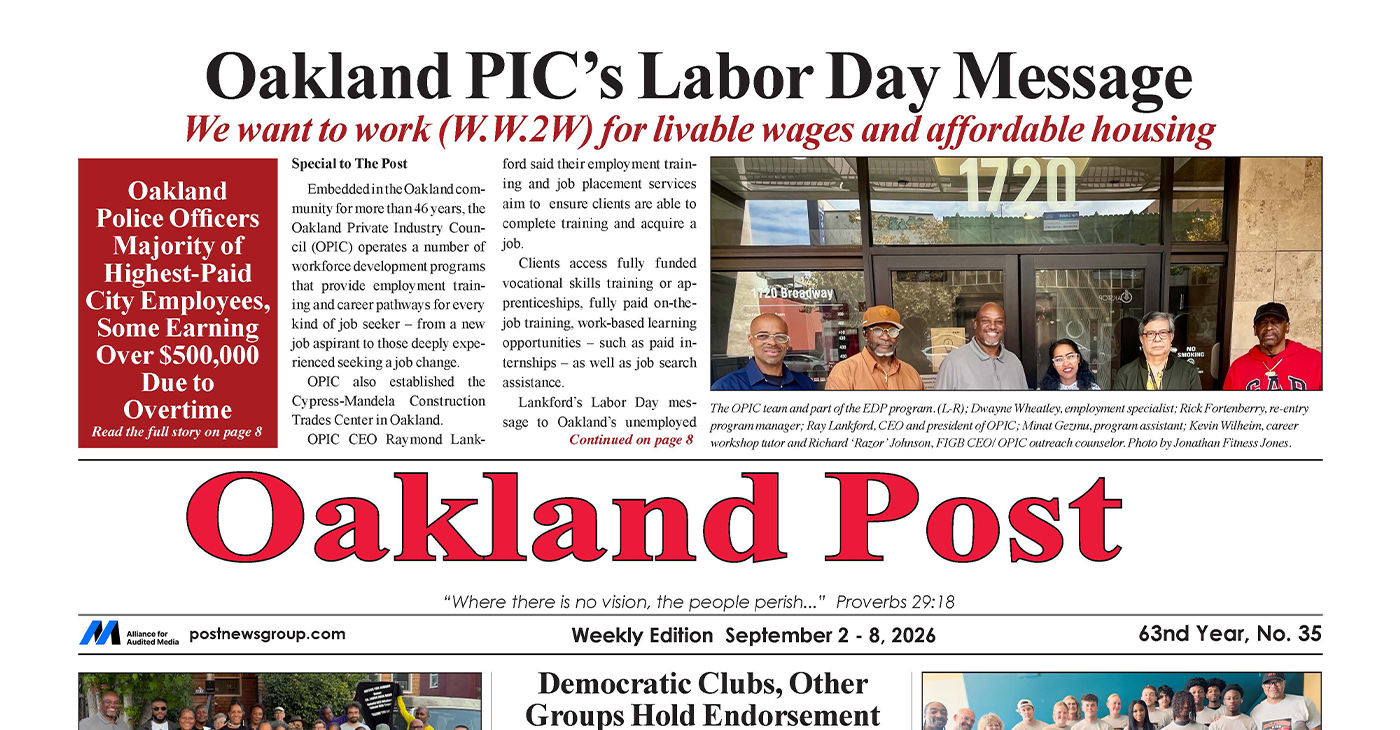
To enlarge your view of this issue, use the slider, magnifying glass icon or full page icon in the lower right corner of the browser window.



Doulas Are Helping Black California Moms Navigate Pregnancy–Even as High Mortality Rates Persist

Newsom Signs Addictive Social Media Law to Protect Kids

On Your November Ballot: Prop 38 Would Allocate $8.4 Billion to Immunology and Immunotherapy Funding

Ask California: Golden State Releases New AI Chatbot

Asm. Isaac Bryan’s Bill Banning California Police From ICE Side Jobs Reaches Newsom’s Desk

Assemblymember LaShae Sharp-Collins’s Bill Would Pause Law Enforcement’s Use of Shock Gloves Pending Study

BOOK REVIEW: ‘Laws of Solomon’ Reveals Tender Heart of Former Child Soldier

OPINION: The New American Fear – From 9-11 to AI

Passing for White, Fighting for Black America: The Courage of Walter White

Oakland People’s Arms Embargo Coalition Demands End to Military Shipments Thru Oakland

Barbara Lee Mourns Gloria Steinem, Remembers a Friendship Rooted in Equality

Event Preview: ‘Fashion v. Fascism’ – A Runway Revolution Is Coming to the Bay Area

Two Looming Threats Every Alameda County Elder Should Know About

Oakland Mayor Reads to Children at Bookout Block Party at Marcus Books Store

Tradition Comes to the Streets in 11th Annual Black-Eyed Pea Festival at the Freedom Farmers Market

Less Affluent School Districts, Including Sacramento City, Face Threat of State Takeover

ESSAY: California Can Close Its Colorectal Cancer Gap

California Hispanic Chambers of Commerce Unveils: ‘Powering the Future’ Theme for 47th Annual Statewide Convention

Four Candidates, Including Incumbent Barbara Lee, Qualify for Oakland Mayor’s Race

Oakland Post: Week of August 12 – 18, 2026

From Blueprint to Breakthrough: Tackling Affordable Housing in Oakland

Oakland Observes Black August with Block Parties, Film Showings, Workshops

COMMENTARY: Why Local School Tax Measure G1 Will Not Be on the November Ballot

Standoff for Justice: Our Homes Are Worth Fighting For

Returning to Its Roots, the Oakland Black-Eyed Pea Festival Partners with the Freedom Farmers Market Sept. 12

NPRC Scores First Advocacy Victory: David Shaw Finally Gets His Wish to ‘Go Home’

Oakland Post: Week of August 26 – September 1, 2026

Frontier Airlines’ Return to Oakland Airport Brings Flights, Jobs and Opportunity

Gubernatorial Candidate Steve Hilton Blasts California New Tire Rules; Newsom Hits Back

Chef Sharon Lee Blends Culinary Excellence, Education and Empowerment

The Conversation With Al McFarlane 6/23/26

Media Monday 6/22/26

LIVE! ASK ALMA! — TUES. 6.23.26 7PM EST

Car Buying Secrets: 4 Hidden Checks Before You Sign!

Is This 550 HP Charger Worth YOUR Money? AutoNetwork Review

Celebrating Juneteenth – Frederick Douglass on education and resistance

LIVE! — ASK ALMA! — TUES. 6.19.26 7PM EST

Hyundai Ioniq 5 Parking, Safety, and 360 View #shorts

2025 Ioniq 5 New Wiper & Powerful Performance! #shorts

Electric SUV Range: Is 259 Miles Enough? #shorts

EV Charging: How Fast Can You Charge an Electric Vehicle? #shorts

Biometric Cooling… Messaging Seats…Come on! 2025 Infiniti QX80 Autograph 4WD

Charged Up: Witness the Magic of a Fully Electric Car! #shorts

Range Rover Sport PHEV Included…: See What’s Inside This Luxury SUV! #shorts

Invisible Hood View: Perfect Parking with X-Ray Vision! #shorts
-
 Commentary4 weeks ago
Standoff for Justice: Our Homes Are Worth Fighting For
-
 Activism4 weeks ago
Oakland Post: Week of August 26 – September 1, 2026
-
 Business4 weeks ago
Frontier Airlines’ Return to Oakland Airport Brings Flights, Jobs and Opportunity
-
 Business4 weeks ago
Gubernatorial Candidate Steve Hilton Blasts California New Tire Rules; Newsom Hits Back
-
 Business4 weeks ago
Chef Sharon Lee Blends Culinary Excellence, Education and Empowerment
-

 Education4 weeks ago
Gov. Newsom’s Latest Appointees Include Sacramento Advocate for Formerly Incarcerated Students; State’s New Tech Chief
-

 Community4 weeks ago
Big City Mayors Ask for “Yes” Vote on Housing Bond Measure; Conservatives Say “No”
-

 Business4 weeks ago
Oakland Coliseum Project Opens Door for Small Businesses to Build Bigger
