
Activism
The Community Democracy Project’s Campaign to Create a People’s Budget


The Community Democracy Project (CDP) is in the final stages of a signature gathering drive to place an amendment on next year’s ballot that, if approved, would vastly increase the role Oakland residents have in planning the city budget.
“This is about the politics of hope and real hope has to be grounded in our ability to take action,” said Shawn McDougal, who came up with the idea for CDP in 2011, the year of Occupy Oakland. “The politics our initiative represents are about we, the people, believing in our ability both as individuals and as a collective to make good choices about how our lives should run.”
CDP’s initiative aims to allow voters to vote on The People’s Budget Amendment which would amend and add to Oakland’s City Charter to allow those who live in Oakland to directly vote on how its budget dollars are allocated.
The plan would create neighborhood assemblies, which would be gatherings for people who live near each other to, as McDougal puts it, “connect their daily lives to the larger community.” They would meet at least ten times per year.
The amendment would also create citywide committees that would focus on specific departments and be comprised of delegates elected by neighborhood assemblies as well as representatives from appropriate city departments. The citywide committees would receive input from neighborhood assemblies to create budget proposals that would use city funds. Then, when the city budget is being planned, all eligible voters who have attended at least one neighborhood assembly could vote on the proposals which would determine how city funds would be allocated.
In addition to those typically allowed to vote in Oakland elections, CDP’s plan would allow undocumented residents and those over the age of 16 to vote on the city budget. Translation services would be provided for each neighborhood assembly that needs them.
“I talk to a lot of [undocumented] people who tell me they’ve been here 10 years, 20 years, 25 years, and they don’t have a say,” said Oakland native and CDP member Christopher J Chew. “Their kids play with our kids but they don’t get a voice. That’s the lack of respect we show each other in our current system; what we hope to build is trust for everyone to grow together.”
To get CDP’s proposal on the 2020 ballot, they need 15% of Oakland’s registered voters to sign their petition within a six-month time frame. That means gathering 36,767 signatures. They’ve had about 100 people gather some signatures for them and about 25 of them have gathered more than 100. They started the signature drive this summer as an all-volunteer project but soon found that they would need to expand to pay some workers who wanted to help with the campaign but would have been unable to without financial compensation. So Chew started the Cooperative 4 Community (C4C), which is a worker-owned cooperative that supports CDP in its signature-gathering campaign and also does teach-ins about issues related to CDP’s work.
Many of those involved with C4C are youth from Oakland. Their funding comes entirely from individual donations and a 15,000$ grant from Policy Advocates, the 501c4 arm of Oakland’s Sustainable Economies Law Center, a non-profit that supports cooperatives.
“It’s been great meeting all these people and trying to change Oakland for the better,” said C4C member Nick Paz. “Right now it’s pretty much the richest and loudest voices that get heard and affect change. We want everyone in Oakland to have a voice.”
Although CDP is close to getting all the signatures they need, they’re still working tirelessly for the final push as Dec 9th is the last date the petition is due.
“We need more volunteers and we need every Oakland voter who sees us out on the street, in front of your local supermarket or tabling at Lake Merrit, to sign our petition,” said CDP member Tia Taruc-Myers. “We only have two and a half weeks left, and if we don’t get the number we need, then even though we’ve already accomplished so much, we’re going to have to do it all over again.”
Readers who wish to learn more about CDP or to join their campaign can email communitydemocracyproject@







Activism
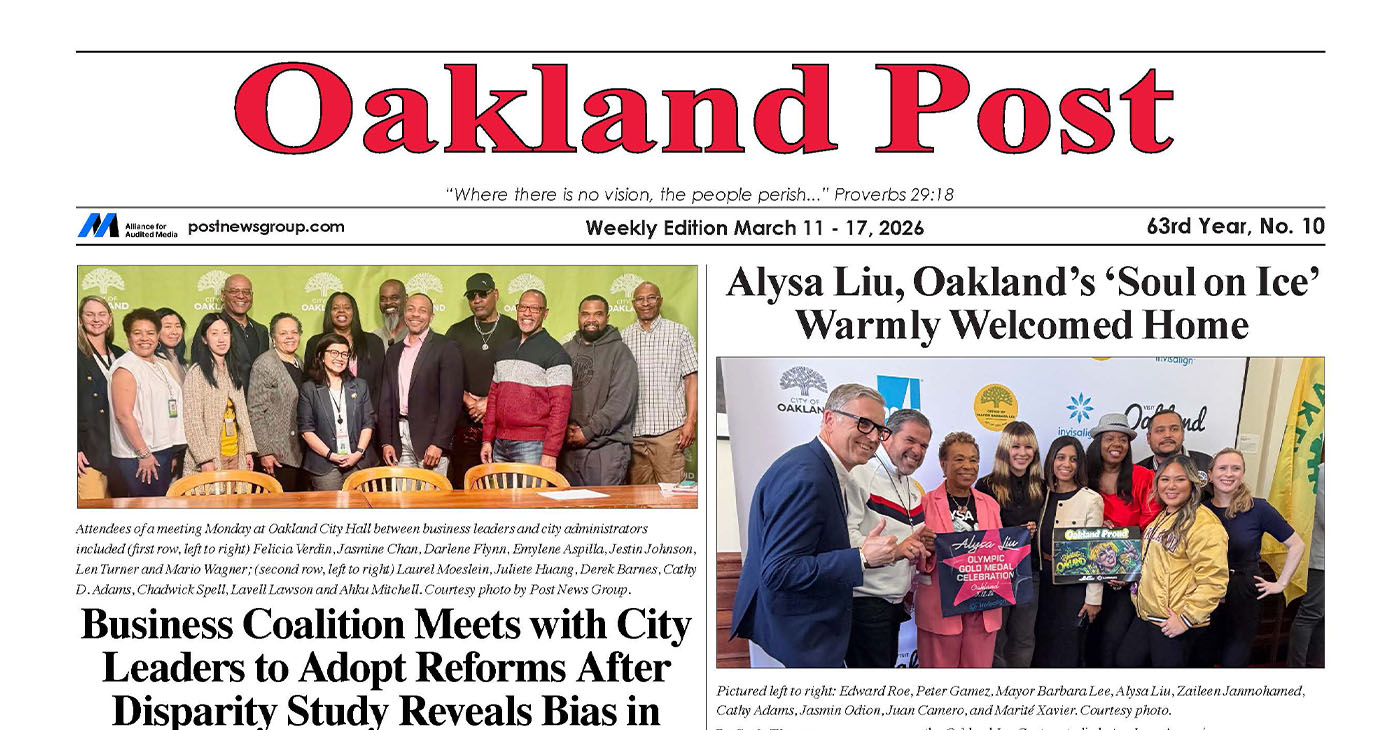
Oakland Post: Week of March 11 -17, 2026
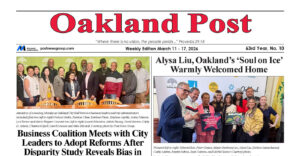
The printed Weekly Edition of the Oakland Post: Week of March 11 – 17, 2026

To enlarge your view of this issue, use the slider, magnifying glass icon or full page icon in the lower right corner of the browser window.

Activism
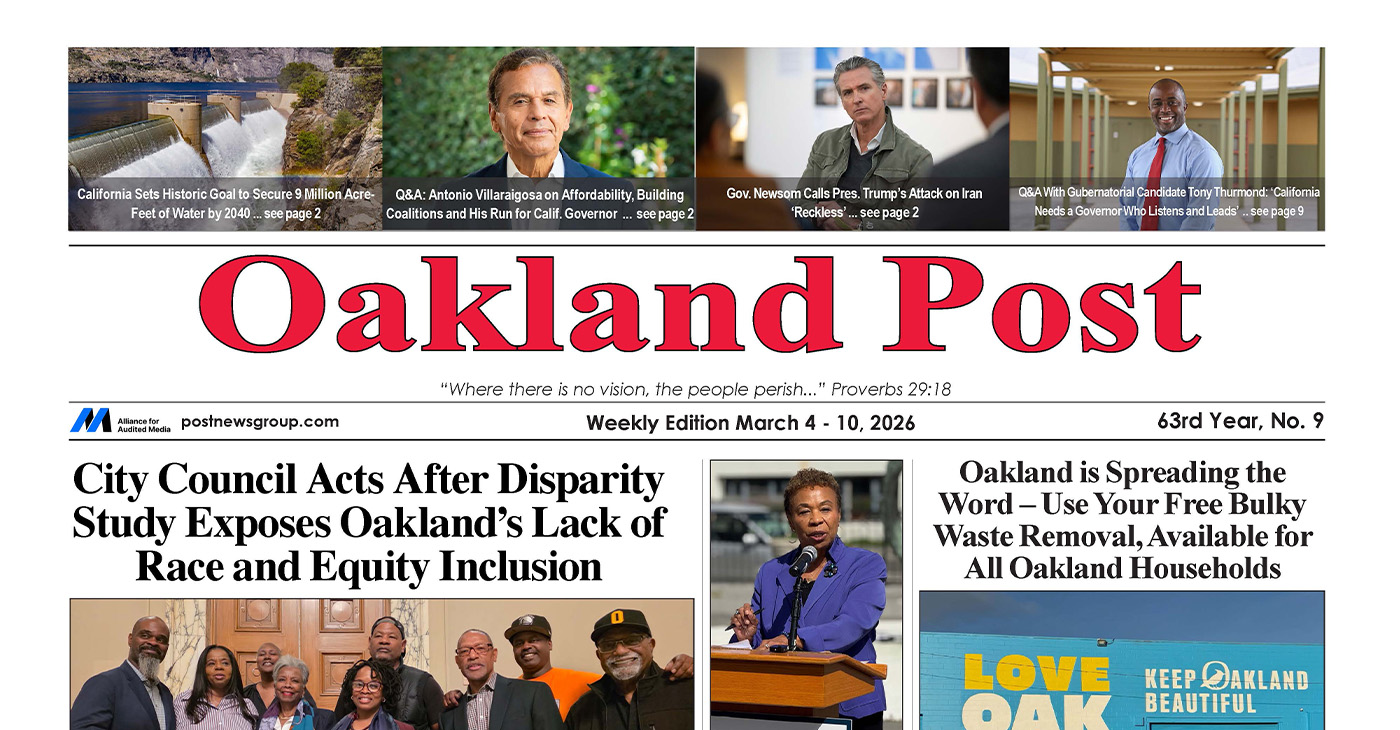
Oakland Post: Week of March 4 – 10, 2026
The printed Weekly Edition of the Oakland Post: Week of March 4 – 10, 2026
To enlarge your view of this issue, use the slider, magnifying glass icon or full page icon in the lower right corner of the browser window.
Activism
Oakland Post: Week of February 25 – March 3, 2026
The printed Weekly Edition of the Oakland Post: Week of – February 25 – March 3, 2026

To enlarge your view of this issue, use the slider, magnifying glass icon or full page icon in the lower right corner of the browser window.
WORK FROM HOME
Home-based business with potential monthly income of $10K+ per month. A proven training system and website provided to maximize business effectiveness. Perfect job to earn side and primary income. Contact Lynne for more details: Lynne4npusa@gmail.com 800-334-0540


Financial Wellness and Mental Health: Managing Money Stress in College

Oakland Post: Week of March 11 -17, 2026

Women & Wealth: Tips for Navigating Your Lifelong Financial Journey

COMMENTARY: Women of Color Shape Our Past and Future

Woman’s Search for Family’s Roots Leads to Ancestor John T. Ward – A Successful Entrepreneur and Conductor on the Underground Railroad

Advocates Raise Alarm Over ICE Operation, MOU and Detention Risks in Baltimore County

Pete Buttigieg to Join Mayor Randall Woodfin for Community Town Hall in Birmingham

WATCH: Week One – NNPA’s “Leadership Matters” Video Series

Oakland Post: Week of March 4 – 10, 2026

OP-ED: NNPA Launches 2026 “Leadership Matters” Video Series

PRESS ROOM: PMG and Cranbrook Horizons-Upward Bound Launch Journey Fellowship Cohort 2

Los Angeles Summit Brings Together Leaders to Tackle Poverty and Affordability

Civil Rights TV Launches 24/7 Network Focused on Black History, Education and Equity

REVIEW: The Ultimate Hot Girl Summer Getaway: Sunseeker Resort Florida

COMMENTARY: How You Stop a Prescription Medicine is as Important as How You Start

Oakland Post: Week of January 28, 2025 – February 3, 2026

Life Expectancy in Marin City, a Black Community, Is 15-17 Years Less than the Rest of Marin County

Community Celebrates Turner Group Construction Company as Collins Drive Becomes Turner Group Drive

Book Review: Books on Black History and Black Life for Kids

California Launches Study on Mileage Tax to Potentially Replace Gas Tax as Republicans Push Back

Discrimination in City Contracts

COMMENTARY: The Biases We Don’t See — Preventing AI-Driven Inequality in Health Care

Post Newspaper Invites NNPA to Join Nationwide Probate Reform Initiative

Black History Events in the East Bay

Art of the African Diaspora Celebrates Legacy and Community at Richmond Art Center

Medi-Cal Cares for You and Your Baby Every Step of the Way

COMMENTARY: The National Protest Must Be Accompanied with Our Votes

New Bill, the RIDER Safety Act, Would Support Transit Ambassadors and Safety on Public Transit

Oakland Post: Week of February 4 – 10, 2026

Oakland Post: Week of February 11 – 17, 2026

Hyundai Ioniq 5 Parking, Safety, and 360 View #shorts

2025 Ioniq 5 New Wiper & Powerful Performance! #shorts

Electric SUV Range: Is 259 Miles Enough? #shorts

EV Charging: How Fast Can You Charge an Electric Vehicle? #shorts

Biometric Cooling… Messaging Seats…Come on! 2025 Infiniti QX80 Autograph 4WD

Charged Up: Witness the Magic of a Fully Electric Car! #shorts

Range Rover Sport PHEV Included…: See What’s Inside This Luxury SUV! #shorts

Invisible Hood View: Perfect Parking with X-Ray Vision! #shorts

AI Is Reshaping Black Healthcare: Promise, Peril, and the Push for Improved Results in California

ESSAY: Technology and Medicine, a Primary Care Point of View

Sanctuary Cities

The RESISTANCE – FREEDOM NOW

STATE OF THE PEOPLE: Freddie

ECONOMIC BOYCOTT DAY!!!!!

I told You So

-
 #NNPA BlackPress3 weeks ago
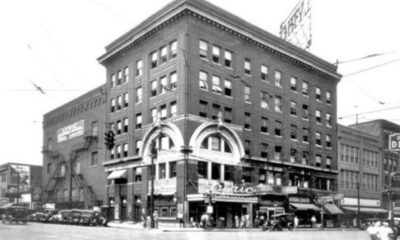
Reflecting on Black History Milestones in Birmingham AL
-
 Bay Area4 weeks ago
CITY OF SAN LEANDRO STATE OF CALIFORNIA PUBLIC WORKS DEPARTMENT ENGINEERING DIVISION NOTICE TO BIDDERS FOR ANNUAL STREET OVERLAY/REHABILITATION 2019-21 – PHASE III
-
 #NNPA BlackPress3 weeks ago
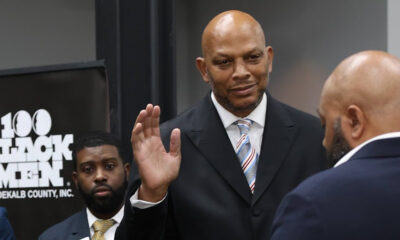
PRESS ROOM: NBA Hall of Fame Nominee Terry Cummings Joins 100 Black Men of DeKalb County to Launch Victory & Values Initiative
-
 Activism4 weeks ago
Oakland Post: Week of February 18 – 24, 2026
-

 #NNPA BlackPress3 weeks ago
U.S. manufacturing rebounds – how foundry services are adapting to rising demand
-

 #NNPA BlackPress3 weeks ago
OP-ED: One Hundred Years of Black Workers Telling the Truth
-

 #NNPA BlackPress3 weeks ago
Advancements in solar technology that are changing the way we power the world
-
 #NNPA BlackPress3 weeks ago
PRESS ROOM: Civil Rights TV Launches in Selma as the World’s First 24/7 Civil Rights Television Network
