
Uncategorized
Shelter Options Remain Unclear as City Passes New Homeless Policy


Late on Oct. 20, Oakland City Council unanimously passed an Encampment Management Policy that codifies where people experiencing homelessness are and are not allowed to live, but firm plans for what shelter options people will be offered if cleared from a prohibited area have not been set.
The policy defines any space within 50 feet of a residence, business, protected waterway, public park, or sports court, and within 100 feet of a school as a “high sensitivity area” and further states that “encampments located within a high sensitivity area that are not approved by City Council will be subject to closure intervention.”
“This means they’re going to evict encampments across the entire city,” said Talya Husbands-Hankin of the Oakland homeless rights advocacy group Love and Justice in The Streets. Calling the policy “cruel and racist,” Husbands-Hankin echoed concerns of public speakers at the Oct. 20 City Council meeting, where over 175 speakers spoke, the vast majority of whom spoke critically of the EMP.
Well over 100 other people took their concerns to the streets during the meeting, as protestors, many of whom were associated with The United Front Against Displacement, House The Bay, and TANC Bay Area, hosted anti-EMP noise demonstrations outside of City Hall and Councilmembers Noel Gallo and Dan Kalb homes.

crowd of about dozen and counting are outside council member Dan Kalb’s home. they’re gearing up for a noise demo to protest Oakland’s proposed Encampment Management Policy. pic.twitter.com/zNCDHkijsI
— Zack Haber (@ZZZZZZZZZZZack) October 21, 2020
Those critical of the EMP said that the policy leaves homeless people with no safe place to go as high sensitive areas encompass most of the city. But Daryel Dunston, Oakland’s Homelessness Administrator who presented the policy to City Council, said that the policy “leads with services, compassion and empathy,” and that services and offers of alternative shelter would be given before a clearance. He repeatedly claimed that the policy does not seek to criminalize homelessness and that no one would be arrested just for sleeping outside.
At the meeting, Dunston referred to a recent operation at Pine and 11th streets in West Oakland as an example of the City’s process of providing alternative shelter before clearing an encampment. But Needa Bee, of The Village, a homeless advocacy group, said an elderly homeless Black resident got displaced during this operation. (Since The Post was unable to communicate with him, we are using a pseudonym for him here.)
“They threw away [Michael Simpson’s] belongings and then offered him a few nights in The Travel Inn,” said Bee.
According to a contract between Simpson and Operation Dignity, a non-profit that the City of Oakland works with that helps to connect homeless people with shelter services, Simpson was offered four days of hotel shelter but then would have to pay to remain in the room. It shows he was also offered space in the City’s Community Cabins program, but Bee said he refused due to negative experiences living in them in the past.
Sara Bedford, of the City of Oakland’s Human Services, disputed Bee’s claim in an e-mail sent on Oct. 26.
“We cannot share any specific information but can confirm the individual is no longer unsheltered,” she wrote.
City programs to shelter homeless people in Oakland are limited. Homeless shelters are usually full and some do not offer extended stays. Oakland Community Housing Services Manager Lara Tannenbaum said in an e-mail that the city has 218 community cabin beds, 108 safe RV spaces, and 128 trailer beds. Oakland’s point-in-time count claims there are 4,000 homeless people in Oakland and the Homeless Advocacy Working Group’s count claims around 10,000 people.
In a newsletter sent on Oct. 23 where he referred to the City Administration who would enforce the EMP, Councilmember Kalb wrote, “They have assured us that no encampment would be fully closed, or individuals asked to move without multiple offers of services and shelter, due process and proper noticing.”
There is not yet an agreed-upon definition between the City Administration and the Council defining what shelter would be offered. In her own newsletter, also sent on Oct. 23, City Council President Rebecca Kaplan wrote, “there is a need to ensure a shared understanding of what is required in terms of the provision of adequate shelter.” Then she wrote that the issue would be addressed in a meeting on Dec. 1.
“What really disturbs me and makes me upset is that Oakland, unlike San Francisco, has the amazing resource of 50 plus acres of vacant public land,” said Margaretta Lin, executive director of Just Cities, a non-profit that works towards racial justice, housing for all, and police transformation in Oakland.
She was critical of the EMP as there currently are no long-term spaces that have been made available for most of Oakland’s homeless people to live in if they are cleared from their current locations.
Lin wants to use the vacant land for mobile homes, trailers and tiny homes that would provide shelter for three to five years, claiming that if this were a natural disaster, like an earthquake that affected middle- to high-income residents, public land would already be used for such purposes.
She also pointed to recent funds from taxes like Measures W and Q, that could be used to arrange and construct such shelters.
Just Cities has arranged an 11-page document listing vacant public lands and Lin said they briefed Mayor Libby Schaaf about their plan two years ago.
“Her response was this is a great plan and we’re doing it,” said Lin. “But I don’t think they’re really doing it.”
Neither Schaaf or her media team have responded to questions about whether or how she is currently implementing the Just Cities plan.
In the meantime, some Oakland residents are building tiny homes of their own. 37MLK, a community of long-term homeless residents in the Bay Area who live on private land that has long been left vacant, have started moving into tiny homes that are built and funded by volunteer community members.
While several units are already built and lived in, volunteers are ramping up efforts and plan to have seven units built by Nov. 7. The 8-by-8 foot and 8-by-10 foot units have locking doors and solar lights. By the winter, they hope to install insulation. They are funding the project through Instagram.
“I think that the city should let us have unused property or land that’s just going to waste,” said Rome, a 53-year-old Bay Area native who has been homeless for nine years, and currently lives in a tiny home at 37MLK. The community sits in a high sensitivity area.
Rome talked of how having a roof over her head has made it possible for her to reduce the risk of infection, which may allow her to get a long-needed hip replacement surgery if she can be assured of stability. A bad hip leaves her in constant pain that fluctuates in intensity and limits her ability to move.
Stefani Echeverría-Fenn, who helped found the 37MLK community and has lived in Oakland since 2010, thinks what is happening at 37MLK could happen on a much larger and more effective scale if the city made use of public lands and funding.
“I think all of us are a set of broke millennials with no real money ourselves and no construction skills until we were trained,” she said. “Imagine what we could do with real resources on public land.”










Uncategorized
Oakland City Council Extends AI Data Center Moratorium for 10 Months.
POST NEWS GROUP — The city must ensure that it has adequate guardrails and that the community is actively involved in decision-making, she said. “It’s important that our staff have the ability to do the appropriate study, and … to do the appropriate outreach to the community, so the community has a voice in anything that we do that will impact their lives.”

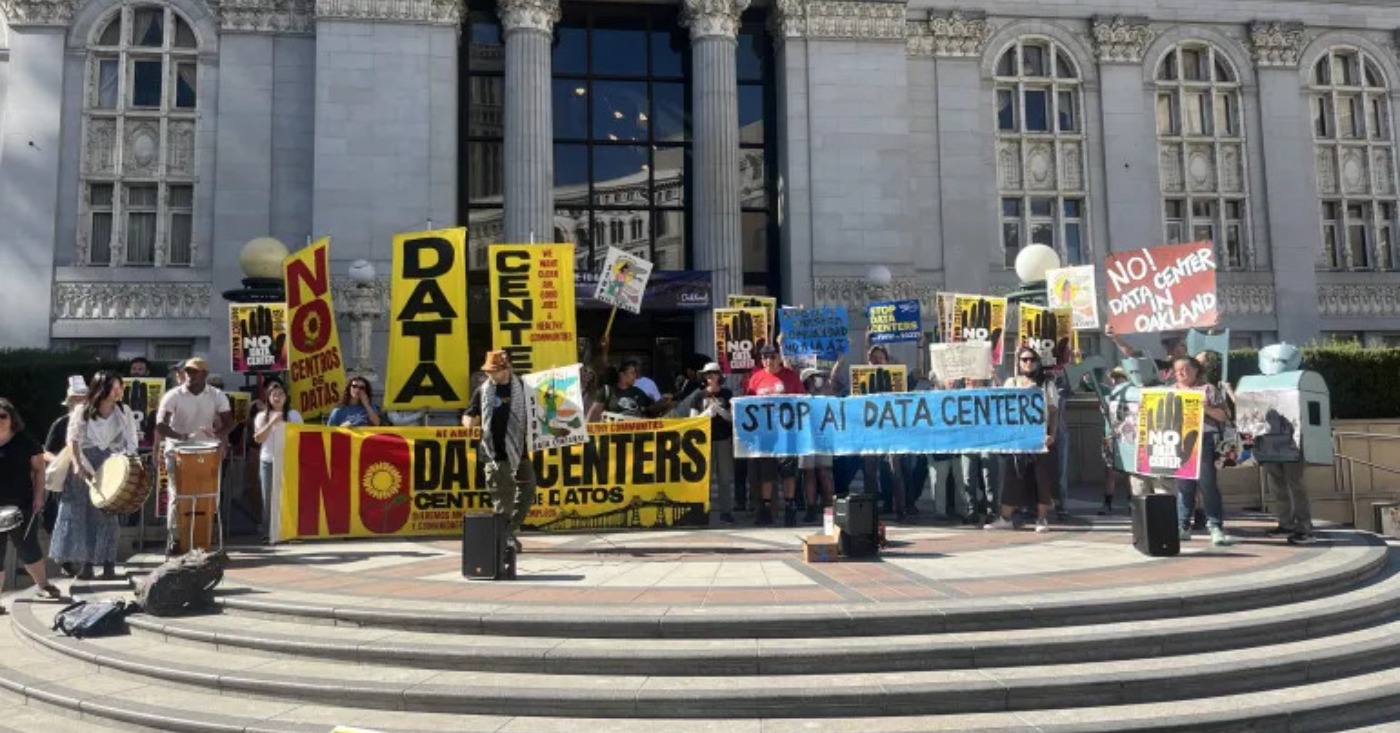
The Oakland City Council voted unanimously this week to extend the city’s moratorium on AI data centers for 10 months – giving the city time to produce a policy that protects residents from the public health and safety dangers that are posed by the proliferation of data centers.
The moratorium extension, which passed at Tuesday’s council meeting, will keep the existing 45-day moratorium in place until Oct. 5, 2027.
“We’re seeing basically an uprising across the country when it comes to how data centers are operating in regard to land use, impacts to the environment, excessive water use and pollution, air pollution, noise pollution, a host of things that are really negatively impacting communities,” said Councilmember Carroll Fife, who is leading the City Council’s efforts to pass the moratorium.
“I represent a district that many of these potential entities are interested in, and two of the giants in the tech industry have leased space in West Oakland, and there’s been another showing interest in a downtown location,” she said.
“I felt it was imperative that I take immediate action to protect Oakland residents from what we’ve seen happen in other parts of the country,” Fife continued. “This is not a rejection of technology. This is not a rejection of economic growth. It’s guardrails against an industry that we’ve seen steamroll individuals throughout the entire globe.”
The city must ensure that it has adequate guardrails and that the community is actively involved in decision-making, she said. “It’s important that our staff have the ability to do the appropriate study, and … to do the appropriate outreach to the community, so the community has a voice in anything that we do that will impact their lives.”
In her recent State of the City address, Mayor Barbara Lee backed the original 45-day moratorium, which passed on Oct. 6 and is set to expire on Nov. 20.
Lee supported the moratorium to give residents more time to consider before any projects move forward, saying, “Residents need to weigh in on any industry that’s trying to come to Oakland.”
Other California cities that already have passed data center moratoriums include San Francisco, Hayward, Oakley, Richmond, Monterey Park, Gilroy, South El Monte, Montebello, and Calexico.
Speaking at the meeting, Bill Gilchrist director of the city’s Planning and Building Department, said that during the moratorium, the city is committed to “looking at areas that might be most severely impacted by land use and residential proximity, and making sure we engage members of the community who may historically have not been able to participate or be invited to participated (in this kind of discussion).”
“The idea for us is to ‘do no harm,’” he said.
Thirty-five public speakers signed up to talk about on the moratorium extension. Almost of them supported the extension, some praising Fife for her leadership on the issue.
Some of the speakers urged the council to consider a permanent ban on data center development in the city.
Supporting the moratorium extension, Laney College professor Peter Brown said, “Don’t cast your vote today based on the illusion we’re operating in the old economy, where corporate investment in Oakland meant thousands of lasting, good-paying jobs, as well as property, business, and income taxes flowing into city coffers,” he said.
“Those days are long gone in this new economy, where every investment is just another asset to be exploited and used as collateral for more investment,” Brown continued. “Every corporate move is to extract from our communities.”
Nyah Tisdell, an East Oakland community organizer with Communities for a Better Environment (CBE), said, “We have community meeting every month…Community members say no (to data centers),” that will go straight to East Oakland, which already has so much industry, so much pollution, and we are trying to better our communities.”
A speaker for Care for Community Action (C4C) said her organization has surveyed more than 400 residents and found that 73% favor a permanent ban on all data centers being built in Oakland.
According to Rev. Leslie Bowling-Dyer, “Data centers are a part of the necessary infrastructure for the rise of an economically and politically untouchable class, and people are not just being lunatics displaying an irrational fear of technology. Technological innovation is not equivalent to social progress. Technological advance is not the problem in itself, but it’s the people who control it.”

Uncategorized
Mississippi Congressman Bennie Thompson Congratulates Scott Colom on Historic Victory
POST NEWS GROUP — “My relationship with Scott dates back to his participation in the Mississippi Black Leadership Institute, which I helped establish in partnership with the NAACP to develop the next generation of public servants. As one of the program’s first graduates, Scott demonstrated the leadership and commitment to public service that would later define his career.

Today, Congressman Bennie G. Thompson (MS-02) issued the following statement on Mississippi Senator-elect Scott Colom’s historic election to the United States Senate:
“I am incredibly proud of Senator-elect Scott Colom and his historic victory. Having known Scott for many years, it has been a pleasure to watch him grow into the leader he is today. His campaign brought together Mississippians from every walk of life — young and old, Black and white, rural and urban —I n a way I have never witnessed in more than 50 years of public service. This victory demonstrates the power of grassroots organizing and what people can accomplish when they come together for a common purpose.
“My relationship with Scott dates back to his participation in the Mississippi Black Leadership Institute, which I helped establish in partnership with the NAACP to develop the next generation of public servants. As one of the program’s first graduates, Scott demonstrated the leadership and commitment to public service that would later define his career.
Recognizing that potential, I encouraged him to run for district attorney of Mississippi’s 16th Judicial District, where he defeated a 28-year incumbent and went on to serve three terms.
“Having witnessed Scott’s leadership firsthand, I had every confidence in his ability to serve as a federal judge when I recommended him to President Joe Biden for nomination in 2022. Former Senator Cindy Hyde-Smith’s decision to block his nomination by withholding her blue slip was disappointing, but it did not lessen my confidence in him or his commitment to serving Mississippi.
“To see him now elected to the very Senate where his nomination was blocked is especially meaningful and a testament to his perseverance and the trust Mississippians have placed in his leadership.”
“Scott has the experience, character, and determination to be an effective advocate for Mississippi. Throughout my career, I have fought to make sure those at the bottom have an opportunity to move up, and I know he shares that commitment.
Having another Mississippi Democrat alongside me in Congress who understands the needs of Mississippians means a great deal. Together, we will fight to improve access to health care, strengthen public education, expand economic opportunities, and ensure our rural and underserved communities are not left behind.
“I look forward to working with Senator-elect Colom and am pleased to welcome him to the Mississippi Congressional Delegation.”
Uncategorized
HISTORY MADE: Keisha Lance Bottoms Becomes First Black Woman Elected Governor in American History
ATLANTA DAILY WORLD — History has been made in Georgia. Keisha Lance Bottoms, the former mayor of Atlanta, has been elected governor of Georgia, becoming the first Black woman in American history to win the highest executive office in any state.

History has been made in Georgia. Keisha Lance Bottoms, the former mayor of Atlanta, has been elected governor of Georgia, becoming the first Black woman in American history to win the highest executive office in any state.
Bottoms’ victory over Republican businessman Rick Jackson represents a defining moment in American politics, breaking a barrier that has stood since the nation’s founding and placing Georgia at the center of a historic political transformation.
For generations, Black women have played a critical role in American democracy, organizing communities, leading movements, mobilizing voters and shaping public policy. Yet despite their contributions, no Black woman had ever been elected governor of a U.S. state.
Until now.
Bottoms’ election also makes her the first woman and first Black person elected governor of Georgia, a state whose political history has been deeply shaped by slavery, segregation, the civil rights movement and the long struggle for equal representation.
Her victory carries particular significance in a state where Black women have been among the most influential forces in voter registration, political organizing and Democratic electoral success.
A fifth-generation Georgian, Bottoms previously served as Atlanta’s 60th mayor from 2018 to 2022. During her administration, she led the city through the COVID-19 pandemic, nationwide protests over racial injustice and a period of significant economic and population growth.

Following her time as mayor, Bottoms served as a senior adviser in President Joe Biden’s administration before returning to Georgia politics to pursue the governorship.
Her campaign focused on expanding access to health care, strengthening public education, increasing wages and addressing the rising cost of living. She also advocated for expanding Medicaid, raising Georgia’s minimum wage to $15 an hour and increasing compensation for teachers and other public employees.
Bottoms faced Jackson, a wealthy health care executive who invested heavily in his campaign and positioned himself as a political outsider. The contest drew national attention as Democrats sought to reclaim the Georgia governor’s office after more than two decades of Republican control.
The historic nature of Bottoms’ victory extends well beyond party politics.
Georgia, once at the center of some of America’s most consequential civil rights battles, has now elected a Black woman to lead its state government. It is a milestone that reflects generations of political participation, organizing and leadership by Black Georgians.
For Atlanta, the moment is especially significant. A former mayor of the city that helped shape the modern civil rights movement will now lead the entire state.
Bottoms’ election opens a new chapter in Georgia’s political history and establishes a milestone that will be remembered far beyond the 2026 election.
For continuing election coverage and results, visit AtlantaDailyWorld.com/election26.



Oakland Post: Week of November 11 -17, 2026

Alameda County Supervisor Miley to Propose Illegal Dumping Ordinance

Oakland City Council Extends AI Data Center Moratorium for 10 Months.

On Veterans Day, U.S. Rep. Simon Demands Answers on Status of Veterans Affairs Clinic, Columbarium Project

OPINION: Mario Juarez’s Courtroom Admissions Raise Questions About Allegations That Fueled Recall of Pamela Price

Hutchinson Concedes: Ballots Still Being Counted in Oakland Board Elections

Mayor Lee and Schools’ Supt. Saddler Issue Joint Statement on Recent ICE Activity in Oakland

Mississippi Congressman Bennie Thompson Congratulates Scott Colom on Historic Victory

Farms to Grow, Inc. Hosts the 8th Annual Sweet Potato Pie Tasting Contest

Oakland Post: Week of November 4 – 10, 2026

How the Sandwich Generation Can Help Protect Aging Parents’ Finances

As Progressive Democrats Celebrate ‘Blue Tsunami,’ Oakland Counts Victories

Golden State Valkyries Become Bay Area Legends Winning WNBA Championship on Halloween Night

IN MEMORIAM: Marcia Ann Gillespie, Editor of Essence and Ms. Magazines, Dies at 82

U.S. Rep. John Garamendi Honors local ‘Women of the Year’ at Annual Awards Ceremony

COMMENTARY: Valarie Bachelor and Jennifer Brouhard are Excellent School Board Members and Deserve to Be Reelected

OUSD Receives State Review of District Finances; Outlines Progress Since January

HISTORY MADE: Keisha Lance Bottoms Becomes First Black Woman Elected Governor in American History

SEIU Local 1000 and State of California Will Continue to Negotiate New Labor Contract

Fate of Bay Area Public Transit Hinges on Regional Transit Measure
Golden State Valkyries Become Bay Area Legends Winning WNBA Championship on Halloween Night

COMMENTARY: Your California Living Trust Could Be Next: When Evidence Isn’t Enough

Chase Launches Fraud & Scam Prevention Month

Mayor Barbara Lee Holds Special State of the City Address in Deep East Oakland

It’s Time to Lose Weight Before the Holidays

Democrats, Community Groups Back Measure EE to Change How Oakland Is Governed

Post News Group Nov. 3 Election Endorsements

Oakland Awarded More than $14 Million in State Funding

Richmond Neighbors Put Pantry Power on the Map

Oakland Post: Week of October 7 – 13, 2026

The Conversation With Al McFarlane 6/23/26

Media Monday 6/22/26

LIVE! ASK ALMA! — TUES. 6.23.26 7PM EST

Car Buying Secrets: 4 Hidden Checks Before You Sign!

Is This 550 HP Charger Worth YOUR Money? AutoNetwork Review

Celebrating Juneteenth – Frederick Douglass on education and resistance

LIVE! — ASK ALMA! — TUES. 6.19.26 7PM EST

Hyundai Ioniq 5 Parking, Safety, and 360 View #shorts

2025 Ioniq 5 New Wiper & Powerful Performance! #shorts

Electric SUV Range: Is 259 Miles Enough? #shorts

EV Charging: How Fast Can You Charge an Electric Vehicle? #shorts

Biometric Cooling… Messaging Seats…Come on! 2025 Infiniti QX80 Autograph 4WD

Charged Up: Witness the Magic of a Fully Electric Car! #shorts

Range Rover Sport PHEV Included…: See What’s Inside This Luxury SUV! #shorts

Invisible Hood View: Perfect Parking with X-Ray Vision! #shorts
-
 Commentary2 weeks ago
COMMENTARY: Valarie Bachelor and Jennifer Brouhard are Excellent School Board Members and Deserve to Be Reelected
-
 Education2 weeks ago
OUSD Receives State Review of District Finances; Outlines Progress Since January
-
 Black History2 weeks ago
HISTORY MADE: Keisha Lance Bottoms Becomes First Black Woman Elected Governor in American History
-
 Business2 weeks ago
SEIU Local 1000 and State of California Will Continue to Negotiate New Labor Contract
-
 Business3 weeks ago
Fate of Bay Area Public Transit Hinges on Regional Transit Measure
-
 Community2 weeks ago
Golden State Valkyries Become Bay Area Legends Winning WNBA Championship on Halloween Night
-
 Business2 weeks ago
COMMENTARY: Your California Living Trust Could Be Next: When Evidence Isn’t Enough
-
 Business4 weeks ago
Chase Launches Fraud & Scam Prevention Month
