
Film
Robert Townsend to visit Twin Cities for Gordon Parks film series kick-off
MINNESOTA SPOKESMAN-RECORDER — Screenings and curated events will serve as a bridge between the Twin Cities community and noteworthy artists and media-makers who drew inspiration from Parks’ legacy.

Acclaimed director and actor Robert Townsend is helping to launch a new Twin Cities film series honoring the legendary photographer and filmmaker Gordon Parks.
Townsend will host two film screenings March 8-9, as part of a two-day tour for the CHOICE Cinema Series: In the Footsteps of Gordon Parks kick-off this weekend.
The new series features “iconic works of Black filmmakers, who like Parks, chose the camera to tell the stories of the Black experience,” said Robin Hickman, Parks’ grand-niece and founder/director of the In The Footsteps of Gordon Parks Legacy Movement, in a recent press release.
“This is the place he chose his weapon of camera to fight against poverty, violence, and racism,” Hickman told the MSR.
On Friday, Townsend will host a screening for The Five Heartbeats and on Saturday, a screening for his new documentary, Making The Five Heartbeats. 
Screenings and curated events will serve as a bridge between the Twin Cities community and noteworthy artists and media-makers who drew inspiration from Parks’ legacy of capturing humanity and the Black presence within.
Of those inspired, Townsend acknowledged Parks as “The Legend” in the closing credits of his now 30-year-old classic film.

During the tour, Townsend will also walk in Parks’ footsteps: staying at the St. Paul Hotel where he filmed, speaking with Black students at St. Paul Central High School (where Parks attended) as well as with scholars at Gordon Parks High School.
CHOICE Cinema Series: In the Footsteps of Gordon Parks is produced by Hickman, who is also CEO/Executive Producer of SoulTouch Productions, in partnership with FilmNorth, Twin Cities Radio Network, and St. Paul Neighborhood Network.
The Five Heartbeats screening will take place Friday, Mar. 8, 7-9 pm at SPNN, located at 550 Vandalia St. in St. Paul. The Making Of The Five Heartbeats & Discussion will take place St. Anthony Main Theater, 115 SE Main St. in Minneapolis.
This article originally appeared in the Minnesota Spokesman-Recorder.







#NNPA BlackPress
IN MEMORIAM: Legendary Funk Pioneer Sly Stone Dies at 82
Sly Stone’s musical approach radically reshaped popular music. He transcended genre boundaries and empowered a new generation of artists. The band’s socially conscious message and infectious rhythms sparked a wave of influence, reaching artists as diverse as Miles Davis, George Clinton, Prince, Dr. Dre, and the Roots.

By Stacy M. Brown
BlackPressUSA.com Newswire
Sylvester “Sly” Stewart—known to the world as Sly Stone, frontman of the groundbreaking band Sly and the Family Stone—has died at the age of 82.
His family confirmed that he passed away peacefully at his Los Angeles home surrounded by loved ones, after battling chronic obstructive pulmonary disease (COPD) and other health complications.
Born March 15, 1943, in Denton, Texas, Stone moved with his family to Vallejo, California, as a child. He began recording gospel music at age 8 with his siblings in a group called the Stewart Four. By his teenage years, he had mastered multiple instruments and was already pioneering racial integration in music—an ethos that would define his career.
In 1966, Sly and his brother Freddie merged their bands to form Sly and the Family Stone, complete with a revolutionary interracial, mixed-gender lineup.
The band quickly became a commercial and cultural force with hits such as “Dance to the Music,” “Everyday People,” and “Thank You (Falettinme Be Mice Elf Agin)”—all penned by Stone himself.
Their album “Stand!” (1969) and live performances—most notably at Woodstock—cemented their reputation, blending soul, funk, rock, gospel, and psychedelia to reflect the optimism and turmoil of their era.
Sly Stone’s musical approach radically reshaped popular music. He transcended genre boundaries and empowered a new generation of artists. The band’s socially conscious message and infectious rhythms sparked a wave of influence, reaching artists as diverse as Miles Davis, George Clinton, Prince, Dr. Dre, and the Roots.
As the 1970s progressed, Stone confronted personal demons. His desire to use music as a response to war, racism, and societal change culminated in the intense album “There’s a Riot Goin’ On” (1971). But drug dependency began to undermine both his health and professional life, leading to erratic behavior and band decline through the early 1980s.
Withdrawn from the public eye for much of the 1990s and early 2000s, Stone staged occasional comebacks. He was inducted into the Rock & Roll Hall of Fame in 1993, received a Lifetime Achievement Award from the Grammys in 2017, and captured public attention following the 2023 release of his memoir “Thank You (Falettinme Be Mice Elf Agin)”—published under Questlove’s imprint. He also completed a biographical screenplay and was featured in Questlove’s documentary “Sly Lives!” earlier this year.
His influence endured across generations. Critics and historians repeatedly credit him with perfecting funk and creating a “progressive soul,” shaping a path for racial integration both onstage and in the broader culture.
“Rest in beats Sly Stone,” legendary Public Enemy frontman Chuck D posted on social media with an illustrative drawing of the artist. “We should thank Questlove of the Roots for keeping his fire blazing in this century.”
Emmy-winning entertainment publicist Danny Deraney also paid homage. “Rest easy Sly Stone,” Deraney posted. “You changed music (and me) forever. The time he won over Ed Sullivan’s audience in 1968. Simply magical. Freelance music publicist and Sirius XM host Eric Alper also offered a tribute.
“The funk pioneer who made the world dance, think, and get higher,” Alper wrote of Sly Stone. “His music changed everything—and it still does.”
Sly Stone is survived by three children.
Arts and Culture
Paul Robeson: A Voice for the Ages, A Champion for Justice
Robeson first gained widespread recognition on stage and screen, delivering commanding performances that captivated audiences. Yet, it was his voice in concert halls that sealed his legacy. His repertoire was vast, spanning spirituals, classical compositions, global folk traditions, and songs of struggle — music that carried the weight of the oppressed and the hopes of the marginalized.
By Tamara Shiloh
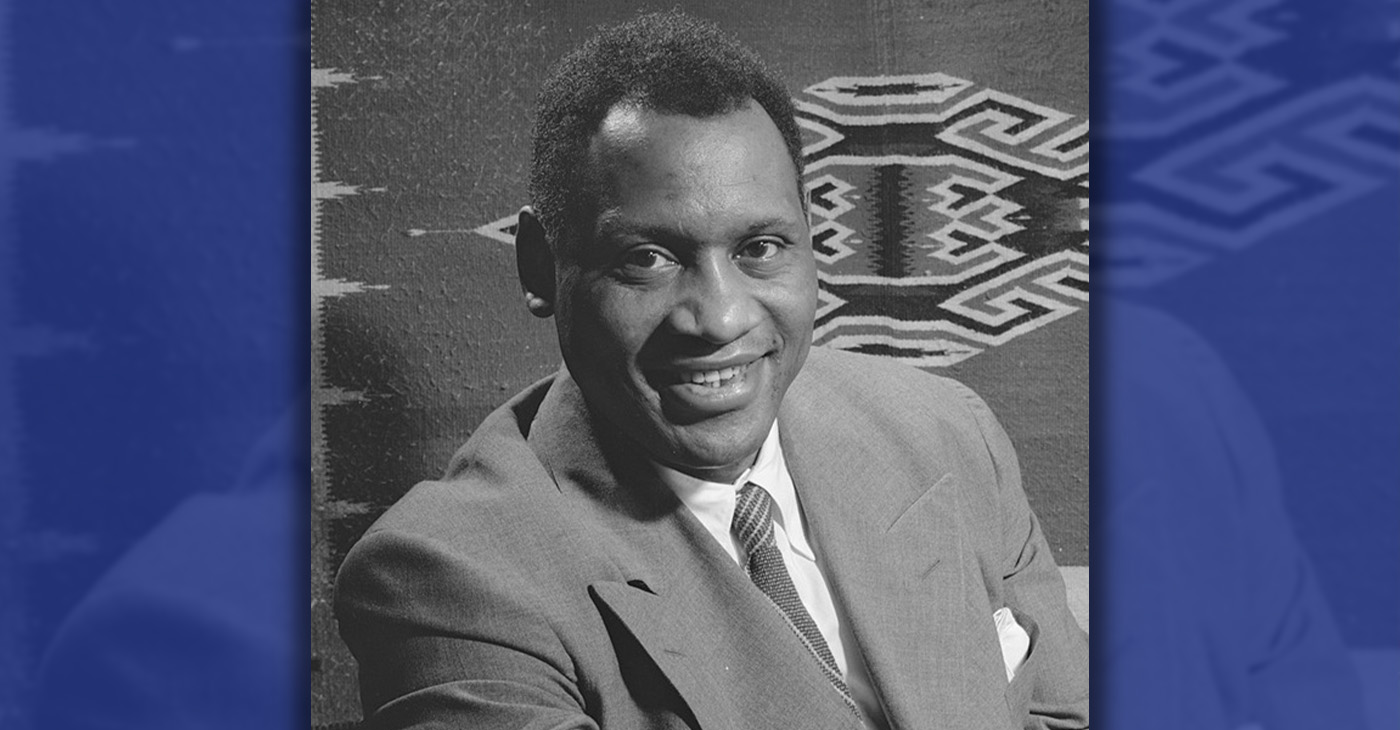
Paul Robeson was born April 9, 1898, in Princeton, New Jersey. At 6’ 3”, he was a towering man of intellect, talent, and conviction. Before he became an international icon, he earned his law degree from Columbia University in 1923, supporting himself by teaching Latin and playing professional football on the weekends. But the law would not hold him for long. His voice had other plans.
Robeson first gained widespread recognition on stage and screen, delivering commanding performances that captivated audiences. Yet, it was his voice in concert halls that sealed his legacy. His repertoire was vast, spanning spirituals, classical compositions, global folk traditions, and songs of struggle — music that carried the weight of the oppressed and the hopes of the marginalized.
In 1921, he married Eslanda Goode, a fellow Columbia student and a journalist with her own remarkable intellect and ambition. Their marriage, which lasted over four decades, was a partnership in every sense. Goode became his manager, encouraging him to leave law behind and fully embrace his calling. In 1927, they welcomed their son, Paul Robeson Jr.
By the mid-1920s, Robeson was making waves in theater. He starred in All God’s Chillun Got Wings (1924) and The Emperor Jones (1925). That same year, he made his film debut in Body and Soul, directed by pioneering Black filmmaker Oscar Micheaux. In 1928, he mesmerized London audiences in Show Boat, where his rendition of Ol’ Man River transformed the song into a powerful anthem of resilience.

Robeson and his family moved to Europe in the late 1920s, and over the next decade, he built an impressive career in both film and music. He starred in Borderline (1930) and later again in the 1933 film adaptation of The Emperor Jones. Over the next few years, he appeared in six British films, including Jericho and Big Fella (both released in 1937). He also starred in the second screen adaptation of Show Boat (1936), alongside Hattie McDaniel and Irene Dunne. However, his final film, Tales of Manhattan (1942), left him deeply disillusioned. He openly criticized its degrading depiction of Black life, signaling his growing commitment to using his platform for activism.
In 1963, after years of political persecution and declining health, Robeson returned to the United States. Following Goode’s death in 1965, he lived quietly with his sister. On January 23, 1976, Robeson passed away from a stroke at the age of 77 in Philadelphia.
Activism
The SixTripleEight: “No Mail, Low Morale”
Women were recruited and trained until May 1942. The Women’s Auxiliary Army Corps was formed, and women of all races were officially allowed to serve. In July of that same year, women were given full benefits in the military, and the word “auxiliary” was removed from their name. The Corps then became known as the Women’s Army Corps (WACs).
By Tamara Shiloh
Many historical accounts of wars do not include women. The word “soldier” often brings to mind a man in uniform. Yet by definition it refers to anyone, including women, serving in the military.
American women were allowed to serve in the army during World War I (1914–1918). Many were nurses and staff who cooked for, and catered to, injured soldiers. Because slavery and racism prevented Black women from giving their services to America, many of these women were White.
Women were recruited and trained until May 1942. The Women’s Auxiliary Army Corps was formed, and women of all races were officially allowed to serve. In July of that same year, women were given full benefits in the military, and the word “auxiliary” was removed from their name. The Corps then became known as the Women’s Army Corps (WACs).
Although the military trained women of all races in all divisions and sections of the army in preparation for war, division among the races remained. Black women were encouraged to become WACs. In other divisions, such as the Navy, Black women were excluded almost entirely. The Army Nurse Corps only allowed 500 Black nurses to serve despite thousands who applied.

But the tables were turned in 1945 when the world’s first all-Black female battalion was sent from the United States to serve in parts of Europe during World War II (1939–1945).
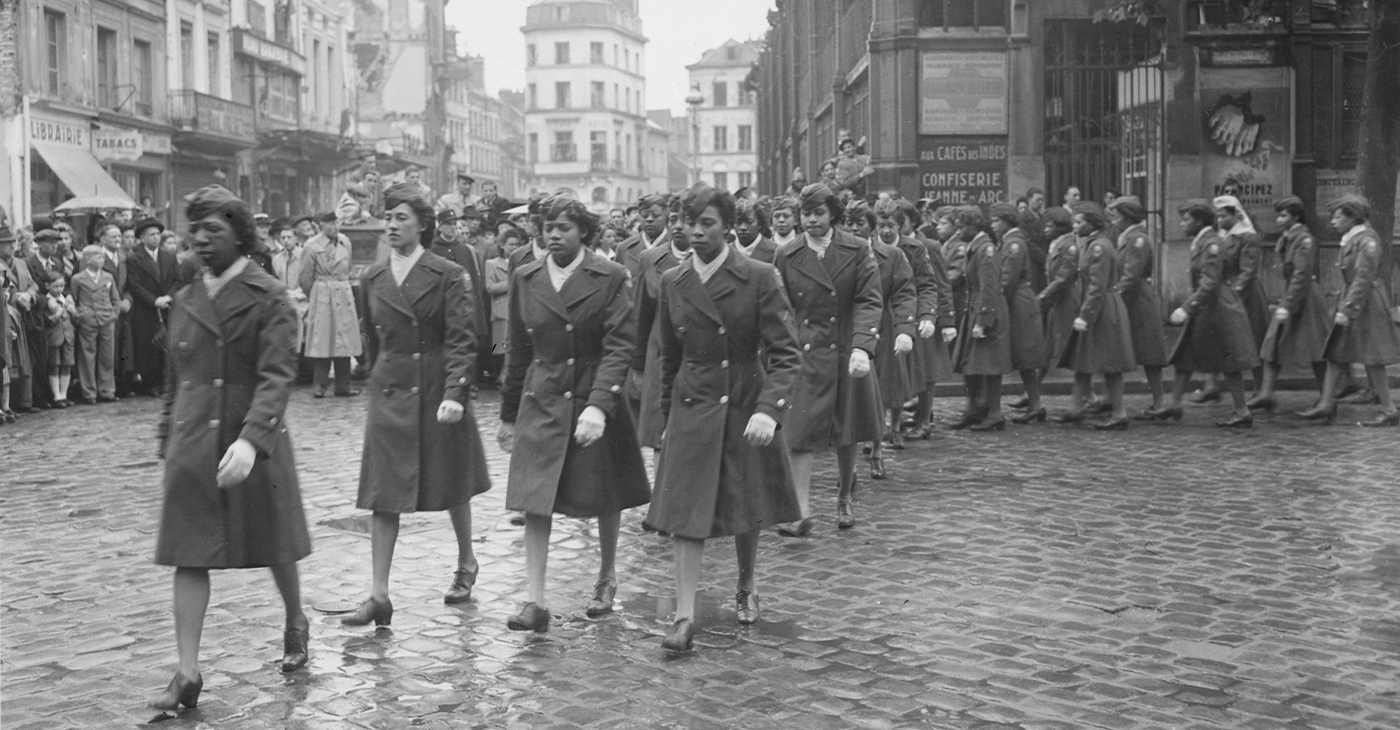
Known as the 6888 Central Postal Directory Battalion, or “the SixTripleEight,” the battalion served in parts of France and England to clear the backlog of mail in the European Theater of Operations. The battalion boasted 855 Black women, both enlisted and officers, and was led by Major Charity Adams Earley. It was the only all-Black, all-female battalion overseas throughout the war.
Many of the women serving were handpicked by civil rights activist and educator Mary McLeod Bethune.
Confronted with racism and sexism from their own leadership and troops, the battalion served with honor and distinction completing their mission in six months. By war’s end, the SixTripleEight had cleared over 17 million pieces of backlogged mail ensuring the troops stayed in touch with their loved ones back home.
Although the SixTripleEight had a motto, “No mail, low morale,” they accomplished more than distributing letters and packages. As the largest contingent of Black women to ever serve overseas, they dispelled stereotypes and represented a change in racial and gender roles in the military.
Between 1945 and 1946, the majority of the women worked under the mail service. Others served as cooks, mechanics, nurse assistants and in other roles when necessary. Working conditions were dangerous and risky, as the women were placed in abandoned and infested aircraft and offices throughout the war.
Women of the SixTripleEight were later honored with the European African Middle Eastern Campaign Medal, the Good Conduct Medal, and the World War II Victory Medal while they were still in service.
The last of the battalion returned home in March 1946.

WORK FROM HOME
Home-based business with potential monthly income of $10K+ per month. A proven training system and website provided to maximize business effectiveness. Perfect job to earn side and primary income. Contact Lynne for more details: Lynne4npusa@gmail.com 800-334-0540


Black Artists in America, Installation Three Wraps at the Dixon Gallery and Gardens

Grief, Advocacy, and Education: A Counselor Reflects on Black Maternal Health

Future of Florida’s Black History Museum in Limbo

New Research Shows the Many Benefits of Early Learning

South Hampton K-8 Students Among Top 10 Finalists for Samsung’s ‘Solve for Tomorrow’ Competition

Cuba: No Negotiation with US on the President or Political System

Brooklyn Academy of Music Names Jamaican-Born Tamara McCaw as President

Trinidad & Tobego – U.S. Launches WhatsApp Channel for American Citizens in the Country

Oakland Post: Week of March 18 – 24, 2026

AI Innovation vs. Ethics and Environmental Impact

AI, Web3, and Digital Reparations

What If You Owned Your AI Agent?

Season 7, Episode 3 – January Reporter’s Roundtable 📱

Season 7, Episode 3 – January Reporter’s Roundtable

AI, Media, and Power | Part 2, Real-World Impacts and Tradeoffs

Oakland Post: Week of February 11 – 17, 2026

Reflecting on Black History Milestones in Birmingham AL

CITY OF SAN LEANDRO STATE OF CALIFORNIA PUBLIC WORKS DEPARTMENT ENGINEERING DIVISION NOTICE TO BIDDERS FOR ANNUAL STREET OVERLAY/REHABILITATION 2019-21 – PHASE III

Oakland Post: Week of February 18 – 24, 2026

PRESS ROOM: NBA Hall of Fame Nominee Terry Cummings Joins 100 Black Men of DeKalb County to Launch Victory & Values Initiative

Oakland Post: Week of February 25 – March 3, 2026

Trump’s MAGA Allies are Creating Executive Order Plan to Steal the 2026 Midterms

U.S. manufacturing rebounds – how foundry services are adapting to rising demand

OP-ED: One Hundred Years of Black Workers Telling the Truth

Chase Oakland Community Center Hosts Alley-Oop Accelerator Building Community and Opportunity for Bay Area Entrepreneurs

Poll Shows Support for Policies That Help Families Afford Child Care

Oakland Post: Week of March 4 – 10, 2026

Advancements in solar technology that are changing the way we power the world

PRESS ROOM: Civil Rights TV Launches in Selma as the World’s First 24/7 Civil Rights Television Network

Woman’s Search for Family’s Roots Leads to Ancestor John T. Ward – A Successful Entrepreneur and Conductor on the Underground Railroad

Hyundai Ioniq 5 Parking, Safety, and 360 View #shorts

2025 Ioniq 5 New Wiper & Powerful Performance! #shorts

Electric SUV Range: Is 259 Miles Enough? #shorts

EV Charging: How Fast Can You Charge an Electric Vehicle? #shorts

Biometric Cooling… Messaging Seats…Come on! 2025 Infiniti QX80 Autograph 4WD

Charged Up: Witness the Magic of a Fully Electric Car! #shorts

Range Rover Sport PHEV Included…: See What’s Inside This Luxury SUV! #shorts

Invisible Hood View: Perfect Parking with X-Ray Vision! #shorts

AI Is Reshaping Black Healthcare: Promise, Peril, and the Push for Improved Results in California

ESSAY: Technology and Medicine, a Primary Care Point of View

Sanctuary Cities

The RESISTANCE – FREEDOM NOW

STATE OF THE PEOPLE: Freddie

ECONOMIC BOYCOTT DAY!!!!!

I told You So

-
 Activism4 weeks ago
Oakland Post: Week of March 4 – 10, 2026
-
 #NNPA BlackPress3 weeks ago
Woman’s Search for Family’s Roots Leads to Ancestor John T. Ward – A Successful Entrepreneur and Conductor on the Underground Railroad
-

 #NNPA BlackPress4 weeks ago
OP-ED: NNPA Launches 2026 “Leadership Matters” Video Series
-

 #NNPA BlackPress3 weeks ago
Advocates Raise Alarm Over ICE Operation, MOU and Detention Risks in Baltimore County
-

 #NNPA BlackPress3 weeks ago
COMMENTARY: Women of Color Shape Our Past and Future
-

 #NNPA BlackPress3 weeks ago
Pete Buttigieg to Join Mayor Randall Woodfin for Community Town Hall in Birmingham
-

 Activism2 weeks ago
Oakland Post: Week of March 11 -17, 2026
-

 #NNPA BlackPress4 weeks ago
PRESS ROOM: PMG and Cranbrook Horizons-Upward Bound Launch Journey Fellowship Cohort 2
