
Business
Prop. 15 Do-Over? Measure Calling for Commercial Tax Increase May Show Up on 2022 Ballot
A request for a ballot measure called the “Housing Affordability and Tax Cut Act of 2022” has been submitted to the California Attorney General’s office.


A request for a ballot measure called the “Housing Affordability and Tax Cut Act of 2022” has been submitted to the California Attorney General’s office. If supporters of the constitutional amendment meet all requirements and collect enough signatures to qualify it, the proposition could appear on the November 2022 general election ballot.
The legislation includes a call to increase property taxes on commercial real estate owners in California. Currently, commercial owners in the state pay property taxes based on the value the property when it was purchased — not the market value.
It is a tax code arrangement that some critics say results in the loss of billions of dollars in revenue for the state each year.
The motivation behind the measure, its supporters say, is to create streams of new state revenue that could be used to combat the state’s housing availability and affordability crises. Among other things, the measure calls for an increase of the tax exemption for eligible California homeowners and a tax relief for renters.
Stanley R. Apps, proponent of the measure, says he intends for the proposition to code into law a substantial property tax exemption for homeowners. In the ‘Purpose and Intent’ section of the proposal, it states, “Since 1972, homeowners have only received a $7,000 property tax exemption, even though the median home price has grown from $28,660 to over $700,000. An increase in this exemption is long overdue. This Act will increase the exemption to $200,000.”

The proposed increase would save most homeowners nearly $2,000 in taxes per year, making housing more affordable for middle and working-class families.
Section 5 of the ballot measure’s language specifically proposes that all property in the state, including commercial real estate, be taxed at a rate that is based on “fair market value.” It also calls for an annual surcharge on all property worth $5 million or more.
If this measure sounds familiar, you may be thinking about Proposition 15 which appeared on last November’s ballot. The proposition also calls for a commercial property increase. California voters rejected the measure.
Prop 15 was drafted in response to Proposition 13, which passed in 1978 and set the current precedent for commercial taxing rates in California.
Critics say Prop 13 led to a 60% decrease in property tax revenue collected by local governments the year after the proposition was passed. Prop 15 would have called for owners of commercial property of a combined value of over $3 million to pay property taxes based on the current value while protecting owners of property under $3 million and owners of agricultural and residential property.
Those opposed to Prop 15 argued that most of the proposed tax burden would fall on renters of the property instead of the owners themselves due to clauses in lease agreements.
The new 2022 act has raised the value to $5 million for the adjusted taxes to take affect and also includes clauses that mandate property owners must take responsibility for the new taxes and may not pass the burden down to tenants.
Although, opponents of the Housing Affordability and Tax Cut Act of 2022 make direct comparisons between it and Prop 15, one distinction between the two proposals that stand out is that the new initiative focuses on housing. Taxes raised from Prop 15 would have supported public education.
Institutions that opposed Prop 15 are prepared to mobilize once again to fight against the new measure. In a press release from the California Business Roundtable, President Rob Lapsey issued this statement in response to the proposal.
“The voters of California already made their position on higher taxes clear last year when they defeated Proposition 15, the largest property tax increase in California history. Today, all Californians continue to pay the highest cost of living while businesses are struggling with a sluggish recovery, a crippling labor shortage and a new tax increase to pay off the massive state-created debt in the Unemployment Insurance Fund. While California needs housing reforms to increase supply and improve affordability, a huge tax increase on homeowners, small business owners and renters is not a solution. We are ready to mobilize our broad coalition to once again defeat this measure in 2022.”
Read the Housing Affordability and Tax Cut Act of 2022 in its entirety.












Black History
George Cook: The Inventor Who Made Fishing Smarter
George Cook was a Black American inventor from Louisville, Kentucky. He was born in 1863, during a time when Black Americans faced unfair laws, limited opportunities, and many barriers to education, jobs, and recognition. Even with these challenges, he became known for his intell

George Cook was a Black American inventor from Louisville, Kentucky. He was born in 1863, during a time when Black Americans faced unfair laws, limited opportunities, and many barriers to education, jobs, and recognition. Even with these challenges, he became known for his intelligence, honesty, and ability to think in practical ways. Some records say he worked as a cook for Buffalo Bill Cody and later as a chef on a private dining car for the Louisville and Nashville Railroad. He was even known by the nickname “Honest Mister Cook.”
As with many Black American inventors and scientists of that era, there is little biographical information about Mr. Cook.
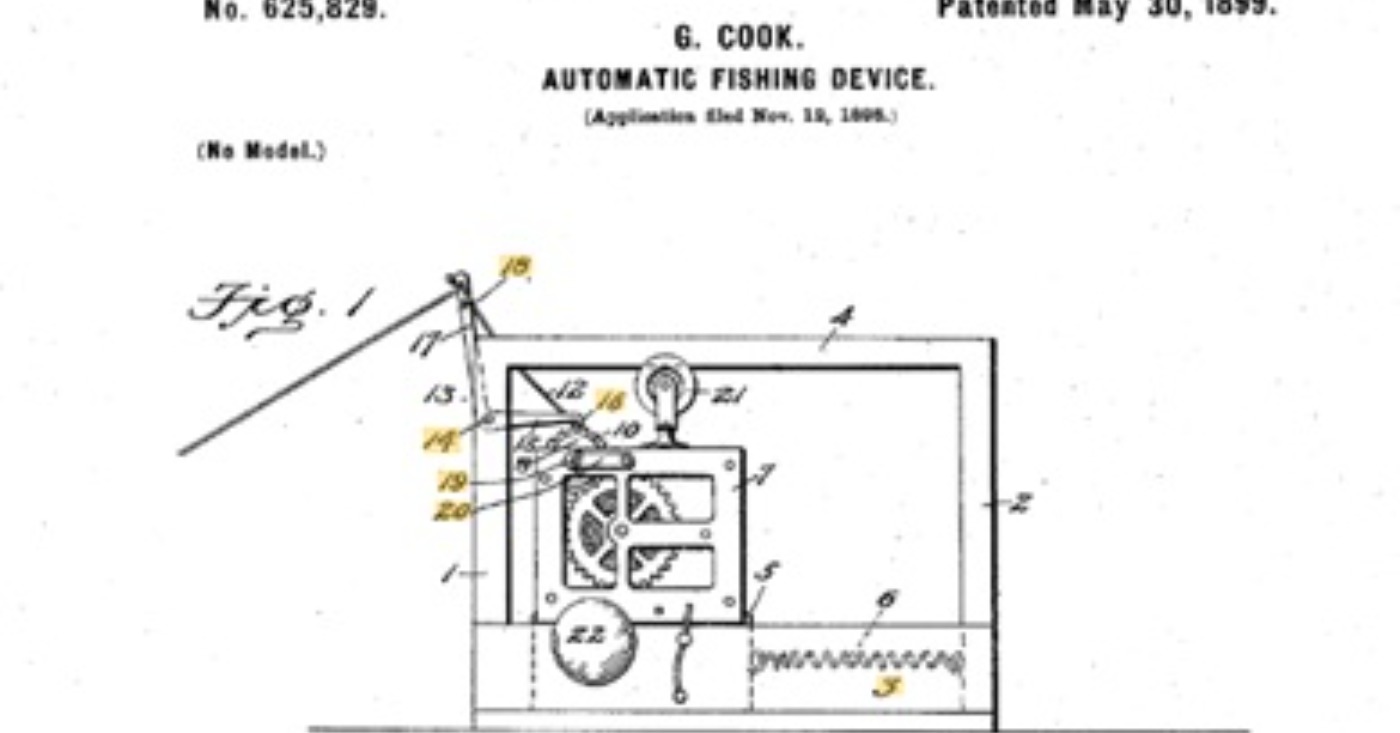
Cook’s most famous invention was the Automatic Fishing Device. He received U.S. Patent No. 625,829 for it on May 30, 1899. His patent shows that he was not just someone with an idea, but someone who made it happen.
So, what did the Automatic Fishing Device do? Imagine fishing with a line in the water. Usually, you have to watch carefully and pull the line at just the right moment when a fish bites. Cook wanted to make that process easier. His device was designed to react when a fish pulled on the line. The tension from the fish would trigger a lever. That lever would release a spring-loaded part of the device, causing it to move quickly and help pull in the line. The device also had an alarm gong that would ring to let the fisher know something was happening.

This invention was important because it used simple mechanical ideas in a clever way. Springs, levers, rails, and alarms were not new by themselves, but Cook combined them to solve a real problem. His device showed how inventors often take familiar parts and arrange them in a new way to make life easier.
Cook looked at fishing and asked, “How can this be improved?” Then, he created a device that could respond automatically when a fish tugged on the line. His invention let fishermen relax instead of watching the line for hours, trusting the alarm to alert them.
Cook may not be as famous as some inventors, but his Automatic Fishing Device shows that creativity and innovation can be applied anywhere. His legacy lives on as part of the larger story of Black innovation in America.

Business
Gov. Newsom Announces $109.6 Million in Funding for 278 Supportive Homes in Bakersfield, Contra Costa, Sacramento and Fresno
POST NEWS GROUP — “Every Californian deserves a safe place to call home, particularly the veterans who bravely served our country,” said Newsom in a statement on July 23. “California voters approved Proposition 1 because they know we must do more to address homelessness and behavioral health challenges.”

Last week, Gov. Gavin Newsom announced $109.6 million in Proposition 1 funding to create 278 permanent supportive homes in Bakersfield, Contra Costa County, Sacramento and Fresno, including 103 homes reserved for veterans experiencing or at risk of homelessness.
The funding, awarded through California’s Homekey+ program, is intended to expand permanent supportive housing and behavioral health services for veterans and other Californians experiencing or at risk of homelessness. State officials said the investment advances Proposition 1, the voter-approved measure aimed at increasing housing, treatment and support services for people with behavioral health needs.
“Every Californian deserves a safe place to call home, particularly the veterans who bravely served our country,” said Newsom in a statement on July 23. “California voters approved Proposition 1 because they know we must do more to address homelessness and behavioral health challenges.”
The largest award, nearly $32.6 million, will help the City of Fresno and Parkway Prime LLC convert an interim housing project into 84 permanent supportive homes at Parkway Terrace, including nine units reserved for veterans. The City of Sacramento and Urban Capital LLC will receive nearly $31.9 million to develop the Rio Linda Senior Housing Project, which will include 100 homes, 49 of them reserved for veterans.
Contra Costa County and Satellite Affordable Housing Associates will receive $28.8 million to develop an 82-unit senior housing community, with 62 units designated for people experiencing or at risk of homelessness who have behavioral health challenges, including 30 units for veterans. In Bakersfield, Community Action Partnership of Kern will receive nearly $14.1 million to convert a 38-room motel into 30 permanent supportive homes, with 15 units reserved for veterans.
State officials also announced an additional $2.3 million for three previously awarded Homekey+ projects in Olivehurst, Sanger and Stockton, primarily to support operating costs and increase veteran housing.
Since its launch, Homekey+ has awarded $968.4 million to 54 permanent supportive housing projects expected to create 2,749 affordable homes statewide, including 723 homes reserved for veterans. Officials said Proposition 1 is expected to expand California’s behavioral health system by funding additional supportive housing, treatment facilities and services for people experiencing homelessness and behavioral health challenges.
Business
100 Black Wings’ Team Oakland Youth Athletes Heading to Taiwan for 2026 International Children’s Games
By Post Staff The Bay Area Chapter of 100 Black Men is sending nine youth athletes from its 100 Black Wings’ Team Oakland Delegation to Taiwan on Thursday, July 30, to represent the City of Oakland at the 58th International Children’s

By Post Staff
The Bay Area Chapter of 100 Black Men is sending nine youth athletes from its 100 Black Wings’ Team Oakland Delegation to Taiwan on Thursday, July 30, to represent the City of Oakland at the 58th International Children’s Games (IGC) in Hualien County, Taiwan.
The Games will bring together young athletes ages 12 to 15 from 76 city delegations around the world. The opening ceremony is scheduled for Aug. 2, and athletic competitions take place Aug. 3-5.
While many international competitions center around national teams, the ICG brings young people together as representatives of their respective cities. This year’s theme – “Shining Hualien, Shining Together!” – reflects the host city’s vision of using sports, education, culture, and tourism to promote friendship, peace, inclusion, and sustainable development.
“Team Oakland’s participation demonstrates what can happen when young people are given opportunity, preparation, and a community that believes in them,” said Danny L. Williams, chairman of 100 Black Men of the Bay Area, Inc.
“These athletes will carry Oakland’s talent, strength, and spirit onto an international stage while building relationships that can extend far beyond the competition,” he said.
Team Oakland will compete in track and field events including the 100-meter and 400-meter races, hurdles, long jump, shot put, javelin, and traditional and mixed 4×100-meter relays.
The athletes representing Oakland are: DeWayne Littlepage, Gia Goodlow, Abisewolu Redmond, Mahari Moore, Marvin Thomas, Najae Ellison, Royal Moore, Sir Kamryn Lloyd, and Jasani Highsmith.
The delegation’s coaching leadership includes Head Coach Dr. Tommie Smith, the
1968 Olympic gold medalist in the 200-meter sprint; Senior Coach Margaret Dixon;
Girls Coach Evangela Dixon; Strength and Conditioning Coach Nola Turnage;
and Boys Coach Michael Flood, Jr.
Delegation leadership also includes Williams, Head of Delegation Juanita Metters-Upshur, and city representative Dr. Mark Alexander.
“Our athletes have trained with tremendous discipline, but this journey represents much more than competition,” said Metters-Upshur, head of delegation. “They will have the opportunity to travel internationally, proudly represent Oakland, experience another culture, and form friendships with young people from communities across the world. We are incredibly proud of them and grateful to the families, coaches, partners, and supporters who have helped make this experience possible.”
In addition to track and field, the games will feature swimming, tennis, table tennis, Taekwondo, archery, football, and 3×3 basketball. Hualien County is located between Taiwan’s Central Mountain Range and the Pacific Ocean and hosts the International Children’s Games for the first time this year.
The International Children’s Games were founded in 1968 by Slovenian coach Metod Klemenc, based on the belief that sports can bridge differences in culture, religion, and race.
The ICG is approved by the International Olympic Committee and emphasizes friendship, fair play, teamwork, perseverance, and cultural understanding among young people.
The Oakland delegation’s participation reflects the 100 Black Wings’ programmatic commitment to developing young people through athletic achievement, discipline, leadership, cultural exposure, and global citizenship.
Team Oakland is supported by a network of families, coaches, community partners, and advocates who believe that international experiences can expand how young people view themselves and their possibilities.

WORK FROM HOME
Home-based business with potential monthly income of $10K+ per month. A proven training system and website provided to maximize business effectiveness. Perfect job to earn side and primary income. Contact Lynne for more details: Lynne4npusa@gmail.com 800-334-0540


Misty Copeland Shapes Ballet’s Tomorrow

As Part of Your Back-to- School Checklist, Vaccinate

As Part of Your Back-to- School Checklist, Vaccinate

Congresswoman Simon Demands Investigation into Trump’s Abuse of Emergency Powers for Coal Export Terminal in West Oakland

OPINION: The Philippines Isn’t Foreign When Your Family Still Lives There

Asm. McKinnor’s Bill Banning Drones Above Outdoor Entertainment Events Awaits Senate Decision

California Sen. Padilla Joins Colleagues to Introduce Bill Imposing Term Limits on Supreme Court Justices

Department of Homeland Security Demands California Secretary of State Shirley N. Weber Scrub Voter Rolls

George Cook: The Inventor Who Made Fishing Smarter

Gov. Newsom Announces $109.6 Million in Funding for 278 Supportive Homes in Bakersfield, Contra Costa, Sacramento and Fresno

Rep. Kamlager Dove Demands Care, Justice for Man Shot by ICE

“The Power to See Threats Sooner”: Gov. Newsom, Safety Officials Showcase California’s Investments in Hi-Tech Wildfire Prevention

100 Black Wings’ Team Oakland Youth Athletes Heading to Taiwan for 2026 International Children’s Games

Oakland ‘Port Serves as a Powerful Engine for Good Jobs and Economic Development

Oakland Faith Leaders Welcome New Police Chief, Mobilize Around Housing and Civic Action
Department of Homeland Security Demands California Secretary of State Shirley N. Weber Scrub Voter Rolls

Oakland Children’s Hospital Workers and Patients Rally for Pediatric Medical Care
“The Power to See Threats Sooner”: Gov. Newsom, Safety Officials Showcase California’s Investments in Hi-Tech Wildfire Prevention

New Judge Could Decide if Karmelo Anthony Gets a New Trial

Surveillance Pricing Fight: State Senate Debates Bill Banning Retailers from Using AI to Set Prices Based on a Buyer’s Profile

Mount Zion MBC, Church of Jesus Christ of Latter-day Saints Partner to Bring 29,000 Meals to Alameda County

Alpha Kappa Alpha Sorority, Inc. Celebrates New North Atlantic Regional Director
California Sen. Padilla Joins Colleagues to Introduce Bill Imposing Term Limits on Supreme Court Justices

Starting This Summer, California Car Buyers Can Get an Instant $3500 Off the Cost of Electric Vehicles

COMMENTARY: You Are Already Paying for the AI Boom

California Bill Would Let Abuse Victims Use Trauma as Legal Defense for Violent Crime

Fed Court to Decide Landmark First Amendment Case

Gov. Gavin Newsom Signs Law Streamlining Affordable Housing Rules

Oakland Celebrates $125 Million Coliseum Sale

Saving Black Mothers Starts Outside the Hospital

The Conversation With Al McFarlane 6/23/26

Media Monday 6/22/26

LIVE! ASK ALMA! — TUES. 6.23.26 7PM EST

Car Buying Secrets: 4 Hidden Checks Before You Sign!

Is This 550 HP Charger Worth YOUR Money? AutoNetwork Review

Celebrating Juneteenth – Frederick Douglass on education and resistance

LIVE! — ASK ALMA! — TUES. 6.19.26 7PM EST

Hyundai Ioniq 5 Parking, Safety, and 360 View #shorts

2025 Ioniq 5 New Wiper & Powerful Performance! #shorts

Electric SUV Range: Is 259 Miles Enough? #shorts

EV Charging: How Fast Can You Charge an Electric Vehicle? #shorts

Biometric Cooling… Messaging Seats…Come on! 2025 Infiniti QX80 Autograph 4WD

Charged Up: Witness the Magic of a Fully Electric Car! #shorts

Range Rover Sport PHEV Included…: See What’s Inside This Luxury SUV! #shorts

Invisible Hood View: Perfect Parking with X-Ray Vision! #shorts
-
 Featured3 days ago
Department of Homeland Security Demands California Secretary of State Shirley N. Weber Scrub Voter Rolls
-
 Business2 weeks ago
Oakland Children’s Hospital Workers and Patients Rally for Pediatric Medical Care
-
 Environment3 days ago
“The Power to See Threats Sooner”: Gov. Newsom, Safety Officials Showcase California’s Investments in Hi-Tech Wildfire Prevention
-
 #NNPA BlackPress2 weeks ago
New Judge Could Decide if Karmelo Anthony Gets a New Trial
-
 Business2 weeks ago
Surveillance Pricing Fight: State Senate Debates Bill Banning Retailers from Using AI to Set Prices Based on a Buyer’s Profile
-
 Business2 weeks ago
Mount Zion MBC, Church of Jesus Christ of Latter-day Saints Partner to Bring 29,000 Meals to Alameda County
-
 Black History1 week ago
Alpha Kappa Alpha Sorority, Inc. Celebrates New North Atlantic Regional Director
-
 Featured3 days ago
California Sen. Padilla Joins Colleagues to Introduce Bill Imposing Term Limits on Supreme Court Justices
