
Bay Area
Post Salon Backs Call on State Officials to Investigate and Remove FCMAT


The Oakland Post Community Assembly, along with parents and teachers in the Oakland Not For Sale (ONFS) coalition, hosted a community discussion last Sunday aimed at opposing the school closures, austerity, and privatization that are threatening the future of Oakland public schools.
The gathering focused on ways to stop the closing of Oakland schools, carried out by the district under the guidance of a non-elected state-funded agency, the Fiscal Crisis Management and Assistance Team (FCMAT).
Attendees praised the Salon for providing rarely discussed information about the power and operation of FCMAT which began pressing the district to close schools at the time when the State took all power away from local residents in 2003 Then state administrator Randy Ward, working in tandem with FCMAT, asked an aide to find out how much money it would save to close schools. The aide returned a few days later with the information that closing schools does not save money, and Ward responded, “Then go back and find another reason for closing schools.”
The state-appointed FCMAT has continued to dominate school district decisions because of the unnecessarily large debt imposed on the district in 2003. FCMAT has at various times become the overseer to nine school districts. In every case, these districts were disproportionately Black and Latino, compared to the rest of the state.
OUSD has already closed 18 schools since the state took over in 2003, and 14 of those buildings have been taken over by charters. All of those schools served predominantly flatlands students. Other schools have lost classroom space as they have been forced to “co-locate” charters on their campuses.
This past school year, the district closed Roots International Academy and recently decided to close Kaiser Elementary and Oakland SOL. The district has committed to closing more schools over the next four years. There are 24 schools on the list of threatened sites, though OUSD has not revealed how many of them will be actually closed.
“The purpose of this salon is not to have an organized gripe session, a place to vent, but rather to take these concerns and convert them to a plan of action and a commitment to action,” said Oakland Post publisher Paul Cobb, who moderated the panel and the discussion that followed. . “The most important thing is that we need a community response and a political organizing response to put pressure for change,” he said.
Among the proposals raised by various individual participants was running a slate next year of four school board candidates who are committed to fighting for the community. Others proposed a recall of school board members. And others planned to set up a meeting with Oakland’s state legislators and Superintendent of Public Instruction Tony Thurmond to discuss the unfair aspects of Oakland’s debt and FCMAT’s actions.
Parents and teachers who are members of Oakland Not for Sale asked for the community to attent the next school board meeting to protest school closures and school board violence, Wednesday, Nov. 13, at 5:30 p.m. at La Escuelita Elementary at 1050 Second Ave. This meeting will give the community a chance to show that the community is not intimidated by the district’s use of police.
The first of the six panelists was Cherisse Gash, a parent from Kaiser Elementary, who said she attended Kaiser as a child and chose Kaiser for her child. “Without fail, the school did exactly did what they were supposed to do for my son. They loved him. They made sure he felt encouraged as a student.”
“We are going to fight for our schools,” she said. “We need board members that support students first.”
Another speaker was Roots teacher Quinn Ranahan, who fought to save her school. “It was a really beautiful place. I loved my kids. There was something that was really magical happening there.”
Central office administrators showed up last December to notify the school community that Roots would close in June. Ignoring its own community engagement policies, the board also ignored the hundreds of parents, teachers and students who protested at school board meetings voting on Jan. 28 to close the school.
Many Roots students were moved to schools that are slated to close next year. “Our kids will again be in an unstable environment,” Ranahan said.
Howard Elementary teacher Yael Friedman talked about how Francophone Charter had taken over part of her school. Under the co-location policy, it was given seven of the 16 classrooms at the school, forcing the Howard to move its reading intervention class to a closet.
She said the teachers went to the school board meeting and showed them photos of the class being taught in the closet. “They said ‘Oh my goodness’ but then they said there was nothing they could do.”
While Howard is told it is losing classrooms because it is under-enrolled, parents report they try to enroll their children at Howard and are told by the district that there is no room!
Representing the Oakland Education Association (OEA) was Executive Board Member Kampala Taiz-Rancifer.
“OUSD has a long legacy of closing schools, primarily in Black and Brown and communities,” she said. “They’ve been intentionally defunding our schools. We’re going to need a new school board, and) we’re trying to figure out right now how to stop these really racist practices.”

The 2019 Post Salon.
Sylvester Hodges was President of the School Board during an earlier era, when the Board prevented State take-over. He said “You have to follow the money,” to see who will make money off school closures – the charter schools that want the campuses and the developers property to build upscale condominiums. The attack on public schools was well planned, he said. “They have supplied the district with all the necessary ingredients to ignore us, and do what they want. They have already sold themselves out.”
This reporter spoke about the role of FCMAT, which he observed while a school district employee during the state takeover in 2003 and later as a reporter.
With FCMAT in charge, along with State Receiver Randy Ward, the word around the district was that OUSD would be drastically downsized, “small enough to hold in your hands,” cutting something like 36 schools, compared to the over 90 school sites the district had at the time.
The salon adjourned after unanimously agreeing to work on various actions, including a meeting with state elected officials






Activism
Oakland Post: Week of March 18 – 24, 2026
The printed Weekly Edition of the Oakland Post: Week of March 18 – 24, 2026


To enlarge your view of this issue, use the slider, magnifying glass icon or full page icon in the lower right corner of the browser window.

Activism
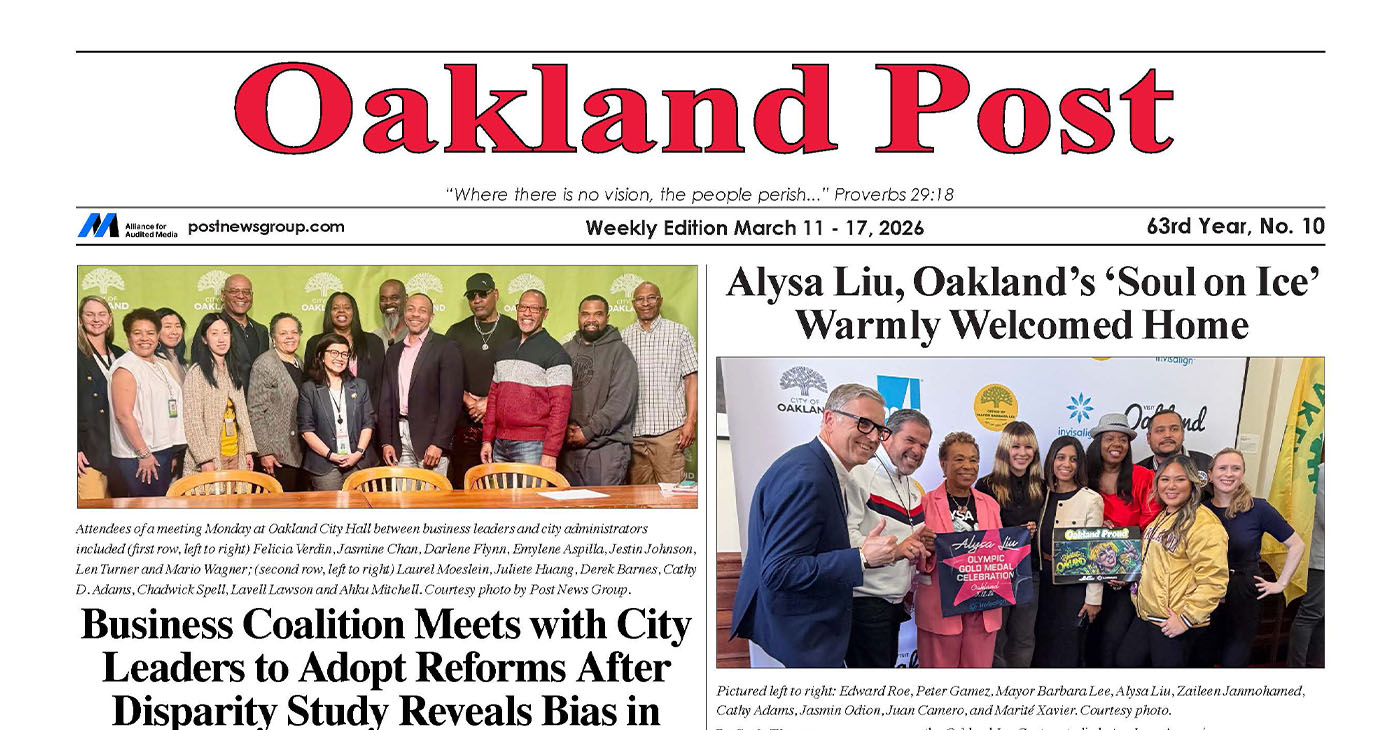
Oakland Post: Week of March 11 -17, 2026
The printed Weekly Edition of the Oakland Post: Week of March 11 – 17, 2026
To enlarge your view of this issue, use the slider, magnifying glass icon or full page icon in the lower right corner of the browser window.
Activism
Oakland Post: Week of March 4 – 10, 2026
The printed Weekly Edition of the Oakland Post: Week of March 4 – 10, 2026

To enlarge your view of this issue, use the slider, magnifying glass icon or full page icon in the lower right corner of the browser window.

WORK FROM HOME
Home-based business with potential monthly income of $10K+ per month. A proven training system and website provided to maximize business effectiveness. Perfect job to earn side and primary income. Contact Lynne for more details: Lynne4npusa@gmail.com 800-334-0540


Black Artists in America, Installation Three Wraps at the Dixon Gallery and Gardens

Grief, Advocacy, and Education: A Counselor Reflects on Black Maternal Health

Future of Florida’s Black History Museum in Limbo

New Research Shows the Many Benefits of Early Learning

South Hampton K-8 Students Among Top 10 Finalists for Samsung’s ‘Solve for Tomorrow’ Competition

Cuba: No Negotiation with US on the President or Political System

Brooklyn Academy of Music Names Jamaican-Born Tamara McCaw as President

Trinidad & Tobego – U.S. Launches WhatsApp Channel for American Citizens in the Country

Oakland Post: Week of March 18 – 24, 2026

AI Innovation vs. Ethics and Environmental Impact

AI, Web3, and Digital Reparations

What If You Owned Your AI Agent?

Season 7, Episode 3 – January Reporter’s Roundtable 📱

Season 7, Episode 3 – January Reporter’s Roundtable

AI, Media, and Power | Part 2, Real-World Impacts and Tradeoffs

Oakland Post: Week of February 11 – 17, 2026

Reflecting on Black History Milestones in Birmingham AL

Rising Optimism Among Small And Middle Market Business Leaders Suggests Growth for California

CITY OF SAN LEANDRO STATE OF CALIFORNIA PUBLIC WORKS DEPARTMENT ENGINEERING DIVISION NOTICE TO BIDDERS FOR ANNUAL STREET OVERLAY/REHABILITATION 2019-21 – PHASE III

Oakland Post: Week of February 18 – 24, 2026

PRESS ROOM: NBA Hall of Fame Nominee Terry Cummings Joins 100 Black Men of DeKalb County to Launch Victory & Values Initiative

Oakland Post: Week of February 25 – March 3, 2026

Trump’s MAGA Allies are Creating Executive Order Plan to Steal the 2026 Midterms

U.S. manufacturing rebounds – how foundry services are adapting to rising demand

OP-ED: One Hundred Years of Black Workers Telling the Truth

Advancements in solar technology that are changing the way we power the world

Chase Oakland Community Center Hosts Alley-Oop Accelerator Building Community and Opportunity for Bay Area Entrepreneurs

Poll Shows Support for Policies That Help Families Afford Child Care

PRESS ROOM: Civil Rights TV Launches in Selma as the World’s First 24/7 Civil Rights Television Network

Oakland Post: Week of March 4 – 10, 2026

Hyundai Ioniq 5 Parking, Safety, and 360 View #shorts

2025 Ioniq 5 New Wiper & Powerful Performance! #shorts

Electric SUV Range: Is 259 Miles Enough? #shorts

EV Charging: How Fast Can You Charge an Electric Vehicle? #shorts

Biometric Cooling… Messaging Seats…Come on! 2025 Infiniti QX80 Autograph 4WD

Charged Up: Witness the Magic of a Fully Electric Car! #shorts

Range Rover Sport PHEV Included…: See What’s Inside This Luxury SUV! #shorts

Invisible Hood View: Perfect Parking with X-Ray Vision! #shorts

AI Is Reshaping Black Healthcare: Promise, Peril, and the Push for Improved Results in California

ESSAY: Technology and Medicine, a Primary Care Point of View

Sanctuary Cities

The RESISTANCE – FREEDOM NOW

STATE OF THE PEOPLE: Freddie

ECONOMIC BOYCOTT DAY!!!!!

I told You So
-
 Activism4 weeks ago
Oakland Post: Week of February 25 – March 3, 2026
-
 #NNPA BlackPress4 weeks ago
Poll Shows Support for Policies That Help Families Afford Child Care
-
 Activism3 weeks ago
Oakland Post: Week of March 4 – 10, 2026
-

 #NNPA BlackPress3 weeks ago
Woman’s Search for Family’s Roots Leads to Ancestor John T. Ward – A Successful Entrepreneur and Conductor on the Underground Railroad
-

 #NNPA BlackPress3 weeks ago
OP-ED: NNPA Launches 2026 “Leadership Matters” Video Series
-

 #NNPA BlackPress3 weeks ago
Advocates Raise Alarm Over ICE Operation, MOU and Detention Risks in Baltimore County
-

 #NNPA BlackPress3 weeks ago
COMMENTARY: Women of Color Shape Our Past and Future
-

 #NNPA BlackPress3 weeks ago
Pete Buttigieg to Join Mayor Randall Woodfin for Community Town Hall in Birmingham
