
Activism
City Begins Wood Street Homeless Encampment Clearance and Faces Protest


On Nov. 5 and 6, the City of Oakland began a clearance operation of a homeless encampment on a privately owned tract of land west of Wood St in West Oakland and were met with local residents who protested against displacing homeless people.
“I’ve developed relationships with people that live there and I understand that their situation is precarious,” said local resident Dale Smith, who protested on Nov. 6. “I don’t think the solution the city is putting forth is going to work.”
The city plans to eventually clear the lot, which runs about quarter mile from north to south. Oakland residents have lived there for over five years in vehicles, tents and self-made structures. No one knows exactly how many people live on the site, but most residents claim there are over 100. The lot has become more crowded recently as residents have been evicted from other areas of the city. Some residents claim that police officers directed them to the site.
“The city has been reviewing the idea of converting this privately owned lot to a safe RV parking area that would serve West Oakland RV dwellers,” said assistant city administrator Joe DeVries, “but the owner would need to clean it thoroughly first.”

The land is owned by a corporation called GameChanger LLC, but the city hasn’t stated who the individual owner is. The East Bay Times has reported that GameChanger LLC’s owner agreed to lease the land to the city for the next two to three years free of charge. As the city’s stated goal for Nov. 5 and 6 was to clear all vehicles from the site, GameChanger also agreed to pay the estimated quarter million dollar towing bill to the city.
The city’s communication director, Karen Boyd, claims OPD identified 139 vehicles that needed to be towed. Although the majority of the vehicles were abandoned, many of the lot’s RVs, vans, and buses serve as homes for people who are unable to afford housing in Oakland.
Past Oakland homeless clearances and evictions have resulted in people losing their vehicle-homes to impound lots. The poorest of the poor were especially vulnerable to these losses, as vehicle-homes that no longer ran were most likely to be impounded. Since many of the lot’s residents had been evicted before and lost their vehicle-homes, they, and the protestors supporting them feared they would lose them again.
On Nov. 5, over 35 housed protestors joined their unhoused neighbors, held signs and chanted “shame” and “quit your jobs” as police officers walked through the lot, directing people out of the way so tow operators could tow vehicles. Some of the signs read “Don’t tow our homes,” “Stop the evictions,” and “Ayuda no destruye,” which means “help don’t destroy” in Spanish.
After word spread that during the present clearance vehicles that served as people’s homes would be towed off the lot and unto Wood Street, as opposed to impound lots, the number of protestors dwindled, though homeless people and their housed supporters were still unhappy with the move. Around a dozen protestors showed up on Nov. 6.

Natasha Noel, a lifelong Oakland resident who was evicted from her home of 17 years, sits in front of her RV with a sign rested on it that says “I live here. this is my home.” Photo by Zack Haber
“It’s more of a safety zone in here and out on streets it’s more public,” said Jennifer ‘Harley’ Boslar, who was forced to move from the lot, “I feel like accidents can happen. A car could run into your RV. A semi-truck could run into your RV. People can get easier access to your RV than they can behind the fence.”
Wood Street, where many of the vehicles were moved, is a major route for big rig trucks. The Wood Street lot sits behind a fence with two small entrances, so residents have an easier time monitoring who approaches their vehicle-homes.
As of the night of Nov. 6, 15 vehicle-homes remain on the site. Police were unclear about when the remaining vehicles would be moved as the clearance was only originally planned to be a two day operation.
Natasha Noel, who grew up in Oakland and was recently evicted from her home of 17 years, still lives in an RV on the site and wants to stay there.
“I don’t feel like [moving] is a safe option at all,” said Noel. “On the street we’re likely to be towed at any second.”








Activism
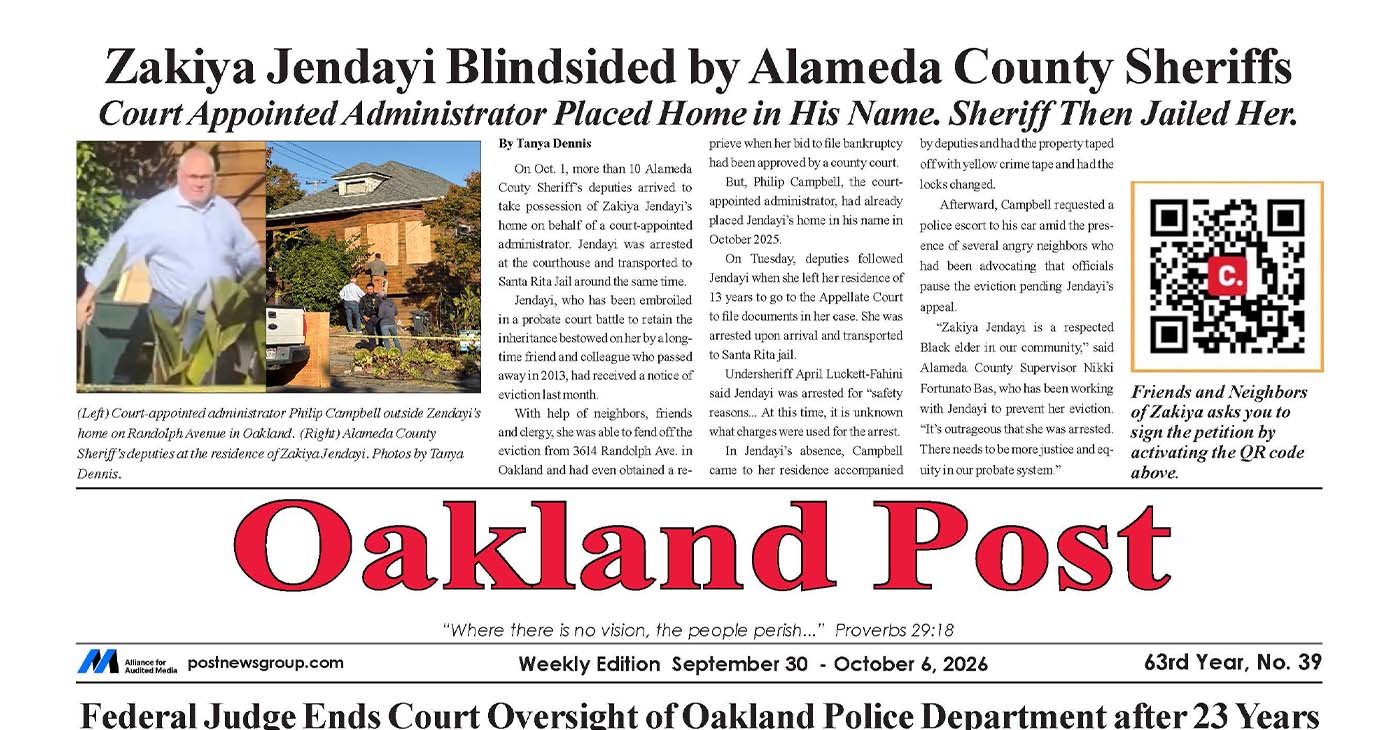
Oakland Post: Week of September 30 – October 6, 2026
The printed Weekly Edition of the Oakland Post: Week of September 30 – October 6, 2026

To enlarge your view of this issue, use the slider, magnifying glass icon or full page icon in the lower right corner of the browser window.


Activism
Oakland Post: Week of September 23 – 29, 2026
The printed Weekly Edition of the Oakland Post: Week of September 23 – 29, 2026

To enlarge your view of this issue, use the slider, magnifying glass icon or full page icon in the lower right corner of the browser window.
Activism
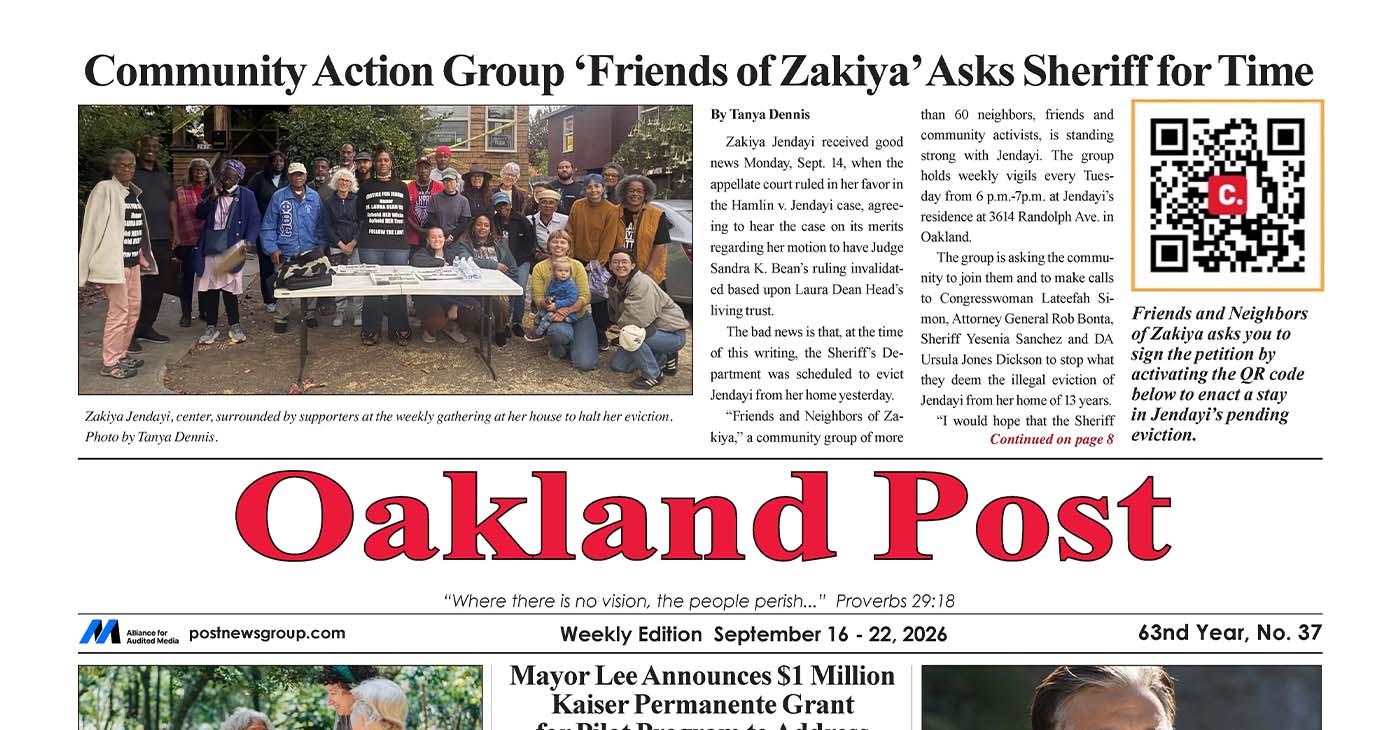
Oakland Post: Week of September 16 – 22, 2026
The printed Weekly Edition of the Oakland Post: Week of September 16 – 22, 2026
To enlarge your view of this issue, use the slider, magnifying glass icon or full page icon in the lower right corner of the browser window.



Listening as a Lifeline: A Doula’s Witness to Black Maternal Health

New Protections for Ticket Buyers: Gov. Newsom Signs Assemblymember Isaac Bryan’s Bill

‘We Don’t Talk Trash — We Pick Up Trash!’

Zakiya Jendayi Arrested, Locked Out of Home by Sheriff’s Deputies

Oakland Post: Week of September 30 – October 6, 2026

Asm. Corey Jackson Announces Launch of 24-Hour Childcare in His District

IN MEMORIAM: The Rev. Leon “Sonny” Clark, Longtime Orange County Pastor and Community Leader, Dies at 72

Poll: Becerra Widens His Lead Over Hilton; Californians Split on Wealth Tax

From Historic Memories to New Possibilities: Oakland Celebrates Coliseum 60

County Office of Education Says OUSD Finances Are Getting Healthier, Materially Stronger

LIVE FREE Sunday Dinner Brings Faith, Fellowship and Civic Conversation to Oakland

Remembering Chauncey Bailey as Student Journalists Face Threats to Truth-Telling

BLACspace Cooperative Invites Bay Area to Experience Oakland’s Black Cultural Ecosystem Through a BLAC Map Tour + Party

In Wake of Death on Doorstep, Williams Chapel Baptist Church Calls for Better Care, Funding for Unhoused

Oakland Centenarian Nuna McKee Honored!

Standoff for Justice: Our Homes Are Worth Fighting For

Oakland Post: Week of August 26 – September 1, 2026

Frontier Airlines’ Return to Oakland Airport Brings Flights, Jobs and Opportunity

Gubernatorial Candidate Steve Hilton Blasts California New Tire Rules; Newsom Hits Back

Chef Sharon Lee Blends Culinary Excellence, Education and Empowerment

Jackie Wright Champions Bay Area Stories, Filmmakers and Cultural Institutions

Misnamed ‘Parent’ PAC Seeks to Influence Oakland School Board Elections

Oakland Coliseum Project Opens Door for Small Businesses to Build Bigger

Big City Mayors Ask for “Yes” Vote on Housing Bond Measure; Conservatives Say “No”

Gov. Newsom’s Latest Appointees Include Sacramento Advocate for Formerly Incarcerated Students; State’s New Tech Chief

Longtime BWOPA Member Brendalyn Goodall Appointed to California Workforce Development Board

Gov. Newsom Signs Law Shielding Immigration Aid Workers From Doxing Threats

Secretary of State Shirley N. Weber Urges Californians to Vote Early as Voter ID Battle Intensifies

Oakland Post: Week of September 2 – 8, 2026

IN MEMORIAM: Dolly Parton Dead at 80 — How She Built a Legacy of Love and Earned Her Place in Black Culture

The Conversation With Al McFarlane 6/23/26

Media Monday 6/22/26

LIVE! ASK ALMA! — TUES. 6.23.26 7PM EST

Car Buying Secrets: 4 Hidden Checks Before You Sign!

Is This 550 HP Charger Worth YOUR Money? AutoNetwork Review

Celebrating Juneteenth – Frederick Douglass on education and resistance

LIVE! — ASK ALMA! — TUES. 6.19.26 7PM EST

Hyundai Ioniq 5 Parking, Safety, and 360 View #shorts

2025 Ioniq 5 New Wiper & Powerful Performance! #shorts

Electric SUV Range: Is 259 Miles Enough? #shorts

EV Charging: How Fast Can You Charge an Electric Vehicle? #shorts

Biometric Cooling… Messaging Seats…Come on! 2025 Infiniti QX80 Autograph 4WD

Charged Up: Witness the Magic of a Fully Electric Car! #shorts

Range Rover Sport PHEV Included…: See What’s Inside This Luxury SUV! #shorts

Invisible Hood View: Perfect Parking with X-Ray Vision! #shorts
-
 Community3 weeks ago
Misnamed ‘Parent’ PAC Seeks to Influence Oakland School Board Elections
-
 Activism4 weeks ago
Oakland Post: Week of September 2 – 8, 2026
-

 Community3 weeks ago
Richmond Tiny House Village Farm & Garden Set to Open Gates on Sept. 26
-

 Activism3 weeks ago
Oakland Post: Week of September 9 – 15, 2026
-

 Black History3 weeks ago
Latest Massacre in Haiti Reveals Cruelty U.S. Deportations
-

 Black History3 weeks ago
OPINION: Nolan Wells’ Death One of Several Signifying Racial Terror Lives on in U.S. South
-

 Community3 weeks ago
Democratic Clubs Interview Candidates for Oakland School Board
-

 Business2 weeks ago
Mayor Lee Announces $1 Million Kaiser Permanente Grant for Pilot Program to Address Homelessness, Clean Up Public Spaces throughout Oakland
