
Bay Area
Black Firefighters’ Long Struggle for Equality in Oakland

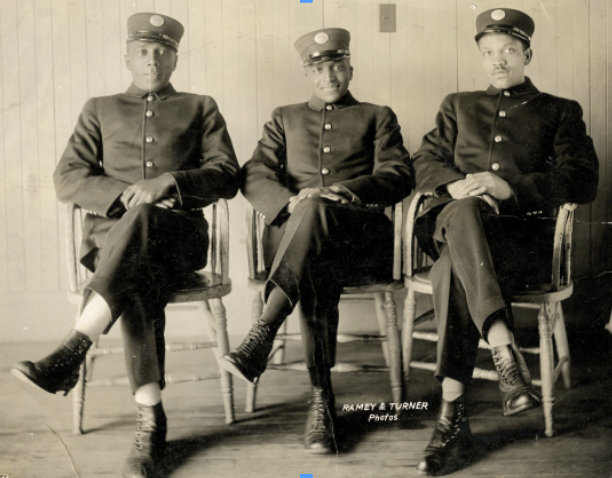
They were young, brazen heroes who faced danger and death during their tenure as Oakland’s first Black firefighters. Nearly a century ago on January 1, 1920, the first Black firefighter joined the city’s Fire Department, with two others to follow a short time later.
“These three men worked in the same firehouse on Eighth and Alice streets as their white counterparts, but on separate shifts,” said Marco Frazier, library assistant and blogger at the African American Museum & Library at Oakland. “It wasn’t until 1925 that the first all-Black firehouse Engine #22 opened in West Oakland at 3230 Magnolia St.”
“After the hiring opened up, 25 other Blacks were brought in, which resulted in the need for additional firehouses to handle the overload. Two other firehouses, Engines #33 and #28 were later opened in the Oakland hills,” added Frazier.
Frazier further noted that “the working conditions for Black firefighters were not comparable with those of their white counterparts. Firefighters, along with the NAACP, challenged the status quo of the Oakland Fire Department (OFD) and sought changes in the working conditions. They began to fight back against racial, discriminatory and segregation practices.”
After the NAACP became involved, the OFD “integrated” on June 1, 1952. However, Samuel Golden, a Black firefighter termed this move as “token integration.” Mainly because in integrated firehouses, Black firefighters were not allowed to use the refrigerator, so their mates had to bring them meals while on shift. Additionally, the Black firefighters had to bring their own bedding because white firefighters would not let them use theirs.
According to Frazier, because the Black firefighters needed further support to confront discriminatory practices, Oakland labor leaders C.L. Dellums and Tarea Hall Pittman became instrumental in getting Oakland fire and police departments to integrate. Golden, insisting on more action, pressured the city manager for a change to eliminate discrimination practices. The city manager capitulated and had the department hire light-skinned firefighters to integrate an all-white station.
However, this form of integration still didn’t settle well with Dellums and the NAACP, who, in 1955, approached the Oakland city manager to voice their concerns. As a result, official integration took place on Aug. 5, 1955. After integration, whites and
Blacks worked fires as a team, but the attitudes of the white firefighters remained the same. These attitudes remained until younger, white firefighters replaced older retiring firefighters.
“Moving up the ranks was tough,” said Frazier. “The first Black firefighter promoted in the OFD was Royce Troyce. He was promoted to engineer in the early ’30s at Engine No.22. Pat Taylor was promoted to become the first Black lieutenant at the OFD and became captain in 1949, the highest ranking black in the OFD until 1973 when Sam Golden made battalion chief.
Previously, Golden had been promoted to the rank of engineer in 1958, lieutenant in 1961, captain in 1964 and battalion chief in 1973. In 1981, he became the first Black fire chief in Oakland.
For more information on early Black firefighters in the Oakland Fire Department, please review the archival interviews of Samuel Golden and Lamont Ewell at the AAMLO or visit the oaklandlibrary.org.








Activism
Oakland Post: Week of September 23 – 29, 2026
The printed Weekly Edition of the Oakland Post: Week of September 23 – 29, 2026


To enlarge your view of this issue, use the slider, magnifying glass icon or full page icon in the lower right corner of the browser window.

Activism
Oakland Post: Week of September 16 – 22, 2026
The printed Weekly Edition of the Oakland Post: Week of September 16 – 22, 2026

To enlarge your view of this issue, use the slider, magnifying glass icon or full page icon in the lower right corner of the browser window.
Activism
Oakland Post: Week of September 9 – 15, 2026
The printed Weekly Edition of the Oakland Post: Week of September 9 – 15, 2026

To enlarge your view of this issue, use the slider, magnifying glass icon or full page icon in the lower right corner of the browser window.



Asm. Corey Jackson Announces Launch of 24-Hour Childcare in His District

IN MEMORIAM: The Rev. Leon “Sonny” Clark, Longtime Orange County Pastor and Community Leader, Dies at 72

Poll: Becerra Widens His Lead Over Hilton; Californians Split on Wealth Tax

From Historic Memories to New Possibilities: Oakland Celebrates Coliseum 60

County Office of Education Says OUSD Finances Are Getting Healthier, Materially Stronger

LIVE FREE Sunday Dinner Brings Faith, Fellowship and Civic Conversation to Oakland

Remembering Chauncey Bailey as Student Journalists Face Threats to Truth-Telling

BLACspace Cooperative Invites Bay Area to Experience Oakland’s Black Cultural Ecosystem Through a BLAC Map Tour + Party

In Wake of Death on Doorstep, Williams Chapel Baptist Church Calls for Better Care, Funding for Unhoused

Oakland Centenarian Nuna McKee Honored!

Caribbean Nations Produce Action Plan Calling for UK Reparations Over Slavery

Oakland Post: Week of September 23 – 29, 2026

Doulas Are Helping Black California Moms Navigate Pregnancy–Even as High Mortality Rates Persist

Newsom Signs Addictive Social Media Law to Protect Kids

On Your November Ballot: Prop 38 Would Allocate $8.4 Billion to Immunology and Immunotherapy Funding

Four Candidates, Including Incumbent Barbara Lee, Qualify for Oakland Mayor’s Race

Standoff for Justice: Our Homes Are Worth Fighting For

Oakland Post: Week of August 26 – September 1, 2026

Frontier Airlines’ Return to Oakland Airport Brings Flights, Jobs and Opportunity

Gubernatorial Candidate Steve Hilton Blasts California New Tire Rules; Newsom Hits Back

Chef Sharon Lee Blends Culinary Excellence, Education and Empowerment

Jackie Wright Champions Bay Area Stories, Filmmakers and Cultural Institutions

Big City Mayors Ask for “Yes” Vote on Housing Bond Measure; Conservatives Say “No”

Gov. Newsom’s Latest Appointees Include Sacramento Advocate for Formerly Incarcerated Students; State’s New Tech Chief

Oakland Coliseum Project Opens Door for Small Businesses to Build Bigger

Misnamed ‘Parent’ PAC Seeks to Influence Oakland School Board Elections

Longtime BWOPA Member Brendalyn Goodall Appointed to California Workforce Development Board

Gov. Newsom Signs Law Shielding Immigration Aid Workers From Doxing Threats

Secretary of State Shirley N. Weber Urges Californians to Vote Early as Voter ID Battle Intensifies

From Palestine to Oakland: Seeds for Liberation Examines Shared Struggles for Freedom

The Conversation With Al McFarlane 6/23/26

Media Monday 6/22/26

LIVE! ASK ALMA! — TUES. 6.23.26 7PM EST

Car Buying Secrets: 4 Hidden Checks Before You Sign!

Is This 550 HP Charger Worth YOUR Money? AutoNetwork Review

Celebrating Juneteenth – Frederick Douglass on education and resistance

LIVE! — ASK ALMA! — TUES. 6.19.26 7PM EST

Hyundai Ioniq 5 Parking, Safety, and 360 View #shorts

2025 Ioniq 5 New Wiper & Powerful Performance! #shorts

Electric SUV Range: Is 259 Miles Enough? #shorts

EV Charging: How Fast Can You Charge an Electric Vehicle? #shorts

Biometric Cooling… Messaging Seats…Come on! 2025 Infiniti QX80 Autograph 4WD

Charged Up: Witness the Magic of a Fully Electric Car! #shorts

Range Rover Sport PHEV Included…: See What’s Inside This Luxury SUV! #shorts

Invisible Hood View: Perfect Parking with X-Ray Vision! #shorts
-
 Business4 weeks ago
Chef Sharon Lee Blends Culinary Excellence, Education and Empowerment
-
 Black History4 weeks ago
Jackie Wright Champions Bay Area Stories, Filmmakers and Cultural Institutions
-
 Community4 weeks ago
Big City Mayors Ask for “Yes” Vote on Housing Bond Measure; Conservatives Say “No”
-
 Community2 weeks ago
Misnamed ‘Parent’ PAC Seeks to Influence Oakland School Board Elections
-
 Business4 weeks ago
Longtime BWOPA Member Brendalyn Goodall Appointed to California Workforce Development Board
-
 Community4 weeks ago
Gov. Newsom Signs Law Shielding Immigration Aid Workers From Doxing Threats
-

 Activism3 weeks ago
Oakland Post: Week of September 2 – 8, 2026
-
 Featured4 weeks ago
‘Passing a Law Isn’t The Finish Line’: California Assembly Evaluates Implementation, Results
