Connect with us

Politics

Police: Andrew Young in Car Hit by Cement Truck in Atlanta

Published

on

In this April 9, 2014, file photo, Andrew Young, former Congressman and United Nations Ambassador,  speaks during the discussion panel, LBJ and MLK:Fulfilling a Promise, Realizing a Dream, held at the the Civil Rights Summit at the Lyndon Baines Johnson Library and Museum in Austin, Texas. Young was taken to a hospital Monday, May 11, 2015, as a precaution after a cement truck overturned on a car he was riding in, authorities said. (Rodolfo Gonzalez/Austin American-Statesman via AP, Pool, File)

In this April 9, 2014, file photo, Andrew Young, former Congressman and United Nations Ambassador, speaks during the discussion panel, LBJ and MLK:Fulfilling a Promise, Realizing a Dream, held at the the Civil Rights Summit at the Lyndon Baines Johnson Library and Museum in Austin, Texas. Young was taken to a hospital Monday, May 11, 2015, as a precaution after a cement truck overturned on a car he was riding in, authorities said. (Rodolfo Gonzalez/Austin American-Statesman via AP, Pool, File)

PHILLIP LUCAS, Associated Press

ATLANTA (AP) — Former U.N. ambassador Andrew Young was taken to a hospital Monday afternoon as a precaution after a cement truck overturned on a car he was riding in, authorities said.

Young, 83, was first treated at roadside by emergency crews after Monday’s accident, Atlanta police spokesman Sgt. Greg Lyon said. Young was in one of two vehicles the truck fell on and he had some minor injuries, Lyon said.

Young, who wasn’t driving, was able to walk away from the accident in the city where he had served as a mayor in the 1980s, according to Kelly Jackson, a spokeswoman with the Andrew J. Young Foundation, Inc.

“After being treated at the scene, he went to the hospital as a precaution,” she added in an emailed statement, noting Young’s wife Carolyn was at his side at the hospital hours afterward Monday night.

“He is doing well and is in good spirits,” Jackson wrote, adding he appreciated calls he had received from well-wishers.

A second man was hospitalized with head and hand injuries after being pulled from a crushed car, authorities said. Video shot by a bystander showed people near the scene helping pull the bloodied man from a mangled car and carry him to a nearby sidewalk. It wasn’t immediately clear what car that man was riding in.

Lyon says the truck driver was cited for disobeying a traffic control device and driving too fast for conditions. The truck spilled diesel fuel at the scene and the driver’s identity wasn’t immediately released.

Young had worked closely with the Rev. Martin Luther King Jr. during the civil rights movement decades ago and became the first black Georgian elected to the U.S. House in 1972. He was appointed to serve as the U.S. ambassador to the United Nations by then-President Jimmy Carter in 1977.

He was elected Atlanta mayor in 1981 and again in 1985, according to his foundation.

Copyright 2015 The Associated Press. All rights reserved. This material may not be published, broadcast, rewritten or redistributed.

Continue Reading
Click to comment

Leave a Reply

Your email address will not be published. Required fields are marked *

Activism

Oakland Post: Week of July 8 – 14, 2026

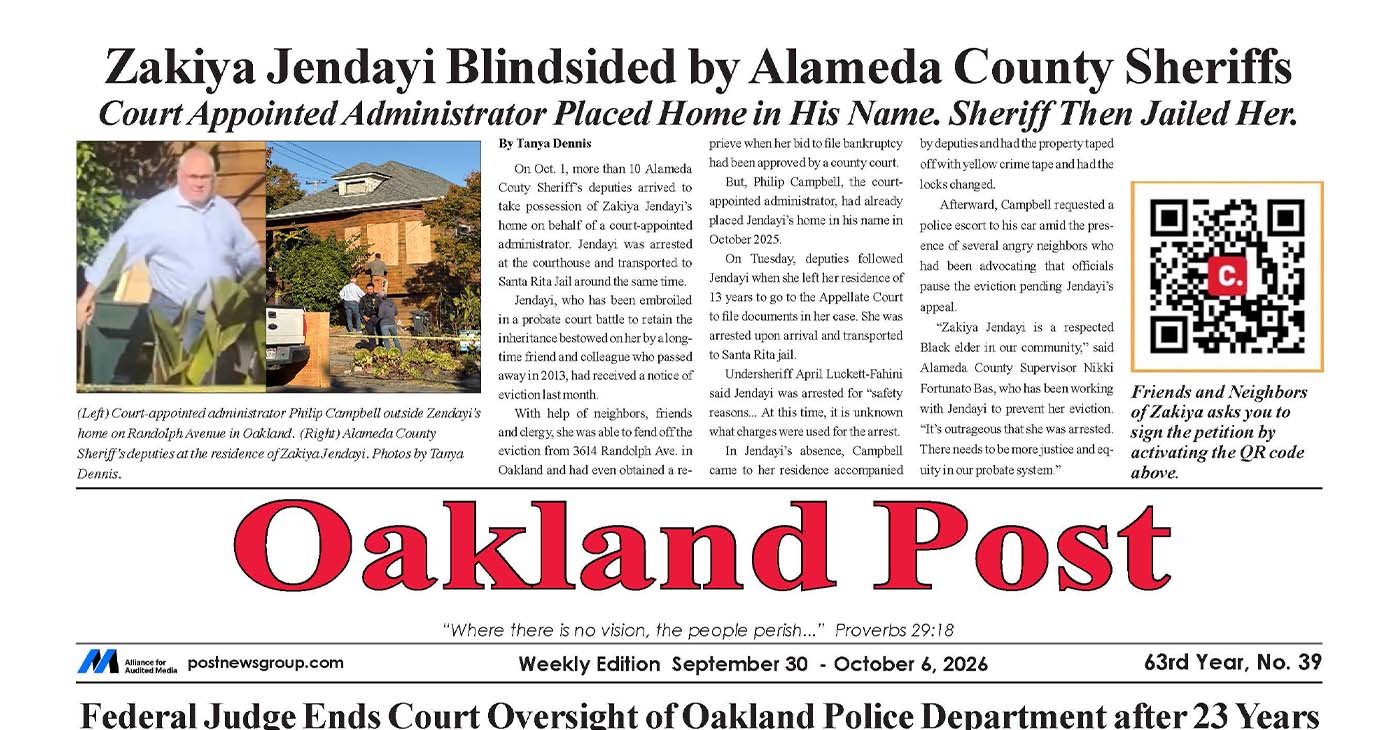
The printed Weekly Edition of the Oakland Post: Week of July 8 – 14, 2026

Published

on

To enlarge your view of this issue, use the slider, magnifying glass icon or full page icon in the lower right corner of the browser window.

Continue Reading

Black History

COMMENATARY: Blackfolk, Is It Past Time for an Exit Strategy?

JACKSONVILLE FREE PRESS — With federal and state governments aligning with what the article describes as an “anti-Black program,” the article questions the efficacy of traditional civil rights strategies.

Published

on

COMMENATARY: Blackfolk, Is It Past Time for an Exit Strategy?

We have arrived at a terrifyingly familiar crossroads. Over the last year and a half, the current administration has executed its Project 2025 playbook to a tee, systematically dismantling the civil rights progress and hard-won gains of the past 60-plus years.

With every branch of the federal government aligned with this anti-Black program—and a majority of state governors and state supreme courts nodding in lockstep—the illusion of permanent legal protection has shattered.

The worst thing Blackfolk can do right now is assume that everything will “automagically” improve. History is screaming a different story. If we look closely at the repeating loops of the American experiment, we must ask an uncomfortable, urgent question: Is it past time for an exit strategy?

Historically, every single time Black people have fought, bled, and successfully forced this country to pivot away from its white supremacist foundations, a radical, violent political pushback has followed.

  • The Reconstruction Precedent: After the abolition of slavery and the brief radiance of Reconstruction, the white backlash plunged Black America into Jim Crow—a violent rollback of rights that lasted roughly a century.
  • The Modern Regression: The monumental gains of the Civil Rights and Black Power movements are being erased right in front of our eyes. In truth, the efforts to dismantle these wins didn’t start recently; they began while the ink on the Voting Rights Act was still wet.

Historians and social commentators today predict that it will take anywhere from 60 to 100 years for Black people living today to fully recover the legal protections, economic ground, and civil rights being stolen from us right now. That means the bitter, unvarnished truth is that most of us living today will not see better days in our lifetime.

If that’s true, why are we still organizing, marching, and voting with the exact same playbook and goals as before? We already know how that story ends: Anti-Black forces will always meet our appeals for justice with violent, economic, and political rollbacks. We need a new approach.

A 21st-century Underground Railroad

For months, national thought leader Lurie Daniel Favors has implored Black people and organizations to stop reacting defensively and start creating the framework for a “21st-century Underground Railroad.” This wouldn’t be a literal trail through the woods, but a sophisticated, underground network designed to allow Black people to escape systemic oppression, pool resources, and find genuine freedom.

But what does a modern exit strategy even look like? The options generally split into two distinct paths: The physical exit and the systemic exit.

“If hereditary bondmen would be free, they must themselves strike the blow… use every means—moral, intellectual, and physical—that promises success,” said the illustrious and under-appreciated Black liberation theologian Henry Highland Garnet, in his Address to the Slaves of the United States, given during the National Negro Convention of 1843. Garnet called for open rebellion against slavery. His idea for an “exit strategy” failed by one vote of being endorsed by the convention.

Option 1: The expatriate route (physical exit)

For some, the answer lies in leaving the United States entirely. This is not a new impulse. In the late 19th and early 20th centuries, Black intellectuals and colonization societies led by figures like Alexander Crummell, Garnet, and Martin Delany argued that Black humanity, creativity, and intellect could never fully flourish on a soil so deeply poisoned by anti-Blackness.

Crummell actively championed emigration, believing that building up self-determining communities elsewhere was a far nobler use of Black genius than begging for citizenship from a nation that despised them.

In 2026, the expatriate route means looking toward West African countries (such as Ghana, with its continued “Year of Return” initiatives), parts of the Caribbean, or European hubs that offer a lower baseline of anti-Blackness. The goal is to relocate to societies that welcome our humanity rather than criminalize it.

But how many of us have the economic capacity to make such a move? On the flip side, how many of us can afford to stay in the U.S. with anti-Blackness rising exponentially daily?

Option 2: Economic secession (systemic exit)

For others, the best exit strategy isn’t physical relocation, but a deliberate exit from America’s economic and social systems. This means creating our own self-reliant, self-determining networks right here. It looks like building independent food supply chains, autonomous security apparatuses, private educational institutions, and closed-loop economic systems. It’s the practice of being in America without being dependent on it. Multiple Black Power Movement members back in the 1960s and 70s called that creating a “nation within a nation.”

The danger of assuming “It can’t happen here”

This is not a message of gloom and doom; it is an urgent wake-up call. Global history is littered with stories of “othered” groups whose rights were slowly, methodically eroded by the dominant society. In almost every instance—from pre-WWII Europe to various global genocides—the erosion of rights started slowly, and then accelerated so fast that it appeared to come out of nowhere.

In every single one of those historical tragedies, there was always a small, prophetic minority calling for an exit strategy. And in every instance, the vast majority of the oppressed group pushed back, insisting that conditions could never get that bad.

Until they did.

Activating the exit

We don’t need a singular, definitive answer today, but we absolutely must begin organizing around the possibilities. Blackfolk need to take concrete steps immediately:

  1. Assess and Resource: Black organizations and individuals must audit their assets, identifying who has the means, dual citizenships, or remote capabilities to pivot.
  2. Build the Infrastructure: We must fund the infrastructure for both paths—supporting those who choose to build autonomous zones of survival in the States, and establishing legal and financial pipelines for those who choose to leave.
  3. Normalize the Conversation: We must strip away the stigma of “giving up” on America. Leaving a burning house isn’t cowardice; it’s intelligence.

We can no longer afford the luxury of hope without a contingency plan. Whether we choose to exit geographically or economically, we must build the backdoor now. History has shown us the script—it’s time we finally change our ending.

Based on reporting by Jacksonville Free Press.


Continue Reading

Black History

Governor Stein Signs Jaleeyah’s Law

THE CAROLINIAN — Governor Josh Stein signed House Bill 1173, known as Jaleeyah’s Law, on Monday, July 6th. The law, named after 13-year-old Jaleeyah Tune, who was fatally shot in December 2025, aims to increase penalties for gang-related crimes and provide more tools for prosecutors.

Published

on

Governor Stein Signs Jaleeyah’s Law

By Jheri Hardaway

Staff Writer

On Monday, July 6th Govenor Josh Stein signed House Bill 1173, widely known as Jaleeyah’s Law, in the presence of Jaleeyah’s mother, family, and community leaders. Jaleeyah’s Law is designed to increase penalties for gang-related crimes and provide stronger tools for prosecutors. The law is named in memory of 13-year-old Jaleeyah Tune who on December 21, 2025, was shot and killed while walking home with her sister. Three teens have been arrested in connection with her death, according to the Goldsboro Police Department; however, the circumstances and details surrounding the murder are not known to the public.

“It’s about giving prosecutors and communities stronger tools. It is about prevention, accountability and protection for families before tragedy happens,” said Whitney Brown-Tune, Jaleeyah’s mother, in a recent press conference. At the bill signing, Brown-Tune also emphasized, “Us as parents, we need to be more accountable for what our kids are doing on social media. It starts on social media before it hits the streets. Keep that in mind.”

Brown-Tune is completely correct. Social media’s profound impact has required changes in policing tactics and should prompt a shift in how we teach and parent our children, who are our future. Laws against organized crime are essential. Organized crime is just as American as student loans. The issue is how we define a gang. There are gangs, executing organized crimes that are not widely recognized as gangs by law enforcement. There are characteristics the state uses to define a gang member that are inaccurate. Jaleeyah’s Law – House Bill 1173 is necessary, but so is reform around law enforcement best practices.

As parents and community leaders do a better job of monitoring and protecting their children’s online presence. Law enforcement should work to better understand the social media landscape and the cultural factors that shape how some present themselves online. Wearing red or being photographed with a firearm are not enough to say someone is in a gang. Alongside this legislation should be more concrete and transparent criteria that law enforcement uses to define a gang member. Subjective social media observations are dangerous and can lead to wrongful convictions by biased law enforcement officials.

How do I know that law enforcement officials need advising on evaluating gang activity? I recently participated in the Harnett County Sheriff’s Office Citizen’s Academy. During the 13-week program, there is a night called “gang night.” The deputies presented a ton of insight into the gangs in and around Harnett County, along with information gathered from the North Carolina Gang Investigators Association.

During the presentation, I was alarmed that Harnett County is only 20% black but 80% of the gang presentation was about Black people. The deputies talked about people using the word “Cuz” as demonstrating gang affiliation, but I use “cuz,” and I’m not in a gang. They talked about the colors red, black, and green being associated with a gang. I’ve always known these colors as black liberation colors and wear them regularly; again, I am not in a gang. The presentation went as far as to show pictures of the Black Israelites, and the officer indicated, “They’re not necessarily a gang, but they’re a group that you should be aware of or afraid of.” I was upset; why vilify groups when they’ve committed no acts of violence? Why don’t they get the right to freedom of religion like other religious groups in America? The definition of a gang or a gang member needs to be evaluated and shared widely. At the conclusion of the Citizen’s Academy, we were encouraged to give feedback. The leadership of the Harnett County Sheriff’s Office expressed gratitude for the feedback and noted that they don’t know unless someone tells them.

I hope this knowledge empowers law enforcement leaders to be more culturally aware and transparent about what alarms them, so we can grow as a community. Dr. Randal Pinkett said, “If you are not prepared to make your organization more receptive to all people of all backgrounds, then you will not be competitive in the 20th century.”

As a Black American growing up in conservative Cary, North Carolina, I was raised to be considerate and aware of all cultures. Jaleeyah’s Law is important for maintaining safety; I hope we also make room for cultural understanding. The way the law is written, a teen or young adult could post something that is interpreted as gang-related and end up with “Enhance penalties for persons convicted of certain felonies if the offense was committed as part of criminal gang activity.”

Based on reporting by The Carolinian.


Continue Reading

Subscribe to receive news and updates from the Oakland Post

* indicates required

CHECK OUT THE LATEST ISSUE OF THE OAKLAND POST

ADVERTISEMENT

WORK FROM HOME

Home-based business with potential monthly income of $10K+ per month. A proven training system and website provided to maximize business effectiveness. Perfect job to earn side and primary income. Contact Lynne for more details: Lynne4npusa@gmail.com 800-334-0540

Facebook

Trending

Copyright ©2021 Post News Group, Inc. All Rights Reserved.