
Activism
OPINION: Let the Voters Vote! Citizens Should Decide on Proposal to Build New Ballpark for Oakland A’s
When the Raiders asked the city to close a $400 million funding gap for additional renovations at the Coliseum in 2015, Mayor Libby Schaaf said no way. In 2015, she told SFGate “we could spend (that money) on police, parks and libraries.” Oakland’s need to address citywide problems is even more dire now than it was seven years ago. How then, can the city consider spending twice as much public money today than was unthinkable seven years ago?


By Paul Cobb, Post Publisher
We applaud Councilmember Carroll Fife’s decision to honor the wishes of Oakland residents and let the voters determine whether it is appropriate to use public funds to support building the Oakland A’s privately owned baseball park and 3,000 luxury condominiums at Howard Terminal.
Oakland faces many challenges including school closures, an ever-increasing homelessness crisis, spiking crime, desperately needed infrastructure repairs of roads, and fire safety investment. Voters should be given the opportunity to decide whether this is the right time to spend hundreds of millions of dollars of public funds on billionaire John Fisher’s privately owned luxury project.
For the past several years, the Oakland A’s have pursued building a new stadium. A strong contingent of Oakland residents wants the stadium to be built at the existing Oakland Coliseum site. For decades, the Coliseum was home to the A’s, Raiders, and Warriors. Each of these teams had great success, sellout crowds, and championship seasons at the Coliseum site.
They also argue that the Coliseum site is shovel-ready, accessible by public transportation, and bordered by two major freeways. It does not have the huge infrastructure costs, estimated at over $800 million, that Howard Terminal requires. But the A’s reject the Coliseum site without good justification, prompting many residents to believe that their objection is really based on not wanting to have a baseball park in a Black neighborhood.

The A’s have set their sights on Howard Terminal, located in West Oakland’s industrial zone, and the heart of the Port of Oakland. Many critics complain that building at Howard Terminal would threaten the viability of the Port of Oakland, and good-paying union jobs.
These complaints were validated when the Seaport Planning Advisory Committee (SPAC) — a committee of the Bay Conservation and Development Commission (BCDC) — said that it was inappropriate to transition lands that are essential for maritime purposes to private use. To support their position, they stated that under the law, if maritime property is needed for current or future maritime use, it cannot be transferred to private non-maritime use.
As well, the International Longshoremen and Warehouse Union (ILWU), Oakland’s largely Black union at the port, convened a work stoppage to protest giving valuable port land to the A’s because it could lead to the loss of hundreds of union jobs, and disrupt port activities at a time where the entire nation is reeling from supply chain issues.
Nobody wants to lose the A’s, but Oakland taxpayers are still smarting from the $200 million debt they will be paying until 2026 for Oakland Coliseum renovations in the 1990s, when Oakland lured the Raiders back from Los Angeles.
When the Raiders asked the city to close a $400 million funding gap for additional renovations at the Coliseum in 2015, Mayor Libby Schaaf said no way. In 2015, she told SFGate “we could spend (that money) on police, parks and libraries.”
Oakland’s need to address citywide problems is even more dire now than it was seven years ago. How then, can the city consider spending twice as much public money today than was unthinkable seven years ago?
This is one of the most divisive issues Oakland will face. It puts the needs of the city against the desires of a wealthy businessman to build luxury housing and a baseball field at a location that will hurt workers and the Port.
Councilmember Noel Gallo is also concerned about the cost and impact of the proposed project to the city and its residents. On March 24, he introduced legislation to require the A’s to provide the City Council with a full and complete economic analysis of the benefits and risks associated with the project. He insisted that this analysis be presented at a public City Council meeting, so the information will be available to all Oakland residents.
We think that Councilmembers Fife’s and Gallo’s proposals are complementary. Every member of the Council should support Councilmember Fife’s call to let the voters decide whether to use public funds to help build the baseball stadium and luxury condominiums at Howard Terminal. They should also support Councilmember Gallo’s legislation requesting a full and complete publicly disclosed economic analysis.
Some opponents argue that this is too complex an issue for the voters to consider. That is wrong for many reasons, but the two most important are these.
Oakland voters have considered and voted on major financial issues in many elections. More importantly, if the voters are smart enough to elect a mayor and City Council members, they are smart enough to evaluate whether it is appropriate to spend public funds on a billionaire’s folly when the city has so many other needs.
We urge the voters of Oakland to demand that the City Council place the question of whether to spend public funds on baseball and luxury housing before the voters on the November 2022 ballot.
We also urge the City Council to schedule a public meeting for a full and complete economic analysis of the benefits and risks of the project to the city. If the City Council refuses to do so, the voters should assess whether people running for office, who refuse to let the voters vote, should be elected.
Thank you, Councilmembers Fife and Gallo, for bringing these issues to the attention of the voters.
Let the voter’s vote.









Activism
Oakland Post: Week of March 18 – 24, 2026
The printed Weekly Edition of the Oakland Post: Week of March 18 – 24, 2026
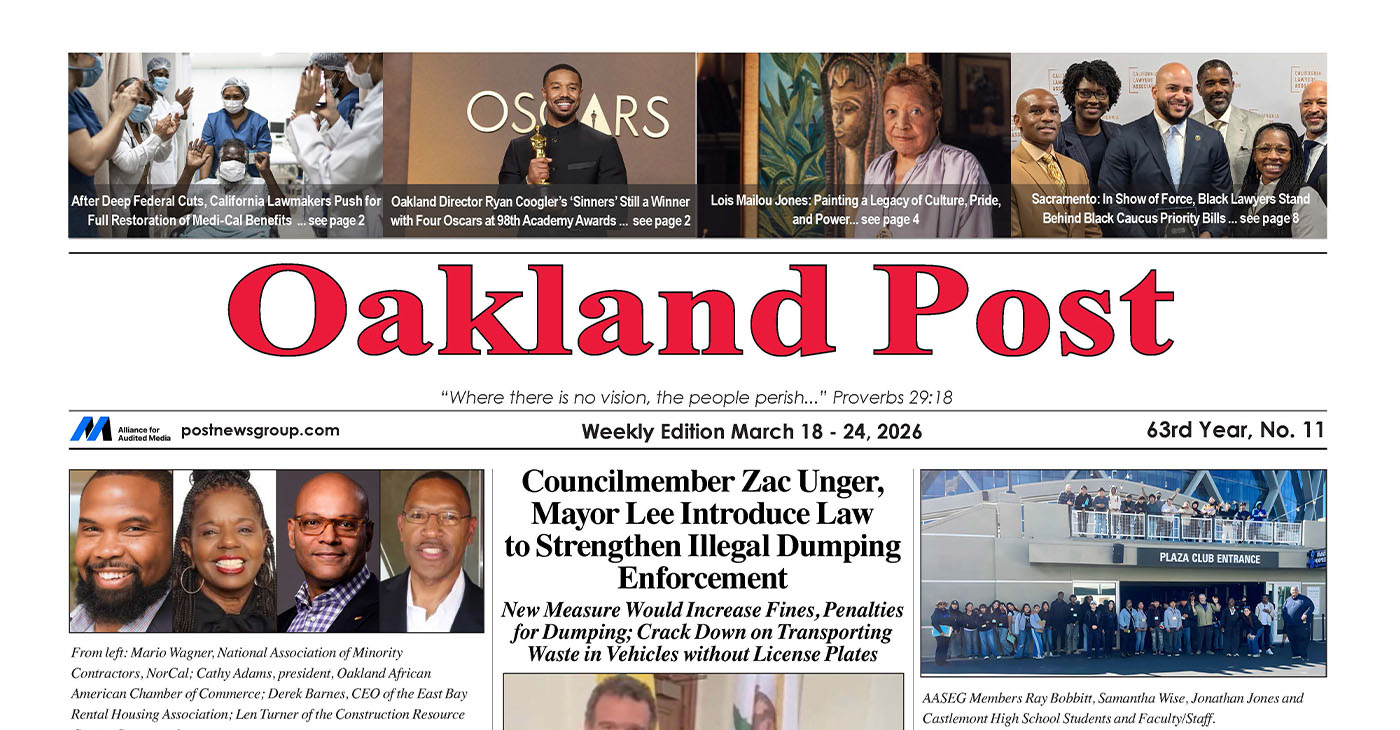
To enlarge your view of this issue, use the slider, magnifying glass icon or full page icon in the lower right corner of the browser window.
Activism
Oakland Post: Week of March 11 -17, 2026
The printed Weekly Edition of the Oakland Post: Week of March 11 – 17, 2026
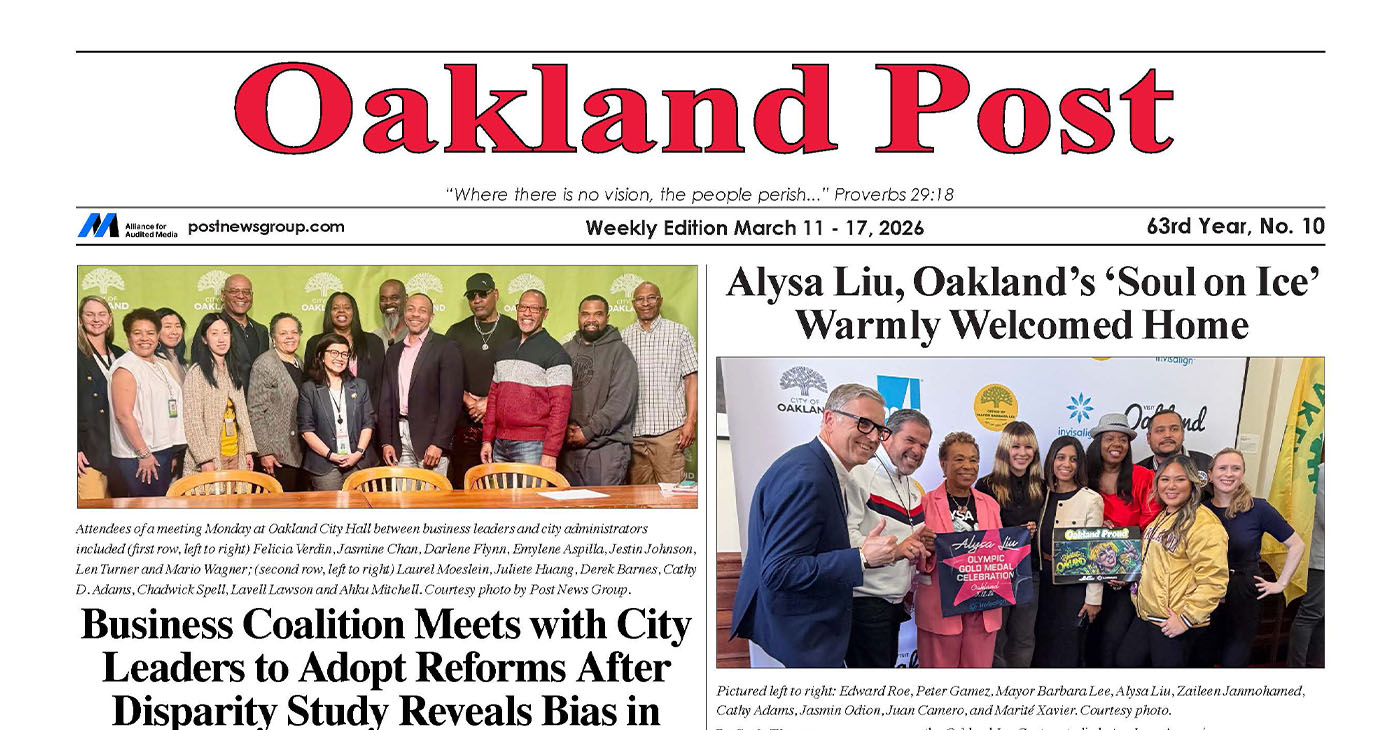
To enlarge your view of this issue, use the slider, magnifying glass icon or full page icon in the lower right corner of the browser window.
Activism
Oakland Post: Week of March 4 – 10, 2026
The printed Weekly Edition of the Oakland Post: Week of March 4 – 10, 2026
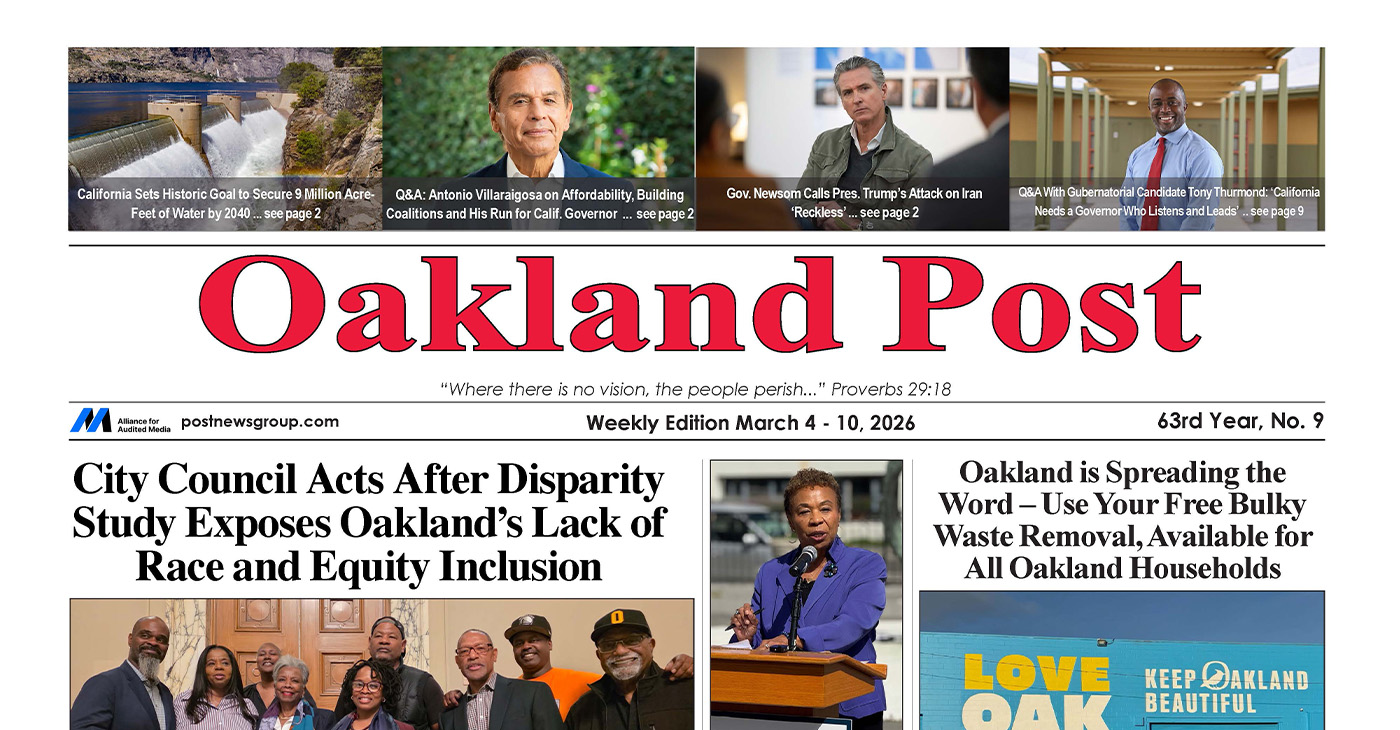
To enlarge your view of this issue, use the slider, magnifying glass icon or full page icon in the lower right corner of the browser window.

WORK FROM HOME
Home-based business with potential monthly income of $10K+ per month. A proven training system and website provided to maximize business effectiveness. Perfect job to earn side and primary income. Contact Lynne for more details: Lynne4npusa@gmail.com 800-334-0540


Black Artists in America, Installation Three Wraps at the Dixon Gallery and Gardens

Grief, Advocacy, and Education: A Counselor Reflects on Black Maternal Health

Future of Florida’s Black History Museum in Limbo

New Research Shows the Many Benefits of Early Learning

South Hampton K-8 Students Among Top 10 Finalists for Samsung’s ‘Solve for Tomorrow’ Competition

Cuba: No Negotiation with US on the President or Political System

Brooklyn Academy of Music Names Jamaican-Born Tamara McCaw as President

Trinidad & Tobego – U.S. Launches WhatsApp Channel for American Citizens in the Country

Oakland Post: Week of March 18 – 24, 2026

AI Innovation vs. Ethics and Environmental Impact

AI, Web3, and Digital Reparations

What If You Owned Your AI Agent?

Season 7, Episode 3 – January Reporter’s Roundtable 📱

Season 7, Episode 3 – January Reporter’s Roundtable

AI, Media, and Power | Part 2, Real-World Impacts and Tradeoffs

Discrimination in City Contracts

Oakland Post: Week of February 11 – 17, 2026

Reflecting on Black History Milestones in Birmingham AL

Rising Optimism Among Small And Middle Market Business Leaders Suggests Growth for California

CITY OF SAN LEANDRO STATE OF CALIFORNIA PUBLIC WORKS DEPARTMENT ENGINEERING DIVISION NOTICE TO BIDDERS FOR ANNUAL STREET OVERLAY/REHABILITATION 2019-21 – PHASE III

Oakland Post: Week of February 18 – 24, 2026

PRESS ROOM: NBA Hall of Fame Nominee Terry Cummings Joins 100 Black Men of DeKalb County to Launch Victory & Values Initiative

Oakland Post: Week of February 25 – March 3, 2026

U.S. manufacturing rebounds – how foundry services are adapting to rising demand

Trump’s MAGA Allies are Creating Executive Order Plan to Steal the 2026 Midterms

OP-ED: One Hundred Years of Black Workers Telling the Truth

Advancements in solar technology that are changing the way we power the world

Chase Oakland Community Center Hosts Alley-Oop Accelerator Building Community and Opportunity for Bay Area Entrepreneurs

PRESS ROOM: Civil Rights TV Launches in Selma as the World’s First 24/7 Civil Rights Television Network

Poll Shows Support for Policies That Help Families Afford Child Care

Hyundai Ioniq 5 Parking, Safety, and 360 View #shorts

2025 Ioniq 5 New Wiper & Powerful Performance! #shorts

Electric SUV Range: Is 259 Miles Enough? #shorts

EV Charging: How Fast Can You Charge an Electric Vehicle? #shorts

Biometric Cooling… Messaging Seats…Come on! 2025 Infiniti QX80 Autograph 4WD

Charged Up: Witness the Magic of a Fully Electric Car! #shorts

Range Rover Sport PHEV Included…: See What’s Inside This Luxury SUV! #shorts

Invisible Hood View: Perfect Parking with X-Ray Vision! #shorts

AI Is Reshaping Black Healthcare: Promise, Peril, and the Push for Improved Results in California

ESSAY: Technology and Medicine, a Primary Care Point of View

Sanctuary Cities

The RESISTANCE – FREEDOM NOW

STATE OF THE PEOPLE: Freddie

ECONOMIC BOYCOTT DAY!!!!!

I told You So
-
 #NNPA BlackPress4 weeks ago
Reflecting on Black History Milestones in Birmingham AL
-
 #NNPA BlackPress4 weeks ago
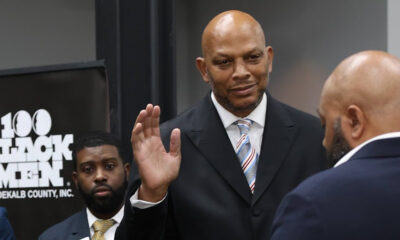
PRESS ROOM: NBA Hall of Fame Nominee Terry Cummings Joins 100 Black Men of DeKalb County to Launch Victory & Values Initiative
-
 Activism4 weeks ago
Oakland Post: Week of February 25 – March 3, 2026
-
 #NNPA BlackPress4 weeks ago
Trump’s MAGA Allies are Creating Executive Order Plan to Steal the 2026 Midterms
-
 #NNPA BlackPress4 weeks ago
OP-ED: One Hundred Years of Black Workers Telling the Truth
-
 #NNPA BlackPress4 weeks ago
Poll Shows Support for Policies That Help Families Afford Child Care
-

 Activism3 weeks ago
Oakland Post: Week of March 4 – 10, 2026
-

 #NNPA BlackPress3 weeks ago
Woman’s Search for Family’s Roots Leads to Ancestor John T. Ward – A Successful Entrepreneur and Conductor on the Underground Railroad
