
Opinion
Opinion: Danger of Historical Amnesia in the Era of Trump


Protester carrying a sign while marching in an anti-Trump rally in New York City in 2016.
By Annie “Q” Sajid
This past President’s Day, many anti-Trump rallies were organized in the name of a “Not My President’s Day.” Ironically enough, the “Not My President” refrain began as a racist chant of the Tea Party to delegitimize Barack Obama’s status as the first Black US president. The framing of Trump as “Not My President” perpetuates the idea that his presidency is an outlier in American history. The backbone of the United States is built on the land theft and murder of Indigenous people and the violent enslavement of Black people. Trump’s win exemplifies the cycles of American history in which any perceived racial progress is inevitably followed by white backlash. To present Trump’s presidency as an unexpected crisis, rather than a byproduct of emboldened American white supremacy, erases this nation’s violent past.
Adrienne Maree Brown insightfully shared in her post-election reflection, “Things are not getting worse, they are getting uncovered. We must hold each other tight and continue to pull back the veil.” While there is a warranted collective anxiety around Trump’s incendiary and dehumanizing political rhetoric, his policies are not fundamentally different from the xenophobic and profit-driven policy agenda of previous presidents. Many liberals forget Obama was dubbed the deporter-in-chief because his administration oversaw the forcible removal of more than 3 million undocumented immigrants and a significant expansion of private for-profit detention centers. Resistance efforts against such inhumane policies were ongoing in the Obama era, but weren’t as visible as they are now.
In the current political moment, we have seen constant direct action, some with deep strategic movement-building such as the collaboration between the Movement for Black Lives and the It Takes Roots Alliance. Others have had a less intersectional understanding of what is at stake, such as the national women’s march which was held accountable for excluding the struggles of women of color, trans women, working-class women, and those whose experiences occupy multiple intersections.
postTo view Trump’s win as the “most volatile” political moment in American history is inaccurate. We are living in volatile and terrifying times, but they are not exceptional political times. We are living in a time of a resurgence and consolidation of power to white supremacist groups. We must vigilantly confront how the evolution of American democracy is not linear.
In Robin D.G. Kelley’s one-year reflection post-Trump, he proposes we move away from “a lack of political imagination beyond crisis recovery and beyond politics as problem management.” We must not just fight back, we must re-imagine and fight for movements that guarantee rights to low-income communities and communities of color including: right to a dignified and stable home, right to accessible and affordable transit, and the right to not just participate in democracy, but democratize power to correct the trajectory of American history.
Among other hats, Annie “Q” Sajid is a communications professional based in Oakland, CA. Currently, she works for Urban Habitat, a policy advocacy organization working to advance equitable policies for low-income communities and communities of color in the Bay Area.






Activism
Oakland Post: Week of July 22 – 28, 2026
The printed Weekly Edition of the Oakland Post: Week of July 22 – 28, 2026

To enlarge your view of this issue, use the slider, magnifying glass icon or full page icon in the lower right corner of the browser window.
Activism
Oakland Post: Week of July 15 – 21, 2026
The printed Weekly Edition of the Oakland Post: Week of July 15 – 21, 2026

To enlarge your view of this issue, use the slider, magnifying glass icon or full page icon in the lower right corner of the browser window.
Activism
Oakland Post: Week of July 8 – 14, 2026
The printed Weekly Edition of the Oakland Post: Week of July 8 – 14, 2026

To enlarge your view of this issue, use the slider, magnifying glass icon or full page icon in the lower right corner of the browser window.

WORK FROM HOME
Home-based business with potential monthly income of $10K+ per month. A proven training system and website provided to maximize business effectiveness. Perfect job to earn side and primary income. Contact Lynne for more details: Lynne4npusa@gmail.com 800-334-0540


Oakland Post: Week of July 22 – 28, 2026

Fed Court to Decide Landmark First Amendment Case

Jordan Walker Leads Call for More Black Youth in Baseball

How Black WNBA Players Became Collateral Damage in the Caitlin Clark Culture War

NAACP Announces $20m Voter Registration Drive at National Convention in Chicago

Starting This Summer, California Car Buyers Can Get an Instant $3500 Off the Cost of Electric Vehicles

Surveillance Pricing Fight: State Senate Debates Bill Banning Retailers from Using AI to Set Prices Based on a Buyer’s Profile

Oakland Children’s Hospital Workers and Patients Rally for Pediatric Medical Care

Opinion: When Politicians Start Sanitizing One Chapter of History, They’re Coming After The Whole Book

Beyond Politics: California Legislators Across Party Lines Celebrate Lori Wilson at 50

NPRC to Meet with California Attorney General’s Office on to Urge Guardianship Reform

Mount Zion MBC, Church of Jesus Christ of Latter-day Saints Partner to Bring 29,000 Meals to Alameda County

Councilmember Houston Helps Deter Trend to Award Contracts to Suburban Companies

Rep. Garamendi, House Democrats Demand Trump Administration Abandon Illegal Plans to Dismantle Civil Rights, Special Ed Offices

Council Gives Approval for $125 Million Oakland Coliseum Sale to AASEG
Oakland Children’s Hospital Workers and Patients Rally for Pediatric Medical Care
Mount Zion MBC, Church of Jesus Christ of Latter-day Saints Partner to Bring 29,000 Meals to Alameda County
Surveillance Pricing Fight: State Senate Debates Bill Banning Retailers from Using AI to Set Prices Based on a Buyer’s Profile

IN MEMORIAM: Oakland Dance Legend Reginald Ray-Savage, 67

Saving Black Mothers Starts Outside the Hospital

Gov. Gavin Newsom Signs Law Streamlining Affordable Housing Rules

Oakland Celebrates $125 Million Coliseum Sale

NPRC Heads to Washington to Elevate Adult Guardianship Reform at National Whistleblower Summit

Starting This Summer, California Car Buyers Can Get an Instant $3500 Off the Cost of Electric Vehicles

Agricultural Engineer Effie Gant Plans Bay Area Farmers Market Initiative

The Part of Buying a Home That No Real Estate Show Ever Prepares You For

Oakland Post: Week of June 17 – 23, 2026

Oakland Post: Week of July 1 – 7, 2026

NCBW-OBAC Champions Black Women Entrepreneurs at Business en Blaque Expo

The Conversation With Al McFarlane 6/23/26

Media Monday 6/22/26

LIVE! ASK ALMA! — TUES. 6.23.26 7PM EST

Car Buying Secrets: 4 Hidden Checks Before You Sign!

Is This 550 HP Charger Worth YOUR Money? AutoNetwork Review

Celebrating Juneteenth – Frederick Douglass on education and resistance

LIVE! — ASK ALMA! — TUES. 6.19.26 7PM EST

Hyundai Ioniq 5 Parking, Safety, and 360 View #shorts

2025 Ioniq 5 New Wiper & Powerful Performance! #shorts

Electric SUV Range: Is 259 Miles Enough? #shorts

EV Charging: How Fast Can You Charge an Electric Vehicle? #shorts

Biometric Cooling… Messaging Seats…Come on! 2025 Infiniti QX80 Autograph 4WD

Charged Up: Witness the Magic of a Fully Electric Car! #shorts

Range Rover Sport PHEV Included…: See What’s Inside This Luxury SUV! #shorts

Invisible Hood View: Perfect Parking with X-Ray Vision! #shorts
-
 Business2 days ago
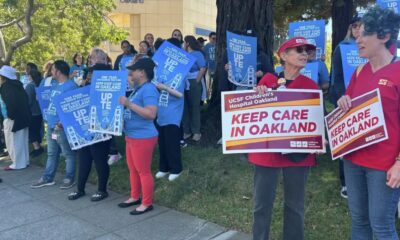
Oakland Children’s Hospital Workers and Patients Rally for Pediatric Medical Care
-
 Business2 days ago
Mount Zion MBC, Church of Jesus Christ of Latter-day Saints Partner to Bring 29,000 Meals to Alameda County
-
 Business1 day ago
Surveillance Pricing Fight: State Senate Debates Bill Banning Retailers from Using AI to Set Prices Based on a Buyer’s Profile
-
 Black History6 days ago
Saving Black Mothers Starts Outside the Hospital
-
 Business4 days ago
Gov. Gavin Newsom Signs Law Streamlining Affordable Housing Rules
-
 Black History1 week ago
Oakland Celebrates $125 Million Coliseum Sale
-
 Community1 week ago
NPRC Heads to Washington to Elevate Adult Guardianship Reform at National Whistleblower Summit
-
 Business1 day ago
Starting This Summer, California Car Buyers Can Get an Instant $3500 Off the Cost of Electric Vehicles
