
Bay Area
Oakland Peacemakers Planning Major “Circle of Peace” Event April 8
Following an African model, a wide coalition of Oaklanders will hold a peace vigil at Lake Merritt on Saturday April 8. The Circle of Peace is an action called for by Adamika Village, pastors, church congregation members, county and city employees, community-based organizations, mental health professionals, small business owners and individual citizens.


By Post Staff

Following an African model, a wide coalition of Oaklanders will hold a peace vigil at Lake Merritt on Saturday April 8.
The Circle of Peace is an action called for by Adamika Village, pastors, church congregation members, county and city employees, community-based organizations, mental health professionals, small business owners and individual citizens.
According to event coordinator Tanya Dennis, the intent of the Circle of Peace is to “shift Oakland’s energy from violence to one of peace.”
The event will begin with the calling of ancestors via djembe drums, spoken word and music, followed by a press conference for city and county proclamations and words of support.
Three years ago, Adamika Village CEO Daryle Allums and Black Leaders Coalition CEO Tanya Dennis acknowledged the European model of society did not work for Black folks and from that came “The African Way” philosophy centered around the Black family and peace.
Their 10-point “peace in the streets” campaign is dedicated to ending violence in Oakland and restoring the family unit.
Thus far, Adamika Village has experienced success and takes partial credit for the 12% reduction in violence Oakland experienced in 2022 through Credible Messengers, their Peace banner project on International Boulevard and their peace messaging and beautification of blighted areas of Oakland.
Another success is the recent approval of funding by Alameda County for their “Havens for Black Healing,” a Black Mental Health Initiative launched by the Oakland Frontline Healers collaborative of which Adamika was the creator and now lead facilitator.
Adamika Village’s “Circle of Peace” vigil is their first outreach to the entire community of Oakland in a quest to find and implement solutions to end violence in Oakland.
“After decades of low levels of homicides, with COVID-19, we witnessed a 50% increase in violence in 2021, with over 100 homicides, and 2022 was even worse,” Allums said.
“It didn’t help that EDD scams put money in the wrong hands, allowing the purchase of more guns, which led to more violence when the money dried up for those use to living high on the hog.
“Desperation set in and so what we’re experiencing now is unprecedented predatory behavior with “bipping,” the breaking of car windows at a pandemic level aimed at vulnerable citizens such as elders, tourists and women being targeted. It’s gotten to a level that no neighborhood is immune, and everyone is living in fear.”
For these reasons, Dennis says, the April 8th Circle of Peace has caught fire and resonated with the public. “People are tired of living behind closed doors and shuttered windows in fear. They’re grateful and ready to join us to do something, and our Circle of Peace is the first event to bring like-minded people together.”
Acknowledging that symbolism without action is futile, Adamika’s collaborative partner, the Violence Prevention Coalition, will host a citywide town hall June 24, 2023, at Laney College.
“The only way we’re going to end this wave of violence is to join together and take action with holistic solutions,” says Dennis “We recognize that many of our citizens are desperate for lack of alternatives and resources like access to mental health services and housing.
“The solution is to provide those resources so people don’t have to resort to violence. Sure, there are predators who are taking advantage, there always will be, but we want those who would change if they had a choice to know we’re here working with them to provide solutions.”
The public is invited to register and join by calling 510-929-7699 or email uractivist@gmail.com or click on the QR code on the flier. https://docs.google.com/forms/d/1h86vv8TYLBovgUBfYtlBVY0gPGUDlCbVBAKWnDbWkM8/edit?usp=drive_web











Activism
Oakland Post: Week of September 30 – October 6, 2026
The printed Weekly Edition of the Oakland Post: Week of September 30 – October 6, 2026
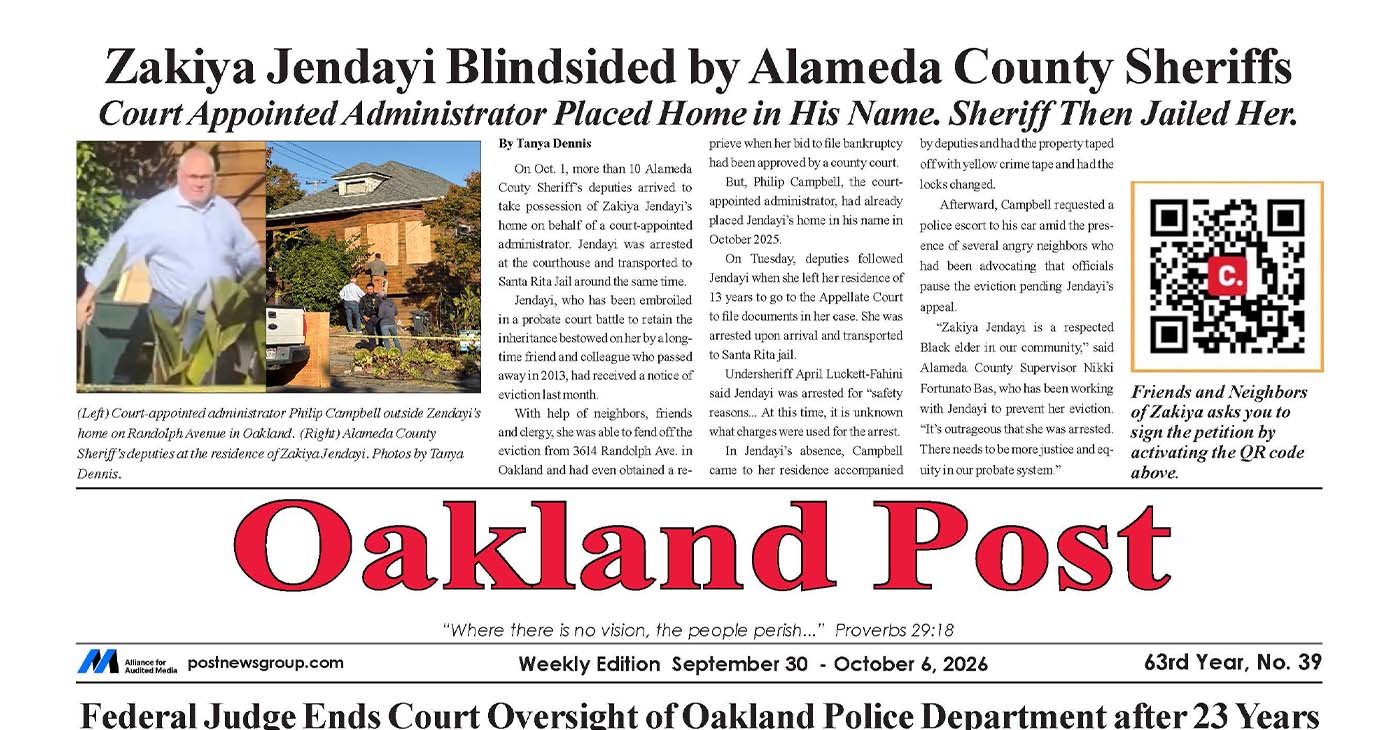
To enlarge your view of this issue, use the slider, magnifying glass icon or full page icon in the lower right corner of the browser window.
Activism
Oakland Post: Week of September 23 – 29, 2026
The printed Weekly Edition of the Oakland Post: Week of September 23 – 29, 2026

To enlarge your view of this issue, use the slider, magnifying glass icon or full page icon in the lower right corner of the browser window.
Activism
Oakland Post: Week of September 16 – 22, 2026
The printed Weekly Edition of the Oakland Post: Week of September 16 – 22, 2026

To enlarge your view of this issue, use the slider, magnifying glass icon or full page icon in the lower right corner of the browser window.



OP-ED: Proposition 44 Would Put a Price on Trust

OP-ED: Proposition 40: It’s Time to Play Chess, Not Checkers

Listening as a Lifeline: A Doula’s Witness to Black Maternal Health

New Protections for Ticket Buyers: Gov. Newsom Signs Assemblymember Isaac Bryan’s Bill

‘We Don’t Talk Trash — We Pick Up Trash!’

Zakiya Jendayi Arrested, Locked Out of Home by Sheriff’s Deputies

Oakland Post: Week of September 30 – October 6, 2026

Asm. Corey Jackson Announces Launch of 24-Hour Childcare in His District

IN MEMORIAM: The Rev. Leon “Sonny” Clark, Longtime Orange County Pastor and Community Leader, Dies at 72

Poll: Becerra Widens His Lead Over Hilton; Californians Split on Wealth Tax

From Historic Memories to New Possibilities: Oakland Celebrates Coliseum 60

County Office of Education Says OUSD Finances Are Getting Healthier, Materially Stronger

LIVE FREE Sunday Dinner Brings Faith, Fellowship and Civic Conversation to Oakland

Remembering Chauncey Bailey as Student Journalists Face Threats to Truth-Telling

BLACspace Cooperative Invites Bay Area to Experience Oakland’s Black Cultural Ecosystem Through a BLAC Map Tour + Party

Standoff for Justice: Our Homes Are Worth Fighting For

Oakland Post: Week of August 26 – September 1, 2026

Frontier Airlines’ Return to Oakland Airport Brings Flights, Jobs and Opportunity

Gubernatorial Candidate Steve Hilton Blasts California New Tire Rules; Newsom Hits Back

Chef Sharon Lee Blends Culinary Excellence, Education and Empowerment

Jackie Wright Champions Bay Area Stories, Filmmakers and Cultural Institutions

Misnamed ‘Parent’ PAC Seeks to Influence Oakland School Board Elections

Oakland Coliseum Project Opens Door for Small Businesses to Build Bigger

Big City Mayors Ask for “Yes” Vote on Housing Bond Measure; Conservatives Say “No”

Gov. Newsom’s Latest Appointees Include Sacramento Advocate for Formerly Incarcerated Students; State’s New Tech Chief

Longtime BWOPA Member Brendalyn Goodall Appointed to California Workforce Development Board

Gov. Newsom Signs Law Shielding Immigration Aid Workers From Doxing Threats

Secretary of State Shirley N. Weber Urges Californians to Vote Early as Voter ID Battle Intensifies

Oakland Post: Week of September 2 – 8, 2026

IN MEMORIAM: Dolly Parton Dead at 80 — How She Built a Legacy of Love and Earned Her Place in Black Culture

The Conversation With Al McFarlane 6/23/26

Media Monday 6/22/26

LIVE! ASK ALMA! — TUES. 6.23.26 7PM EST

Car Buying Secrets: 4 Hidden Checks Before You Sign!

Is This 550 HP Charger Worth YOUR Money? AutoNetwork Review

Celebrating Juneteenth – Frederick Douglass on education and resistance

LIVE! — ASK ALMA! — TUES. 6.19.26 7PM EST

Hyundai Ioniq 5 Parking, Safety, and 360 View #shorts

2025 Ioniq 5 New Wiper & Powerful Performance! #shorts

Electric SUV Range: Is 259 Miles Enough? #shorts

EV Charging: How Fast Can You Charge an Electric Vehicle? #shorts

Biometric Cooling… Messaging Seats…Come on! 2025 Infiniti QX80 Autograph 4WD

Charged Up: Witness the Magic of a Fully Electric Car! #shorts

Range Rover Sport PHEV Included…: See What’s Inside This Luxury SUV! #shorts

Invisible Hood View: Perfect Parking with X-Ray Vision! #shorts
-
 Community3 weeks ago
Misnamed ‘Parent’ PAC Seeks to Influence Oakland School Board Elections
-
 Activism4 weeks ago
Oakland Post: Week of September 2 – 8, 2026
-

 Activism3 weeks ago
Oakland Post: Week of September 9 – 15, 2026
-

 Community3 weeks ago
Richmond Tiny House Village Farm & Garden Set to Open Gates on Sept. 26
-

 Black History3 weeks ago
Latest Massacre in Haiti Reveals Cruelty U.S. Deportations
-

 Black History3 weeks ago
OPINION: Nolan Wells’ Death One of Several Signifying Racial Terror Lives on in U.S. South
-

 Business2 weeks ago
Mayor Lee Announces $1 Million Kaiser Permanente Grant for Pilot Program to Address Homelessness, Clean Up Public Spaces throughout Oakland
-

 Community3 weeks ago
Democratic Clubs Interview Candidates for Oakland School Board
