
Activism
Marin County Residents Hold Rally Protesting Death of George Floyd

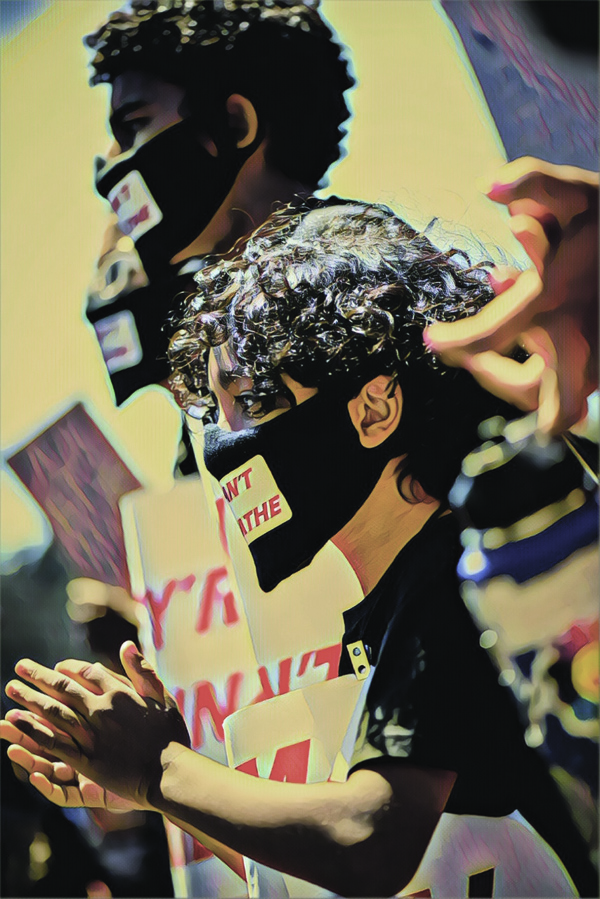
Marin County residents took to the streets June 2 in response to the killing of George Floyd in Minneapolis May 25, 2020. Like many of the protests across the country and around the world, it was organized by young people.
Below, in the words of organizers Lynnette Egenlauf, Mikyla Williams, Ayana Morgan-Woodard and Paul Austin, is how it all came together.
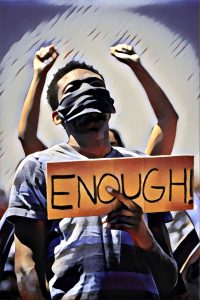
Photos by Felecia Gaston.
Lynnette Egenlauf
On Friday night, Tamalpais High School sophomore Mikyla Williams called Paul Austin to ask if Marin City was going to have any protests. The founder of Play Marin, Austin is one of the youngest community leaders the city has. He is often the voice of the young people in Marin City.
Saturday morning, Austin sent me a text message saying, “I’m here to support whatever protest the young people want to do.” We knew being residents of Marin City that we needed to show our Black brothers and sisters our solidarity in the world, because we, too, matter.
By 2 p.m., we had a multi-generational group of Marin City residents ready to lead a peaceful protest that would give Marin County, OUR VOICE.

Austin (40), Lynnette Egenlauf (30), Ayana Morgan-Woodard (22) and Mikyla Williams (16). We felt as if this was the official passing of the torch. Our older leaders had given us the support we needed to put everything in motion.
There had been many other protests around the county earlier that week in support of Black Lives Matter. We had one question “How could these protests happen without the voice/input of Black people?”
This is the origin of our battle cry “Our Voice, Our Movement.” Marin City is the only town in Marin County that is predominantly African American. We loved that allies were protesting, but we needed to show Marin County that Black lives matter and that Marin City matters!
We organized this peaceful protest in four days, expecting just those in our community and a few others in our county to show up at the Bridge the Gap Center at 105 Drake Avenue. Never did we expect that about 1,500 would show up in support of the protest. It felt amazing! The support, the voices who spoke, and the people who marched in solidarity.
The speakers included Set Shakur, a community activist and the sister of Tupac Shakur; Rondall Legett, pastor of First Missionary Baptist Church; Honour Knudsen, a police officer; Rondall Gibson, a college success specialist for 10K Degrees and Malachia Hoover, a Stanford University Ph.D. student in molecular biology.
Our peaceful protest was in honor of all Black lives that were lost due to society’s fears of African American excellence — Marin City’s excellence! For far too long Marin County has had its knee on Marin City’s neck. It was time for us to take action and show up!
If it took four days to gather over 1,000 people, what would a week of planning have accomplished? In those three days we made and posted flyers in our local community, promoted it on social media and through word-of-mouth.
As I made the flyer I had trouble putting locations on it because I did not intend on it getting out of Marin City, so I named the locations in ways that Marin City residents knew them.
But I began to get feedback from those who wanted to attend who were wondering what I meant and that showed me that if we were going to pull this off by Tuesday afternoon that it would take all four of us to come together to accomplish a goal to change history for the residents of Marin City.
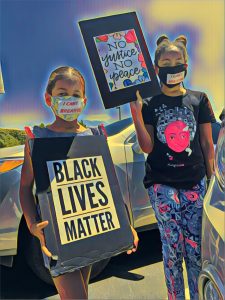
Photos by Felecia Gaston.
Ayana Morgan-Woodward
The Marin City peaceful protest was in honor of all Black lives that were lost due to the society’s fears of African American excellence. Marin County stood in solidarity with the voices of those they saw on a TV screen.
Yet they don’t stand with up with Black lives that are local that face the same problems but because we are considered privileged to live in Marin County we get the scraps (bare minimum) to survive and then are forgotten about, in one of these wealthiest counties in America.
We as Marin City needed the support of one another and others to realize how truly special we are and how we could thrive by ourselves if we were given the proper resources.
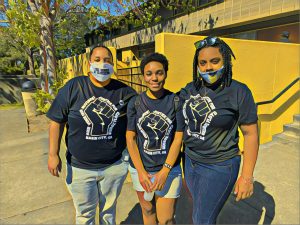
Marin youth participated in the peaceful protest in Marin City on June 2, 2020. Photos by Felecia Gaston.







Activism
Oakland Post: Week of April 8 – 14, 2026
The printed Weekly Edition of the Oakland Post: Week of April 8 – 14, 2026


To enlarge your view of this issue, use the slider, magnifying glass icon or full page icon in the lower right corner of the browser window.

Activism
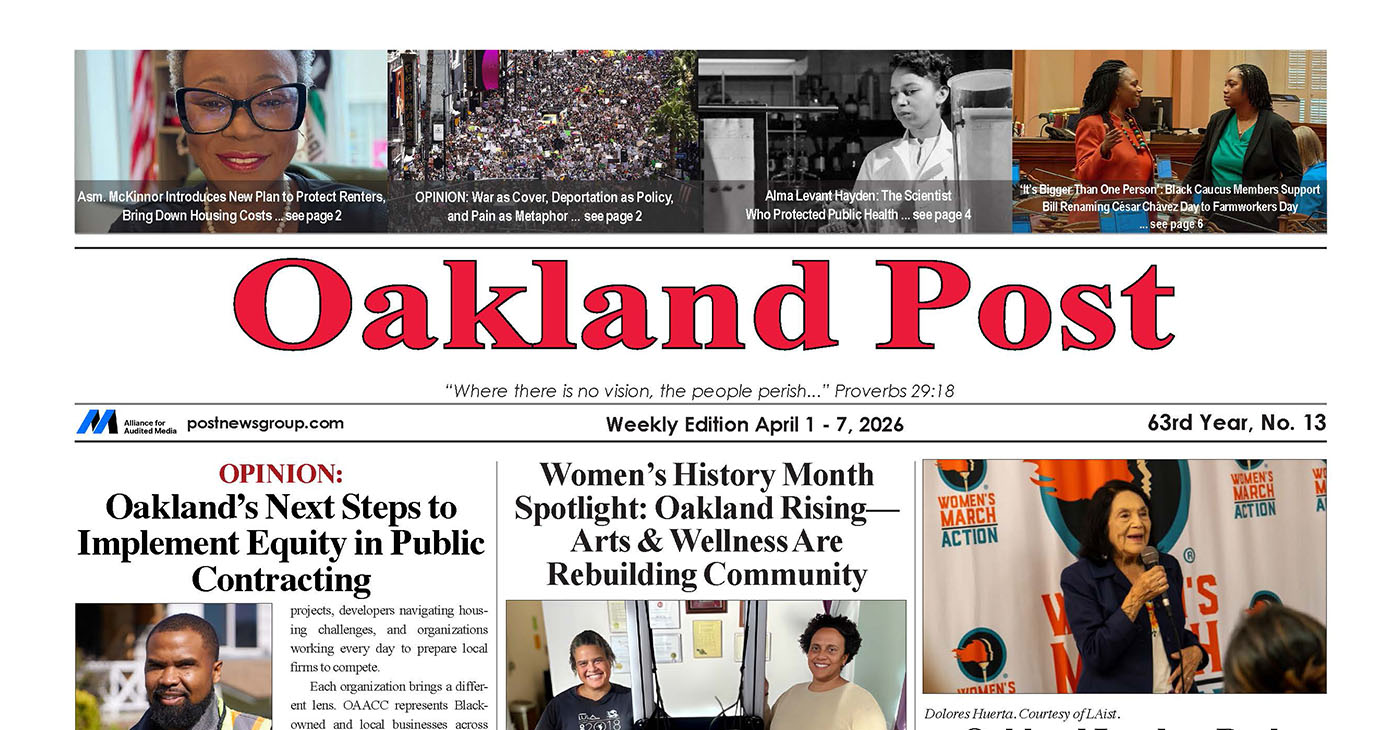
Oakland Post: Week of April 1 – 7, 2026
The printed Weekly Edition of the Oakland Post: Week of April 1 – 7, 2026
To enlarge your view of this issue, use the slider, magnifying glass icon or full page icon in the lower right corner of the browser window.
Activism
Oakland Post: Week of March 18 – 24, 2026
The printed Weekly Edition of the Oakland Post: Week of March 18 – 24, 2026

To enlarge your view of this issue, use the slider, magnifying glass icon or full page icon in the lower right corner of the browser window.


WORK FROM HOME
Home-based business with potential monthly income of $10K+ per month. A proven training system and website provided to maximize business effectiveness. Perfect job to earn side and primary income. Contact Lynne for more details: Lynne4npusa@gmail.com 800-334-0540


Oakland Post: Week of April 8 – 14, 2026

Oakland Post: Week of April 1 – 7, 2026

Black Artists in America, Installation Three Wraps at the Dixon Gallery and Gardens

Grief, Advocacy, and Education: A Counselor Reflects on Black Maternal Health

Future of Florida’s Black History Museum in Limbo

New Research Shows the Many Benefits of Early Learning

South Hampton K-8 Students Among Top 10 Finalists for Samsung’s ‘Solve for Tomorrow’ Competition

Cuba: No Negotiation with US on the President or Political System

Brooklyn Academy of Music Names Jamaican-Born Tamara McCaw as President

Trinidad & Tobego – U.S. Launches WhatsApp Channel for American Citizens in the Country

Oakland Post: Week of March 18 – 24, 2026

AI Innovation vs. Ethics and Environmental Impact

AI, Web3, and Digital Reparations

What If You Owned Your AI Agent?

Season 7, Episode 3 – January Reporter’s Roundtable 📱

Reflecting on Black History Milestones in Birmingham AL

Oakland Post: Week of February 25 – March 3, 2026

Oakland Post: Week of March 4 – 10, 2026

PRESS ROOM: NBA Hall of Fame Nominee Terry Cummings Joins 100 Black Men of DeKalb County to Launch Victory & Values Initiative

Trump’s MAGA Allies are Creating Executive Order Plan to Steal the 2026 Midterms

U.S. manufacturing rebounds – how foundry services are adapting to rising demand

Poll Shows Support for Policies That Help Families Afford Child Care

Oakland Post: Week of March 11 -17, 2026
Oakland Post: Week of March 18 – 24, 2026

OP-ED: One Hundred Years of Black Workers Telling the Truth

Advancements in solar technology that are changing the way we power the world

Financial Wellness and Mental Health: Managing Money Stress in College

Woman’s Search for Family’s Roots Leads to Ancestor John T. Ward – A Successful Entrepreneur and Conductor on the Underground Railroad

COMMENTARY: Women of Color Shape Our Past and Future

PRESS ROOM: Civil Rights TV Launches in Selma as the World’s First 24/7 Civil Rights Television Network

Hyundai Ioniq 5 Parking, Safety, and 360 View #shorts

2025 Ioniq 5 New Wiper & Powerful Performance! #shorts

Electric SUV Range: Is 259 Miles Enough? #shorts

EV Charging: How Fast Can You Charge an Electric Vehicle? #shorts

Biometric Cooling… Messaging Seats…Come on! 2025 Infiniti QX80 Autograph 4WD

Charged Up: Witness the Magic of a Fully Electric Car! #shorts

Range Rover Sport PHEV Included…: See What’s Inside This Luxury SUV! #shorts

Invisible Hood View: Perfect Parking with X-Ray Vision! #shorts

AI Is Reshaping Black Healthcare: Promise, Peril, and the Push for Improved Results in California

ESSAY: Technology and Medicine, a Primary Care Point of View

Sanctuary Cities

The RESISTANCE – FREEDOM NOW

STATE OF THE PEOPLE: Freddie

ECONOMIC BOYCOTT DAY!!!!!

I told You So
-
 Activism3 weeks ago
Oakland Post: Week of March 11 -17, 2026
-
 Activism3 weeks ago
Oakland Post: Week of March 18 – 24, 2026
-
 Advice3 weeks ago
Financial Wellness and Mental Health: Managing Money Stress in College
-
 #NNPA BlackPress3 weeks ago
Brooklyn Academy of Music Names Jamaican-Born Tamara McCaw as President
-
 #NNPA BlackPress2 weeks ago
Grief, Advocacy, and Education: A Counselor Reflects on Black Maternal Health
-
 #NNPA BlackPress2 weeks ago
New Research Shows the Many Benefits of Early Learning
-
 #NNPA BlackPress2 weeks ago
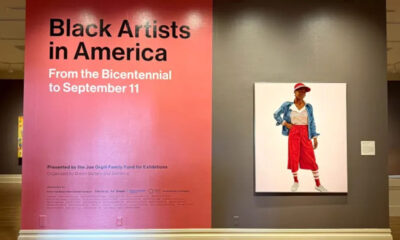
Black Artists in America, Installation Three Wraps at the Dixon Gallery and Gardens
-

 Advice4 weeks ago
Women & Wealth: Tips for Navigating Your Lifelong Financial Journey
