
Activism
Local Organizers Demand Community Benefits Agreement for A’s Ballpark

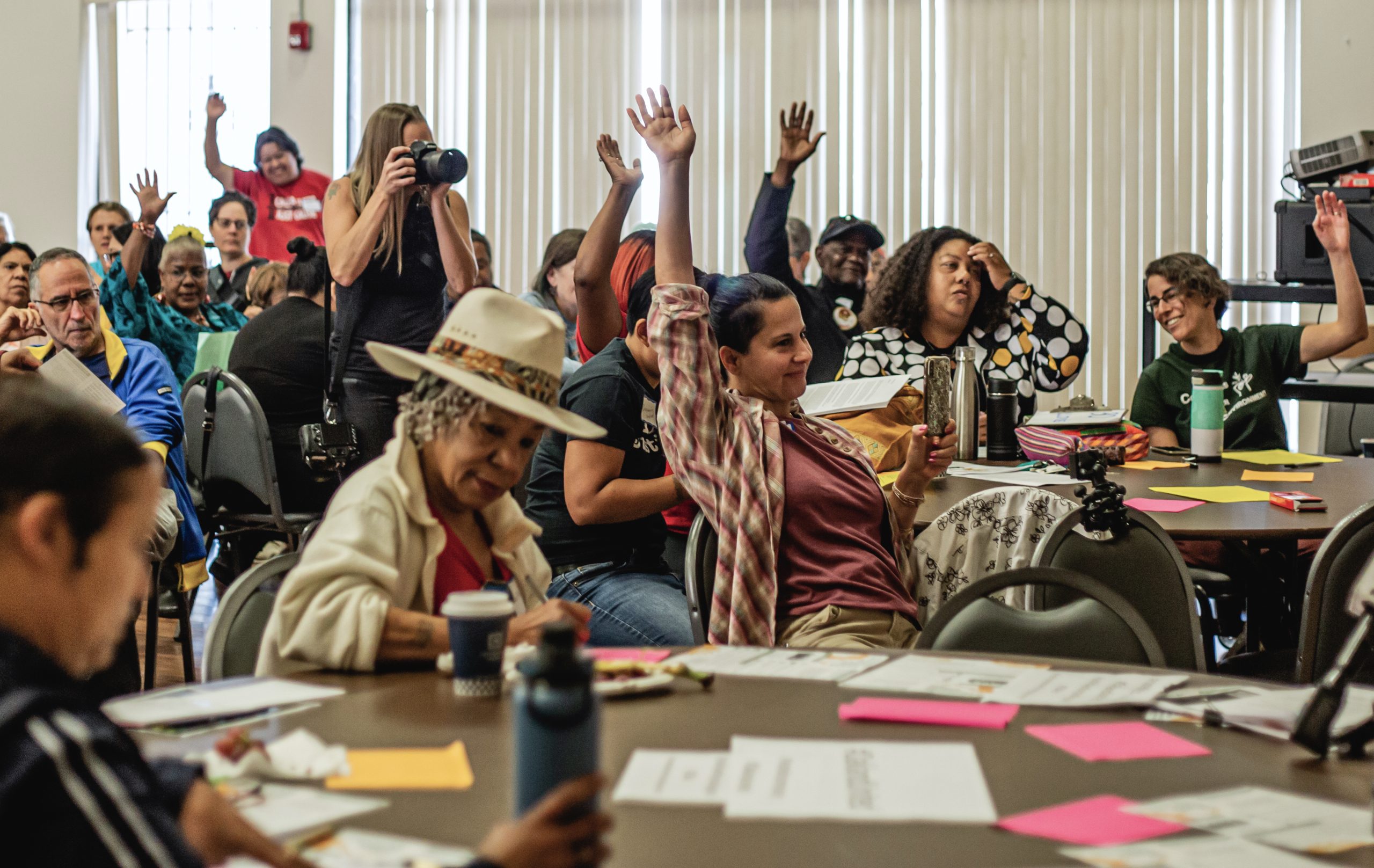
Over 100 Oakland residents and community organizers attended a public forum at Taylor Memorial United Methodist Church in West Oakland on Saturday Oct. 4, to discuss the Oakland Athletic’s plans to purchase and develop the Coliseum and Howard Terminal sites.
“This is urgent…and Oakland United wants you to know that the time is now to speak up,” said Jahmese Meyers, deputy director of the East Bay Alliance for a Sustainable Economy (EBASE), who spoke to a crowded room.
EBASE is one of several organizations that joined to form the Oakland United Coalition five years ago when the talk of a new Coliseum development began, Meyers said.
The coalition has demanded a written community benefits agreement (CBA) — a legally binding contract that would ensure that the A’s meet community demands — before plans advance.
Community organizers and Oakland residents gathered for a Town Hall in West Oakland, demanding a community benefits agreement from the A’s. Photo by Saskia Hatvany.
“We have a choice, we can have a playground for the wealthy out-of-towners or we can have a community-centered project that represents and supports the needs of the existing community and uses public land for public good,” said Meyers.
The CBA would legally bind the A’s to a series of promises to the community, which include living-wage jobs for residents, significant affordable housing, anti-displacement measures, and a cleaner environment.
President of the Oakland Athletics Dave Kaval said that the A’s have long been “committed” to the community benefits agreement, but that the contract is largely in the hands of the City of Oakland.
“To date, in all our signed agreements both with the city and the county and the port, we’ve agreed to a framework around community benefits,” said Kaval. “We’ve made ourselves available to the meetings and we’ve agreed to the intent of what needs to be discussed, and we look forward to the city leading that effort.”
A CBA is usually negotiated between a local coalition and the developer. When the contract involves local government, the city is granted the power to legally enforce the terms of the agreement.
Despite the A’s verbal support, according to Meyers the team has not yet agreed to a CBA on paper, which concerns Oakland United.
”Oakland is working hard to keep the A’s in Oakland, but how hard are they working to keep us in Oakland?” said Alma Blackwell, Housing Rights Organizer at Causa Justa/Just Cause, who also spoke at the event.
“We want development that will serve the people who live in the neighborhood and a development that will keep public land in the public hands,” said Blackwell.
Former Oakland mayoral candidate Cat Brooks also made an appearance and declared her support for a community benefits agreement no matter where the A’s choose to build.
“I see pros and cons for both (locations). I’m very concerned about the Black community around the Coliseum that will be pushed out as a result of any development, and I’m very concerned about the remaining Black community in West Oakland that will be pushed out as a result of the (Howard Terminal) development,” said Brooks.
Cat Brooks speaks to the crowd at Taylor Memorial United Methodist Church in West Oakland. Photo by Saskia Hatvany.
While the A’s ambitions have the very public support of Mayor Libby Schaff, the City of Oakland filed a lawsuit against Alameda County on Sept. 29 in an attempt to block the sale of the county’s portion of the Coliseum for $85 million, according to the San Francisco Chronicle.
In response to the suit, Major League Baseball Commissioner Robert Manfred warned that if the city does not drop the charges, Oakland will risk losing the A’s altogether.
“We love our team. We want them to stay. We’re proud that they’re rooted in Oakland and we want them to also be rooted in community,” said Meyers. “For Oakland United, ultimately, no matter where the stadium locates, whether it stays at the Coliseum or at Howard terminal it’s public land, it needs to be for public good.”
The Oakland Post will continue to provide coverage on this story. Stay tuned for next week’s article featuring A’s President Dave Kaval’s response to community concerns over the proposed ballpark development at Howard Terminal.







Activism
Oakland Post: Week of September 23 – 29, 2026
The printed Weekly Edition of the Oakland Post: Week of September 23 – 29, 2026


To enlarge your view of this issue, use the slider, magnifying glass icon or full page icon in the lower right corner of the browser window.

Activism
Oakland Post: Week of September 16 – 22, 2026
The printed Weekly Edition of the Oakland Post: Week of September 16 – 22, 2026

To enlarge your view of this issue, use the slider, magnifying glass icon or full page icon in the lower right corner of the browser window.
Activism
Oakland Post: Week of September 9 – 15, 2026
The printed Weekly Edition of the Oakland Post: Week of September 9 – 15, 2026

To enlarge your view of this issue, use the slider, magnifying glass icon or full page icon in the lower right corner of the browser window.



Asm. Corey Jackson Announces Launch of 24-Hour Childcare in His District

IN MEMORIAM: The Rev. Leon “Sonny” Clark, Longtime Orange County Pastor and Community Leader, Dies at 72

Poll: Becerra Widens His Lead Over Hilton; Californians Split on Wealth Tax

From Historic Memories to New Possibilities: Oakland Celebrates Coliseum 60

County Office of Education Says OUSD Finances Are Getting Healthier, Materially Stronger

LIVE FREE Sunday Dinner Brings Faith, Fellowship and Civic Conversation to Oakland

Remembering Chauncey Bailey as Student Journalists Face Threats to Truth-Telling

BLACspace Cooperative Invites Bay Area to Experience Oakland’s Black Cultural Ecosystem Through a BLAC Map Tour + Party

In Wake of Death on Doorstep, Williams Chapel Baptist Church Calls for Better Care, Funding for Unhoused

Oakland Centenarian Nuna McKee Honored!

Caribbean Nations Produce Action Plan Calling for UK Reparations Over Slavery

Oakland Post: Week of September 23 – 29, 2026

Doulas Are Helping Black California Moms Navigate Pregnancy–Even as High Mortality Rates Persist

Newsom Signs Addictive Social Media Law to Protect Kids

On Your November Ballot: Prop 38 Would Allocate $8.4 Billion to Immunology and Immunotherapy Funding

Standoff for Justice: Our Homes Are Worth Fighting For

Oakland Post: Week of August 26 – September 1, 2026

Frontier Airlines’ Return to Oakland Airport Brings Flights, Jobs and Opportunity

Gubernatorial Candidate Steve Hilton Blasts California New Tire Rules; Newsom Hits Back

Chef Sharon Lee Blends Culinary Excellence, Education and Empowerment

Jackie Wright Champions Bay Area Stories, Filmmakers and Cultural Institutions

Big City Mayors Ask for “Yes” Vote on Housing Bond Measure; Conservatives Say “No”

Oakland Coliseum Project Opens Door for Small Businesses to Build Bigger

Gov. Newsom’s Latest Appointees Include Sacramento Advocate for Formerly Incarcerated Students; State’s New Tech Chief

Misnamed ‘Parent’ PAC Seeks to Influence Oakland School Board Elections

Longtime BWOPA Member Brendalyn Goodall Appointed to California Workforce Development Board

Gov. Newsom Signs Law Shielding Immigration Aid Workers From Doxing Threats

Secretary of State Shirley N. Weber Urges Californians to Vote Early as Voter ID Battle Intensifies

From Palestine to Oakland: Seeds for Liberation Examines Shared Struggles for Freedom

IN MEMORIAM: Dolly Parton Dead at 80 — How She Built a Legacy of Love and Earned Her Place in Black Culture

The Conversation With Al McFarlane 6/23/26

Media Monday 6/22/26

LIVE! ASK ALMA! — TUES. 6.23.26 7PM EST

Car Buying Secrets: 4 Hidden Checks Before You Sign!

Is This 550 HP Charger Worth YOUR Money? AutoNetwork Review

Celebrating Juneteenth – Frederick Douglass on education and resistance

LIVE! — ASK ALMA! — TUES. 6.19.26 7PM EST

Hyundai Ioniq 5 Parking, Safety, and 360 View #shorts

2025 Ioniq 5 New Wiper & Powerful Performance! #shorts

Electric SUV Range: Is 259 Miles Enough? #shorts

EV Charging: How Fast Can You Charge an Electric Vehicle? #shorts

Biometric Cooling… Messaging Seats…Come on! 2025 Infiniti QX80 Autograph 4WD

Charged Up: Witness the Magic of a Fully Electric Car! #shorts

Range Rover Sport PHEV Included…: See What’s Inside This Luxury SUV! #shorts

Invisible Hood View: Perfect Parking with X-Ray Vision! #shorts
-
 Community3 weeks ago
Misnamed ‘Parent’ PAC Seeks to Influence Oakland School Board Elections
-

 Activism4 weeks ago
Oakland Post: Week of September 2 – 8, 2026
-

 Community3 weeks ago
Richmond Tiny House Village Farm & Garden Set to Open Gates on Sept. 26
-

 Activism3 weeks ago
Oakland Post: Week of September 9 – 15, 2026
-

 Black History3 weeks ago
Latest Massacre in Haiti Reveals Cruelty U.S. Deportations
-

 Black History3 weeks ago
OPINION: Nolan Wells’ Death One of Several Signifying Racial Terror Lives on in U.S. South
-

 Community3 weeks ago
Democratic Clubs Interview Candidates for Oakland School Board
-

 Business2 weeks ago
Mayor Lee Announces $1 Million Kaiser Permanente Grant for Pilot Program to Address Homelessness, Clean Up Public Spaces throughout Oakland
