Connect with us

Activism

Local Organizers Demand Community Benefits Agreement for A’s Ballpark

Published

on

Over 100 Oakland residents and community organizers attended a public forum at Taylor Memorial United Methodist Church in West Oakland on Saturday Oct. 4, to discuss the Oakland Athletic’s plans to purchase and develop the Coliseum and Howard Terminal sites.

“This is urgent…and Oakland United wants you to know that the time is now to speak up,” said Jahmese Meyers, deputy director of the East Bay Alliance for a Sustainable Economy (EBASE), who spoke to a crowded room.

EBASE is one of several organizations that joined to form the Oakland United Coalition five years ago when the talk of a new Coliseum development began, Meyers said.

The coalition has demanded a written community benefits agreement (CBA) — a legally binding contract that would ensure that the A’s meet community demands — before plans advance.
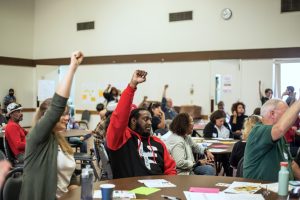
Community organizers and Oakland residents gathered for a Town Hall in West Oakland, demanding a community benefits agreement from the A’s. Photo by Saskia Hatvany.

“We have a choice, we can have a playground for the wealthy out-of-towners or we can have a community-centered project that represents and supports the needs of the existing community and uses public land for public good,” said Meyers.

The CBA would legally bind the A’s to a series of promises to the community, which include living-wage jobs for residents, significant affordable housing, anti-displacement measures, and a cleaner environment.

President of the Oakland Athletics Dave Kaval said that the A’s have long been “committed” to the community benefits agreement, but that the contract is largely in the hands of the City of Oakland.

“To date, in all our signed agreements both with the city and the county and the port, we’ve agreed to a framework around community benefits,” said Kaval. “We’ve made ourselves available to the meetings and we’ve agreed to the intent of what needs to be discussed, and we look forward to the city leading that effort.”

A CBA is usually negotiated between a local coalition and the developer. When the contract involves local government, the city is granted the power to legally enforce the terms of the agreement.

Despite the A’s verbal support, according to Meyers the team has not yet agreed to a CBA on paper, which concerns Oakland United.

”Oakland is working hard to keep the A’s in Oakland, but how hard are they working to keep us in Oakland?” said Alma Blackwell, Housing Rights Organizer at Causa Justa/Just Cause, who also spoke at the event.   

“We want development that will serve the people who live in the neighborhood and a development that will keep public land in the public hands,” said Blackwell.

Former Oakland mayoral candidate Cat Brooks also made an appearance and declared her support for a community benefits agreement no matter where the A’s choose to build.

“I see pros and cons for both (locations). I’m very concerned about the Black community around the Coliseum that will be pushed out as a result of any development, and I’m very concerned about the remaining Black community in West Oakland that will be pushed out as a result of the (Howard Terminal) development,” said Brooks.
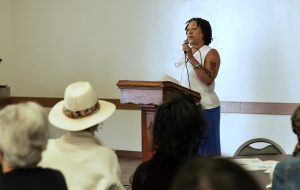
Cat Brooks speaks to the crowd at Taylor Memorial United Methodist Church in West Oakland. Photo by Saskia Hatvany.

While the A’s ambitions have the very public support of Mayor Libby Schaff, the City of Oakland filed a lawsuit against Alameda County on Sept. 29 in an attempt to block the sale of the county’s portion of the Coliseum for $85 million, according to the San Francisco Chronicle.

In response to the suit, Major League Baseball Commissioner Robert Manfred warned that if the city does not drop the charges, Oakland will risk losing the A’s altogether.

“We love our team. We want them to stay. We’re proud that they’re rooted in Oakland and we want them to also be rooted in community,” said Meyers. “For Oakland United, ultimately, no matter where the stadium locates, whether it stays at the Coliseum or at Howard terminal it’s public land, it needs to be for public good.”

The Oakland Post will continue to provide coverage on this story. Stay tuned for next week’s article featuring A’s President Dave Kaval’s response to community concerns over the proposed ballpark development at Howard Terminal.


Continue Reading
Click to comment

Leave a Reply

Your email address will not be published. Required fields are marked *

Activism

At the event, 16 entities signed the EIP pledge, vowing to take steps to increase public contracting opportunities in their spheres for small and historically underutilized businesses.  The pledge signees included Hub International, the Port of San Francisco, the San Francisco Public Utilities Commission, California High-Speed Rail Authority, the Port of Oakland, Robert Graham of Webcor Builders, Holder Construction, the Weitz Company, Sky Blue Builders, Hornblower, Swinerton, Luster National, Talson Solutions, Center for Community Wealth Building, and the Construction Contractors Alliance.

Published

on

Toks Omishakin, secretary of the California State Transportation Agency, was one of the speakers at the event. Photo by Shellee Fisher Photography and Design.

By Calvin Naito, Special to The Post

On June 4, a national nonprofit named the Equity in Infrastructure Project (EIP) – which aims to increase public construction contracting opportunities for small and historically underutilized businesses – held a day-long event in downtown San Francisco to rally supporters and build momentum to its cause.

It was attended by more than 100 individuals from public agencies, private firms, and other organizations committed to increasing contracting opportunities with governmental agencies, thereby creating more competition and lowering public costs.

The EIP event was held the Hyatt Regency San Francisco in conjunction with BuildIT, which aims to increase contracting opportunities for LGBT-owned businesses.

At the event, 16 entities signed the EIP pledge, vowing to take steps to increase public contracting opportunities in their spheres for small and historically underutilized businesses.

The pledge signees included Hub International, the Port of San Francisco, the San Francisco Public Utilities Commission, California High-Speed Rail Authority, the Port of Oakland, Robert Graham of Webcor Builders, Holder Construction, the Weitz Company, Sky Blue Builders, Hornblower, Swinerton, Luster National, Talson Solutions, Center for Community Wealth Building, and the Construction Contractors Alliance.

Following the workshop, BuildIT hosted a VIP evening reception honoring EIP, whose principals – Phil Washington, John Procari, and Rick Jacobs – accepted the award.

The event also set in motion the coalition’s efforts to implement recommendations from EIP’s “Procurement for Prosperity: A Playbook.”

The Playbook is a practical guide for public agency leaders and procurement and contracting practitioners to grow the capacity of small and first-time contractors, strengthen competition, and deliver better value for taxpayers.

Toks Omishakin, Secretary of the California State Transportation Agency (CalSTA), a long-time EIP supporter, also told attendees, “This is about commitment.  This has been a life’s work. This is a tailwind moment.”

The event’s presenting sponsor was Hub International, one of the largest insurance brokerages in the nation, which was joined by partners Travelers Insurance and the State Compensation Insurance Fund.

After the pledge-signing ceremony, attendees participated in a workshop in which they examined the policies, practices, and programs needed to meet EIP goals, learned from practitioners, and identified next steps toward utilizing the Playbook.

Ingrid Meriwether, formerly of Merriwether & Williams Insurance Services (MWIS) and current president of Hub International’s Aligned Risk Management, MWIS, described the hard-fought lessons she and her MWIS team have learned over the last three decades administering contractor development programs (CDPs) for the City and County of San Francisco, Alameda County, City of Los Angeles, LA Metro, and other municipalities.

The CDPs help small and local construction firms win public infrastructure contracts with these government agencies.  The program provides bonding assistance, contract financing, technical support, training, and other services to underrepresented businesses funded by public agencies who seek greater contracting participation with these firms.

Merriwether said programs like these “break down systemic barriers, create greater fairness, and save taxpayers money by enabling more competition.  The contractor development programs have, cumulatively, over two decades, helped contractors access over $1 billion in bonding, supporting over $380 million in awarded contracts, and maintaining a loss ratio 250 times lower than the industry average – while saving participating municipalities more than $27 million in contracting costs as a result of enabling more competition.”

Rick Jacobs, EIP co-founder and co-chair urged attendees make plans to meet again in the near future “to continue building on this work, share progress on organizational commitments, and discuss how we can collectively advance the goals of the EIP pledge.”

For more information on the EIP and to access a copy of the Playbook, go online to https://equityininfrastructure.org/

Calvin Naito is communications manager for Equity in Infrastructure Project.

Continue Reading

Activism

Oakland Museum Presents Landmark Retrospective Celebrating Beloved Bay Area Artist Mildred Howard

“Poetics of Memory” coincides with a year of major recognition for Howard. In 2026, she received the California Arts Council’s 50th Anniversary Award, honoring artists whose work has shaped California’s cultural and civic life, as well as the Museum of the African Diaspora’s Artist Impact Award. In 2025, she was awarded a prestigious Guggenheim Fellowship in recognition of her transformative contributions to American cultural life.

Published

on

Mildred Howard. Photo by Christine Cueto for the Oakland Museum of California, 2025.

Special to The Post

The Oakland Museum of California (OMCA) opened “Mildred Howard: Poetics of Memory,” the first major museum survey of Bay Area artist Mildred Howard, on June 12.

The exhibition spans five decades of Howard’s influential work, bringing together immersive installations, found-object sculptures, archival materials, and new commissions that explore memory, identity, and power in American life.

“Poetics of Memory” coincides with a year of major recognition for Howard. In 2026, she received the California Arts Council’s 50th Anniversary Award, honoring artists whose work has shaped California’s cultural and civic life, as well as the Museum of the African Diaspora’s Artist Impact Award. In 2025, she was awarded a prestigious Guggenheim Fellowship in recognition of her transformative contributions to American cultural life.

Howard was born in San Francisco in 1945 and raised in the East Bay, where she went on to study Afro-Haitian dance, make and sell clothing, and experiment with collage and sculpture.

Her multimedia art practice emerged from these experiences, later becoming associated with West Coast conceptual art, San Francisco funk, and a vibrant community of artists like Oliver Jackson, Betye Saar, and Raymond Saunders. Since the 1970s, she has used found materials and family stories to explore memory—both individual and collective.

At OMCA, visitors enter “Poetics of Memory” through a series of intimate galleries featuring Howard’s early mixed-media pieces and sculptures, along with a large video projection of a number of her public artworks.

Together, they emphasize Howard’s interest in everyday objects as powerful carriers of individual and shared stories. Highlights include collages that remix images of the artist herself; found-object sculptures like The History of the United States with a few Parts Missing (2007) that address omissions in dominant narratives; and public works like “Locks and Keys for Harry Bridges” (2001) that transform urban space into a meditation on access and labor.

This culminates in a richly detailed “studio” environment, where works in progress, archival exhibition flyers, historic photographs of Howard and her community, postcards from fellow artists, and other materials offer insight into her creative process and daily life.

The exhibition then opens into a high-ceilinged, dramatically lit space that brings together Howard’s signature immersive installations. On one end, “Crossings” (1997/2026) – a field of hundreds of ceramic eggs leading to an ornate mirror – suggests cycles of birth, motherhood, and transition, while drawing on the emotional echoes of the Middle Passage. On the other end, “Blackbird in a Red Sky” (a.k.a. “Fall of the Blood House”) (2002) – a red glass shack bordered by a pond – also uses reflection and transparency to draw viewers into the work and prompt consideration of themes of identity and home.

Howard’s newest video installation, “Moving Stills” (2026), repurposes never-before-seen family footage she took as a teenager on a train trip to the American South. Projected onto cascading layers of translucent fabric that stretch across an entire gallery wall, the piece immerses viewers in a layered meditation on memory, migration, and time.

The “Mildred Howard: Poetics of Memoryexhibit will be on display through Oct. 11 at the Oakland Museum of California, 1000 Oak St., Oakland, CA 94612. Museum hours are Wednesday through Sunday, 11 a.m. to 5 p.m., with extended hours on Fridays to 9 p.m.

This story is sourced from the Oakland Museum of California press office.

Continue Reading

Activism

Stop the Hate Symposium Brings Oakland Together Through Dialogue, Partnership, and Community Healing

 More than a meeting and panel discussion, the annual symposium serves as a powerful example of what can happen when neighbors, community leaders, and organizations choose conversation over division, and unity over silence.

Published

on

Speakers and guests at the annual ‘Stop the Hate Symposium posed with Oakland Chinatown Improvement Council ambassadors. Photo by Marcus Calloway.

By Dr. Maritony Jones, Special to The Post

With the purpose of creating safer, stronger, and more inclusive communities, and in partnership with the Oakland Private Industry Council and other community organizations, the Oakland Chinatown Improvement Council (OCIC) hosted the ‘Stop the Hate Symposium’ on June 13 at the Oakland Asian Cultural Center.

More than a meeting and panel discussion, the annual symposium serves as a powerful example of what can happen when neighbors, community leaders, and organizations choose conversation over division, and unity over silence.

The free event featured keynote speakers, breakout sessions, cultural programming, creating a space where people from many backgrounds sat together with a shared purpose.

The turnout itself reflected the urgency and importance of the topic. The room was packed with community members eager not only to listen, but also to participate. Throughout the event, speakers shared data, personal experiences, research, and practical solutions designed to address hate, violence, social inequity, and community safety.

The keynote panel featured respected leaders and advocates, including Ray Bobbitt, founder of the African American Sports & Entertainment Group (AASEG); Ryan Takemiya from RAMA; Caheri Gutierrez from the Unity Council; honorary guest speaker Oakland City Councilmember at-Large Rowena Brown and City Councilmember Charlene Wang; representatives for Oakland Mayor Barbara Lee and U.S. Rep. Lateefah Simon, with Gia Vang of NBC serving as moderator.

The symposium also offered multiple breakout sessions that addressed issues affecting communities across Oakland and Alameda County:

  • Session 1, 2, 3: Building Safer and More Inclusive Communities, led by Pastor Raymond Lankfort, CEO of Oakland Private Industry Council (OPIC), Jessica Kang, research manager for Stop AAPI Hate, Kara Guerra of The Unity Council, and Gabriela delaRiva of the Spanish Speaking Citizens Foundation
  • Session 4: Talk Story: Collective Healing and Relationship Repair, presented by Ryan Takemiya, executive director of RAMA
  • Session 5: Sexual Violence Prevention, presented by Tunisia Owens, interim deputy director of Realized Potential
  • Session 6: Violent Attacks on Teens, presented by MaryAnn Alvarado, program manager of Youth Alive

Every session contributed to an important truth: meaningful change begins within communities, through honest dialogue and a willingness to work together.

One of the strongest themes to emerge from the day was the need to create more conversations and stronger partnerships—not just during times of crisis, but consistently and intentionally. Relationships among organizations, neighborhoods, and community leaders often operate behind the scenes but are not always highlighted or celebrated.

Bobbitt spoke powerfully about this issue, noting that partnerships and relationships often go unrecognized despite being essential to community progress. He pointed to examples such as the partnership between OPIC and OCHIC, emphasizing that these collaborations deserve more visibility, investment, and expansion.

Perhaps his most memorable message resonated deeply throughout the room. Bobbitt explained that when a grandparent is attacked or harmed, the impact extends beyond race or ethnicity because today’s families and communities are increasingly multicultural and interconnected.

“We are not going to see our grandparents as just Latino, Asian, Caucasian, or African American,” he shared in essence. “We are going to see them simply as our grandparents.”

Those words reflected the heart of the symposium. Hate may target one group, but pain and loss are felt by everyone. Likewise, healing and progress are shared responsibilities.

For more information about the Stop The Hate Program visit the website: https://www.oaklandchinatownchamber.org/stop-the-hate (or) https://oaklandpic.or

Continue Reading

Subscribe to receive news and updates from the Oakland Post

* indicates required

CHECK OUT THE LATEST ISSUE OF THE OAKLAND POST

ADVERTISEMENT

WORK FROM HOME

Home-based business with potential monthly income of $10K+ per month. A proven training system and website provided to maximize business effectiveness. Perfect job to earn side and primary income. Contact Lynne for more details: Lynne4npusa@gmail.com 800-334-0540

Facebook

Trending

Copyright ©2021 Post News Group, Inc. All Rights Reserved.