
Business
Howard Terminal Project for A’s Dealt Blow as State Commission Opposes Shoreline Development
During four and a half hours of discussion, speakers and sub-committee members considered various complex issues having to do with the uses and need for Howard Terminal, the proposed site of the development. The recommendation of the subcommittee will go to the BCDC, which will make the final decision.


By Post Staff
The Seaport Planning Advisory Committee (SPAC) on Wednesday voted 5-4-1 to oppose the request to remove the port priority use designation from Howard Terminal at the Port of Oakland, which would be necessary before billionaire John Fisher’s luxury real estate, ballpark and office development could go forward.
The SPAC is a subcommittee of the Bay Conservation and Development Commission (BCDC), a state agency which protects the Bay. During four and a half hours of discussion, speakers and sub-committee members considered various complex issues having to do with the uses and need for Howard Terminal, the proposed site of the development. The recommendation of the subcommittee will go to the BCDC, which will make the final decision.
During the discussion, some committee members were concerned that the development would take away space at the Port that is necessary for Port operations. One of the considerations was what is the likely rate of growth for the Oakland Port in coming years.
Oddly, the executive director of the Oakland Port argued that Oakland’s rate of growth was likely to be “slow,” meaning that Howard Terminal was less likely to be needed. Some of the public participants in the Zoom meeting found it surprising to hear the executive director of the Port denigrating his agency, arguing that the Port he is charged with leading has had “slow growth” and will continue to have “slow growth” in spite of demand for expansion of Port capacity around the world and the serious supply chain issues facing global transport.
Observers attempting to explain this anomaly thought perhaps it was related to the fact that Mayor Libby Schaaf is the executive director’s ultimate boss, and she is avidly pushing for the Fisher development.
Future dates in this process:
- April 1: Staff Report Released
- April 21: Commission Briefing in Cargo Forecast
- May 5: BCDC Public Hearing
- June 2: BCDC Public Vote






Business
Car Wash Workers Cope with Lingering Impacts of ICE Raids
WAVE COMMUNITY NEWSPAPERS — Hundreds of car wash workers across Southern California have been detained in federal immigration raids, leaving lingering impacts on families and communities. Mario, a 33-year U.S. resident and father of three, was arrested at a Santa Ana car wash last August and held for two months.


LOS ANGELES — Mario relied on his job in the car wash industry to raise his three children. It was during a shift at a Santa Ana car wash last August that he was arrested by federal agents, taken to a U.S. Immigration and Customs Enforcement detention center and held for two months.
“They made me sleep on the cold floor for a week without a blanket, a toothbrush or basic medical care for the injured man next to me,” Mario, a 33-year resident of the United States, said at a news conference earlier this summer at Inglewood’s Crenshaw Imperial Car Wash, which is now closed after being raided by federal agents.
Mario, who is being identified only by his first name for safety reasons, is among hundreds of car wash workers detained across Southern California in the year since the Trump administration began an aggressive immigration crackdown in the region, according to the CLEAN Carwash Worker Center.
News of raids by masked agents has faded from the headlines, but the effects still linger for those caught in the crosshairs. Family members have been deported or left to languish in detention, and many who remain live with the fear of being hunted down by immigration officers.
At least 373 car wash workers have been detained at car washes across Southern California since the raids began last summer, according to figures compiled by CLEAN. The group’s data also shows federal agents raided or attempted to raid at least 106 car washes in communities across Los Angeles, Orange County and surrounding areas, including Inglewood, Culver City, Westchester, Bell and Whittier.
CLEAN, an advocacy group founded in 2007, has been fighting to protect car wash workers from exploitation and unsafe conditions. When the raids began last year, the group sprang into action, working around the clock to help detained workers and provide their families with legal and financial support.
“We gathered our information from workers, managers, and owners of the car washes that were being raided,” CLEAN Deputy Director Andrea Gonzalez said. “We also gathered information from rapid response teams who were on the ground responding to the raids.”
The Department of Homeland Security did not respond to a request for comment on the group’s findings.
Mario said he was one of seven workers at the Harbor Blvd Car Wash detained on the same day last August, but the only one who has been released. He said he refused to sign deportation papers and is fighting to stay in the United States, a process that has drained his family emotionally and financially.
“Being released is not the same as being free,” he said.
During Mario’s detention at the Adelanto ICE Processing Center, his wife and children struggled to cope with his sudden absence while fighting for his release, his wife Alejandra said.
“The employer gave us a video showing my husband being taken away under arrest, treated worse than a common criminal, with chains binding his legs, arms and waist,” Alejandra said. “It wasn’t right.”
The experience of a car wash worker named José was recounted at the news conference by the Rev. Andy Schwiebert of Immanuel Presbyterian Church in Los Angeles, who said agents “took him” from the La Cienega Car Wash last August.
José’s wife is a U.S. citizen, Schwiebert said, and José had a pathway to gaining citizenship before he was detained. By the time a judge ordered his release on bond, the car wash had shut down, Schwiebert said, leaving José without a job.
“These raids did not just target workers; they destabilized families, congregations, workplaces and entire communities,” Schwiebert said.
The administration’s aggressive enforcement operations have continued across the nation in the months since José’s and Mario’s detention, with ICE arrests in July surging to their highest rate so far under President Donald Trump.
Last month, ICE agents shot and killed Lorenzo Salgado Araujo, a 52-year-old father of three in Houston. Less than a week later, an immigration officer fatally shot 26-year-old Johan Sebastián Duran Guerrero in Biddeford, Maine.
Back in Inglewood, Mario said he was grateful to share his story and that, even though he was released, his experience in detention stays with him.
“I still feel frustrated and traumatized,” Mario said, “because my life is no longer the same as it used to be.”
Ernesto Ureño is a Loyola Marymount University journalism major and intern at Capital & Main, a nonprofit publication focused on inequality. It is published here with permission.
Based on reporting by Wave Community Newspapers.

Black History
George Cook: The Inventor Who Made Fishing Smarter
George Cook was a Black American inventor from Louisville, Kentucky. He was born in 1863, during a time when Black Americans faced unfair laws, limited opportunities, and many barriers to education, jobs, and recognition. Even with these challenges, he became known for his intell
George Cook was a Black American inventor from Louisville, Kentucky. He was born in 1863, during a time when Black Americans faced unfair laws, limited opportunities, and many barriers to education, jobs, and recognition. Even with these challenges, he became known for his intelligence, honesty, and ability to think in practical ways. Some records say he worked as a cook for Buffalo Bill Cody and later as a chef on a private dining car for the Louisville and Nashville Railroad. He was even known by the nickname “Honest Mister Cook.”
As with many Black American inventors and scientists of that era, there is little biographical information about Mr. Cook.
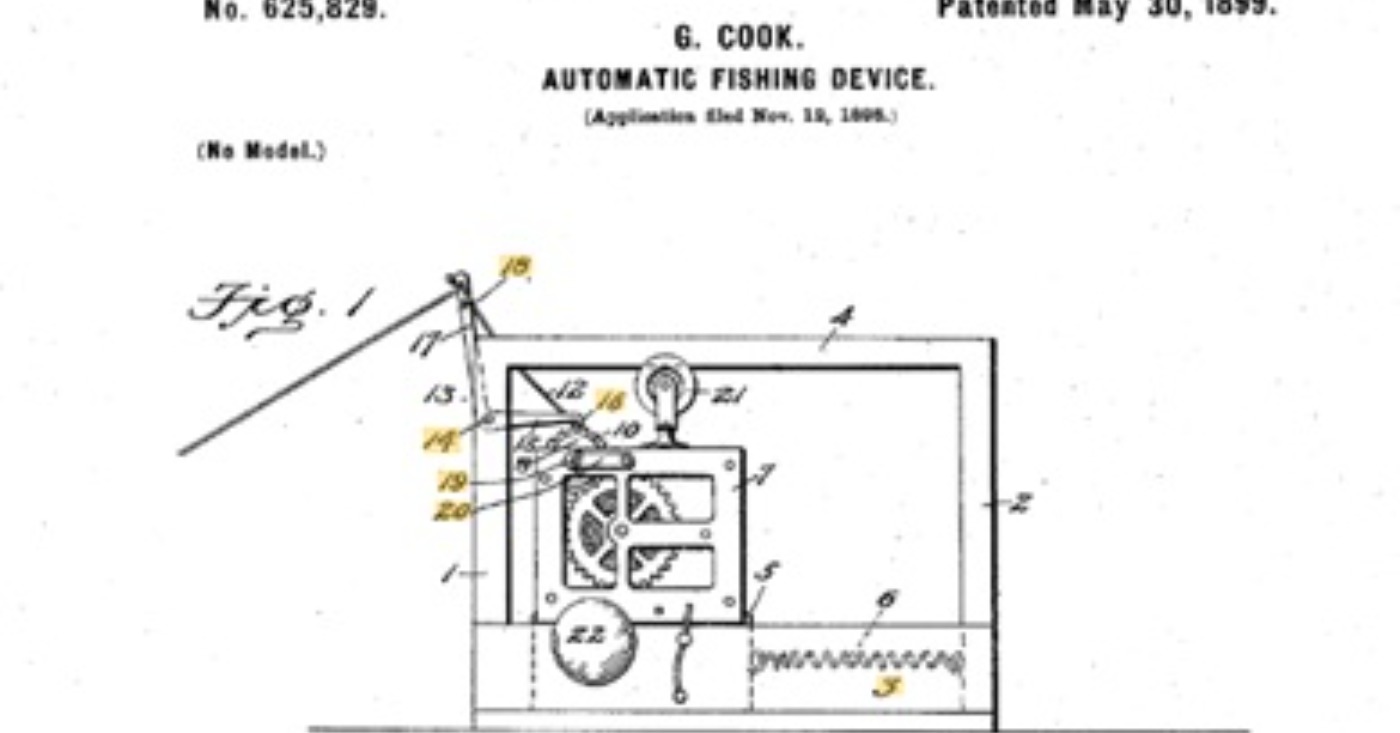
Cook’s most famous invention was the Automatic Fishing Device. He received U.S. Patent No. 625,829 for it on May 30, 1899. His patent shows that he was not just someone with an idea, but someone who made it happen.
So, what did the Automatic Fishing Device do? Imagine fishing with a line in the water. Usually, you have to watch carefully and pull the line at just the right moment when a fish bites. Cook wanted to make that process easier. His device was designed to react when a fish pulled on the line. The tension from the fish would trigger a lever. That lever would release a spring-loaded part of the device, causing it to move quickly and help pull in the line. The device also had an alarm gong that would ring to let the fisher know something was happening.

This invention was important because it used simple mechanical ideas in a clever way. Springs, levers, rails, and alarms were not new by themselves, but Cook combined them to solve a real problem. His device showed how inventors often take familiar parts and arrange them in a new way to make life easier.
Cook looked at fishing and asked, “How can this be improved?” Then, he created a device that could respond automatically when a fish tugged on the line. His invention let fishermen relax instead of watching the line for hours, trusting the alarm to alert them.
Cook may not be as famous as some inventors, but his Automatic Fishing Device shows that creativity and innovation can be applied anywhere. His legacy lives on as part of the larger story of Black innovation in America.
Business
Gov. Newsom Announces $109.6 Million in Funding for 278 Supportive Homes in Bakersfield, Contra Costa, Sacramento and Fresno
POST NEWS GROUP — “Every Californian deserves a safe place to call home, particularly the veterans who bravely served our country,” said Newsom in a statement on July 23. “California voters approved Proposition 1 because they know we must do more to address homelessness and behavioral health challenges.”

Last week, Gov. Gavin Newsom announced $109.6 million in Proposition 1 funding to create 278 permanent supportive homes in Bakersfield, Contra Costa County, Sacramento and Fresno, including 103 homes reserved for veterans experiencing or at risk of homelessness.
The funding, awarded through California’s Homekey+ program, is intended to expand permanent supportive housing and behavioral health services for veterans and other Californians experiencing or at risk of homelessness. State officials said the investment advances Proposition 1, the voter-approved measure aimed at increasing housing, treatment and support services for people with behavioral health needs.
“Every Californian deserves a safe place to call home, particularly the veterans who bravely served our country,” said Newsom in a statement on July 23. “California voters approved Proposition 1 because they know we must do more to address homelessness and behavioral health challenges.”
The largest award, nearly $32.6 million, will help the City of Fresno and Parkway Prime LLC convert an interim housing project into 84 permanent supportive homes at Parkway Terrace, including nine units reserved for veterans. The City of Sacramento and Urban Capital LLC will receive nearly $31.9 million to develop the Rio Linda Senior Housing Project, which will include 100 homes, 49 of them reserved for veterans.
Contra Costa County and Satellite Affordable Housing Associates will receive $28.8 million to develop an 82-unit senior housing community, with 62 units designated for people experiencing or at risk of homelessness who have behavioral health challenges, including 30 units for veterans. In Bakersfield, Community Action Partnership of Kern will receive nearly $14.1 million to convert a 38-room motel into 30 permanent supportive homes, with 15 units reserved for veterans.
State officials also announced an additional $2.3 million for three previously awarded Homekey+ projects in Olivehurst, Sanger and Stockton, primarily to support operating costs and increase veteran housing.
Since its launch, Homekey+ has awarded $968.4 million to 54 permanent supportive housing projects expected to create 2,749 affordable homes statewide, including 723 homes reserved for veterans. Officials said Proposition 1 is expected to expand California’s behavioral health system by funding additional supportive housing, treatment facilities and services for people experiencing homelessness and behavioral health challenges.

WORK FROM HOME
Home-based business with potential monthly income of $10K+ per month. A proven training system and website provided to maximize business effectiveness. Perfect job to earn side and primary income. Contact Lynne for more details: Lynne4npusa@gmail.com 800-334-0540


Car Wash Workers Cope with Lingering Impacts of ICE Raids

Misty Copeland Shapes Ballet’s Tomorrow

As Part of Your Back-to- School Checklist, Vaccinate

As Part of Your Back-to- School Checklist, Vaccinate

Congresswoman Simon Demands Investigation into Trump’s Abuse of Emergency Powers for Coal Export Terminal in West Oakland

OPINION: The Philippines Isn’t Foreign When Your Family Still Lives There

Asm. McKinnor’s Bill Banning Drones Above Outdoor Entertainment Events Awaits Senate Decision

California Sen. Padilla Joins Colleagues to Introduce Bill Imposing Term Limits on Supreme Court Justices

Department of Homeland Security Demands California Secretary of State Shirley N. Weber Scrub Voter Rolls

George Cook: The Inventor Who Made Fishing Smarter

Gov. Newsom Announces $109.6 Million in Funding for 278 Supportive Homes in Bakersfield, Contra Costa, Sacramento and Fresno

Rep. Kamlager Dove Demands Care, Justice for Man Shot by ICE

“The Power to See Threats Sooner”: Gov. Newsom, Safety Officials Showcase California’s Investments in Hi-Tech Wildfire Prevention

100 Black Wings’ Team Oakland Youth Athletes Heading to Taiwan for 2026 International Children’s Games

Oakland ‘Port Serves as a Powerful Engine for Good Jobs and Economic Development
Department of Homeland Security Demands California Secretary of State Shirley N. Weber Scrub Voter Rolls

Oakland Children’s Hospital Workers and Patients Rally for Pediatric Medical Care
“The Power to See Threats Sooner”: Gov. Newsom, Safety Officials Showcase California’s Investments in Hi-Tech Wildfire Prevention

New Judge Could Decide if Karmelo Anthony Gets a New Trial

Surveillance Pricing Fight: State Senate Debates Bill Banning Retailers from Using AI to Set Prices Based on a Buyer’s Profile

Alpha Kappa Alpha Sorority, Inc. Celebrates New North Atlantic Regional Director

Mount Zion MBC, Church of Jesus Christ of Latter-day Saints Partner to Bring 29,000 Meals to Alameda County
California Sen. Padilla Joins Colleagues to Introduce Bill Imposing Term Limits on Supreme Court Justices

Starting This Summer, California Car Buyers Can Get an Instant $3500 Off the Cost of Electric Vehicles

COMMENTARY: You Are Already Paying for the AI Boom

California Bill Would Let Abuse Victims Use Trauma as Legal Defense for Violent Crime

Fed Court to Decide Landmark First Amendment Case

Gov. Gavin Newsom Signs Law Streamlining Affordable Housing Rules

Oakland Celebrates $125 Million Coliseum Sale

Saving Black Mothers Starts Outside the Hospital

The Conversation With Al McFarlane 6/23/26

Media Monday 6/22/26

LIVE! ASK ALMA! — TUES. 6.23.26 7PM EST

Car Buying Secrets: 4 Hidden Checks Before You Sign!

Is This 550 HP Charger Worth YOUR Money? AutoNetwork Review

Celebrating Juneteenth – Frederick Douglass on education and resistance

LIVE! — ASK ALMA! — TUES. 6.19.26 7PM EST

Hyundai Ioniq 5 Parking, Safety, and 360 View #shorts

2025 Ioniq 5 New Wiper & Powerful Performance! #shorts

Electric SUV Range: Is 259 Miles Enough? #shorts

EV Charging: How Fast Can You Charge an Electric Vehicle? #shorts

Biometric Cooling… Messaging Seats…Come on! 2025 Infiniti QX80 Autograph 4WD

Charged Up: Witness the Magic of a Fully Electric Car! #shorts

Range Rover Sport PHEV Included…: See What’s Inside This Luxury SUV! #shorts

Invisible Hood View: Perfect Parking with X-Ray Vision! #shorts
-
 Featured4 days ago
Department of Homeland Security Demands California Secretary of State Shirley N. Weber Scrub Voter Rolls
-
 Business3 weeks ago
Oakland Children’s Hospital Workers and Patients Rally for Pediatric Medical Care
-
 Environment4 days ago
“The Power to See Threats Sooner”: Gov. Newsom, Safety Officials Showcase California’s Investments in Hi-Tech Wildfire Prevention
-
 #NNPA BlackPress2 weeks ago
New Judge Could Decide if Karmelo Anthony Gets a New Trial
-
 Business3 weeks ago
Surveillance Pricing Fight: State Senate Debates Bill Banning Retailers from Using AI to Set Prices Based on a Buyer’s Profile
-
 Black History1 week ago
Alpha Kappa Alpha Sorority, Inc. Celebrates New North Atlantic Regional Director
-
 Business3 weeks ago
Mount Zion MBC, Church of Jesus Christ of Latter-day Saints Partner to Bring 29,000 Meals to Alameda County
-
 Featured4 days ago
California Sen. Padilla Joins Colleagues to Introduce Bill Imposing Term Limits on Supreme Court Justices
